Active Recall And Spaced Repetition: A Step-by-Step Method
You sit down to practice, pick up where you left off, and realize you've forgotten half of what you worked on last week. Sound familiar? The problem isn't effort, it's timing. Active recall and spaced repetition are two learning techniques that, when combined, solve this exact issue. They work by forcing your brain to retrieve information at strategic intervals, right before you're about to forget it. Decades of cognitive science research back them up, and they apply to far more than flashcards and textbooks.
For anyone building practical skills, learning an instrument, drilling technique, working through a repertoire, these methods change how progress sticks. Instead of grinding through the same exercises randomly, you practice what actually needs attention, exactly when it needs it. That's the principle we built MemoRep around: a platform that uses spaced repetition algorithms to schedule your practice sessions automatically, so you spend less time planning and more time improving.
This guide breaks down how active recall and spaced repetition work at a scientific level, why they're so effective together, and gives you a step-by-step method to start using them in your own practice. Whether you apply these techniques manually or let a tool handle the scheduling, you'll walk away with a clear system for retaining more of what you learn.
What active recall and spaced repetition do
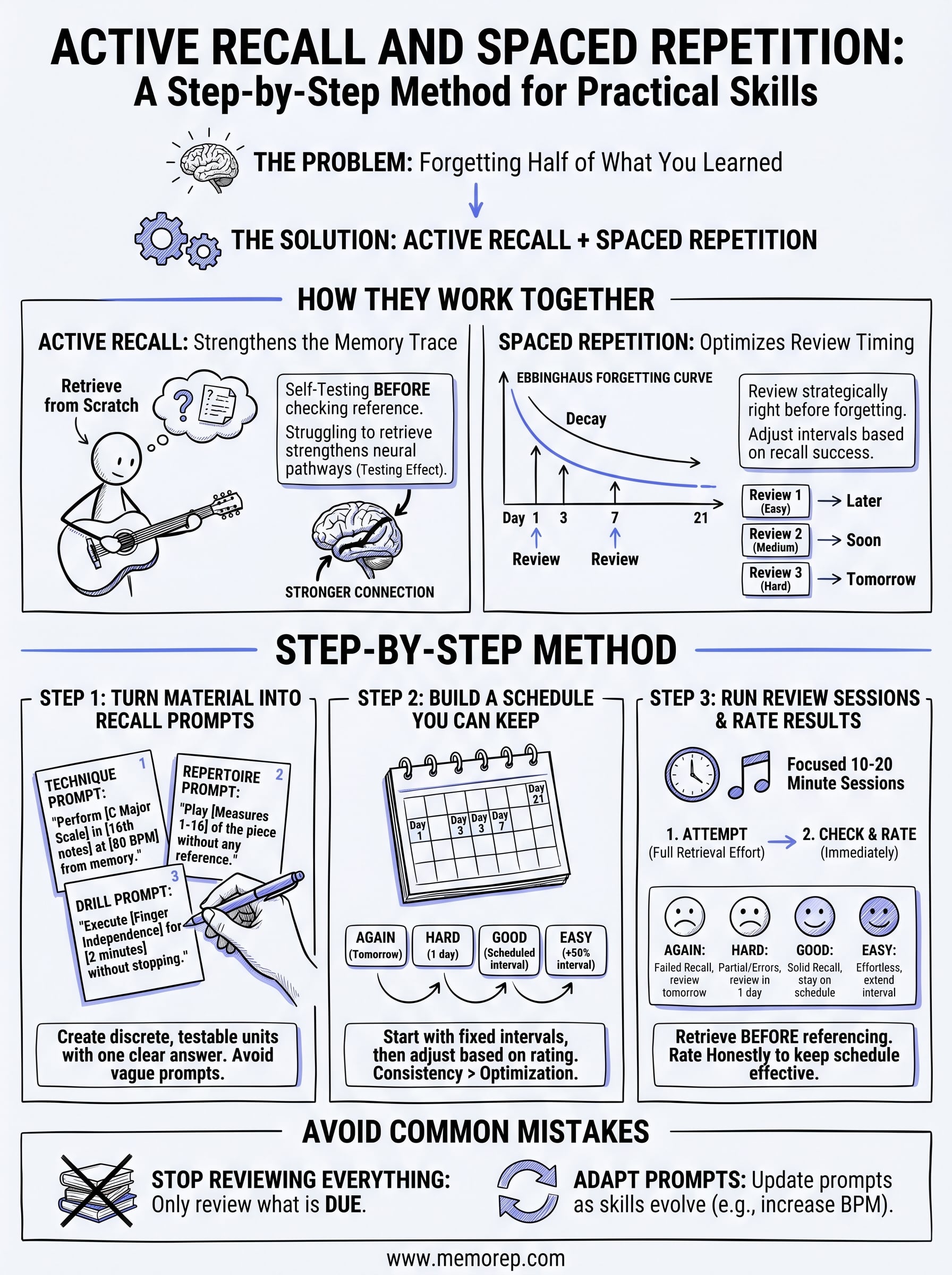
Most people learn by re-reading or re-watching material. It feels productive, but your brain is mostly just recognizing what it sees rather than strengthening the underlying memory. Active recall forces you to retrieve information from scratch before you look at the answer. Spaced repetition then controls when you do that retrieval, timing sessions to hit right before a memory fades.
How active recall works
Active recall means testing yourself on material before checking any reference. Instead of reading over a guitar scale, you close your eyes and play it. Instead of skimming a technique description, you perform it without a prompt. The act of struggling to retrieve something strengthens the neural pathway that stores it. Cognitive psychology calls this the "testing effect": retrieval practice produces significantly stronger long-term retention than re-studying the same material.
Retrieval effort is not a sign of a weak memory. It is the mechanism that makes memory stronger.
Each time you fail a recall attempt and then correct yourself, your brain rebuilds and reinforces that memory trace. Each successful recall confirms the connection is still strong. Both outcomes move your learning forward.
How spaced repetition works
Spaced repetition is built on the Ebbinghaus forgetting curve, the finding that memory decays at a predictable rate over time. Hermann Ebbinghaus demonstrated in the 1880s that reviewing material just before it fades locks it in longer with each pass. Modern algorithms like SM-2 calculate the optimal review interval for each item based on how well you recalled it last time, so harder material comes back sooner and solid material comes back later.
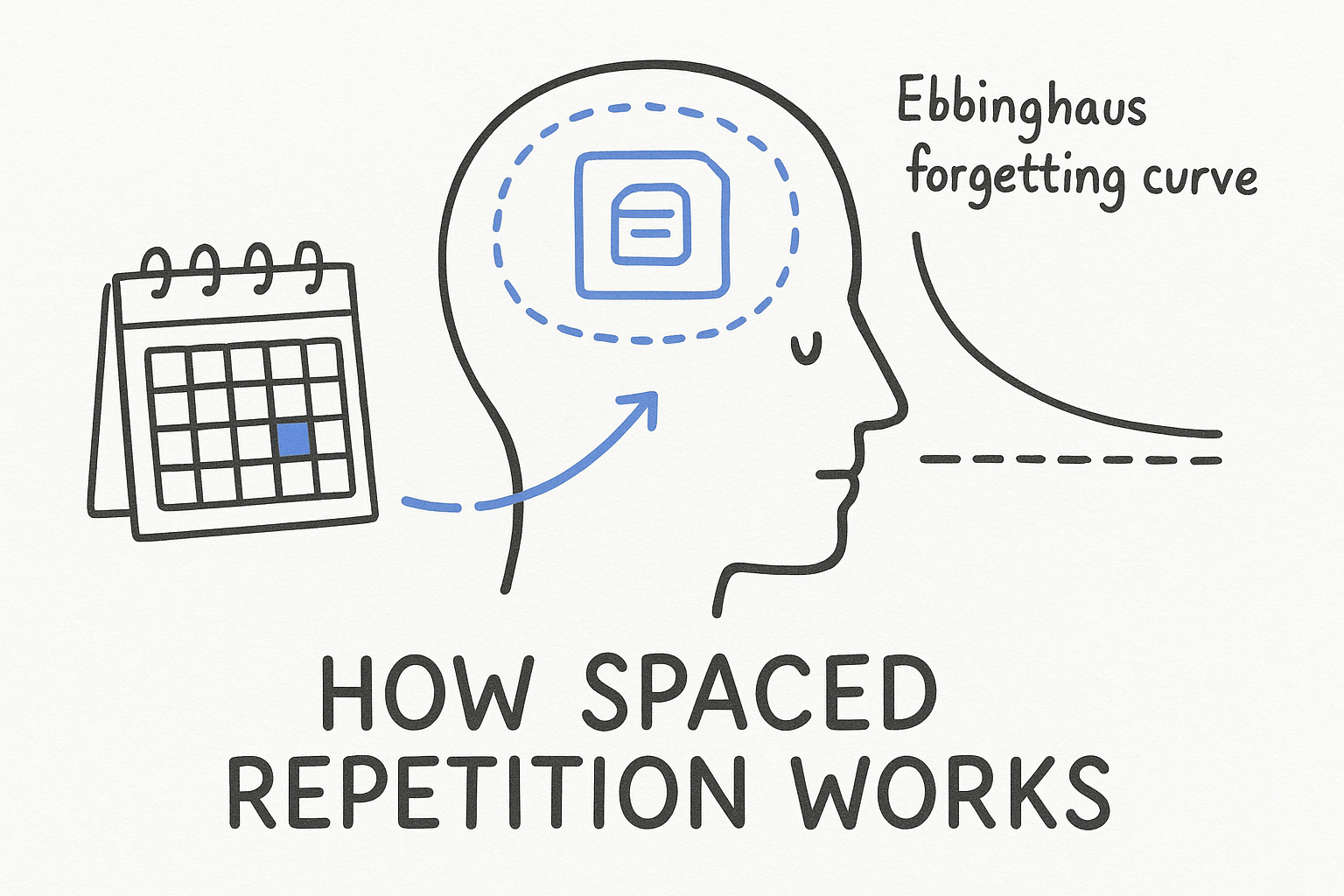
Combining active recall and spaced repetition gives you a system that targets the right skill at the right moment with the right kind of effort. For musicians and other practical skill learners, this means fewer forgotten pieces, faster long-term progress, and no wasted sessions grinding through material your memory already has secure.
Step 1. Turn your material into recall prompts
Before scheduling anything, you need to break your material down into discrete, testable units. A recall prompt is a single question or cue that asks your brain to retrieve one specific thing without looking at the answer. The smaller and more specific each prompt, the easier it is to pinpoint exactly what you remember and what you don't.
What makes a strong recall prompt
A strong prompt is narrow enough to have one clear answer and broad enough to require real retrieval effort. Avoid prompts you can answer with a vague gesture or a single word that doesn't prove understanding. For practical skills like music, the cue should match how you'll use the skill in performance, not just describe it in abstract terms.
The best prompt forces retrieval in the same context where you'll actually need the skill, not just pattern recognition on paper.
Prompt templates for practical skills
Use these templates to convert your material into actionable recall prompts that work with active recall and spaced repetition:
| Skill Type | Prompt Template | Example |
|---|---|---|
| Technique | "Perform [technique] from memory at [tempo]" | "Play the C major scale in 16th notes at 80 BPM" |
| Repertoire | "Play [section] without any reference" | "Play measures 1-16 of the piece from memory" |
| Drill | "Execute [drill] for [duration] without stopping" | "Run the finger independence exercise for 2 minutes" |
Step 2. Build a spaced repetition schedule you can keep
Once your prompts exist, you need a review schedule that actually fits your life. The goal isn't a perfect algorithm on day one. It's a consistent rhythm you can sustain, then adjust as you collect feedback from your own recall performance.
Start with a simple interval pattern
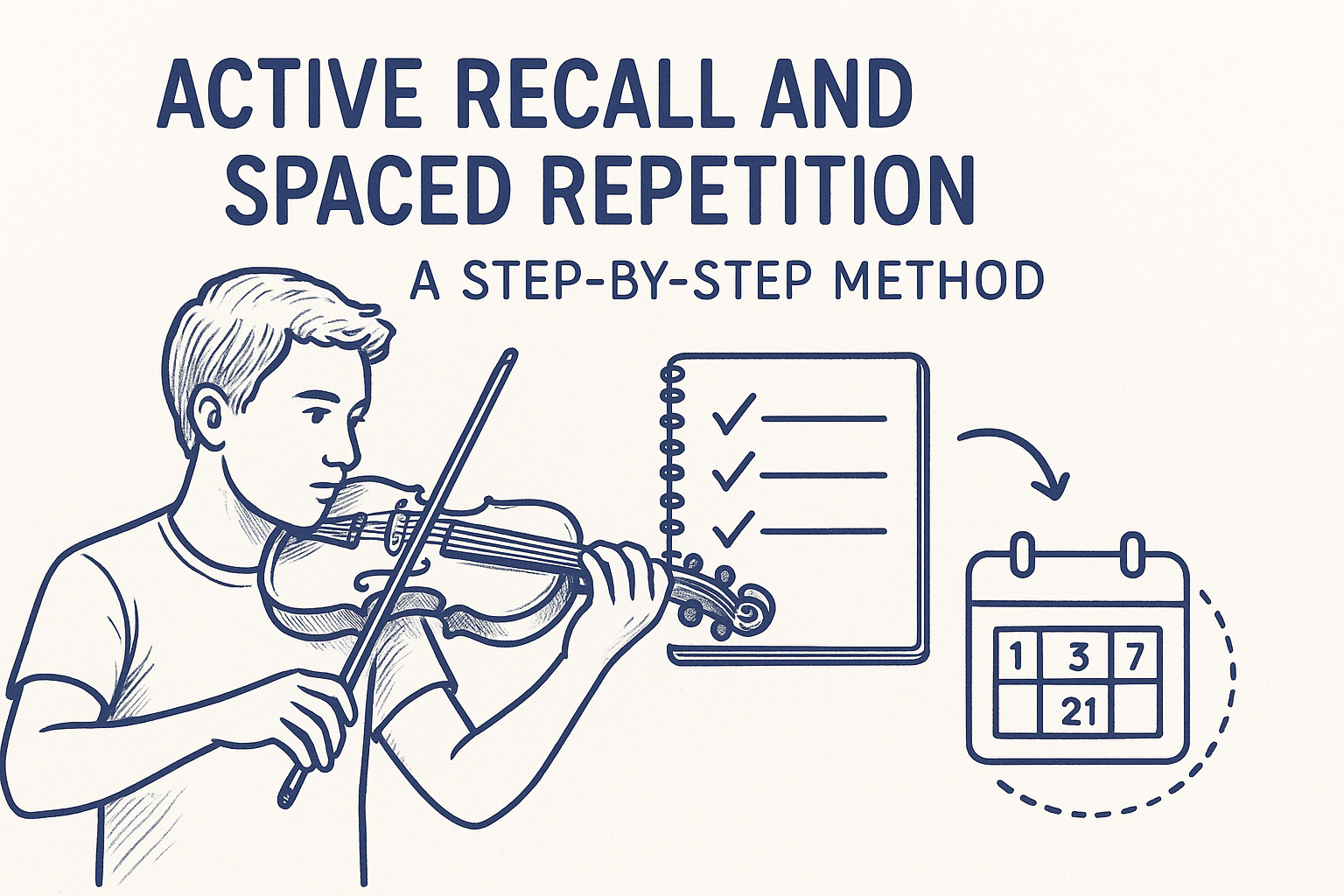
Most people over-engineer their first schedule and quit within two weeks. Start with fixed intervals that you know you can hit: review new material on day 1, day 3, day 7, and day 21. This rough pattern mirrors how the Ebbinghaus forgetting curve drops fastest early and flattens over time. You can tighten or loosen intervals once you see which prompts you keep failing.
The schedule only works if you actually run sessions on the days you planned. Consistency beats optimization.
| Review Stage | Interval | Purpose |
|---|---|---|
| First review | Same day | Confirm initial recall |
| Second review | Day 3 | Catch early forgetting |
| Third review | Day 7 | Solidify the memory |
| Fourth review | Day 21 | Test long-term retention |
Adjust intervals based on your rating
When you apply active recall and spaced repetition together, your recall rating after each session tells you where to move the next review. Struggling means shorten the interval; clean recall means push it further out. Use these four ratings to guide each adjustment:
- Again: failed recall, review tomorrow
- Hard: partial recall, review in 1 day
- Good: solid recall, stay on schedule
- Easy: effortless recall, extend interval by 50%
Step 3. Run review sessions and rate your results
A review session only works if you retrieve before you reference. Open your first prompt, attempt the skill or answer completely from memory, then check the result. Do not skip ahead or hint yourself mid-attempt. Your brain needs the full retrieval effort to build the memory trace that makes the next session easier.
Structure each session for maximum retrieval
Keep sessions short and focused: 10 to 20 minutes is enough for most practice schedules. Work through only the prompts due that day rather than reviewing everything you own. This keeps the cognitive load manageable and prevents decision fatigue from undermining your consistency. End each session by noting which prompts felt rough so you can flag them before the next round.
Retrieve completely before checking. Half-attempts produce half-results.
Rate each prompt right after you attempt it
Accurate rating is where active recall and spaced repetition either succeed or break down. If you rate yourself too generously, you push reviews out too far and forget the material before the next session arrives. Rate each prompt immediately after the attempt using this template:
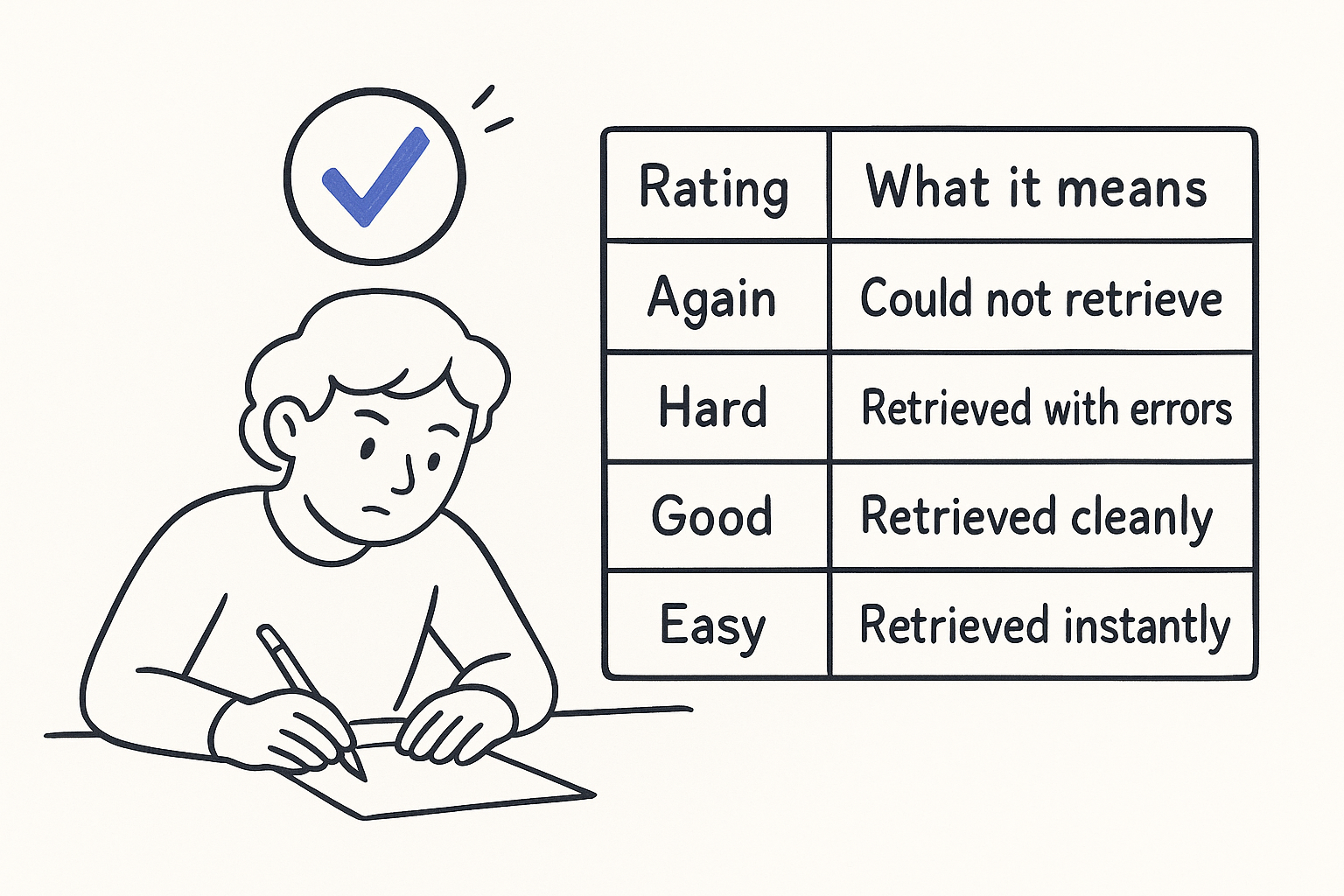
| Rating | What it means | Next review |
|---|---|---|
| Again | Could not retrieve | Tomorrow |
| Hard | Retrieved with errors | 1 day |
| Good | Retrieved cleanly | Scheduled interval |
| Easy | Retrieved instantly | +50% interval |
Fix common mistakes and adapt for real skills
Even a solid system breaks down when common errors creep in. The biggest one is reviewing too much at once: loading every prompt into each session instead of only what's due. That habit turns practice into a marathon that burns time without delivering the focused retrieval effort that makes active recall and spaced repetition actually work.
Stop reviewing everything every session
Limit each session to only the prompts scheduled for that day. If you have 30 prompts in your system and 8 are due, review those 8. Resist the urge to "stay fresh" on everything else. Over-reviewing secure material wastes the time you need for struggling items and dilutes the cognitive effort that drives retention.
Reviewing material you already know well delays the session where you'd catch material you're about to forget.
Adapt prompts when skills evolve
Skills do not stay static, and your recall prompts should not either. When you master a technique at 80 BPM, update the prompt to 100 BPM rather than retiring it. When a piece section feels fully automatic, split it into a harder variant that adds an expressive element, a different starting point, or a new context. Prompts that no longer require real retrieval effort stop producing memory benefit, so revisit and update them regularly to keep the challenge meaningful.
Conclusion
Active recall and spaced repetition work because they match how memory actually behaves: it decays without retrieval, and retrieval effort is what makes it last. Every step in this guide, from building narrow recall prompts to rating your results honestly after each session, serves that one principle. You practice what needs attention, when it needs attention, and nothing else.
Putting this into practice manually takes discipline. You have to build the prompts, track the intervals, adjust them after each session, and update them as your skills grow. That overhead is real, and it's where most people stall. If you want the scheduling handled automatically so you can focus on actually practicing, try MemoRep and get free lifetime access during the beta. The platform applies these same spaced repetition principles to your practice sessions, telling you exactly what to work on and when, without the planning work.