7 benefits of spaced repetition for practical skills
Most practice plans fail in a boring way: everything competes for attention at once. You repeat familiar material because it feels productive, while older songs, drills, and techniques quietly get rusty.
Spaced repetition gives each practice item its own return date. A weak attempt comes back sooner. A fluent attempt earns a longer gap. The point is not to practice less for the sake of it. The point is to spend your limited time on the skills that need another pass.
What spaced repetition does
Spaced repetition schedules retrieval attempts across increasing intervals. Instead of repeating every item every day, you revisit an item after some time away and use the result to choose the next interval.
For a practical skill, retrieval means performing: play the passage, draw the form, execute the drill, or explain the process without leaning on the answer. That cold attempt gives you better evidence than the final repetition of a long warm-up.
The method has limits. Evidence for spacing is strongest when people must remember information over time. Practical skills also involve movement, perception, and feedback. Use spaced repetition to decide when a skill should return, then use deliberate practice to decide how to improve it.
1. You stop guessing what to practice next
A long list of songs and exercises is not a plan. It makes you choose from scratch every session, usually based on mood or whatever is already comfortable.
A spaced schedule turns past performance into a short queue. Items that are due appear first. You can start practicing instead of spending ten minutes rearranging a list.
2. Weak skills get attention before they disappear
A skill rarely goes from solid to gone in one clean step. It becomes slower, less accurate, or more dependent on a warm-up. A scheduled cold attempt catches that change while the item is still recoverable.
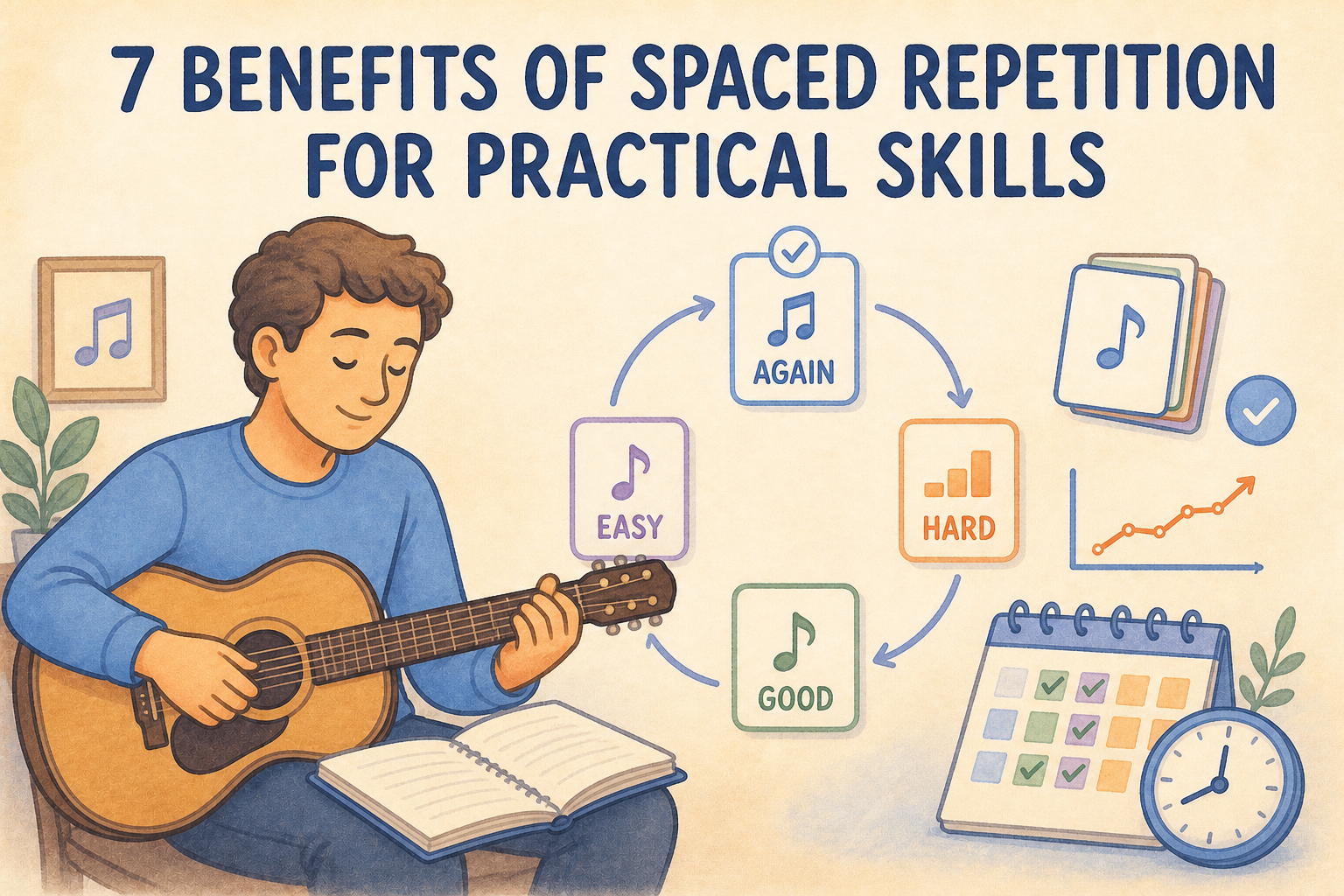
Rate the attempt honestly. “Hard” should bring the item back sooner. “Easy” should move it farther away. That simple feedback loop is more useful than pretending every skill deserves the same weekly slot.
3. Strong skills stop stealing practice time
Repeating a comfortable scale every day can feel disciplined, but familiarity is not the same as need. If the scale remains fluent after a longer gap, daily repetition has a high opportunity cost.
Longer intervals free time for new material and fragile skills. You still maintain the scale, just often enough to verify that it remains available.
4. You reduce expensive relearning
Rebuilding a forgotten passage takes longer than refreshing one that has started to wobble. Spaced review aims for the useful middle: enough delay to test retention, but not so much that every return becomes a rescue mission.
This matters when you maintain a repertoire. Ten songs can look manageable until three of them need to be relearned in the same week.
5. The schedule adapts to difficulty
Two practice items created on the same day may need completely different intervals. A familiar chord progression might survive a week. A new position shift may need another attempt tomorrow.
Performance-based ratings separate them. The schedule gets more personal because it follows the item’s history instead of applying one generic calendar to the entire project.
6. Progress becomes visible
Practical improvement is messy. A session can feel bad even when a skill is becoming more stable across longer gaps.
Review history adds context. If a passage moves from daily work to reliable weekly attempts, that is progress. If an item keeps returning as “Hard,” the log is telling you to change the exercise, reduce the scope, or get better feedback.
7. A large repertoire becomes maintainable
Musicians do not practice one thing forever. Songs, scales, rhythm work, ear training, and technique all compete for time. The problem gets worse as your repertoire grows.
Spaced repetition lets mature items move into maintenance while new items receive more frequent attention. That makes growth possible without pretending your practice day can expand indefinitely.
How the benefits fit together
- Create a specific practice item.
- Attempt it after some time away.
- Rate the actual performance.
- Schedule the next return from that rating.
- Lengthen or shorten the interval as evidence accumulates.
The cycle works because every rating changes a future decision. If you record ratings but keep a fixed calendar, you have a log. You do not yet have an adaptive practice schedule.
A guitar example
Suppose your project contains these practice items:
- play the “Little Wing” intro from memory;
- switch between G and C cleanly at 90 BPM;
- play the major scale in three positions;
- identify I, IV, and V by ear;
- perform one finished song as a cold run.
After practice, you rate each item. The chord transition was easy, so it moves farther out. The ear-training item was hard, so it returns sooner. The song fell apart in the bridge, so you split that bridge into its own item.
That is the practical benefit: tomorrow’s plan reflects what happened today.
When spaced repetition is the wrong tool
Do not use a review scheduler to solve a technique problem that needs instruction. If your wrist hurts, your timing drifts, or you do not understand the movement, repeating the item on a smarter calendar will not fix it.
Spaced repetition also works poorly with items that are too vague. “Practice guitar” cannot produce a meaningful rating. “Play the bridge cleanly at 80 BPM without stopping” can.
How to start without building a monster system
- Choose one project, such as guitar.
- Add five to ten skills you already care about maintaining.
- Keep each item small enough to judge in one attempt.
- Use Again, Hard, Good, or Easy after practice.
- Review the schedule after two weeks and split any item that keeps failing.
Do not migrate your entire musical life on day one. A perfect taxonomy is procrastination wearing glasses.
Frequently asked questions
What are the main benefits of spaced repetition?
It helps prioritize weak items, reduces unnecessary repetition, supports maintenance, and turns performance history into a clearer next-practice decision.
Does spaced repetition make you learn faster?
It can make review more efficient, but speed depends on the skill, instruction, practice quality, and feedback. It does not replace focused work.
Can musicians use spaced repetition?
Yes, as a scheduling method. Create practice items for passages, songs, drills, or cold runs, then adjust intervals from actual performance.
Is daily practice still useful?
Yes. You can practice daily without practicing every item daily. A spaced schedule changes the contents of the session, not necessarily the habit.
Turn the method into a practice routine
MemoRep creates a daily plan from the skills that are due, records the session, and uses your ratings to schedule the next revisit. You keep control of the practice. MemoRep handles the queue.
For the science behind the timing, read the Ebbinghaus forgetting curve guide. For a musician-specific walkthrough, see how guitarists can use spaced practice.