Ebbinghaus forgetting curve: what it means for practice
You practice a piece until it feels secure. A week later, the opening is still there, but the difficult transition has gone missing. That drop is the problem the Ebbinghaus forgetting curve helps describe.
The curve is not a countdown that tells you exactly when every memory will fail. It is a model of a broader pattern: when you do not retrieve or use something, access usually gets weaker over time. The decline tends to be faster soon after learning and slower later.
For musicians and other practical-skill learners, the useful question is not “How much will I forget after 24 hours?” It is “Which skill is close enough to fading that another attempt would strengthen it?”
What the Ebbinghaus forgetting curve is
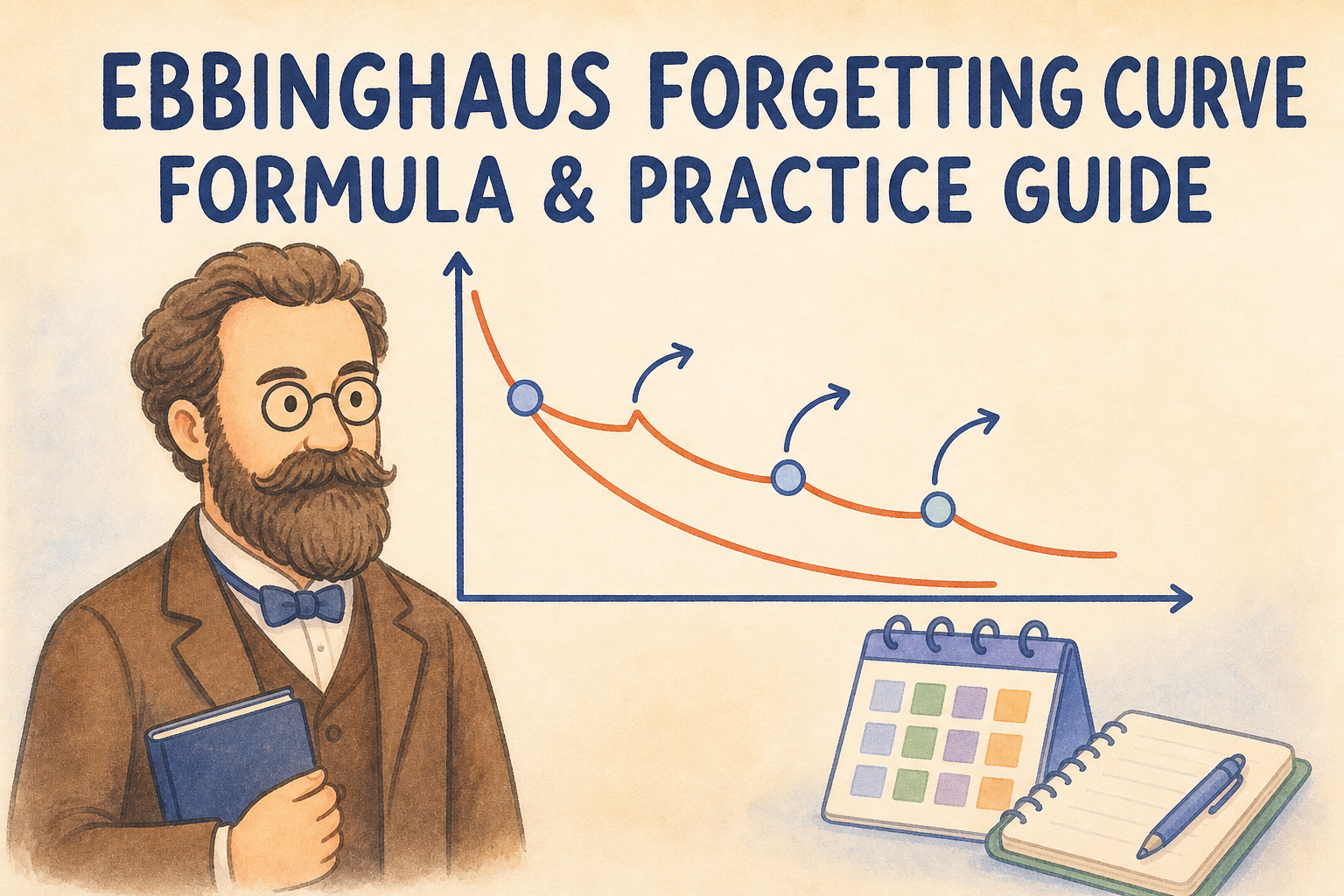
Hermann Ebbinghaus studied how retention changed after learning unfamiliar material. His experiments showed a recognizable pattern: the largest loss often happened early, then the rate of forgetting slowed.
That pattern became known as the forgetting curve. On a graph, time runs from left to right and retention runs from low to high. A newly learned item starts near the top. Without retrieval or use, the line bends downward.
The curve explains a common practice mistake. A clean performance at the end of one session can feel permanent because the movement is still warm. That feeling says more about the current session than it does about next week.
What the curve does not prove
There is no universal rule that everyone forgets a fixed percentage after one hour, one day, or one week. You will see tidy numbers repeated online, but real forgetting depends on what you learned, what you already knew, how well you understood it, and whether you retrieved it later.
Ebbinghaus also used highly controlled material and tested himself. That made the work measurable, but it is not the same as learning a song, improving a chord change, or maintaining a drawing technique.
Use the curve as a scheduling idea, not as a stopwatch for the brain.
The forgetting curve formula, without the fake precision
A common simplified model writes retention like this:
R(t) = e-t/S
R(t)is estimated retention after timet.Srepresents memory stability. A larger value means slower decay.eis the mathematical constant used in exponential-decay models.
This equation is useful for understanding the shape of a curve, but it is not a personal diagnosis and it does not generate a perfect practice calendar. A practical scheduler estimates stability from your performance over repeated sessions instead of pretending one formula fits everyone.
How review changes the curve
Retrieval interrupts passive forgetting. When you attempt a scale, passage, drill, or concept after some time away, you learn two things at once:
- whether the skill is still available without rebuilding it from scratch;
- how long the next gap can probably be.
If the attempt is fluent, the next interval can grow. If it is shaky, the item should return sooner. If it has collapsed, shorten the interval and simplify the practice target.
This is the useful connection between the forgetting curve and spaced repetition: reviews are scheduled from evidence about your performance, not from a rigid calendar.
An example forgetting-curve schedule
A fixed schedule can help you start, but treat it as a trial rather than a law. A new guitar passage might look like this:
- Initial session: isolate the passage and play it cleanly at a controlled tempo.
- First return: try it the next day without a long warm-up.
- Second return: if it was solid, wait a few days.
- Later returns: extend the gap to a week, then longer, while performance stays reliable.
- After a miss: shorten the next interval and identify what failed.
The rating matters more than the calendar. “Easy” after a genuine cold attempt supports a longer interval. “Easy” after ten warm-up repetitions does not tell you much about retention.
Why this matters for practical skills
Practical skills are not stored as a single fact. A song can involve memory for structure, sound, fingering, timing, and movement. Those parts can fade at different rates.
That is why “practice guitar” is too broad to schedule well. Break the work into practice items you can actually judge:
- the bar 17 position shift;
- the chorus chord sequence from memory;
- the sixteenth-note rhythm at 90 BPM;
- the full song as a cold run.
Specific items produce useful feedback. Broad categories produce vague ratings.
Four variables that change how quickly you forget
Prior knowledge
New material sticks more easily when it connects to patterns you already understand. An unfamiliar chord shape may fade quickly; the same shape inside a familiar progression has more support.
Quality of retrieval
Reading the answer again is not the same as producing it. A cold attempt gives you better evidence than a heavily prompted repetition.
Complexity
A single fingering and a complete arrangement do not deserve the same interval. Split complex skills until failures tell you what to fix.
Interference
Similar material can compete. Two nearly identical voicings or passages may need contrast practice so you can choose the right one on purpose.
How to use the curve without overengineering practice
- Create one practice item for each skill you want to keep available.
- Attempt the item before drilling it.
- Rate the cold attempt: Again, Hard, Good, or Easy.
- Let strong attempts lengthen the interval.
- Bring weak attempts back sooner.
- Change the item when repeated failures reveal that it is too broad.
This creates a feedback loop. You practice, record what happened, and adjust the next revisit. The curve provides the reason for revisiting; your performance decides the timing.
Frequently asked questions
How much do people forget after 24 hours?
There is no reliable percentage that applies to every person and every kind of learning. Treat fixed percentages as illustrations, not guarantees.
Is the Ebbinghaus curve the same as spaced repetition?
No. The curve describes forgetting over time. Spaced repetition is a scheduling method that uses later retrieval to decide when an item should return.
Does the forgetting curve apply to muscle memory?
Practical performance includes memory, perception, and motor control. A forgetting-curve model can help schedule revisits, but it does not replace physical practice, feedback, or technique work.
What is the best forgetting-curve schedule?
The best schedule is the longest interval that still produces a reliable performance. Start conservatively, rate real attempts, and adjust from evidence.
Use forgetting as a scheduling signal
The useful lesson from Ebbinghaus is not that your memory is doomed. It is that timing matters. Revisit everything too soon and you waste practice time. Wait until a skill is gone and you pay to relearn it.
MemoRep turns each skill into a practice item, records your rating, and schedules the next revisit. You still do the work. The system simply keeps the right work from disappearing.