How Long to Practice Guitar Daily to See Real Progress
You picked up the guitar, and now you want a number. Ten minutes? One hour? Every day, or just on weekends? Most advice online gives you a range so wide it is useless, and you end up guessing. Here is the straight answer on how long to practice guitar daily so you can stop guessing.
For most beginners, 20 to 30 minutes a day, five to six days a week, beats a single three-hour session on Sunday. Short, frequent sessions let your fingers and memory lock in what you did yesterday. If you have more time, 45 to 60 minutes is a solid ceiling before focus drops. How many hours of practice to be good at guitar is a different question, and it depends on your goals.
Below, we break down how daily time maps to real progress, what changes as you move past the beginner stage, and why what you practice and when you revisit it matters as much as the clock. At MemoRep, we build spaced repetition scheduling for musicians, so that second part is something we think about every day.
Why practice time matters for guitar progress
Practice time matters because skills fade when you leave them alone and get stronger when you return at the right moment. The clock is only a container. What fills it, and how often you come back to it, decides how much practice to play guitar you actually need.
Frequency beats session length
Take two players who each log 210 minutes a week. One plays a single Sunday marathon. The other plays 35 minutes, six days a week. The second player almost always improves faster, because how often to practice guitar matters more than how long you sit in one go.
Touching a skill every day beats long gaps followed by long sessions.
| Schedule | Weekly total | Times you revisit the material | Longest gap |
|---|---|---|---|
| One Sunday session | 210 min | 1 | 7 days |
| Six short sessions | 210 min | 6 | 1 day |
What happens between sessions
Hermann Ebbinghaus showed in the 1880s that memory drops fastest in the first day or two after learning, then levels off. Guitar skills follow a similar pattern. A chord change that felt smooth on Tuesday can feel clumsy by Saturday. Short gaps keep that loss small, so each session starts closer to where the last one ended.
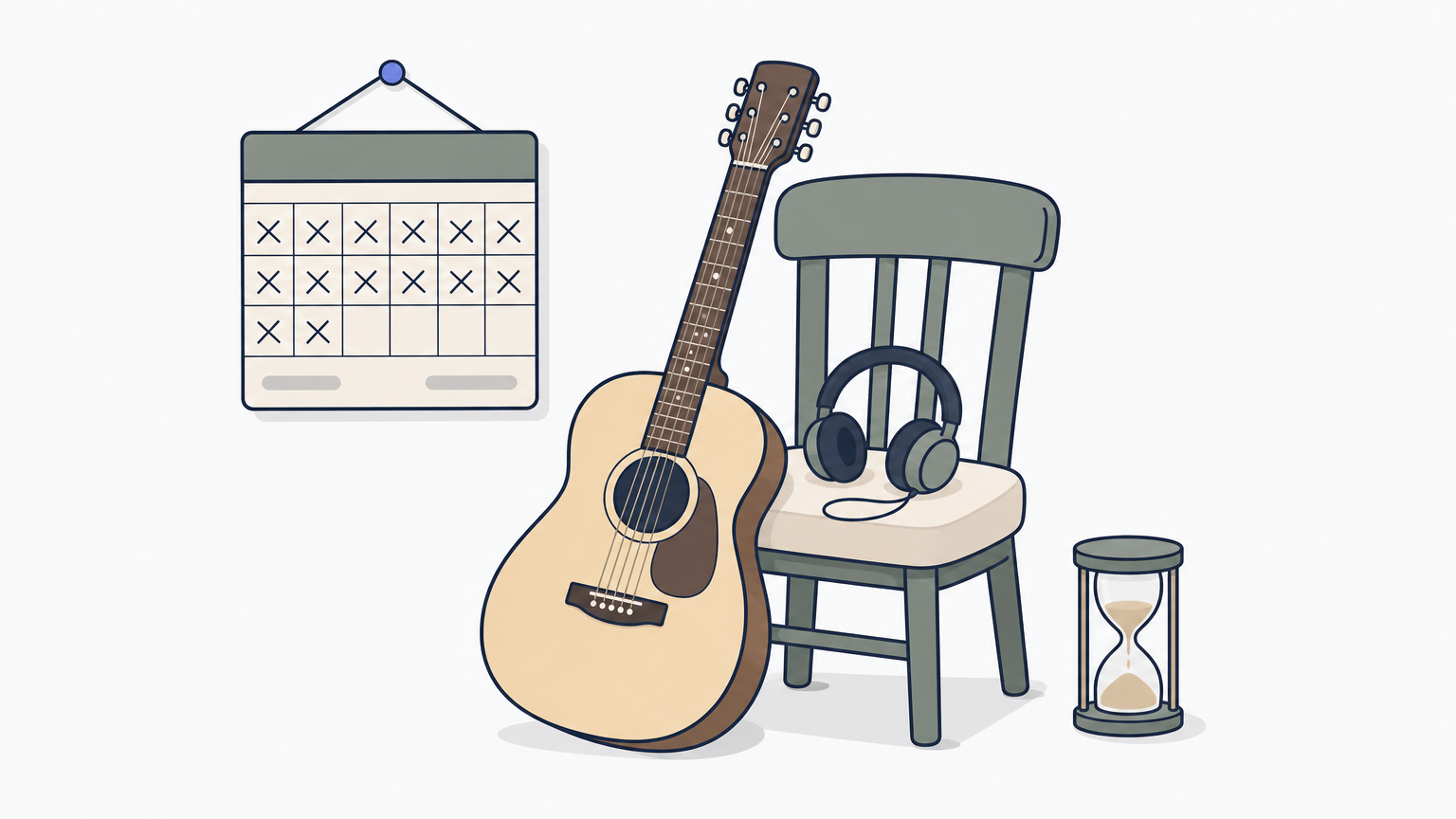
Sleep also plays a part. Research on motor learning suggests your brain keeps consolidating a movement pattern for hours after you stop, including overnight. Daily sessions give that process fresh material every day instead of leaving it idle for a week.
Why longer is not always better
Fatigue sets in. After roughly 45 to 60 minutes, most players notice their attention slipping, and sloppy repetitions start to feel normal. Past that point you are mostly adding minutes, not progress. That is why how much to practice guitar a day has a practical ceiling for most people.
If you are a beginner asking how long to practice guitar daily, this should be a relief. You do not need heroic sessions. Twenty focused minutes that you repeat tomorrow will take you further than an hour you dread and then skip for three days.
How to decide how long to practice guitar each day
Deciding your daily time comes down to three things: the minutes you can protect, how long your focus holds, and how consistently you show up. Start with the first, because a plan you cannot keep is worth nothing, and your real schedule sets the true limit.
Start with the time you can protect
Look at your actual week, not your ideal one. Find a slot you can hit at least five days out of seven, even if it is only 15 minutes. For a beginner asking how long to practice guitar daily, 15 to 30 minutes is a sensible starting block. You can always lengthen it later.
Test it for two weeks, then adjust
Run your chosen length for two weeks, then ask yourself three questions:
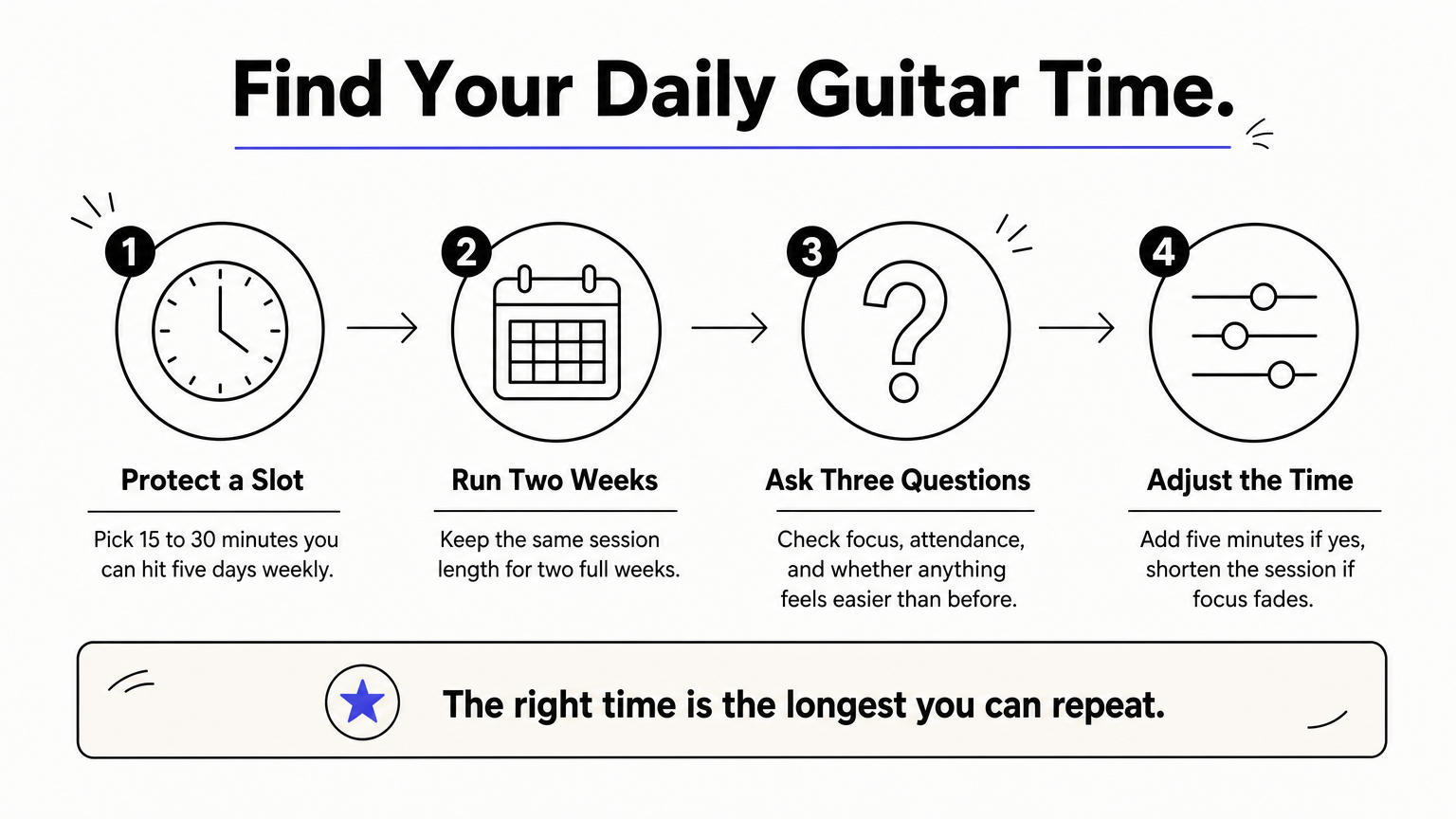
- Do I finish most sessions still focused?
- Do I show up at least five days a week?
- Can I name something that feels easier than it did last week?
If you answer yes to all three, add five minutes. If focus fades early, shorten the session and add a second short one later in the day. Over time you will land on a number that fits you, and it is usually lower than you feared.
The right daily time is the longest session you can repeat without dreading it.
Practice time by goal: hobby to advanced player
Your goal sets the number. A weekend player and someone aiming for a music degree need different amounts, but frequency still comes first at every level. What changes is how much time each session can productively hold.
Daily targets at a glance
These ranges assume focused, planned sessions, not noodling with the TV on. Use them as starting points, then adjust with the two-week test above.
| Goal | Daily time | Days per week |
|---|---|---|
| Casual hobby | 15 to 30 min | 4 to 5 |
| Committed hobbyist | 30 to 45 min | 5 to 6 |
| Serious amateur or band player | 45 to 90 min | 6 |
| Advanced or aspiring pro | 2 to 4 hours, in blocks | 6 |
What changes as you advance
Beyond about an hour, split your time into blocks. Two 45-minute sessions, one in the morning and one in the evening, hold attention better than a single 90-minute stretch.
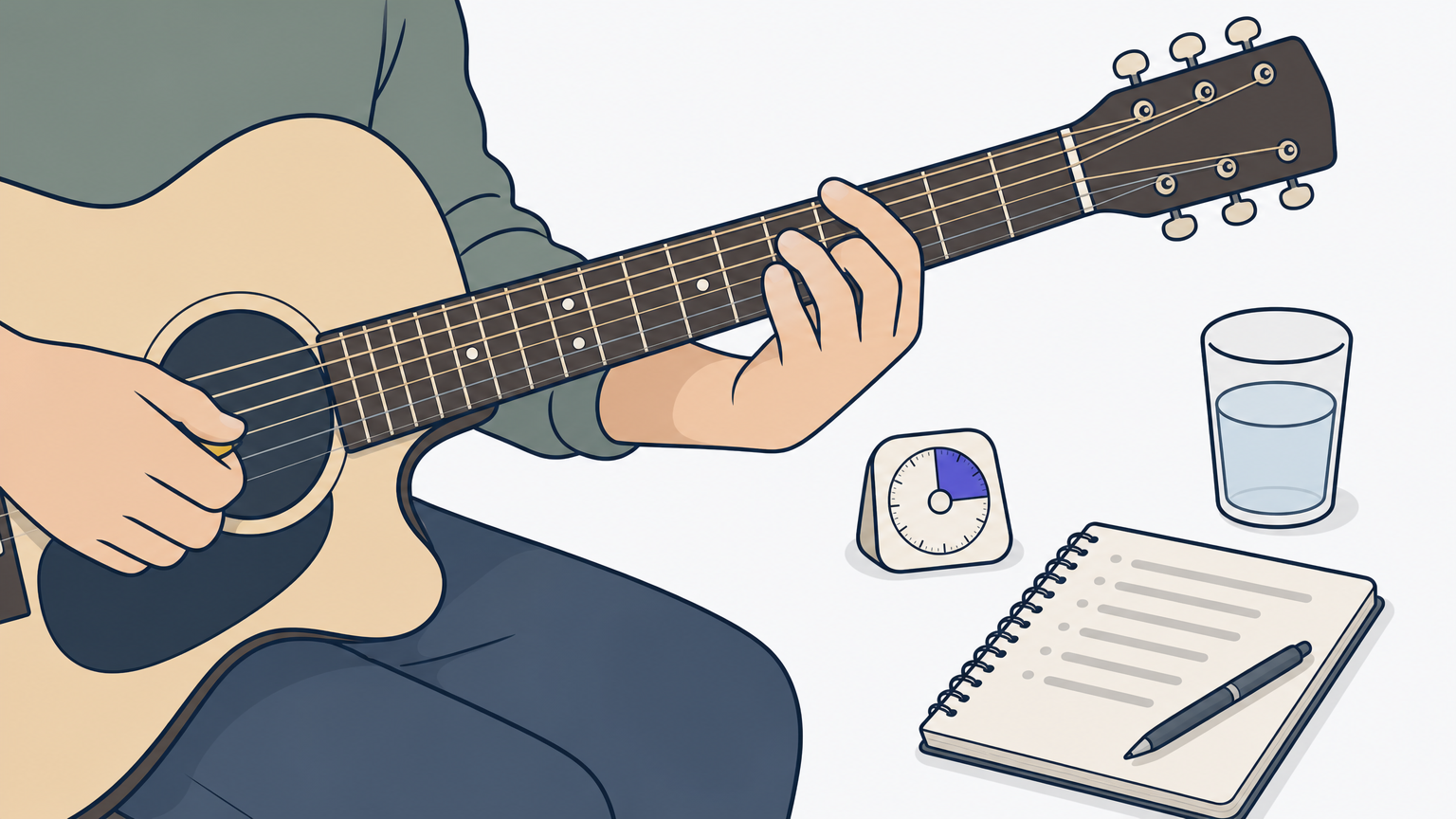
Advanced players and professionals may reach two to four hours, but they build up over months. Jumping straight to long days invites fatigue and sore hands, and overuse injuries are a real risk. If you feel pain, stop and rest, and see a doctor if it lingers.
More time only helps when your focus and recovery can keep up with it.
How many hours it takes to get good at guitar
Nobody can hand you one exact number for how long it takes to learn guitar, because "good" means different things to different players. Still, rough hour counts help you plan, and they answer how many hours to practice guitar before you reach a level you enjoy.
Rough hour counts by milestone
These are estimates, not promises. They assume focused practice, and the timeline column assumes about three hours a week, which is 30 minutes, six days a week.
| Milestone | Total hours | Time at 3 hrs/week |
|---|---|---|
| Play a few simple songs | 30 to 50 | 3 to 4 months |
| Play common songs with friends or a band | 150 to 300 | 1 to 2 years |
| Strong intermediate player | 500 to 1,000 | 3 to 6 years |
| Advanced or professional | Several thousand | 10+ years |
Why hours alone can mislead
Many people quote the 10,000-hour rule. It grew out of research on elite violinists, and it describes the road to world-class performance, not how many hours of practice to learn guitar well enough to enjoy it. For that goal, you are talking about tens or hundreds of hours.
Hours show your progress only when each one is spent on the right material at the right time.
Quality moves the numbers too. Fifty hours of planned, revisited material will usually beat 100 hours of random playing. You can double your weekly time, or you can make the time you already have count. The second option is cheaper and kinder to your hands.
Sample weekly schedules and when to stop for the day
Turning a number into a calendar is what makes it stick. Below are two sample weeks built on the ranges above, plus clear signals for when to put the guitar down. Use them as templates you can edit, not rules.
Two sample weeks
| Plan | Mon to Fri | Saturday | Sunday | Weekly total |
|---|---|---|---|---|
| Beginner | 20 min | 30 min | Off | 130 min |
| Committed hobbyist | 40 min | 60 min | Off | 260 min |
Each plan includes one full rest day. Your hands and your focus both recover, and you return to the guitar fresher. If you are a beginner wondering how long to practice guitar daily, treat Saturday as a bonus, and five short sessions still count as a win.
When to stop for the day
End the session when the timer ends, or sooner if you notice any of these signs:
- You repeat the same mistake three times in a row.
- You keep glancing at the clock.
- You are speeding up but getting sloppier.
- You feel pain, tingling, or numbness in your hands or wrists, which is different from tired fingertips.
Stopping early is not quitting. Past the point where attention fades, you mostly rehearse errors, and pain is a signal to rest, not push through.
Stop while you still want to play tomorrow.
One more habit helps. Finish on a planned stopping point, even if you feel great. Leaving a little energy in the tank makes it easy to pick the guitar up the next day, and tomorrow's session is where the progress compounds.
Finding a routine you can keep
The best answer to how long to practice guitar daily is the one you can repeat. For most beginners that means 20 to 30 minutes, five or six days a week, with one rest day built in. Raise the time slowly as your goals grow, and stop when focus fades or your hands hurt.
Frequency, planned sessions, and returning to material at the right moment matter more than any single long day. Once your time is set, the only open questions are what to practice next and when to come back to it.
MemoRep answers both for you. It schedules your practice cards for the moment a skill is about to fade, so you spend your minutes playing instead of deciding. Try MemoRep and claim your free-for-life subscription while the limited offer is open, and let the schedule build the routine with you.