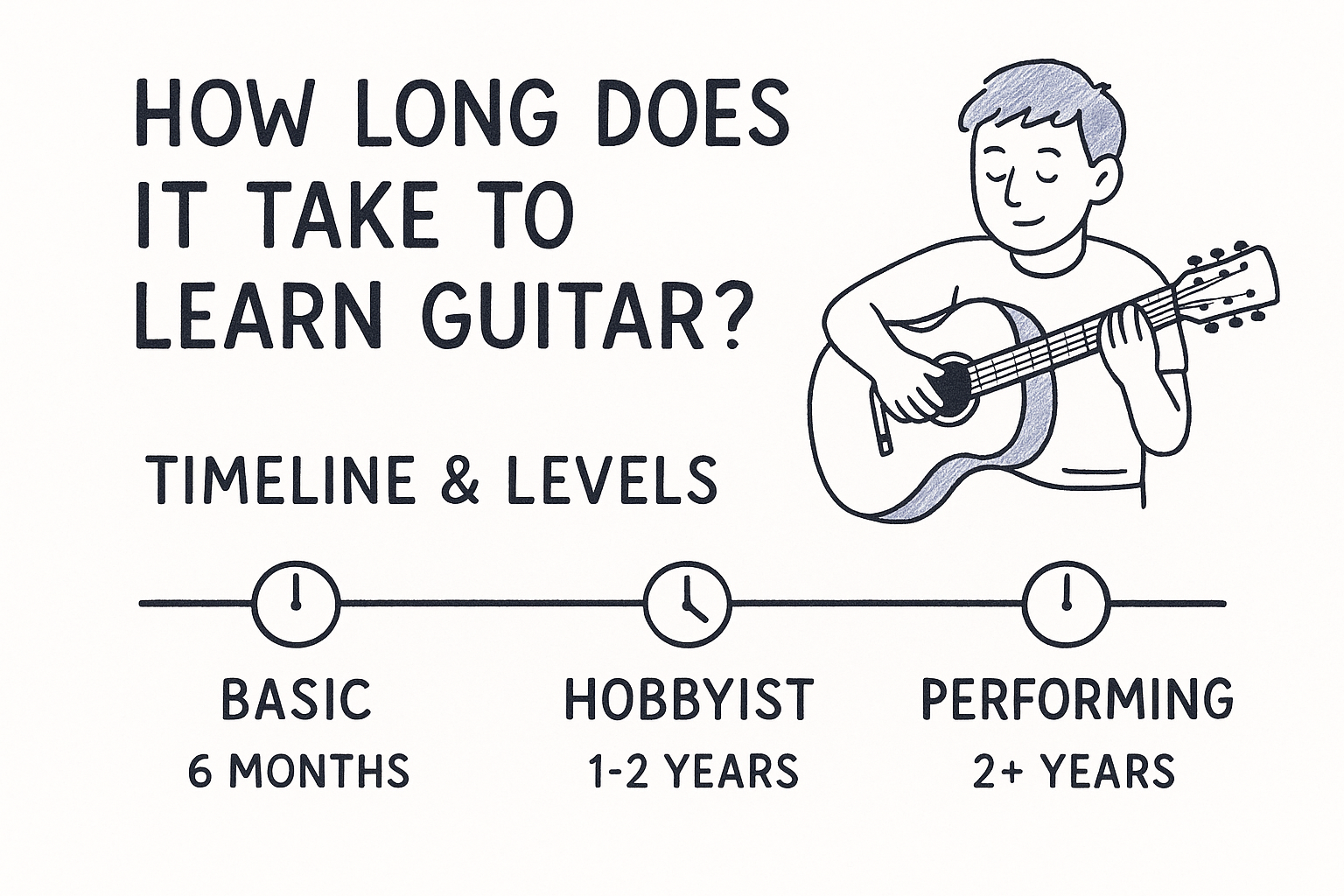
How Long Does It Take To Learn Guitar? Timeline & Levels
If you've ever picked up a guitar and wondered how long does it take to learn guitar, you're asking one of the most common, and most complicated, questions in music. The honest answer is: it depends on what "learn" means to you. Playing a campfire song in a few weeks is very different from shredding a solo that took someone years to master.
The timeline varies based on your goals, how often you practice, and, critically, how you practice. Random noodling for an hour doesn't produce the same results as a focused session where you revisit the right skills at the right time. That's exactly the problem we built MemoRep to solve: it uses spaced repetition algorithms to schedule your practice so nothing goes rusty and nothing gets wasted.
In this article, we'll break down realistic timelines for reaching beginner, intermediate, and advanced levels on guitar. You'll learn what milestones to expect at each stage and which factors have the biggest impact on how fast you actually progress, so you can set goals that make sense and build a practice routine that hits them.
What "learning guitar" really means
"Learning guitar" means something different to almost everyone who picks one up. For some people, the goal is playing a handful of chords well enough to sing along at home. For others, it means performing complex compositions on a stage in front of an audience. Before you can answer how long does it take to learn guitar, you first need to define what "learned" actually looks like for you, because that single decision shapes every part of your timeline and determines how you should be spending your practice time.
The three common goal types
Most guitarists fall into one of three broad camps when it comes to what they want to achieve, and each camp has a very different endpoint.
- Casual player: You want to play songs you enjoy, strum around the house, and have fun without pressure. Technical perfection is not on your list.
- Serious hobbyist: You want to build real technique, understand some music theory, and tackle progressively harder songs over time. You practice consistently and care about measurable progress.
- Performing musician: You are aiming for a professional or near-professional standard. You need reliability under pressure, a wide and polished repertoire, and clean technique across multiple styles.
Your goal type directly affects how long the process takes. A casual player can feel genuinely satisfied within three to six months. A performing musician might spend five or more years building the foundation that stage performance demands.
Skills versus songs
One of the biggest misconceptions guitarists carry into their first year is that learning songs equals learning guitar. Songs are the output, but skills are the foundation. Skills include things like chord transitions, picking accuracy, rhythm timing, and fretboard navigation. When you build skills systematically, new songs get easier to pick up because you are applying tools you already own. When you only chase songs, you often hit a plateau that feels impossible to push through.
Skills compound. Every technique you lock in makes the next one faster to learn.
This distinction matters a lot when you think about how you structure your sessions. Drilling a chord transition for five focused minutes produces more lasting progress than playing through a song casually for an hour, because one builds the underlying skill while the other just rehearses the output.
Why "finished" is the wrong frame
Guitar is not a subject you complete. Skill maintenance is a permanent part of the process, even for players who have been at it for decades. Techniques you haven't used in a few months get rusty. Songs you played well last year need refreshing before a performance. This is why organizing your practice around what actually needs revisiting, rather than whatever feels enjoyable that day, makes such a measurable difference over time.
Think of your practice schedule as a living system that adapts to your weak spots, not a checklist you finish once and file away. Experienced players do not stop working on the fundamentals. They return to them deliberately, and that habit is a big part of what separates players who keep growing from those who stall out.
A realistic timeline by level and milestones
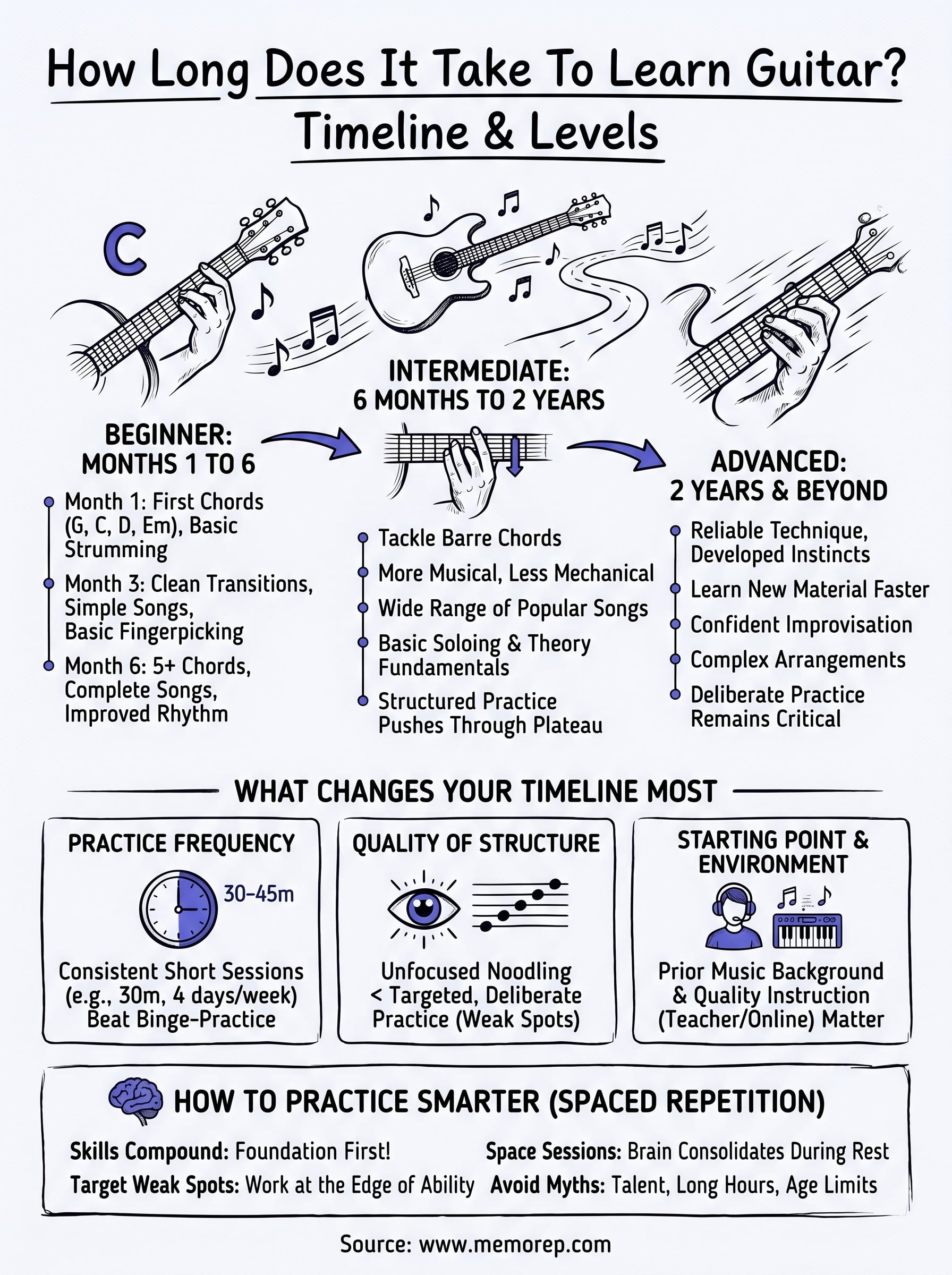
When people ask how long does it take to learn guitar, they usually want a number. The honest answer comes in stages, because progress on guitar is not linear and the milestones you hit in year one look nothing like the ones you hit in year three. Here is what you can realistically expect at each level if you practice consistently for 30 to 45 minutes per day.
Beginner: months 1 to 6
During the first six months, your hands are learning new physical patterns from scratch. By the end of month one, most people can play two or three open chords and switch between them slowly. By month three, transitions get smoother, your fingers stop buzzing strings as much, and you can strum through simple songs at a steady tempo. By month six, you should have five or more chords in your toolkit and be able to play full beginner songs without stopping.
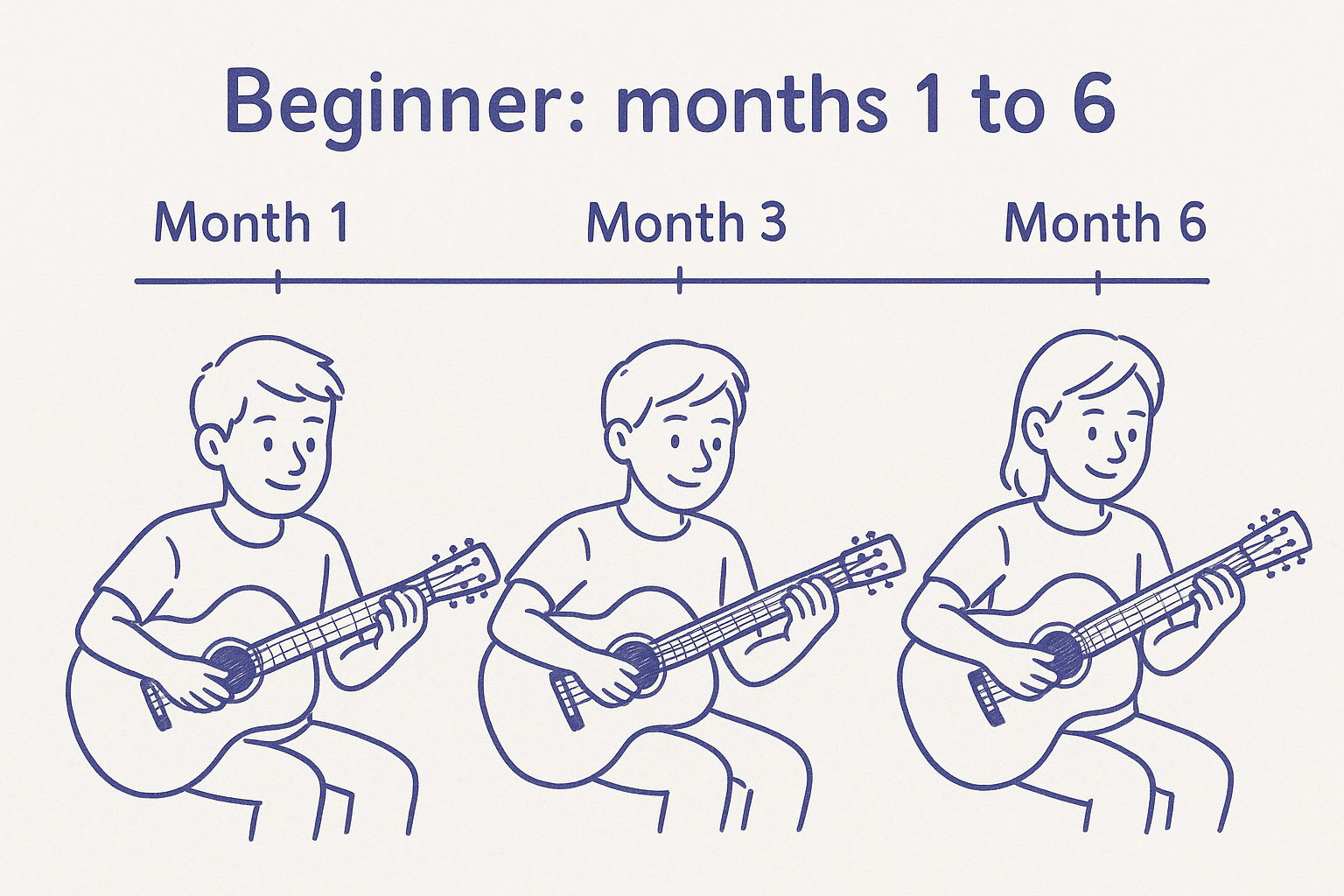
- Month 1: First chords (G, C, D, Em), basic strumming pattern
- Month 3: Clean transitions, simple songs, basic fingerpicking introduction
- Month 6: Five-plus chords, complete songs, improving rhythm control
Intermediate: 6 months to 2 years
This stage is where most guitarists spend the longest time. You start tackling barre chords, which are notoriously difficult, and your playing becomes more musical rather than mechanical. By the 12-month mark, a consistent player can handle a wide range of popular songs, basic soloing, and some music theory fundamentals. Many players plateau here, not because they lack talent, but because their practice becomes repetitive without clear direction.
Structured practice that targets your weak spots directly is what pushes you through the intermediate plateau.
Advanced: 2 years and beyond
Reaching an advanced level means your technique is reliable and your musical instincts are developed. You can learn new material faster, improvise with confidence, and handle complex arrangements. The two-year mark is not an endpoint; it is the point where deliberate, targeted practice becomes even more critical to keep growing rather than coasting on what you already know.
What changes your timeline most
When people debate how long does it take to learn guitar, they often focus on raw talent. Talent is real, but it is a much smaller factor than most beginners expect. The variables that actually determine your pace are mostly under your control, which is good news if you are willing to be intentional about how you approach practice.
Practice frequency and consistency
Practicing four days a week for 30 minutes produces dramatically better results than practicing once a week for two hours. Your brain consolidates motor skills during rest periods between sessions, so spreading your practice out gives each session time to stick. Players who practice every day, even briefly, build muscle memory far faster than those who binge-practice on weekends and go quiet for days in between.
Consistency beats intensity every time when it comes to building physical skills on guitar.
The quality of your practice structure
Showing up is necessary but not sufficient. What you actually do during your session has an enormous impact on your rate of improvement. Unfocused repetition of things you already know feels productive, but it does not push your skills forward. Targeting the specific chords, transitions, or techniques that are currently just beyond your comfort zone is what drives real growth. This is why players with a clear, structured practice plan consistently outpace those who improvise their sessions day to day.
Your starting point and environment
Your prior musical background matters more than most people admit. If you already play piano or have trained your ears through another instrument, you will absorb theory and rhythm concepts faster. On the other hand, someone who has never read music or studied an instrument starts from zero. Access to quality instruction, whether through a teacher or well-structured online resources, also closes a significant gap. A good teacher identifies your weak spots and corrects bad habits before they become ingrained, saving you months of undoing damage that self-teaching can quietly create.
How to practice so you improve faster
The most common reason guitarists stall is not a lack of time. It is practicing the wrong things in the wrong order. If you want to cut down how long does it take to learn guitar to reach your specific goals, the structure of your sessions matters more than the total hours you log.
Target the things you can't do yet
Most players gravitate toward what already feels good. You run through songs you know, noodle on patterns that are comfortable, and avoid the exercises that make you struggle. That instinct is understandable but counterproductive. Deliberate practice means you spend the bulk of your session working at the edge of your current ability, not inside it. Pick one technique that feels just out of reach, isolate it, slow it down, and repeat it until it becomes reliable before moving on.
- Identify one weak spot per session before you start
- Practice it slowly until accuracy improves, then gradually increase speed
- End with something you already play well to close on a strong note
Space your sessions to let skills stick
Your brain consolidates motor skills during rest, not during practice. Two 20-minute sessions on separate days will do more for your muscle memory than a single 40-minute block. Short, frequent sessions are the foundation of faster skill acquisition, and skipping days between long binges throws that advantage away.
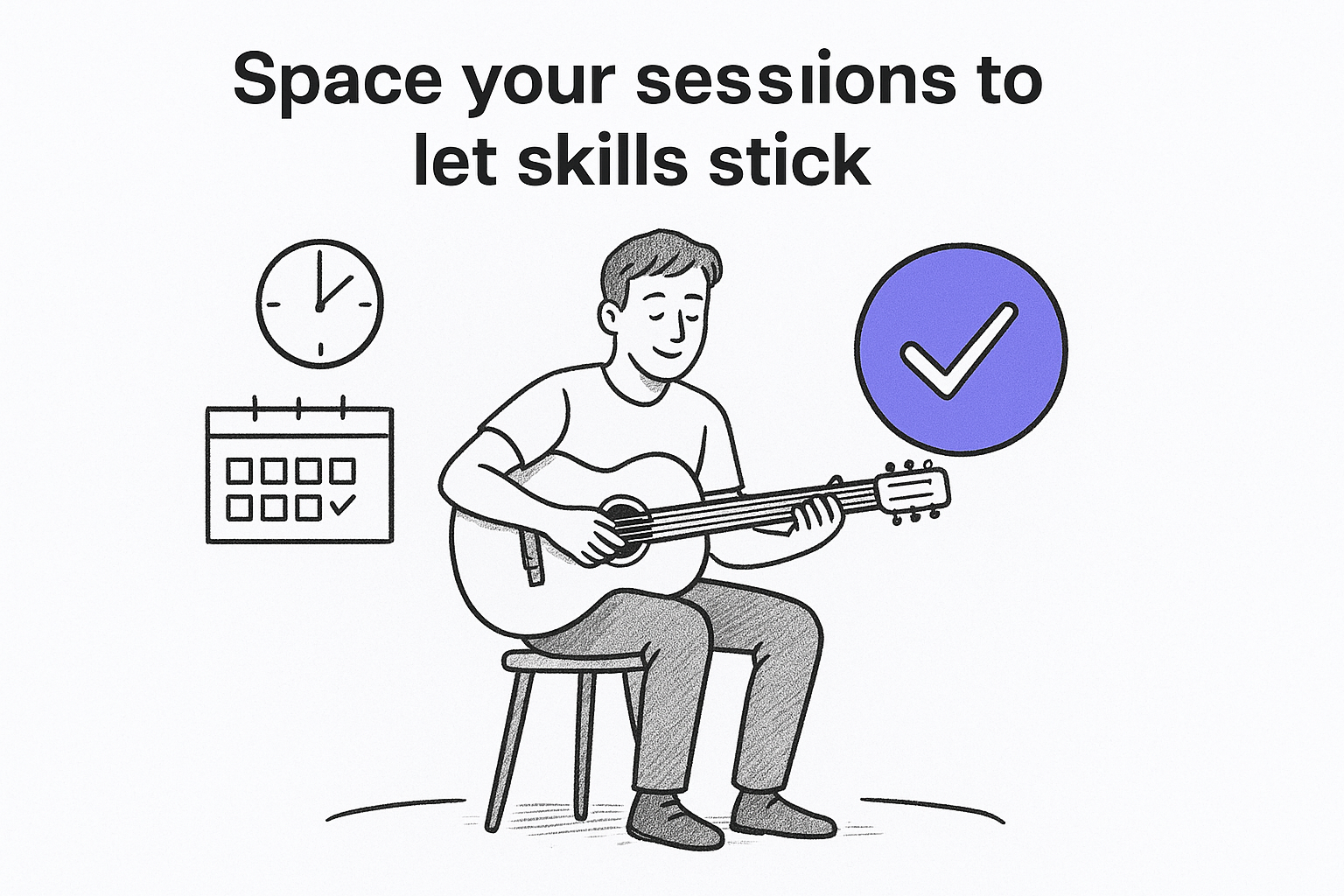
The spacing effect is one of the most well-documented findings in learning science, and it applies directly to physical skills like guitar technique.
Spaced repetition takes this principle a step further by scheduling each skill at the exact interval when it is about to fade. That is the logic behind MemoRep: instead of guessing what to revisit, the algorithm tells you which exercises need attention today and which ones are solid enough to skip for now. You stop wasting session time on skills you have already locked in, and you stop forgetting the ones you practiced two weeks ago and haven't touched since.
Common questions and myths people get wrong
A few misconceptions about how long does it take to learn guitar show up constantly in beginner forums and comment sections. Believing these myths early on can cost you months of misdirected effort and leave you feeling like you're failing when the problem is just bad information. Here are the ones that do the most damage.
You need natural talent to progress quickly
Natural talent plays a smaller role than most people expect. Much of what people call talent is actually early childhood exposure to music. If you didn't grow up playing an instrument, that gap is real but entirely closeable through consistent, structured practice over time. Talent sets a ceiling, but most beginners are nowhere near that ceiling when they stall.
Research on skill acquisition consistently shows that practice frequency and structure outweigh innate ability for the vast majority of learners.
Practicing for hours every day speeds things up
More time does not automatically produce faster results. Your brain consolidates motor memory during rest, not during the session itself, so cramming long blocks of practice back to back can actually slow down skill retention. Short, frequent sessions of 20 to 40 minutes spread across the week build more durable muscle memory than marathon weekend sessions. Quality and spacing beat raw volume every time.
It's too late to start as an adult
Adult learners bring stronger focus, clearer goal-setting, and faster theory comprehension to practice than children typically do. You may build finger dexterity slightly more slowly, but adults close that gap quickly with intentional repetition. Many players who started in their 30s or 40s reached a confident intermediate level within two years of consistent, structured practice.
- Children: adapt physically fast but often lack sustained focus
- Adults: adapt slightly slower physically but learn deliberately and retain context better
- Both groups improve at similar rates when practice is well-organized
Online lessons can't replace in-person teaching
The quality of instruction matters more than whether it happens in a room or on a screen. A well-structured online course from a skilled teacher works just as well as in-person lessons for most players. The real risk with self-directed online learning is that nobody flags your bad habits before they become ingrained, so having some form of feedback, even periodic, matters a great deal.
Keep going from here
The question of how long does it take to learn guitar doesn't have one clean answer, but it has a practical one: faster than you'd expect with consistent, structured practice, and slower than you hope if you rely on random noodling. Your timeline hinges on how often you show up, what you work on when you get there, and whether your sessions target the skills that actually need attention right now.
Every point in this article leads back to the same conclusion: deliberate, spaced practice beats repetitive grinding every single time. You don't need more hours in your day. You need a system that decides what to work on and when to revisit each skill before it fades from memory.
Try MemoRep free and build smarter practice sessions using spaced repetition scheduling that adapts to your progress automatically. The first 200 users get free lifetime access, so the best time to start organizing your practice is right now.