Forgetting Curve Spaced Repetition: How It Works
You practice a passage until it feels solid, move on to the next one, and three weeks later it sounds like you never touched it. That's not a discipline problem. It's biology. Your brain is wired to drop information it doesn't use, and this is exactly what forgetting curve spaced repetition was built to fight. Understanding the mechanics behind it changes how you think about practice entirely.
Hermann Ebbinghaus mapped out how memory decays over time back in the 1880s, and the forgetting curve formula he produced still holds up in practice rooms today. Spaced repetition works by hitting a skill again right as it's about to slip, which resets the decay and stretches out the interval before you need to revisit it. Each well-timed repetition makes the memory more durable, so instead of relearning a passage from scratch you're reinforcing something that's already there.
In this article, you'll see exactly how the forgetting curve behaves for physical and musical skills, why cramming everything into one long session backfires, and how adaptive scheduling decides when you should return to a technique before it fades. You'll walk away knowing why timing your practice matters more than the hours you put in.
Why the forgetting curve matters for anyone practicing a skill
What Ebbinghaus actually measured
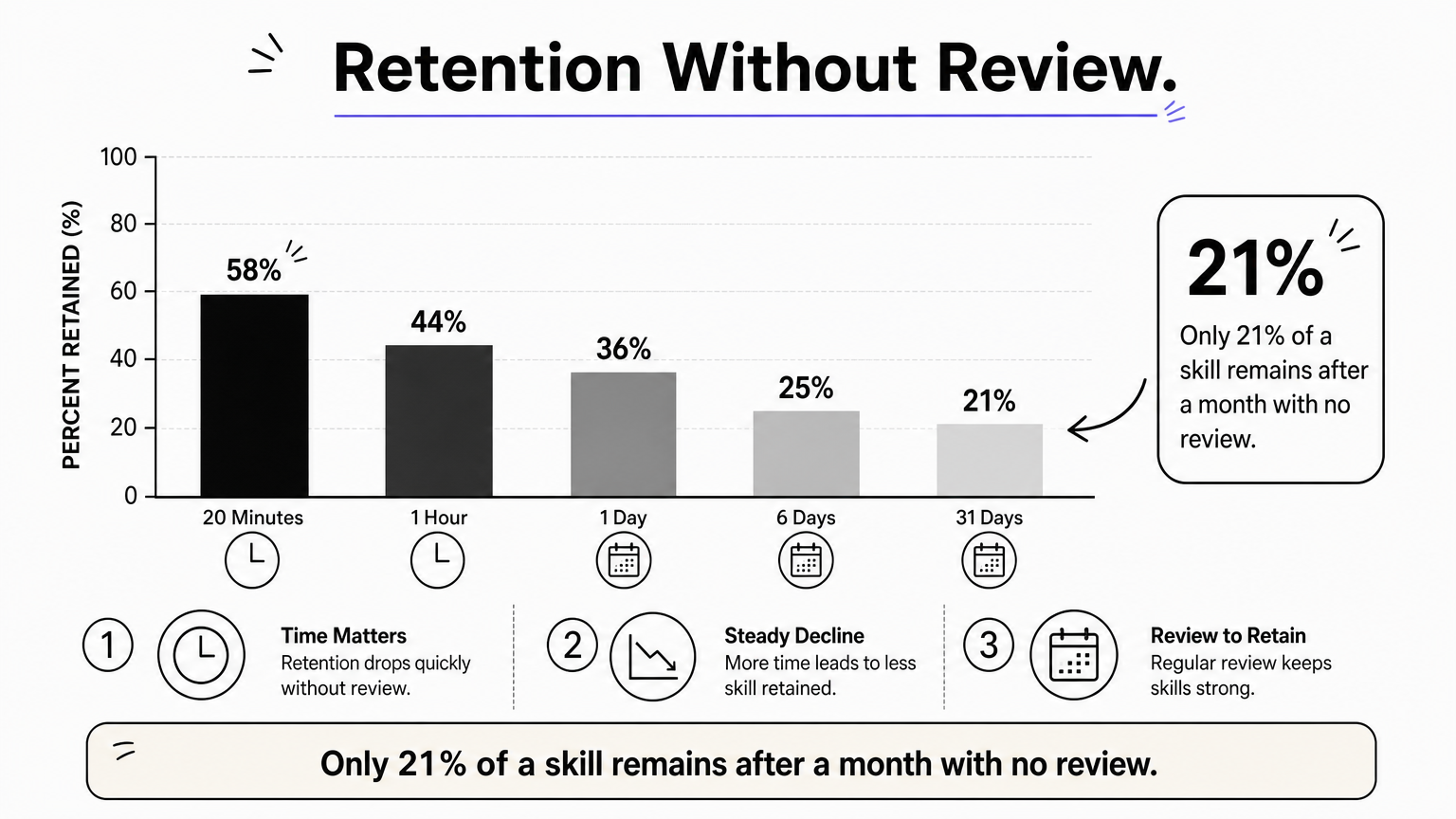
Hermann Ebbinghaus tested his own memory with nonsense syllables and tracked how much he could recall over time. The pattern he found was steep and consistent: most of what you learn disappears fast, then the loss slows down. Here's roughly what that decay looks like without any review:
| Time since practice | Retention |
|---|---|
| 20 minutes | ~58% |
| 1 hour | ~44% |
| 1 day | ~36% |
| 6 days | ~25% |
| 31 days | ~21% |
Those numbers came from memorized syllables, not violin fingerings or golf swings, but the shape of the curve shows up in physical skill retention too. The steepest drop happens in the first day, which is exactly why a skill you nailed on Monday can feel foreign by Wednesday.
Muscle memory fades the same way facts do
Musicians often assume that once a passage is "in the fingers," it stays there. It doesn't. Motor patterns decay on a similar timeline to verbal memory, which is why you forget what you learn, just at a rate that depends on how deeply the skill was encoded and how complex the movement is. A scale you've played a thousand times resists decay far longer than a tricky passage you learned yesterday, because repetition depth changes the slope of the curve, not just the starting point.
A skill you don't revisit isn't preserved, it's just quietly decaying until the next time you need it.
This is where the spacing effect becomes relevant. Left alone, a newly learned passage or technique follows Ebbinghaus's curve downward. Reviewed at the right moment, the same skill decays more slowly each time, because your brain treats a well-timed repetition as evidence that the information matters and is worth keeping accessible.
The real cost of ignoring the curve
Skip the curve and you pay for it in wasted hours. Every time a skill slides too far down the decay curve before you revisit it, you're not reviewing anymore, you're relearning from close to zero. That's the trap most self-directed practice falls into: you spend real time on ten different passages, move on, and by the time you circle back, half of them need to be rebuilt rather than refreshed.
Worse, this compounds. Musicians juggling a full repertoire, exercises, and technique work end up with dozens of items all fading at different rates, and no reliable way to know which one is closest to disappearing. That uncertainty is where decision fatigue creeps in. Instead of practicing, you're guessing, and guessing wrong means either wasting time on something still solid or losing something that needed attention today. Recognizing the shape of the forgetting curve is the first step toward fixing that guesswork with a few proven strategies instead of just working harder around it.
How spaced repetition resets the forgetting curve
Every time you review a skill at the right moment, you don't just refresh it, you change its trajectory. Spaced repetition works because each successful recall pushes the next forgetting point further into the future. The first time you learn a passage, the curve might collapse in a day. Review it right before that collapse and the next drop takes three days instead of one. Review it again and you're looking at a week, then two, then a month. The forgetting curve spaced repetition relationship is really a feedback loop: timing plus recall equals a flatter, slower decay each round.
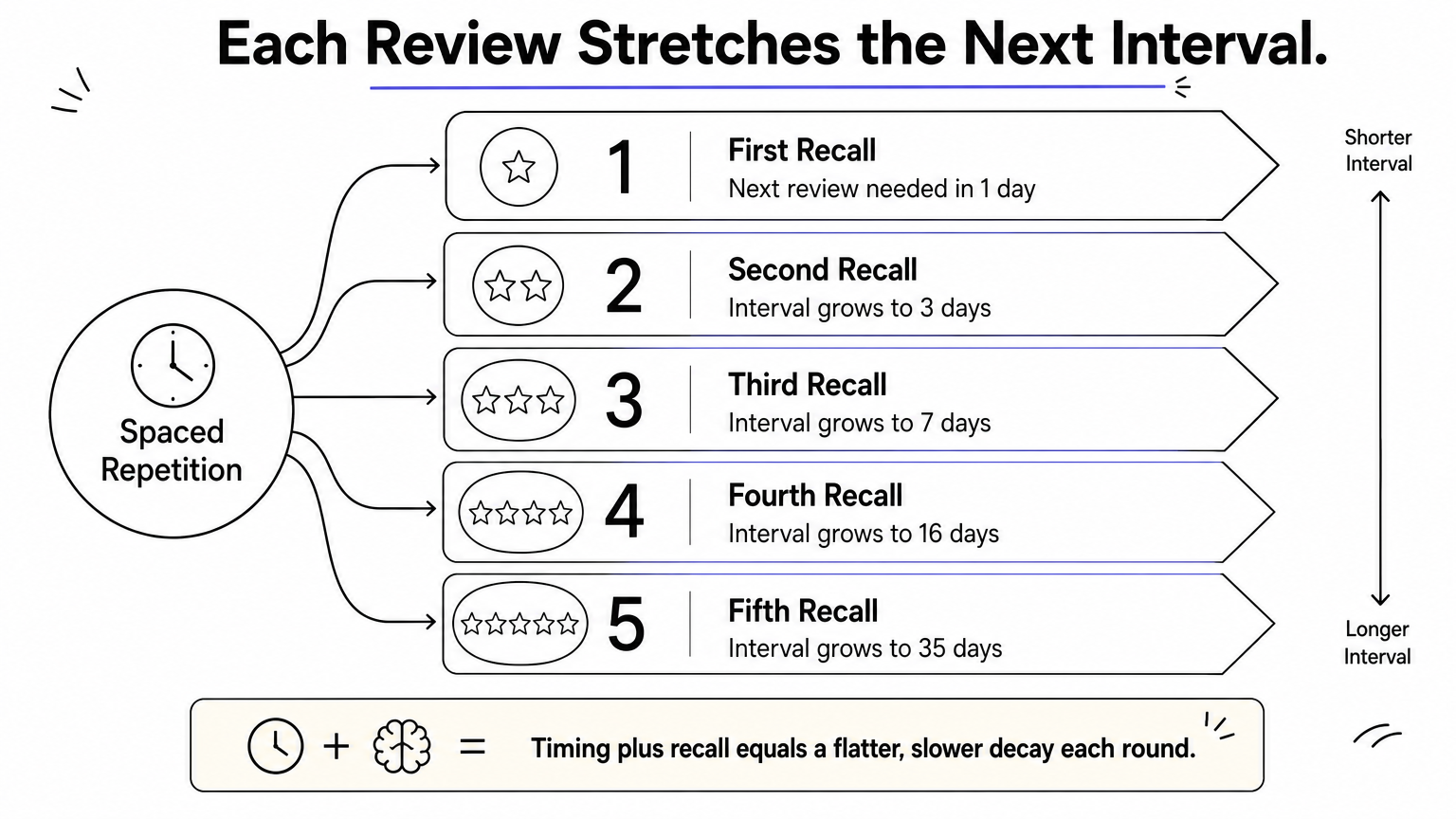
Each review flattens the decay slope
This is the mechanism behind algorithms like SM-2 and how they calculate intervals, which MemoRep builds its scheduling on. Instead of a fixed "practice every day" rule, the interval expands based on how well you performed last time. A typical progression for a well-retained skill looks like this:
| Review number | Interval before next review |
|---|---|
| 1 | 1 day |
| 2 | 3 days |
| 3 | 7 days |
| 4 | 16 days |
| 5 | 35 days |
The goal isn't to review more often, it's to review exactly often enough to keep the curve from ever bottoming out.
Why timing matters more than repetition count
More repetitions don't automatically mean better retention. Practicing the same passage twenty times in one afternoon barely touches long-term memory compared to five reviews spread across two months, because repetition timing is what tells your brain a skill deserves permanent storage. Ten reps crammed into one session teach your brain that the information is only needed short-term, so it gets deprioritized the moment you stop.
Spacing forces retrieval from a weaker memory trace, and the neuroscience of that struggle is what strengthens it. Skip the struggle by reviewing too soon and you get an easy, low-value repetition. Wait too long and you're relearning from scratch. MemoRep's adaptive scheduling, built on the ideas behind a free spaced repetition scheduler, exists precisely to find that narrow window between the two, using your own Again/Hard/Good/Easy feedback to adjust the next interval in real time rather than relying on a generic calendar.
How long to wait between reviews
There's no universal number
Asking "how many days should I wait" is the wrong question, because the right review interval depends on how well you performed last time and how complex the skill is. A one-line rhythm exercise you nailed on the first try can wait two weeks. A shift in position you barely landed needs a look tomorrow. Treating every skill with the same fixed schedule ignores the whole point of the forgetting curve, which is that decay speed is personal to each item, not a property of a calendar.
Let performance set the pace
Instead of picking a number in advance, base the wait on your last rating. Here's the general logic behind adaptive interval scaling:
- Again (you couldn't recall it): reset to a short interval, often the next day.
- Hard (you got it, but it was shaky): small increase, maybe 2 to 3 days.
- Good (solid recall): standard multiplier, often doubling or more.
- Easy (no effort at all): larger jump, sometimes weeks ahead.
The right interval is the longest one you can go without forgetting, not the shortest one that feels safe.
Judging that boundary by feel is exactly where people struggle, which is why manually run spacing systems tend to drift toward either too-frequent reviews or missed ones entirely.
Complexity changes the math
Motor skills involving coordination, like a tricky fingering pattern or a technical run, decay faster early on than simpler recall tasks, so they need tighter spacing in the first week even if they'll eventually stretch out just as far. Skills built on strong existing foundations, like a scale pattern layered onto years of technique, tolerate longer gaps sooner. This is the core reason a rigid daily or weekly routine wastes time on some skills while under-serving others, and it's why the spaced repetition algorithm behind tools like MemoRep recalculates the interval after every single session instead of running on a fixed loop.
Common mistakes that break the spacing effect
Most musicians who try to "space out" their practice still undo the benefit without realizing it, because the mistakes are procedural, not attitude problems. Fixing them takes less discipline than you'd think, just a different set of habits around how you review and how honestly you rate yourself.
Cramming disguised as spacing
Playing a passage five times in a row and calling it "spaced" is the most common trap. Real spacing needs a gap long enough for some forgetting to start, otherwise you're just doing massed practice with extra steps. Blocking three reviews into one evening session feels productive, but your brain logs it as a single event, not three separate reinforcements, so the decay curve barely moves and nothing settles into long-term memory.
Rating recall too generously
Marking something "Good" or "Easy" when you actually hesitated or fumbled the timing breaks the whole feedback loop. The SM-2 algorithm trusts your input to set the next interval, so an inflated rating pushes the next review too far out, and the skill quietly slides past the point where it's still retrievable.
Honest feedback is what keeps the schedule accurate; a flattering rating just moves the failure to a later date.
Letting the review queue pile up
Skipping sessions for a week turns a manageable queue into a backlog where half the items need full relearning instead of a quick refresh. This is one of the fastest ways to erase the gains spacing was supposed to give you.
Treating every skill the same way
Applying one fixed interval to a whole repertoire ignores how differently each piece decays. A few patterns worth watching for:
- Overlong intervals on complex passages that haven't been encoded deeply enough yet
- Overlapping reviews where too many skills come due on the same day, causing rushed, low-quality recall
- No adjustment after a rating, so a shaky "Hard" gets the same next-review date as a confident "Easy"
Each of these mistakes has the same root cause: reviewing on autopilot instead of letting performance drive the timing. A scheduling system built around your ratings catches these drifts automatically, which is exactly what manual tracking struggles to do.
Making the curve work in your favor
The forgetting curve isn't something you beat once and move past. It's a constant pull on every passage, scale, and technique you've ever learned, and the only real defense is timing your reviews before decay sets back in. Forgetting curve spaced repetition turns that pull into a predictable pattern instead of a source of anxiety, replacing guesswork with intervals shaped by your actual performance.
What you don't need is another spreadsheet or a memorized set of rules about when to review what. That's decision fatigue wearing a different mask. What works is a system that tracks each skill's decay individually and tells you what's due today, nothing more.
If you want to see the algorithm behind this in action rather than just read about it, see how MemoRep builds your review schedule and start practicing on a schedule your memory actually follows.