Intrinsic vs Extraneous Cognitive Load: What's the Difference?
You sit down to practice a new piece, a new chord progression, or a new technique, and ten minutes in your brain feels full. Some of that mental strain comes from the skill itself. Some of it comes from how you're practicing. The distinction between intrinsic vs extraneous cognitive load matters because only one of these you can actually control.
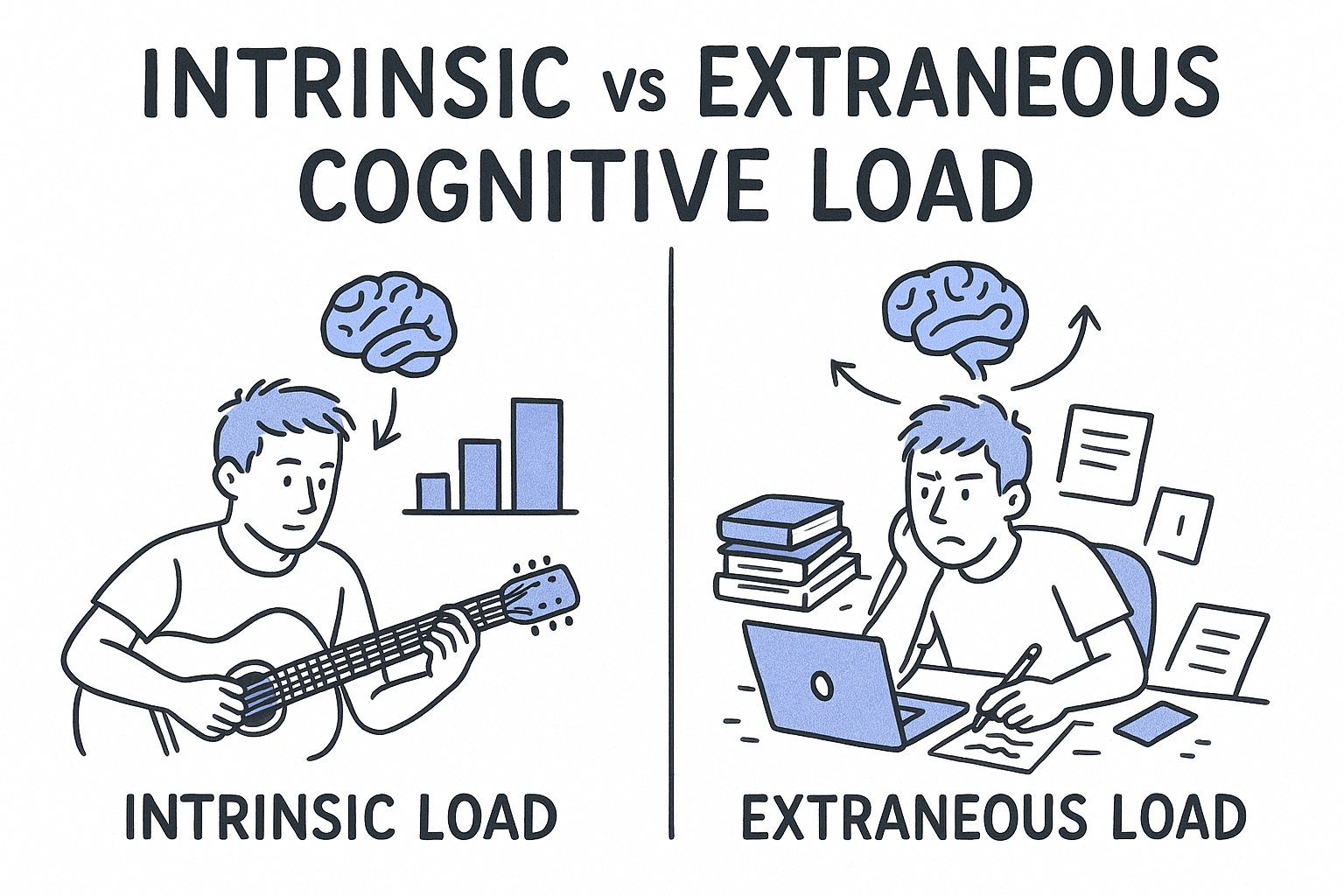
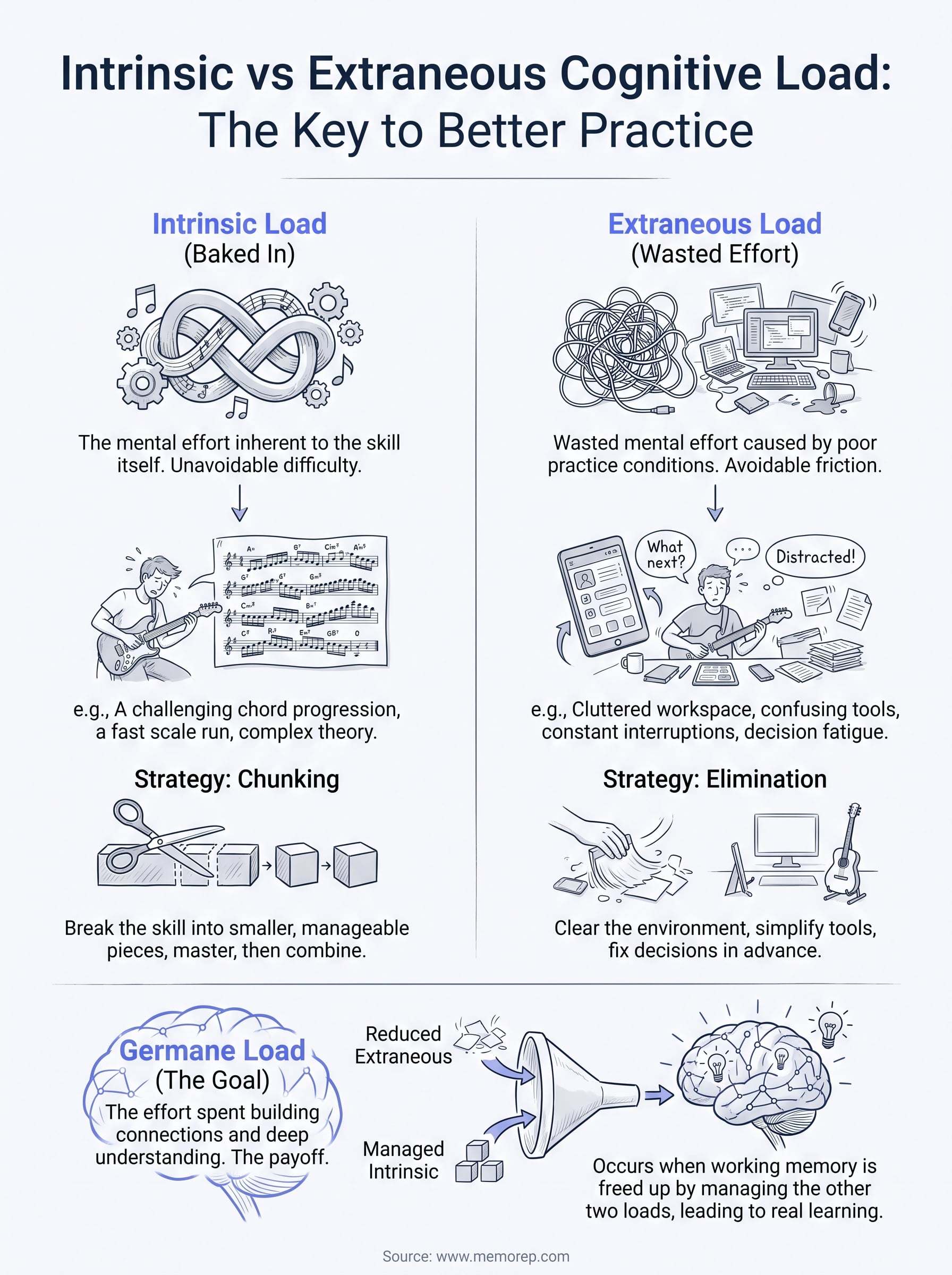
Intrinsic load is the mental effort baked into the material you're learning, a hard passage is harder than an easy one, no way around it. Extraneous load is the wasted effort caused by bad practice conditions: cluttered sheet music, confusing instructions, constant interruptions, or trying to juggle five exercises with no clear order. Cognitive load theory separates these two because reducing extraneous load frees up mental capacity for the intrinsic load you actually need to master, and that's the leverage point most learners ignore.
This article breaks down both types with clear definitions and concrete examples from music and skill practice, so you can spot which kind of load is slowing you down. Once you see the difference, structuring your practice sessions becomes a lot less about willpower and a lot more about design.
Why the distinction matters for effective learning
Working memory can only hold a handful of things at once, somewhere around four to seven chunks of information according to classic cognitive psychology research. When you're learning a practical skill, every bit of that limited space matters. If extraneous load eats up three of your four slots, you've got almost nothing left for the actual learning. This is why two people can spend the same hour practicing the same piece and walk away with wildly different results. One person's brain was fighting clutter. The other's was fighting the music.
Working memory is the bottleneck
Your brain doesn't process intrinsic and extraneous load separately, it just runs out of room. A messy PDF of sheet music with tiny print, a metronome app that's confusing to set up, or a teacher's instructions buried in five minutes of unrelated chatter all pull from the same finite pool as the actual skill you're trying to build. Cognitive overload shows up as frustration, slower progress, and that foggy feeling where nothing sticks even after repeated attempts.
Reduce extraneous load and you don't make the skill easier, you make room for your brain to actually learn it.
Misdiagnosing the struggle wastes your effort
Here's the practical danger of not knowing the difference. If you think a skill is too hard for you, intrinsic load, when the real problem is extraneous load, you'll waste time on the wrong fix. You might simplify the material when what you actually needed was a cleaner practice environment, a clearer routine, or fewer competing decisions about what to work on next.
- Intrinsic problem, wrong fix: giving up on a difficult passage instead of breaking it into smaller repeatable chunks
- Extraneous problem, wrong fix: buying a more advanced instrument or method book instead of fixing a chaotic, interruption-heavy practice space
- Correct diagnosis: isolating whether the strain comes from the skill's inherent difficulty or from how the practice session is organized
Getting this diagnosis right changes what you actually do next. Researchers like John Sweller, who first formalized cognitive load theory in the 1980s, built the whole framework around this separation for exactly this reason: you manage each type differently, and confusing them leads to fixes that don't address the real bottleneck. Learners who understand which type of load is dragging them down stop wasting sessions on the wrong adjustment.
How to manage intrinsic load and cut extraneous load
Managing these two types of load takes opposite strategies. You can't shrink intrinsic load below what the skill actually demands, but you can present it in smaller doses. Extraneous load, on the other hand, you can often eliminate entirely once you spot it.
Break intrinsic load into manageable chunks
Sequencing is your main tool here. Instead of attempting a full four-bar run at tempo, isolate two beats, master the fingering, then extend it. This is chunking, and it's the standard technique musicians and coaches use to keep intrinsic load inside the limits of working memory without dumbing down the material itself.
You can't lower how hard a skill is, but you can control how much of it you face at once.
Strip extraneous load out of your setup
Extraneous load usually hides in your environment and your habits, not the skill. A quick audit before each session catches most of it:
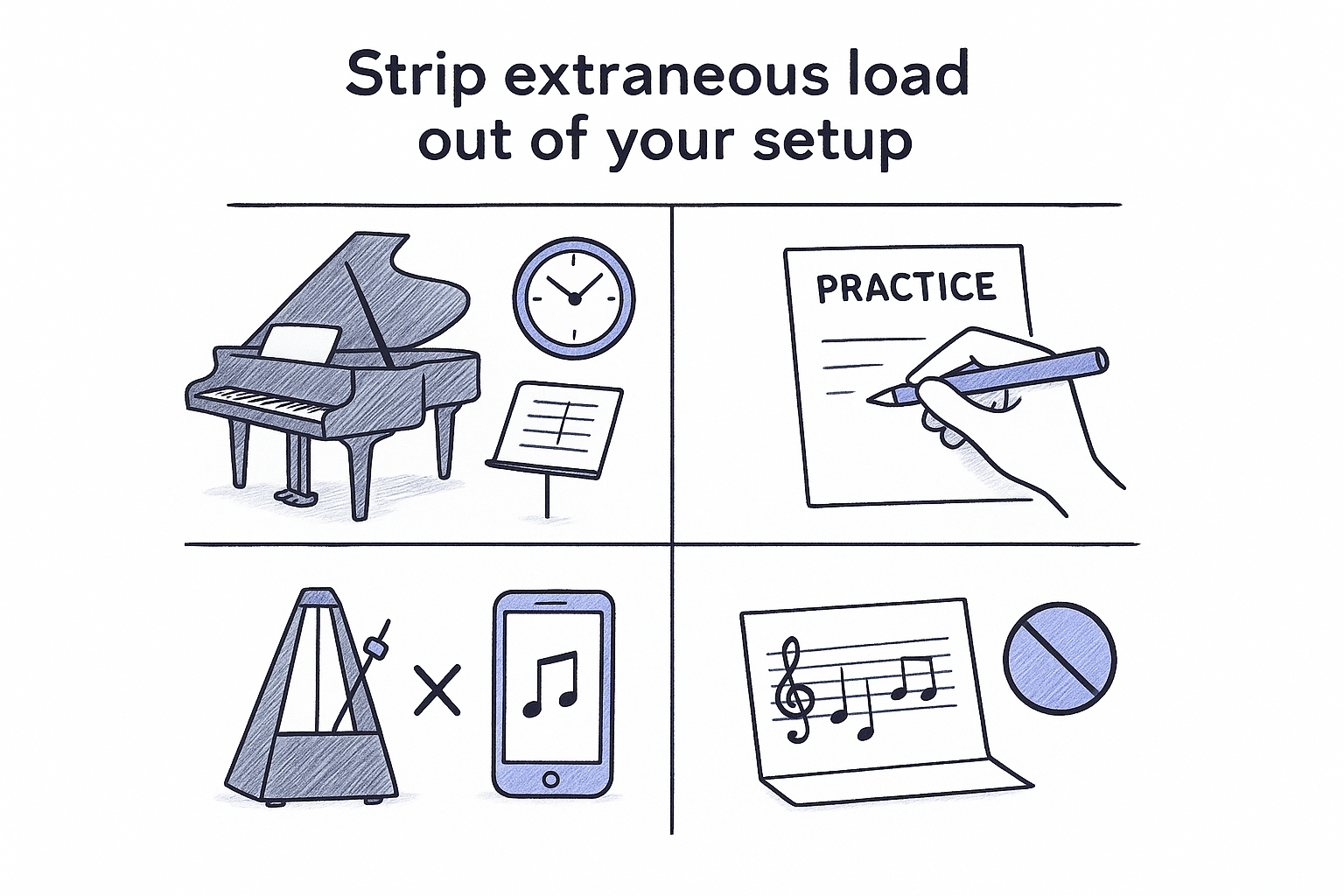
- Clear the workspace: one instrument, one piece of music, no phone notifications
- Simplify instructions: write down the one thing you're working on today, nothing else
- Fix the decision fatigue: decide your practice order in advance, don't improvise mid-session
- Check your tools: a confusing metronome app or cluttered sheet music adds friction that has nothing to do with the music
Together, these two moves, chunking the hard stuff and clearing the clutter, give you far more usable working memory than either fix alone.
Intrinsic vs extraneous load in real practice sessions
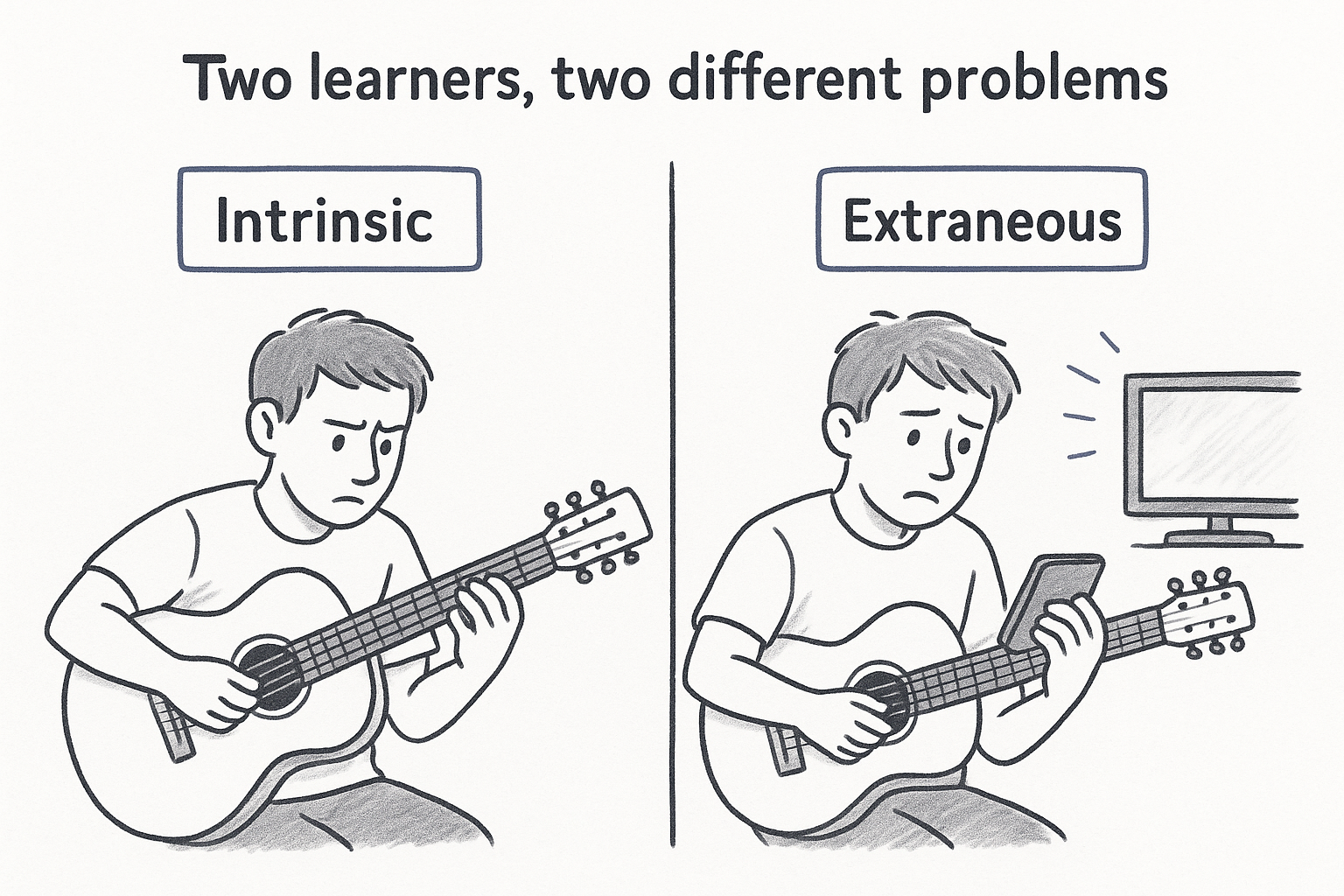
Theory only helps if you can spot these two types of load while you're actually practicing. Picture a guitarist tackling a barre chord for the first time. The intrinsic load is the coordination problem itself: pressing six strings evenly, angling the thumb, keeping the wrist relaxed. No amount of tidying the room removes that difficulty. Now picture the same guitarist trying to learn the chord from a shaky phone video, in a room with the TV on, while also trying to remember three other chords for the same song. That pile-up is pure extraneous load, and it has nothing to do with how hard barre chords actually are.
Two learners, two different problems
The table below shows how the same instrument and skill level can produce very different practice experiences depending on which load dominates.
| Scenario | Type of load | What's actually happening |
|---|---|---|
| Isolating a fast scale run at half speed | Intrinsic | The finger sequence itself is demanding |
| Reading cramped, low-resolution sheet music | Extraneous | Poor formatting adds strain unrelated to the notes |
| Memorizing a long chord progression | Intrinsic | The material has many interdependent parts |
| Switching apps mid-session to find a metronome | Extraneous | Tool friction, not skill difficulty |
Two musicians can hit the same wall in a practice session for completely opposite reasons.
Why the pattern repeats across skills
Drummers, painters, and public speakers run into the same split. A drummer struggling with a genuinely complex polyrhythm is fighting intrinsic load. A drummer struggling because the click track keeps cutting out is fighting extraneous load dressed up as difficulty. Spotting which one you're facing, session by session, is what separates productive frustration from wasted time.
Where germane load fits into the picture
Cognitive load theory actually includes a third type, and it's the one most practice guides skip. Germane load is the mental effort you spend building connections, patterns, and mental models from the material itself. It's not wasted effort like extraneous load, and it's not the raw difficulty of intrinsic load either. It's what happens when your brain takes the freed-up space and uses it to actually understand the skill, not just survive the session.
Germane load builds understanding, not just endures it
Think back to the barre chord example. Once you've chunked the coordination problem and cleared the clutter, your working memory has room left over. What you do with that room is germane load: noticing that the same finger shape works two frets up, connecting this chord to one you already know, building a mental map instead of memorizing an isolated shape. This is the effort that turns one chord into a transferable skill.
Germane load is the only kind of mental effort you actually want more of.
Turning free capacity into real learning
Sweller's later work on cognitive load theory, expanded through the 1990s and 2000s, treats germane load as the payoff for managing the other two well. You can't force germane load directly. It shows up on its own once extraneous load is cleared out and intrinsic load is sized correctly. That's the real argument for organizing your practice: not just comfort, but making room for the kind of thinking that actually sticks.
Making cognitive load work for your practice
Understanding intrinsic vs extraneous cognitive load gives you a real diagnostic tool, not just a vocabulary lesson. Next time a session feels harder than it should, ask which type is actually dragging you down. Skill genuinely too advanced? Chunk it smaller. Room cluttered, tools confusing, order undecided? Fix the setup, not the material. That single question saves you from the wrong adjustment and gets you back to actual progress faster.
Sequencing and scheduling matter here too. Random practice order recreates extraneous load even after you've cleaned up your workspace, because your brain still has to decide what comes next every single session. That's exactly the gap spaced repetition software closes for practical skills, not flashcards or vocabulary lists, but chord progressions, drills, and techniques. If you want to see how an algorithm can hold that scheduling load for you instead of your working memory, see how memoRep's science works.