Which Statement Best Describes Deliberate Practice? Answer
Which statement best describes deliberate practice? In the Learning How to Learn course, the correct choice is "Focusing intently on the parts of the problem that are more difficult to you." Deliberate practice is effortful, concentrated work aimed at the specific weaknesses that hold your performance back. It is not a comfortable replay of what you already do well.
This article gives you the answer first and then the reasoning behind it, so you can handle any reworded version of the question. You will see where the term comes from, why it matters, how to build a session around it, what real examples look like, where its limits are, and how it connects to chunking and spaced repetition.
MemoRep is a spaced repetition app for musicians and practical-skill learners, so deliberate practice sits close to our daily work. We schedule when a skill comes back for another pass. We never give technique or theory instructions, because that is a teacher's job, and this article follows the same rule.
The quiz answer and why it is correct
The correct answer is "Focusing intently on the parts of the problem that are more difficult to you." It is the statement that best describes deliberate practice because it holds the two ideas that separate it from ordinary practice: full concentration and a target aimed at your weakest parts.
The answer in plain words
Take the statement apart piece by piece. "Focusing intently" means your attention stays on the task for the whole block, with no phone and no drifting. "The parts of the problem" means you split a skill into pieces instead of treating it as one lump. "More difficult to you" means you pick the pieces by your own weakness, not by what feels fun or familiar.
Most people do the reverse. We drift toward what we already do well, because it feels good and keeps us feeling competent. That comfortable repetition adds very little. Deliberate practice goes straight to the places where you stall, stumble, or hesitate, and it stays there until they improve.
The right answer is the one that sends your attention to your hardest parts, not your favorite ones.
How to recognize the right option when the wording changes
Quiz banks get reworded and options get shuffled, so match by meaning instead of by position or by a memorized letter. The table below shows the patterns that wrong options usually follow. It is not a copy of any specific quiz.
| What an answer option says | Deliberate practice? | Why |
|---|---|---|
| Concentrating on the parts of a skill that are hardest for you | Yes | It targets weakness with full attention |
| Repeating what you already do well for a long time | No | It stays in the comfort zone and asks nothing new |
| Putting in as many hours as possible | No | Hours say nothing about focus or targets |
| Practicing while relaxed and just having fun | No | Fun is fine, but it rarely stretches you |
| Running through the whole task from start to finish every time | No | It skips isolating the hard parts |
Notice that the wrong options all describe practice that feels easy or measure practice by quantity instead of quality. The right option is the only one that names both focus and difficulty.
Where the question comes from
The question belongs to Learning How to Learn, the Coursera course taught by Barbara Oakley and Terrence Sejnowski. Deliberate practice appears there as one tool in a larger set that includes chunking, retrieval, spaced repetition, and the contrast between focused and diffuse thinking. Quiz sets from several weeks of the course contain this question, so you may meet it more than once.
The course gives a short, learner-friendly version of an idea that researchers define more strictly. A related version of the question asks which statement describes a component of deliberate practice. The same logic applies. Choose the option about focus, difficulty, or feedback, and skip the options about passive repetition or sheer hours. The next section shows how the strict definition fills in the rest.
What deliberate practice means in research
In research, deliberate practice is effortful training designed to improve one specific aspect of performance, done with full concentration, quick feedback, and repetition that refines the result. The quiz answer is a compact version of that definition.
Where the term comes from
Psychologist K. Anders Ericsson coined the term. With Ralf Krampe and Clemens Tesch-Römer, he published "The Role of Deliberate Practice in the Acquisition of Expert Performance" in Psychological Review in 1993. The team studied violinists at a Berlin music academy and asked which activities best explained differences in skill. The answer was a particular kind of solitary, effortful practice, not time spent playing in general.
Ericsson spent the rest of his career refining the idea. He summarized it for general readers in his 2016 book Peak, and many people meet the term there or through Oakley's course. That is why the wording differs from place to place. Ericsson's own 2020 paper restates that deliberate practice came out of a search for the features of effective practice that had been shown to improve expert performance.
The defining characteristics
Across Ericsson's writing, the same features keep appearing:
- A specific goal for the session, small enough that you can tell whether you reached it.
- Full concentration for the whole block, not half-attention.
- Feedback from a teacher, a recording, a measurement, or your own honest rating.
- Work at the edge of your ability, just beyond what feels comfortable.
- Isolation of weak spots, repeated until they improve.
- Methods informed by top performers in the field, usually passed on by a teacher.
- Effort that feels demanding and is often not fun.
If a question asks for the key characteristic of deliberate practice, pick the option about focused effort on weaknesses with feedback. Every other feature on the list supports that core.
Naive, purposeful, and deliberate practice
Ericsson separates three kinds of practice in Peak, and the difference clears up many confusing quiz options.
| Type | What it looks like | Typical result |
|---|---|---|
| Naive | Repeating what you already do, on autopilot | Skill stalls once it is "good enough" |
| Purposeful | Specific goals, full focus, feedback, work beyond comfort | Steady improvement |
| Deliberate | Purposeful practice guided by methods that top performers use, usually with a teacher | The fastest route in fields with established expertise |
Read strictly, the quiz answer describes the heart of purposeful practice. Deliberate practice adds one more layer: a teacher or coach who knows the training methods that have worked for the best people in the field. For most learners, the label matters less than the habit. If you aim your attention at your hardest parts and have a teacher guiding what to work on, you are already close to the full definition.
Deliberate practice is purposeful practice plus expert guidance on what to work on.
Why deliberate practice matters
Deliberate practice matters because time alone does not make you better. Once a skill reaches an acceptable level, more of the same practice mostly maintains it. Deliberate practice is what keeps improvement going.
Experience is not the same as improvement
Think about a person who has driven to work for twenty years. They are not necessarily a better driver than someone with five years of experience, because the daily drive asks nothing new of them. Ericsson's research found the same pattern in many fields. Once performance becomes automatic, it stops improving, even if the person keeps going for decades.
Automatic habits are useful, and they are also the trap. A habit feels effortless because the brain has stopped working hard on it. That is exactly why repeating a habit does not push it forward. Deliberate practice works against that tendency by choosing the parts that are not yet easy.
What the violinist study showed
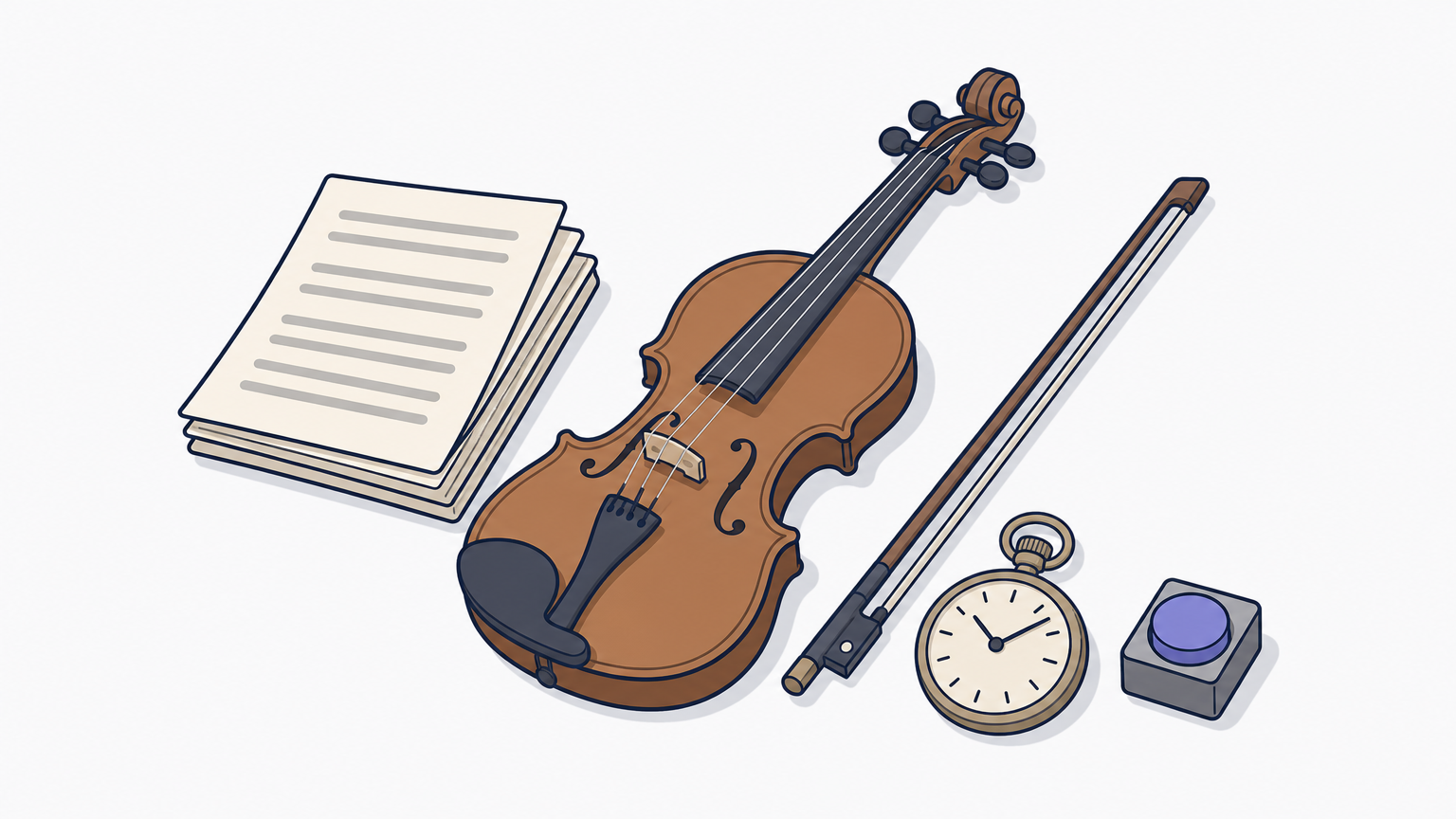
The 1993 study compared violinists at three levels of accomplishment. The measure that separated them best was the hours of solitary practice they had accumulated by age 18, which they rated as high in effort and low in enjoyment.
| Group | Average hours of solitary practice by age 18 |
|---|---|
| Top group | 7,410 |
| Second group | 5,301 |
| Lowest group | 3,420 |
The top group logged about 2.2 times the hours of the lowest group, a gap of 3,990 hours. The key point is that these hours were solitary, effortful, and aimed at improvement, not hours of playing for fun. More and better practice together explained the gap.
What it means for you as a learner
Your time is limited, so the question is how to spend it. An hour aimed at your weakest parts changes more than an hour spent replaying your favorite material. Small gains from focused sessions also compound over months, because each fixed weakness stops dragging down everything built on top of it.
There is a second payoff. Learners who practice without a plan often feel busy but stuck, and that feeling is demotivating. A session built around a specific, hard target gives you a clear sign of progress when the target finally moves.
More hours help only when those hours are aimed at something you cannot yet do.
How to apply deliberate practice in five steps
You apply deliberate practice by splitting your skill into parts, choosing the hardest ones, working them with full focus, getting feedback, and returning later. No official five-step list exists, but this cycle covers the components that Ericsson's research describes. It organizes your practice. What to actually change in your playing or technique is a question for your teacher.
The five steps
- Split the skill into parts. Divide a piece, routine, or exercise list into small sections. Parts you can name are parts you can track.
- Choose the hardest parts and set a target. Pick the sections that give you the most trouble. Write down what "better" means for each one, such as "no stops" or "three clean passes in a row."
- Work at the edge of your ability. Give each target a short, fully focused block. If you feel bored or zone out, the task is too easy. If you feel lost, it is too hard.
- Get feedback. Ask your teacher, record yourself, or rate the attempt honestly. Without feedback you cannot tell whether the block worked.
- Record the result and come back later. Note how it went, rest, and schedule the next visit. Sleep and time away do part of the work.
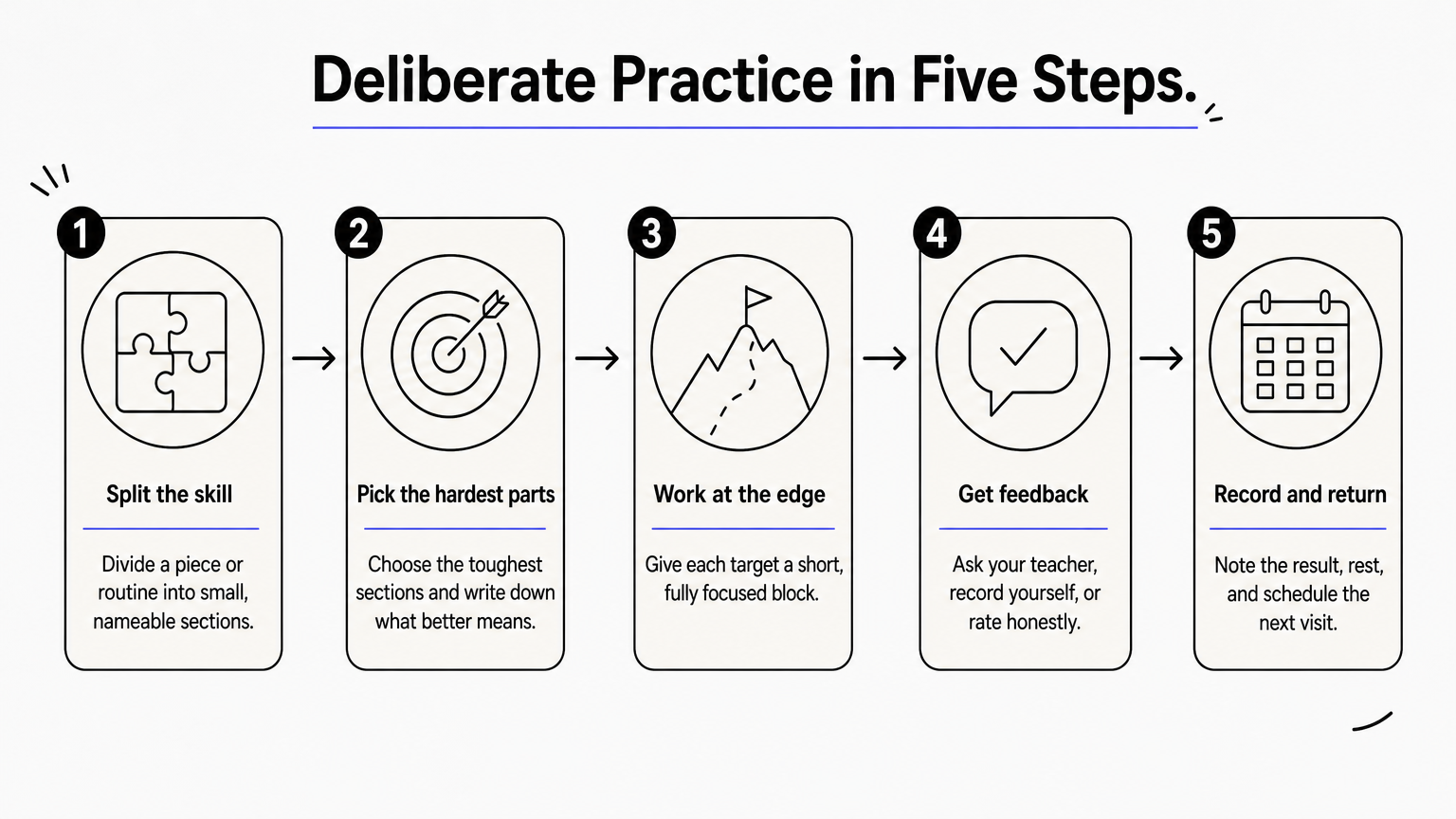
Each step answers a different failure. Step 1 stops you from treating everything as one lump, step 2 stops you from practicing what is comfortable, and step 3 keeps attention high. Step 4 removes guessing, and step 5 makes the gains stick.
A worked example
Say you are preparing three pieces and you split each into four sections. That gives you 12 items to track. After your last session, you rated each item, and five of them are now due for another pass. You rank those five by difficulty and choose the three hardest for today.
Each gets a 20-minute block with a clear target. You take two 5-minute breaks. The result is 60 minutes of focused work inside a 70-minute session. Twenty minutes sits at the low end of the 20 to 30 minutes that beginners to deliberate practice usually manage. After each block, you rate the item and write one line about what happened. The next visit is then scheduled by that rating, not by your mood.
How to tell when you are not practicing deliberately
Some quick checks catch drift early:
- You feel bored or zone out. Deliberate practice is frustrating or tiring, rarely boring.
- You always start with the same favorite section. Comfort is choosing for you.
- You track a number that feels good but means little. A vanity metric counts easy things, such as total minutes, instead of progress on a hard target.
- You cannot say what you were trying to improve when the session ends.
If you cannot name the one thing a session was meant to improve, it was probably just repetition.
Examples of deliberate practice
Examples of deliberate practice share one pattern: a narrow target, intense attention, fast feedback, and repetition on the miss. The activity changes from field to field, but the structure does not.
Writing
Benjamin Franklin described his own method in his autobiography. He studied a passage from a well-written essay, then tried to reproduce its structure and content from his notes. Afterward he compared his version with the original to find the differences. Each round gave him specific feedback on where his writing fell short, and he repeated the cycle. The activity was designed to improve writing, not just to produce more of it.
Chess
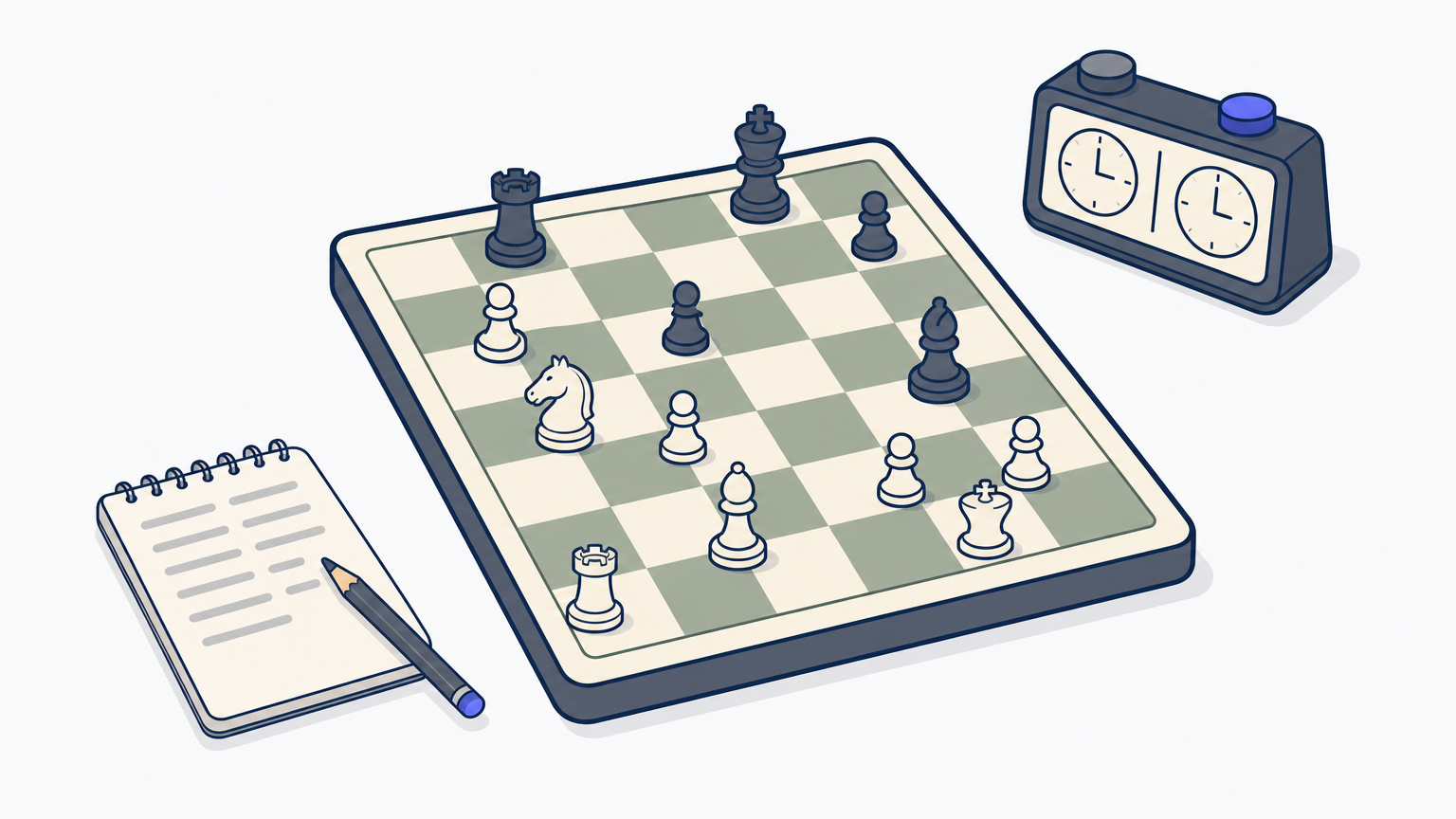
A 2005 study found that the strongest predictor of chess skill was serious solitary study, not playing game after game. Grandmasters in the study had spent about 5,000 hours on serious study alone during their first decade of play, nearly five times the average reported by intermediate players. One common study method is to review a master's game and predict each move before seeing it. When your prediction differs, you stop and work out what you missed. That mismatch is the feedback.
Free throws
Performance coach Aubrey Daniels offered a thought experiment about two basketball players who each practice free throws for an hour. Player A takes 200 shots with a partner who retrieves the ball and records each miss as short, long, left, or right. Player A reviews the record every 10 minutes, which is six reviews in the hour. Player B takes 50 shots, retrieves his own ball, and chats with friends between attempts. Both players "practiced" for an hour, but only one of them got a stream of specific feedback.
Music
Author Daniel Coyle describes a seven-year-old clarinet student he watched in The Talent Code. She plays a few notes, stops at the exact point where she errs, and studies the page. She sings the phrase, then starts again and gets a little further. She pauses for several seconds to replay it in her head. The scene shows how deliberate practice looks from the outside: short runs, immediate stops at the mistake, and repeated attempts at the same spot.
| Same activity | Naive version | Deliberate version |
|---|---|---|
| Chess | Playing game after game | Studying master games and predicting moves |
| Tennis | A casual match with friends | Drills on one weak shot, reviewed with a coach |
| Music | Playing through your favorite piece | Stopping at the weak spot and returning to it |
| Writing | Writing more of the same | Rewriting from a model and comparing the two |
What separates the two columns is not effort alone. It is whether the effort was aimed and checked.
The limits and criticisms of deliberate practice
Deliberate practice has two kinds of limits. Your concentration runs out after a few hours a day, and researchers disagree about how much of the gap between people it explains.
How much you can do in a day
Deliberate practice is demanding, so it cannot fill the whole day. Across fields, the upper limit for experts is about four to five hours per day, usually in sessions of no more than 60 to 90 minutes. Beginners start much lower.
| Stage | Typical focused block | Daily total |
|---|---|---|
| Just starting out | 20 to 30 minutes | Build up slowly over months |
| Experienced | 60 to 90 minutes | Four to five hours at the high end |
Rest is part of the method. In Ericsson's violinist research, the best players tended to nap in the afternoon and slept about eight hours a night, more than the average person. Sleep also helps consolidate what you practiced, so skipping it undercuts the work you just did.
What critics found
The idea has been tested hard. A 2014 meta-analysis by Brooke Macnamara, David Hambrick, and Frederick Oswald found that deliberate practice explained roughly 26% of the differences in performance in games, 21% in music, 18% in sports, 4% in education, and under 1% in professions. So it matters, but it is not the whole story. Other factors, including when people start and how they respond to training, also play a role.
Ericsson replied that many studies in the analysis counted ordinary practice or playing time as "deliberate" and did not use the strict definition. His point is fair. A study that treats any practice as deliberate will show weak results for deliberate practice. The honest reading is that the strict version has strong support in fields with clear standards, such as music and chess, and weaker evidence in loosely defined fields.
The 10,000-hour myth
Malcolm Gladwell popularized a "10,000-hour rule" based on Ericsson's work. The figure was an average for one group of top violinists, not a threshold that guarantees mastery. It also says nothing about the quality of those hours.
The real lesson is the one from the violinist table. Pace matters. At one focused hour a day you accumulate 365 hours a year, so reaching 7,410 hours, the top group's total by age 18, would take about 20 years. That is why serious learners start early, practice consistently, and spend their hours on targets instead of on repetition.
Deliberate practice is powerful, finite, and not magic: it explains a lot of skill in some fields and little in others.
How deliberate practice fits with chunking and spacing
Deliberate practice supplies the focus, chunking is what that focus builds, and spaced repetition decides when you return. The Learning How to Learn course teaches all three, which is why quiz questions about one often mention the others.
Deliberate practice and chunking
In the course, a chunk is a piece of information or skill bound together by meaning or use, so you can handle it as one unit. You build one by focusing your attention, understanding the basic idea, and practicing until it becomes automatic. Deliberate practice speeds this up, because working on the hard parts is what turns shaky pieces into reliable ones.
The course also warns that a chunk formed by rote, without understanding, may be useless because it won't connect to other material you are learning. So when a quiz asks which statements about chunking are true, pick the options that tie chunks to focus, understanding, and practice, and be skeptical of options that treat chunks as pure memorization.
Deliberate practice and spacing
Spaced repetition addresses a different question. Hermann Ebbinghaus showed in the 1880s that memory fades along a curve, quickly at first and then more slowly. Reviewing something just before you would forget it flattens that curve, and each review lets you wait longer before the next. The SM-2 algorithm from SuperMemo is a well-known way to schedule those reviews.
| Idea | The question it answers |
|---|---|
| Deliberate practice | What do I focus on inside a session? |
| Chunking | How do separate pieces become one automatic unit? |
| Spaced repetition | When should I come back to this? |
| Focused and diffuse thinking | How do I rest between hard efforts? |
Why rest belongs in the picture
The course describes two modes of thinking. Focused mode is the tight concentration you use during deliberate practice. Diffuse mode is the relaxed, wandering state in which your brain connects ideas in the background. You need both, which is why breaks and sleep are part of the method and not a reward for finishing it.
Deliberate practice picks the target, spacing picks the date, and rest lets the work settle.
Keeping a deliberate practice routine on schedule
The hardest part of deliberate practice is rarely understanding it. It is remembering which parts need attention and when. A scheduler can handle that logistics, while a teacher still decides what the work itself should be.
Where routines usually break down
Three problems show up again and again. Skills become rusty from inconsistent revisiting, because nothing reminds you to return to them. Sessions turn random and inefficient, because you pick whatever is on top. And with many exercises in play, decision fatigue eats the first ten minutes of every session as you decide what to do.
Each of these undermines the quiz answer in practice. If you never revisit the hard parts, you cannot keep focusing on them. If you choose by mood, you drift back to what is comfortable.
How MemoRep handles the logistics
MemoRep turns songs, techniques, and exercises into practice cards that you organize inside projects. The app uses spaced repetition, built on the Ebbinghaus forgetting curve and the SM-2 algorithm, to schedule each card when the skill is ready for another pass. After a pass, you rate it Again, Hard, Good, or Easy, and the schedule adjusts to how it felt. That rating works as the feedback step of the cycle, and daily notifications remind you to come back.
MemoRep does not give technique or theory instructions of any kind. It tells you what to practice and when, and your teacher tells you how. The app is in a limited beta, and the first 200 users get free premium access. Features and details may change, so the how-it-works page is the place to check the current state.
The short version
The statement that best describes deliberate practice is the one about focusing intently on the parts of a problem that are hardest for you. Everything else in the research supports that idea: specific goals, full attention, feedback, work at the edge of your ability, limited daily hours, and enough rest for the gains to settle. Used well, it explains why some practice moves you forward and some only keeps you busy.
The rest is organization. Split the skill into parts, pick the hard ones, check your results, and return to each part at the right time. If you want help with the scheduling side, see how MemoRep schedules practice.