Anders Ericsson Deliberate Practice Book: Is Peak Worth It?
The Anders Ericsson deliberate practice book is Peak: Secrets from the New Science of Expertise, written with science writer Robert Pool and published in 2016. Its argument is simple: top performers are made by a specific kind of practice, not by innate talent or raw hours. If you practice a skill regularly and want the reasoning behind how experts improve, it is worth reading.
Deliberate practice means working on a skill with a specific goal, full attention, fast feedback, and a difficulty level just beyond what you can already do, usually guided by a good teacher. It is not repetition, and it is not playing for fun.
This article covers the book's key ideas, what readers praise, what critics dispute, and how to apply it to a weekly routine. At MemoRep we build a spaced repetition app for musicians and practical-skill learners, so we read Peak closely. We never tell you how to play or perform. That belongs to your teacher, and Ericsson would agree.
Why Peak still matters to anyone who practices
Peak matters because it swaps a vague question ("do I have talent?") for a testable one: "how am I practicing?" That shift changes how you spend every session.
The 10,000-hour rule, corrected
Malcolm Gladwell popularized the 10,000-hour rule in Outliers, citing Ericsson's research. Ericsson says the claim is a distortion. The figure was an average for the best violin students at a Berlin music academy by age 20. It was never a threshold, and individuals varied widely.
The hours in that study were also focused, goal-driven practice, not time spent merely playing. Different fields need different amounts, and no number guarantees mastery.
What changes when you accept the argument
Once you accept that practice quality drives improvement, you stop waiting for a gift to show up. You start checking whether each session has a goal and whether you get feedback.
Ericsson's best-known example is a student known as Steve Faloon. He started with an ordinary memory span of about seven digits. After more than 200 hours of structured training, he could recall 79 digits. The point was not the trick. It was that a plain-looking ability grew enormously under the right method.
Hours logged are a poor measure of progress; what happens inside those hours is what counts.
Key ideas in Peak: naive, purposeful, and deliberate practice
The core of Peak is a ladder of three practice types, driven by one mechanism: mental representations. Understand both and you understand the book.
Three kinds of practice
Ericsson separates practice by how much structure it has. The difference between the rungs explains why some people play for decades without getting better.
| Type | Goal | Feedback | Guidance |
|---|---|---|---|
| Naive | Just do the activity again | Little or none | None |
| Purposeful | Specific, well-defined targets | Yes, usually self-checked | Self-directed |
| Deliberate | Specific targets from proven training methods | Frequent, from an expert | Teacher or coach |
Deliberate practice works best in fields with established training traditions and clear ways to compare performers, such as music, chess, and sport. Purposeful practice is the version you can run alone.
Mental representations, plateaus, and effort
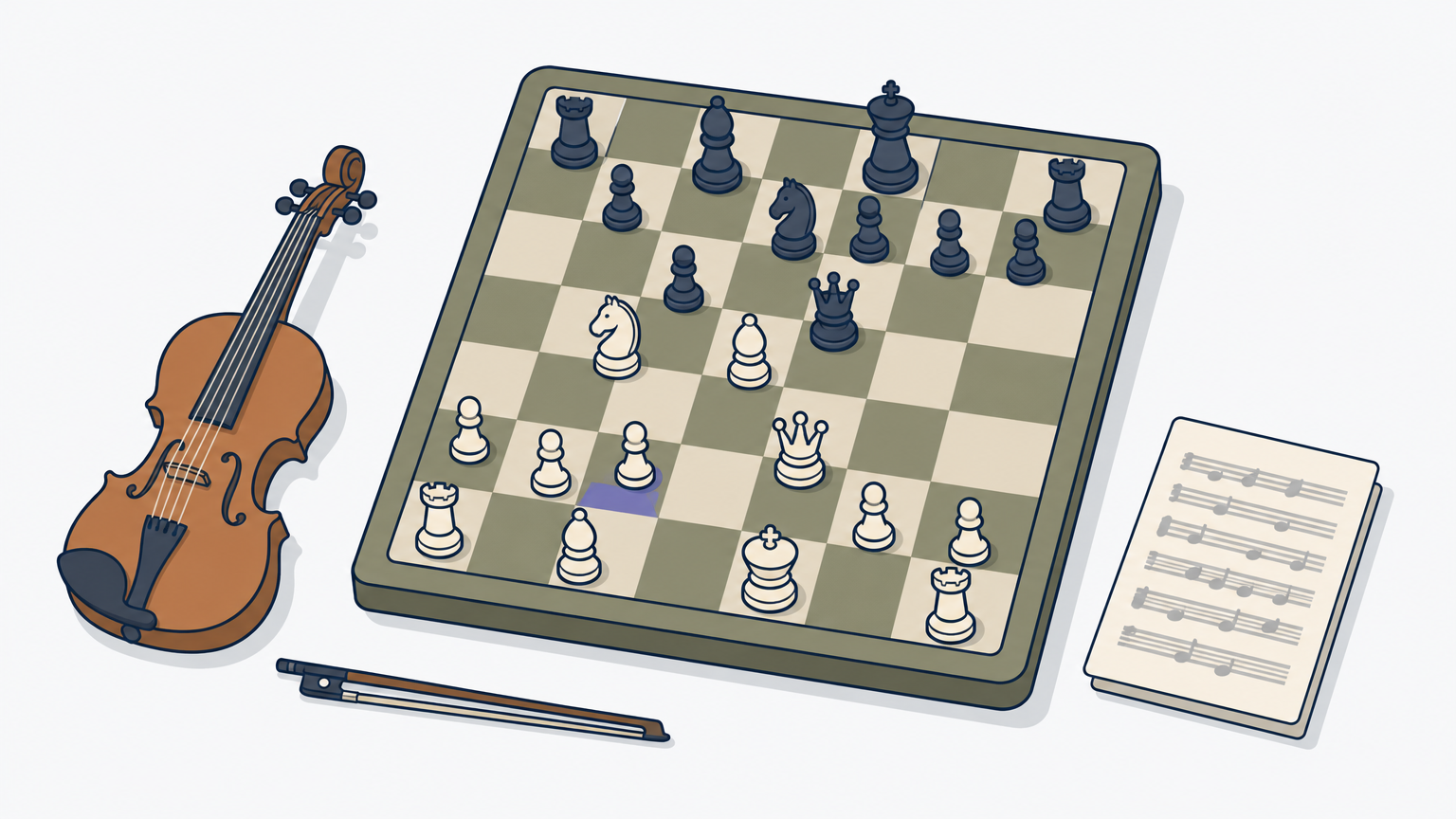
A mental representation is your internal picture of what a good performance looks like. It lets you notice errors as they happen. Chess masters see patterns in a position at a glance, and experienced musicians hear the sound they are aiming for before they make it. Ericsson calls building these representations the main purpose of deliberate practice.
He also explains plateaus. Once a skill feels "good enough" and runs on autopilot, more repetition stops helping. Progress resumes only when you push into uncomfortable territory.
Two practical warnings follow. Real practice is mentally tiring and rarely fun. Even elite performers manage only about four or five hours a day, split into sessions with rest between them.
Practice only improves you when it is aimed at a target just past your current ability.
How to apply the book's ideas to your own routine
You apply Peak by giving every session a clear target, a feedback source, and a limit on length. The steps below stay at the level of structure, because what to work on is your teacher's call.
Six habits drawn from the book
- Define the target. Each item should be small enough to judge as done or not done.
- Arrange feedback. Use a teacher, a recording, or an honest self-rating.
- Keep sessions short. Stay near one hour of full focus, then rest.
- Stay just past comfortable. When progress stalls, change something rather than repeating more.
- Track results. Write down what happened so you can see the trend.
- Return to older material. Peak says little about when to revisit what you have learned. Here spaced repetition fills the gap.
A worked example with scheduled review
Say you keep six practice items in one project, with each item a card. On a given day, three cards are due. At 15 minutes each, your session is 45 minutes, well inside the one-hour limit.

After each card, you rate how it went: Again, Hard, Good, or Easy. In an SM-2-style scheduler like the one MemoRep uses, a weak rating brings the card back soon, and a strong rating pushes it further out. You never have to decide what to practice next.
What each card says, meaning how to approach the material, still comes from your teacher. MemoRep handles the "what and when." It does not instruct on the "how."
Peak tells you how good practice feels; a schedule makes sure you actually do it at the right time.
What reviews and critics say about Peak
Readers mostly praise Peak's clarity and its empowering message, while researchers question how much of performance practice alone explains. Both views are worth knowing before you buy.
What readers praise
Reviewers consistently call the book empowering, because it removes "I don't have the talent" as an excuse. They like the chapter on applying the principles in everyday life. Many also appreciate that it explains why a hobby can stay flat for years.
Where critics push back
A 2014 meta-analysis by Macnamara, Hambrick, and Oswald found that deliberate practice explained a meaningful but limited share of performance differences, and that share varied by field.
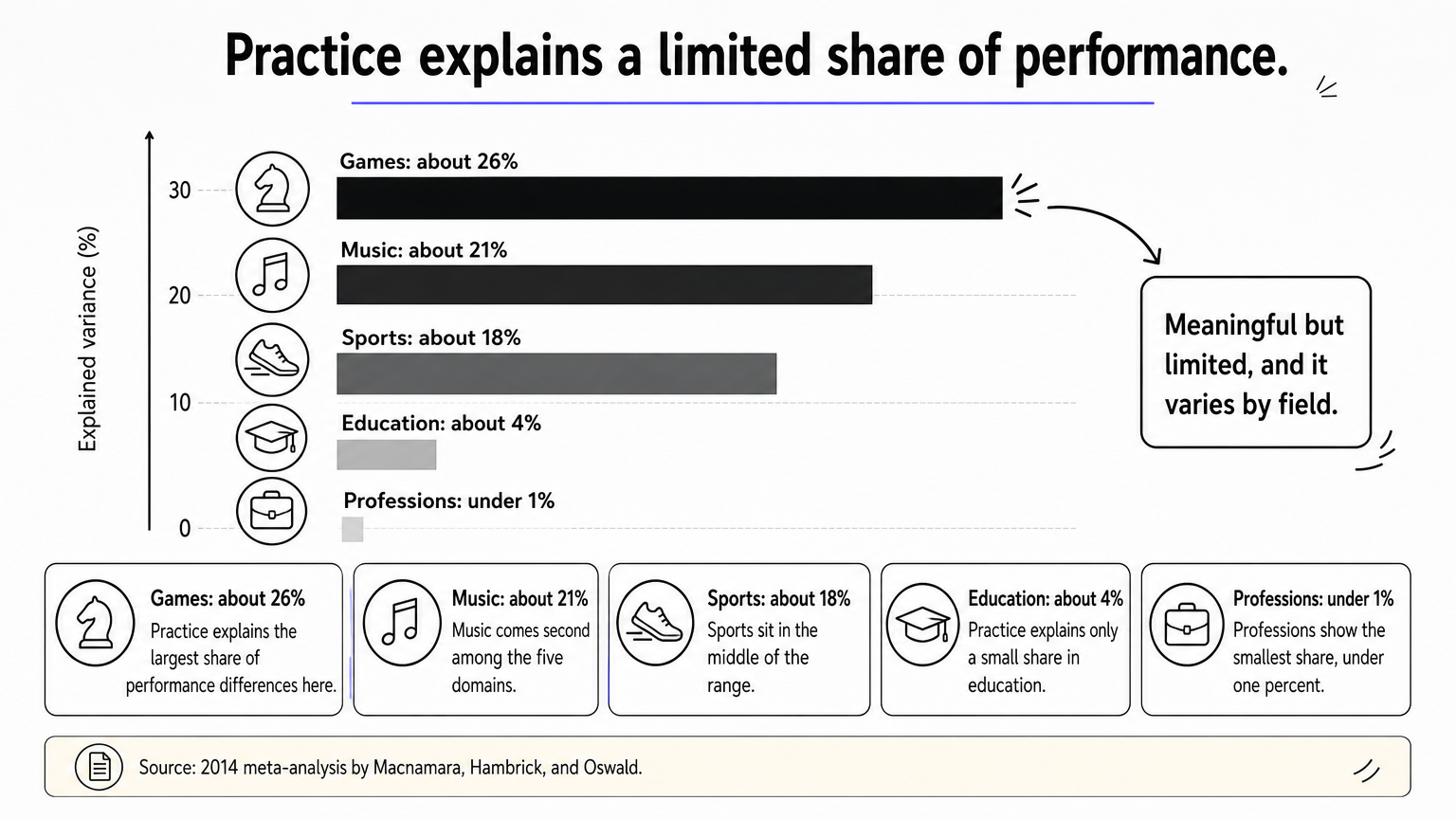
| Domain | Variance explained by practice |
|---|---|
| Games | about 26% |
| Music | about 21% |
| Sports | about 18% |
| Education | about 4% |
| Professions | under 1% |
Ericsson and Harwell answered in 2019 that many studies in such analyses count any practice, not deliberate practice as originally defined. Other complaints are about the book itself. It is aimed at general readers, leans on stories, and repeats its main idea. It also fits best where training methods are established, and it is less clear for fields without them.
The strongest criticism is not that practice is unimportant, but that it is not the whole story.
Should you read or buy Peak?
Read Peak if you practice a skill regularly and want to understand why some practice works and some does not. Skip it if you want instrument-specific drills, because it is a book about principles, not methods.
Who gets the most from it
Musicians, athletes, students, and teachers benefit most, as do parents who guide a child's practice. The book gives you vocabulary for conversations with a teacher. If you already know the three practice types and the mental representation idea, a summary may be enough, though it will lack the evidence.
Formats and alternatives
Peak is sold in paperback and e-book. Your local library probably lends it as well. For the original science, look up Ericsson's 1993 paper "The Role of Deliberate Practice in the Acquisition of Expert Performance" in Psychological Review. For a business angle, Geoff Colvin's Talent Is Overrated covers similar ground. For the best book on deliberate practice, Peak is still the primary source, since the researcher who named the concept wrote it.
Peak is the source text; everything else on deliberate practice is commentary on it.
The short answer on Peak
Peak is worth reading for its central message: improvement comes from how you practice, not from talent or hours alone. Its three-level model, its focus on mental representations, and its warnings about plateaus and effort hold up well. Critics are right that practice does not explain everything, and the book is more about principles than methods.
Good practice also needs good timing. You need to return to skills before they fade, without spending your energy deciding what is next. If you want that part handled for you, see how MemoRep schedules your practice.