
Beginner Electric Guitar Practice Routine in 30 Minutes
The best beginner electric guitar practice routine is a 30-minute session split into four timed blocks: warm-up, chords, scales, and songs. Do it five or six days a week. If you only have 15 minutes, shrink every block. If you have 45, stretch them. Take your material from your teacher or course, set a timer, and let your own ratings decide what comes back tomorrow.
Most beginners fail at structure, not effort. You sit down, play what you already know, skip the exercise that feels awkward, and run out of time before you touch the new song. A month later the chord change you learned in week one is rusty again. Deciding what to practice every day burns energy before you play a note, and many beginners quit during that stretch.
This guide gives you a four-step system to fix that. You will sort your material into blocks, set the clock, rate each item so a schedule can rotate it, and review once a week. MemoRep is a practice scheduler, so we cover the organizing side only. We never tell you how to play or what to learn next, because that is your teacher's job.
Why a timed routine works and what you need first
A timed routine works because it removes the daily decision and gives equal attention to the items you would otherwise avoid. It also brings old material back before you forget it. You need four things before you start: material from a teacher or course, a timer, a tuned guitar ready to plug in, and a place to log your sessions.
What a timed routine fixes
Free practice drifts toward comfort. You replay the song you like, and the shape that gives you trouble gets two minutes at the end of the night, if it gets any. A fixed time per block makes the hard items show up every session, whether you feel like them or not.
Forgetting is the second problem. The Ebbinghaus forgetting curve describes how quickly memory fades without review, and practical skills fade the same way. A chord change that felt solid on Thursday can feel clumsy the next Wednesday. A routine that revisits older items on a planned schedule stops that slide, and that is the idea behind the spaced repetition approach used later in this guide.
What you need before step 1
You do not need much gear or software. Check that you have each of these:
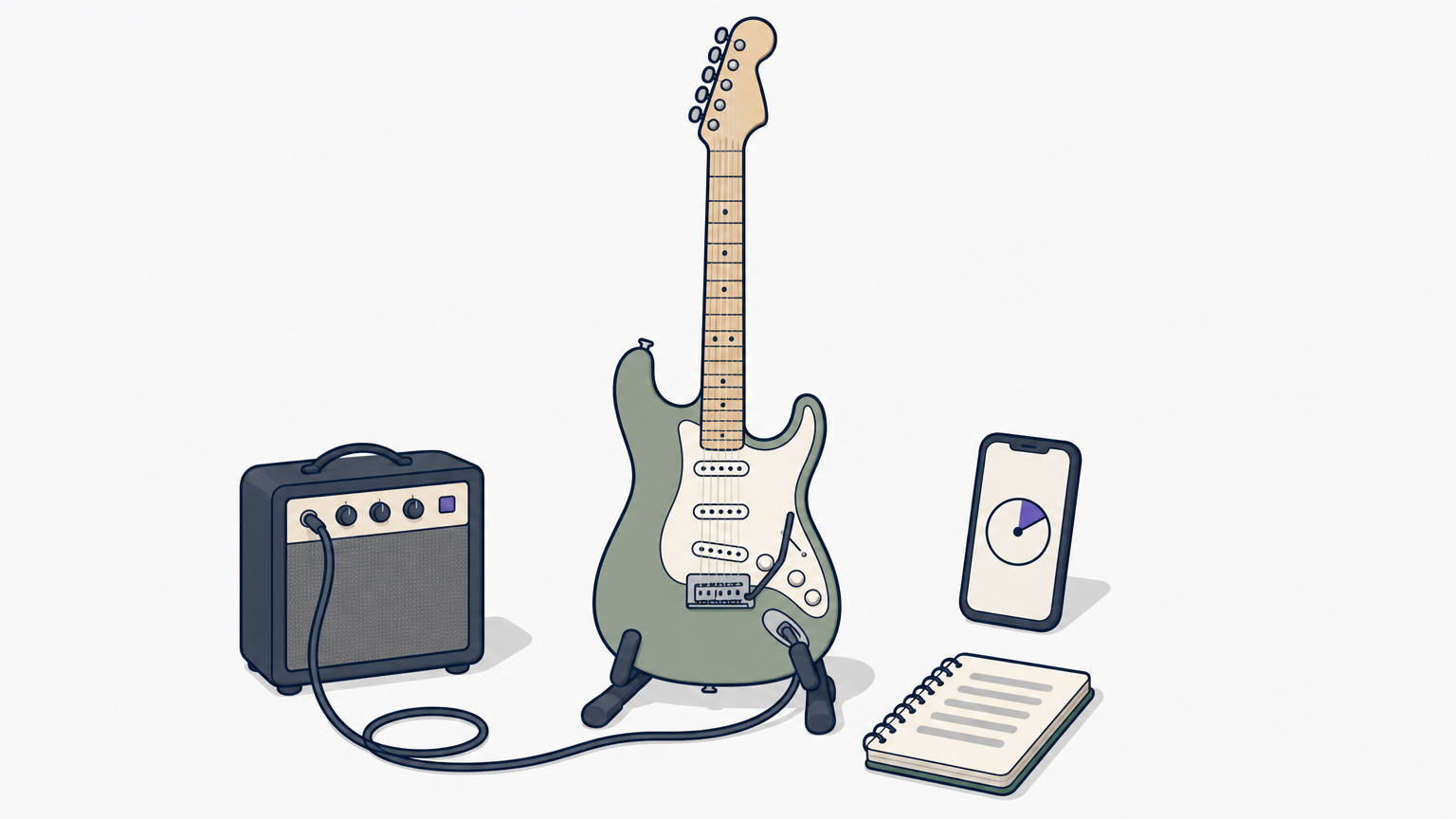
- An electric guitar that stays in tune, plus an amp or headphone setup you can switch on in under a minute.
- A source of material: a teacher, an online course, or a method book that tells you what to learn.
- A timer on your phone, set to loop through blocks.
- A log, either a notebook or an app, to record what you practiced and how it went.
Setup time matters more than it seems. If plugging in and tuning takes ten minutes, you will skip sessions on busy days. Keep the guitar on a stand, the cable attached, and the amp within reach.
What this routine does and does not cover
This is a schedule, not a lesson. It tells you how long to spend on each block and when to revisit each item. It does not tell you which chords to learn, how to hold the pick, or how to play a scale. Your teacher or course answers those questions, and this routine organizes the answers into a week you can follow.
A routine does not teach you what to play. It makes sure that whatever you were taught actually gets practiced.
Step 1. Split your material into four blocks
Sort everything you are currently learning into four blocks: warm-up, chords, scales and single-note work, and songs. Then break each block into small cards, where one card is one item you can finish in a few minutes. That list becomes the menu your daily sessions pull from.
Choose the four blocks
Every block has a different job in the session, and each one draws on a different part of your lessons.
| Block | What goes in it | Where the content comes from |
|---|---|---|
| Warm-up | Easy material you already play comfortably, plus tuning | Your own repertoire, or what your teacher recommends |
| Chords | Chord shapes and chord changes from your current lessons | Your teacher or course |
| Scales and single-note work | Scale patterns, riffs, and picking exercises you were assigned | Your teacher or course |
| Songs | Pieces you are learning, taken a section at a time | Your teacher, course, or songs you chose together |
If you do not have a teacher yet, a structured beginner course can fill the same role. The point is that someone other than you decides the content, so the routine only has to decide the schedule.
Turn each item into a practice card
A practice card is a small, named item with a clear way to know it went well. Name it by what it is and where it came from. For example: "Chord change pair from this week's lesson," "Scale pattern my teacher assigned on Tuesday," or "Chorus of the song I'm learning." A good card fits inside one block without crowding out the others.
Start with 8 to 12 cards across all four blocks. More than that and you recreate the problem you are trying to escape, because a long list means you spend the first five minutes picking again. Songs deserve at least two or three cards from day one. Playing real music is what keeps a beginner showing up in week six.
In MemoRep you create these cards inside a project, such as "Beginner electric guitar," so everything lives in one place. A notebook works too. The system matters more than the tool.
Small, named cards beat vague goals. "Work on chords" cannot be finished. "Chord change pair from Tuesday's lesson" can.
Step 2. Set the clock for a 30-minute session
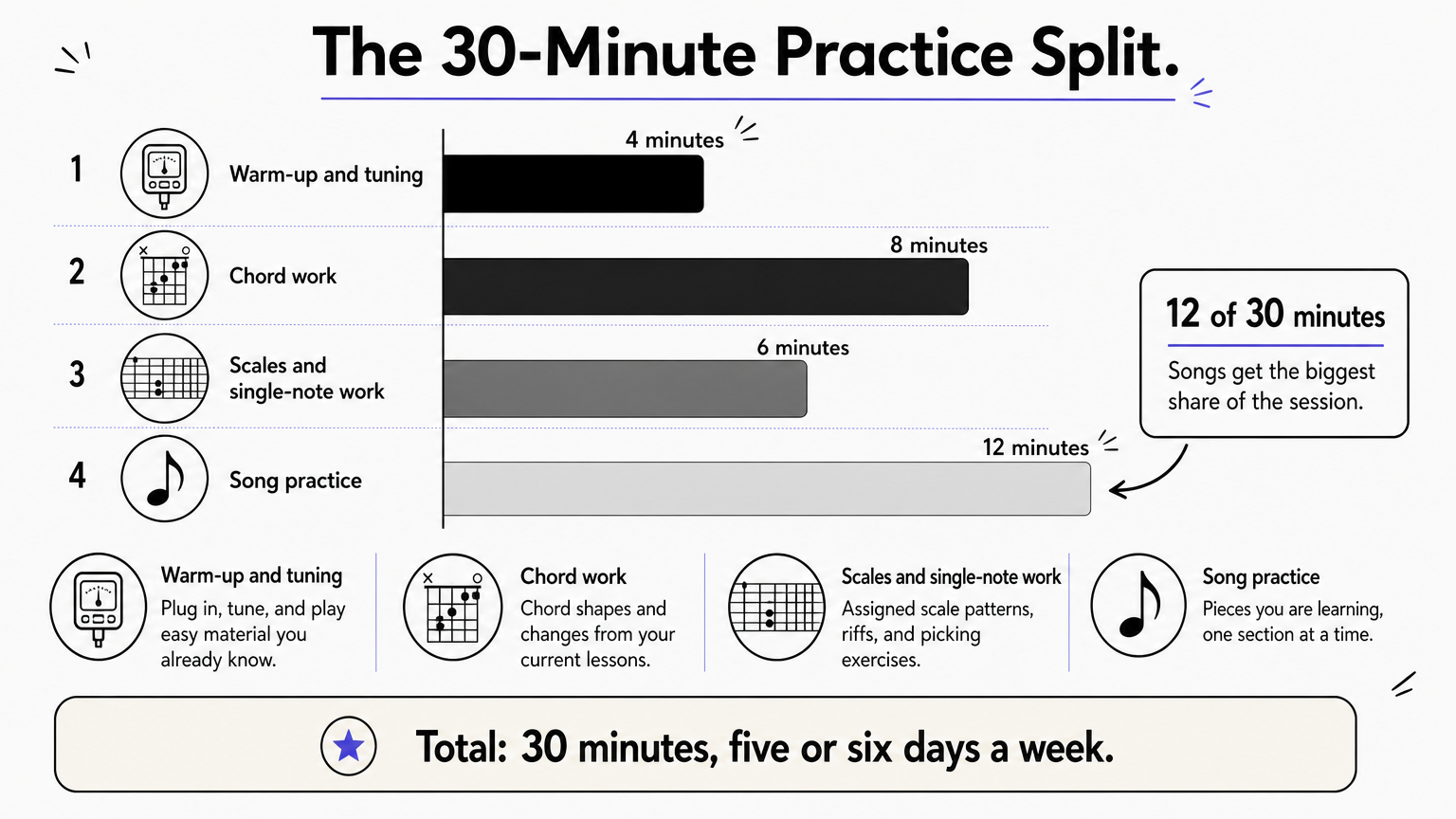
A 30-minute beginner electric guitar practice routine splits as 4 minutes of warm-up, 8 on chords, 6 on scales, and 12 on songs. Run it five or six days a week. Shorter and longer versions use the same proportions, so you can scale the plan up or down without redesigning it.
The timed split
Use this table to pick the session that fits your day. Setup, meaning plugging in and tuning, sits inside the warm-up block.
| Block | 15 minutes | 30 minutes | 45 minutes |
|---|---|---|---|
| Warm-up and tuning | 3 | 4 | 5 |
| Chords | 4 | 8 | 11 |
| Scales and single-note work | 3 | 6 | 9 |
| Songs | 5 | 12 | 20 |
| Total | 15 | 30 | 45 |
Songs get the biggest share on purpose, roughly a third to 45 percent of the session. Chords and scales exist so the songs get better, and the song block is where you check that they did. If your teacher wants a different balance, follow your teacher.
How many days a week
Aim for five or six days a week with at least one real rest day. Frequent short sessions beat one long weekend session because you return to each item more often. Here is the math for a typical beginner. Thirty minutes, five days a week, is 150 minutes a week. Over four weeks that is 10 hours of focused practice. One 150-minute session per week gives the same total, but each card would be touched once instead of five times.
If you hit a wall of fatigue or soreness, rest. Pain is a reason to stop and ask your teacher, not a reason to push through.
Run the timer, not your mood
Set the timer to loop four intervals and move to the next block when it rings, even if the current one feels unfinished. That is a feature. Unfinished items get rated honestly in step 3, and the schedule brings them back soon. Without the bell, the first block expands and the song block, the one you came to play, gets squeezed to nothing.
When the timer rings, move on. Unfinished work is information, not failure.
Step 3. Rate each card and let the schedule rotate
After each card, rate it Again, Hard, Good, or Easy, and let a spaced repetition schedule decide when it returns. This turns your guitar practice routine as a beginner into a rotation that revisits weak items soon and strong items later. You stop choosing and start following.
Rate every card honestly
The rating takes two seconds. It records how the card felt right now, not how you hope it will feel.
| Rating | What it means | What the schedule does |
|---|---|---|
| Again | It fell apart or you could not do it | Brings the card back very soon |
| Hard | You got through it, but only with effort | Brings it back sooner than normal |
| Good | It went as planned | Spaces it out a normal distance |
| Easy | It took almost no effort | Spaces it out much further |
Be harsh. An inflated rating pushes a shaky item far into the future, and you meet it again after you have forgotten it. If you are unsure between two ratings, pick the lower one.
Why spacing beats repeating
Spaced repetition places each review just before you would forget the item. The SM-2 algorithm, which MemoRep builds on, shows the pattern. In the classic version a card you pass is reviewed after 1 day, then 6 days, then each gap is multiplied by an ease factor, often around 2.5. That gives gaps of roughly 1, 6, 15, and 38 days. A card you rate Again drops back to a short gap and starts climbing again.
Treat those numbers as an illustration, not a promise about your own schedule. MemoRep adjusts each card to how you experience it, so your intervals follow your ratings. The practical effect is that settled items take almost no time, which frees minutes for the shaky ones.
Let the schedule pick what's due
Each day you open your session and work through the cards that are due, in whatever block they belong to. If more cards are due than your block time allows, do the Again and Hard ones first and let the rest wait a day. This is also the honest version of the 80/20 idea. A small share of your cards causes most of your trouble, and the rating system keeps pulling that share to the front.
Daily reminders help here, since a missed session is the main thing that breaks the chain. MemoRep sends daily practice notifications, but a phone alarm at a fixed time does the same job.
Rate honestly and let the schedule choose. The cards you dread are the ones that need the most reps.
Step 4. Review weekly and adjust
Once a week, spend five minutes reviewing your log, retire or add cards with your teacher's input, and trim the plan to your real calendar. This keeps the routine matched to your life and your progress. It also gives you proof that the work is paying off.
Run a five-minute weekly review
Pick the same day each week and answer these questions in your log:
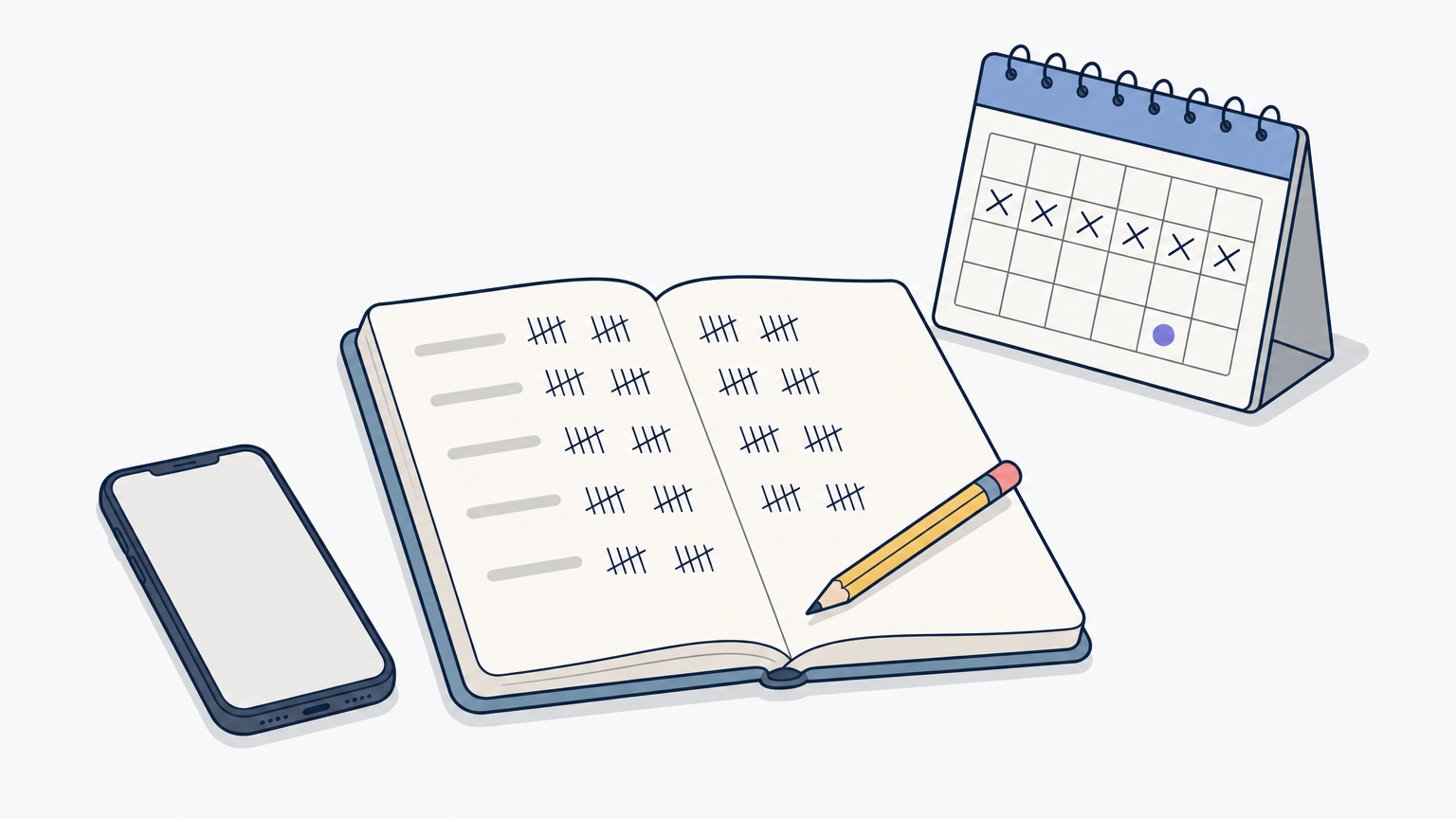
- How many sessions did I complete, out of how many I planned?
- Which cards got an Again rating more than once?
- Which block always runs short or feels too long?
- Which cards have been Easy for several reviews in a row?
Progress tracking makes the answers visible. In MemoRep you can see your history on screen, and in a notebook a simple tally of sessions per week works. Seeing four weeks of consistent sessions is surprisingly motivating, especially during a week where playing felt stuck.
Bring the results to your teacher
Cards that keep landing on Again are your list of questions for your next lesson. Cards that stay Easy are a signal that you may be ready for something new. In both cases, your teacher decides what comes next, not the schedule and not you. Add new cards slowly, one or two at a time, and only after older cards settle. Otherwise the due list balloons and the session turns into a scramble.
Handle short days and missed days
Some days you will have ten minutes. On those days, skip the full split and play only what is due: one chord card, one song card, and a short warm-up. Do not try to make up a missed day by doubling the next one. Just resume the schedule. If you miss several days, the cards will come back due, and a few Again ratings are a normal price for time away.
A short session on a bad day keeps the habit alive. A missed week costs far more than a ten-minute one.
Start your first week tonight
A beginner electric guitar practice routine works when it is simple enough to repeat: four timed blocks, a short list of small cards, a rating after each one, and a weekly check. You do not need more time. You need a plan that decides for you, so the minutes you have go to the right items.
Set up your cards tonight, pick the 15, 30, or 45-minute split, and run your first session tomorrow. If you want the scheduling handled for you, try MemoRep and claim the limited-time free-for-life subscription. It turns your list of songs, exercises, and techniques into a daily practice queue, so all you have to do is plug in and play.