How to Practice Guitar Chord Changes: 4 Steps That Stick
The best way to approach how to practice guitar chord changes is to treat each change as its own small drill. Pick two to four chord pairs from songs you want to play, give each one a clear pass mark, and practice them in short sessions. Rate how each pair went, then let a spaced schedule decide when it comes back. Short, repeated, spaced visits beat one long grind.
Most beginners do the opposite. You loop G to C for twenty minutes, feel better, and then skip it for four days. When you return, the change feels rusty again. You also spend part of every session just deciding what to work on. That forgetting between sessions and that decision fatigue are why chord changes feel slow, not a lack of talent.
This guide gives you a four-step routine that fixes both. It covers the structure around your practice: what to pick, how to define success, how to run a session, and when to review. It does not cover finger technique, because how your hands should move is a question for your teacher. We built MemoRep around this scheduling side of practice, so each step shows how it works in the app. You can also run the same routine with pen and paper.
Why chord change practice needs a plan
Chord changes improve fastest when you practice a few specific pairs in short sessions and revisit them on a spaced schedule. Looping one change until your hand tires does not do the same job. The plan matters more than the minutes.
What goes wrong with random practice
Repeating one change many times in a single sitting feels productive, because the last few reps are smoother than the first. But that smoothness is short-term. The Ebbinghaus forgetting curve describes how memory of a new skill fades quickly after practice unless you revisit it. Three days later, the progress you felt is partly gone.
Random practice has a second cost. You naturally return to the pairs you like and skip the ones that frustrate you. The hard changes get the least attention, which is backwards. A plan removes that bias because the schedule, not your mood, picks what comes next.
Forgetting between sessions, not lack of effort, is what makes chord changes feel stuck.
What this routine covers
The routine has four steps, and each one has a single job:
- Pick a short list of chord pairs from real songs.
- Turn each pair into a practice card with a pass mark.
- Run a short session and rate every card.
- Let the schedule bring each pair back at the right time.
Everything here is about organizing practice. If a change feels physically awkward, bring that to your teacher and add whatever they say as a note on the card. You will still use this routine to decide when to practice it.
Step 1. Pick your chord pairs
Choose two to four chord pairs that appear in a song you actually want to play, ideally from your teacher's assignment or songbook. Practicing changes you will use makes the work feel relevant, and you will notice progress when you play the song.
Pull pairs from your repertoire
A chord change is a move from one chord to another, so each direction is its own item. G to C and C to G are two different changes, and one is often harder for you than the other. Write them as separate entries.
Take your song and list its changes in order. If the verse goes G, C, D, Em and then loops back, you get four changes. If your song has only two chords, that is fine. You have two cards, and you can start right away.
Cap your active list
Keep no more than four pairs active at once. More than that, and you are back to deciding what to practice instead of practicing. Extra pairs wait in a backlog until a current card settles down.
| Song section | Changes you find | Active cards |
|---|---|---|
| Verse: G, C, D, Em | G to C, C to D, D to Em, Em to G | Start with the first three |
| Chorus: C, G, Am, D | C to G, G to Am, Am to D | Add one when a current card is solid |
For a worked example, say you pick the verse above. You start with G to C, C to D, and D to Em. Em to G waits in the backlog. That is three cards, which fits easily into a ten-minute session.
Four active pairs is plenty, and fewer is often better at the start.
Step 2. Turn each pair into a practice card
A practice card is one chord change plus a pass mark you can check. Without a pass mark, "practice G to C" has no finish line, and you cannot rate it honestly later.
Write a pass mark you can verify
A good pass mark is a number. For example, "8 changes in a row without a pause" or "12 clean changes in one minute." Choose a count you can reach in a few attempts, so the card feels winnable. Define "clean" yourself, or ask your teacher what counts as clean for your level.
Also note the tempo you used. A metronome setting gives you a fixed reference, so a Good rating this week means the same thing as next week. When you raise the tempo, change the card, so your history stays comparable.
Use a simple card template
Whether you use MemoRep or a notebook, keep each card the same shape:
Card: G to C
Pass mark: 8 changes in a row, no pause
Tempo: 60 bpm (or the tempo your teacher sets)
Time cap: 2 minutes
Teacher note: (anything your teacher tells you to watch for)
The time cap matters. It stops one stubborn card from eating the whole session. In MemoRep you create these cards inside a project, for example one project per song, and the app handles the scheduling from there.
A card without a pass mark is just a wish, so give every pair a number.
Step 3. Run a short session and rate it
Run each due card for its time cap, compare the result to the pass mark, and then rate it Again, Hard, Good, or Easy. The system adjusts to how each practice card feels for you, so your rating shapes what follows.
Rate each card honestly
Use the same meaning every time. This is the scale that MemoRep uses, with what each rating should mean for a chord change:
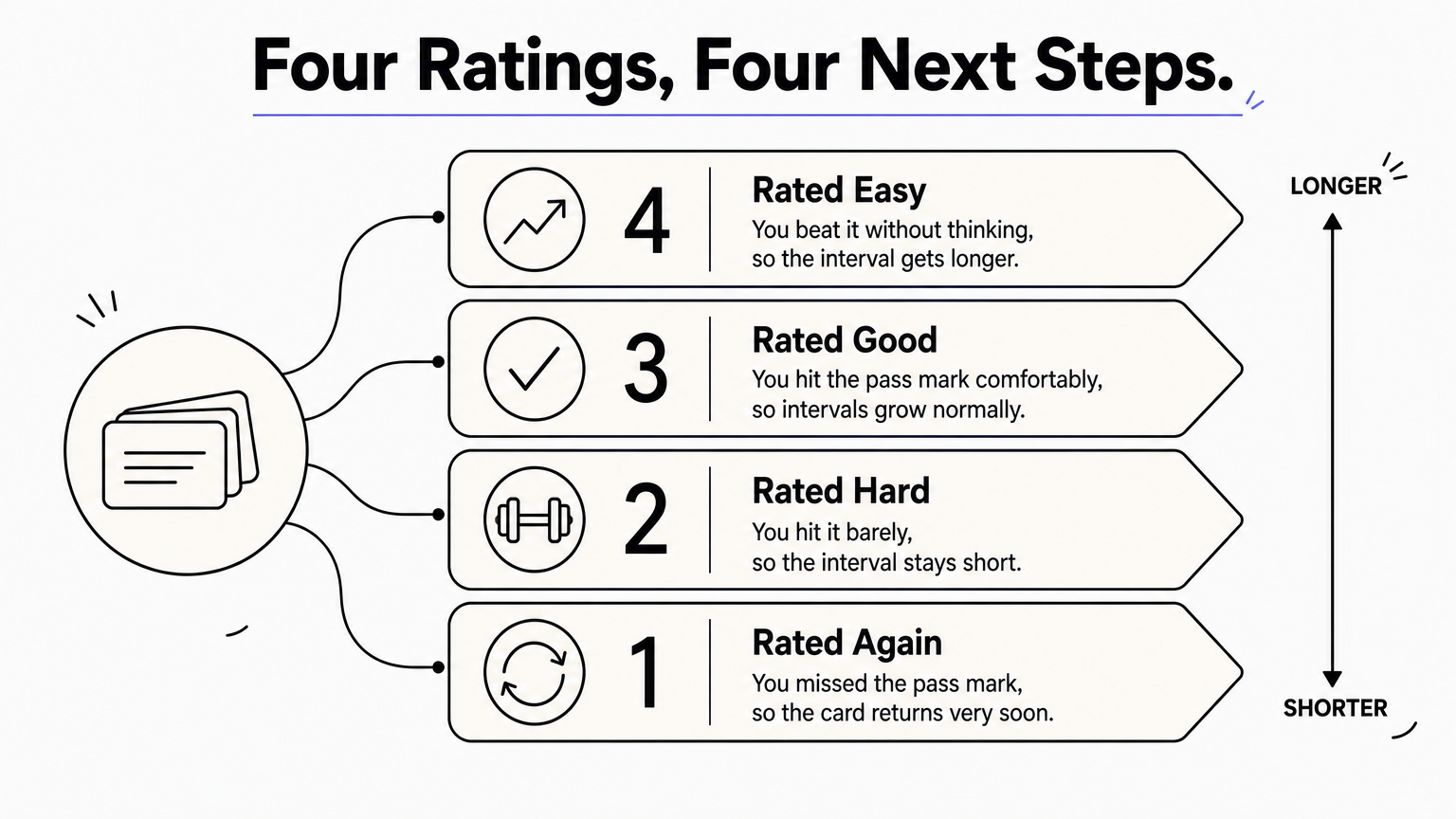
| Rating | What it means | What happens next |
|---|---|---|
| Again | You missed the pass mark | Card returns very soon |
| Hard | You hit it, but barely or with effort | Short interval, shorter growth |
| Good | You hit the pass mark comfortably | Normal interval growth |
| Easy | You beat it without thinking | Longer interval |
The common mistake is rating Good out of optimism. If you needed three tries to hit your pass mark, that is Hard. An inflated rating pushes the next review too far away, and the pair is rusty when it comes back.
A worked ten-minute session
Say three cards are due: G to C, C to D, and D to Em. Give each about three minutes, leaving a minute to rate and set up.
- G to C: you hit 8 in a row on the second try. Rate it Good.
- C to D: you hit it only once, after several misses. Rate it Hard.
- D to Em: you never reach 8 before the time cap. Rate it Again.
You are done in ten minutes with no decisions left to make. Tomorrow, the app shows you the cards it considers due, and you do not have to think about the list.
Your rating is the data the schedule runs on, so rate what happened and not what you hoped for.
Step 4. Let the schedule bring each pair back
Each pair should return just as it starts to fade, with short gaps for cards you struggled with and longer gaps for cards you have nailed. This is the job of spaced repetition, and it is why you stop deciding what to practice.
Trust the interval
The classic SM-2 algorithm, which MemoRep builds on, starts with a gap of about 1 day after a successful review, then about 6 days. After that, gaps stretch by a multiplier of roughly 2.5 for a card that keeps going well. A card rated Again drops back to short gaps. MemoRep adapts to your ratings, so your exact dates will differ from this classic pattern.
| Review | Rating | Approximate next review |
|---|---|---|
| Monday, first pass | Good | Tuesday (1 day) |
| Tuesday | Good | The following Monday (6 days) |
| That Monday | Good | About 15 days later |
| Any later review | Again | Back to a short gap |
This is why you can add new material without losing old progress. A solid G to C visits you every couple of weeks while your hard pairs get daily attention. Most of your minutes go to the cards that need them, in the spirit of the 80/20 rule: put the bulk of your time where you are weakest.
Add new pairs and retire solid ones
Look at your cards once a week. When a card has earned several Good or Easy ratings in a row, its gaps are long, and it takes almost no session time. That frees a slot, so pull the next pair from your backlog or from the song you are moving to.
Do not delete finished cards. Leaving them in the schedule means they come back occasionally, which is the cheapest insurance against a pair going rusty. Daily practice notifications help you keep the habit, since the routine only works if you show up for the short sessions.
A pair you have mastered should cost you almost no practice time, and the schedule makes that happen.
Start with three cards
Chord changes get smoother when you practice them in small, spaced doses. Pick a few pairs from a real song, give each a pass mark, rate every session honestly, and let the schedule decide when each pair returns. Technique questions belong with your teacher. The structure around them is what this routine handles.
You do not need a perfect setup to begin. Write three cards today, run a ten-minute session, and rate each one. If you would rather not track intervals by hand, try MemoRep and set up your first chord change cards. The app does the scheduling and sends the reminder, so you can spend your practice time playing.