Daily Guitar Practice Routine for Intermediate Players
You can already play chords, a few scales, and a handful of songs. Now progress has slowed. Most intermediate players don't lack effort, they lack structure. You sit down, noodle through what feels comfortable, and leave wondering if the hour did anything. A solid guitar practice routine for intermediate players fixes that by deciding in advance what you work on and for how long.
Here is the short answer. A good daily session runs 30 to 60 minutes and splits into four blocks: a brief warm-up, focused technique work, scales or fretboard drills, and time on repertoire. Keep each block timed, and rotate what goes inside it so nothing gets ignored for weeks. Consistency beats session length every time.
Below, you'll get a ready-to-use time split for 30, 45, and 60 minute sessions, plus ways to rotate material through the week. We'll also cover how to track what you've practiced. That last part is where MemoRep fits in, since its spaced repetition scheduling tells you when each exercise or song section is due again, so you spend less time deciding and more time playing.
Why intermediate players need a different routine
A beginner practice routine is simple because everything is new. Learn a chord, play a song, repeat. Almost any practice moves you forward at that stage. Once you pass it, that stops being true, and you now have more material than you can touch in one sitting.

What changes after the beginner stage
Compare the two stages side by side. A guitar practice routine for beginner to intermediate players has to shift from building new skills to maintaining and deepening many skills at once. That changes what a good session looks like.
| Beginner | Intermediate | |
|---|---|---|
| Main goal | Learn the basics | Keep many skills sharp while adding new ones |
| Biggest risk | Quitting early | Plateaus and rusty material |
| Material | A few chords and songs | Scales, songs, drills, and sections that pile up |
| Key decision | Which lesson is next | What to rotate in today |
Where intermediate practice goes wrong
Comfort is the first trap. Without a plan, you drift toward what already sounds good. The songs you like get played ten times, and the shaky ones wait until "later." Your hour feels productive while the weak spots stay exactly where they were.
Forgetting is the second trap. Skills fade on a predictable curve, known as the Ebbinghaus forgetting curve, and the more material you carry, the more of it is fading at any moment. That song you nailed three weeks ago now falls apart in the bridge. Rust is a scheduling problem, not a talent problem.
A skill you don't revisit on schedule is a skill you will eventually relearn from scratch.
What a good routine has to do
An intermediate guitar practice routine needs to do three jobs that a beginner routine never had to. It has to remove the guesswork from each session, and it has to protect time for weak spots instead of favorite material. The jobs look like this:
- Decide in advance what you work on and for how many minutes.
- Rotate content so nothing sits untouched for weeks.
- Bring older material back right before it fades.
The next four steps build exactly that, starting with your goals.
Step 1. Set goals and pick your practice areas
Write goals you can check
Start with one or two goals for the next 4 to 8 weeks. A vague goal can't guide a session, because you never know when you've done it. A useful goal is specific, measurable, and tied to a date. Compare these:
- Vague: "Improve my soloing."
- Better: "Play the solo from my favorite song cleanly at 100 BPM by November 15."
- Vague: "Learn more songs."
- Better: "Play three songs start to finish without stopping by the end of the month."
A goal you can't measure is a wish, and wishes don't fill a practice schedule.
Pick four practice areas
Next, turn those goals into areas. A guitar practice routine for intermediate players works best with four areas, which match the blocks you'll time in Step 2. Write two to four items under each. Keep the list short, because a list of 30 items recreates the overload you're trying to escape.
| Area | Example items |
|---|---|
| Warm-up | Slow chromatic run, easy chord changes |
| Technique | Alternate picking drill, barre chord changes, bends |
| Scales and fretboard | Pentatonic positions, major scale in two keys, note finding on one string |
| Repertoire | Two songs in progress, one song to maintain, one new song |
Finally, give each item its own entry, either in a notebook or as a practice card in MemoRep. One item per card lets you rate and schedule it separately, which is exactly what Step 4 relies on.
Step 2. Divide your time into blocks
Match the blocks to your session length
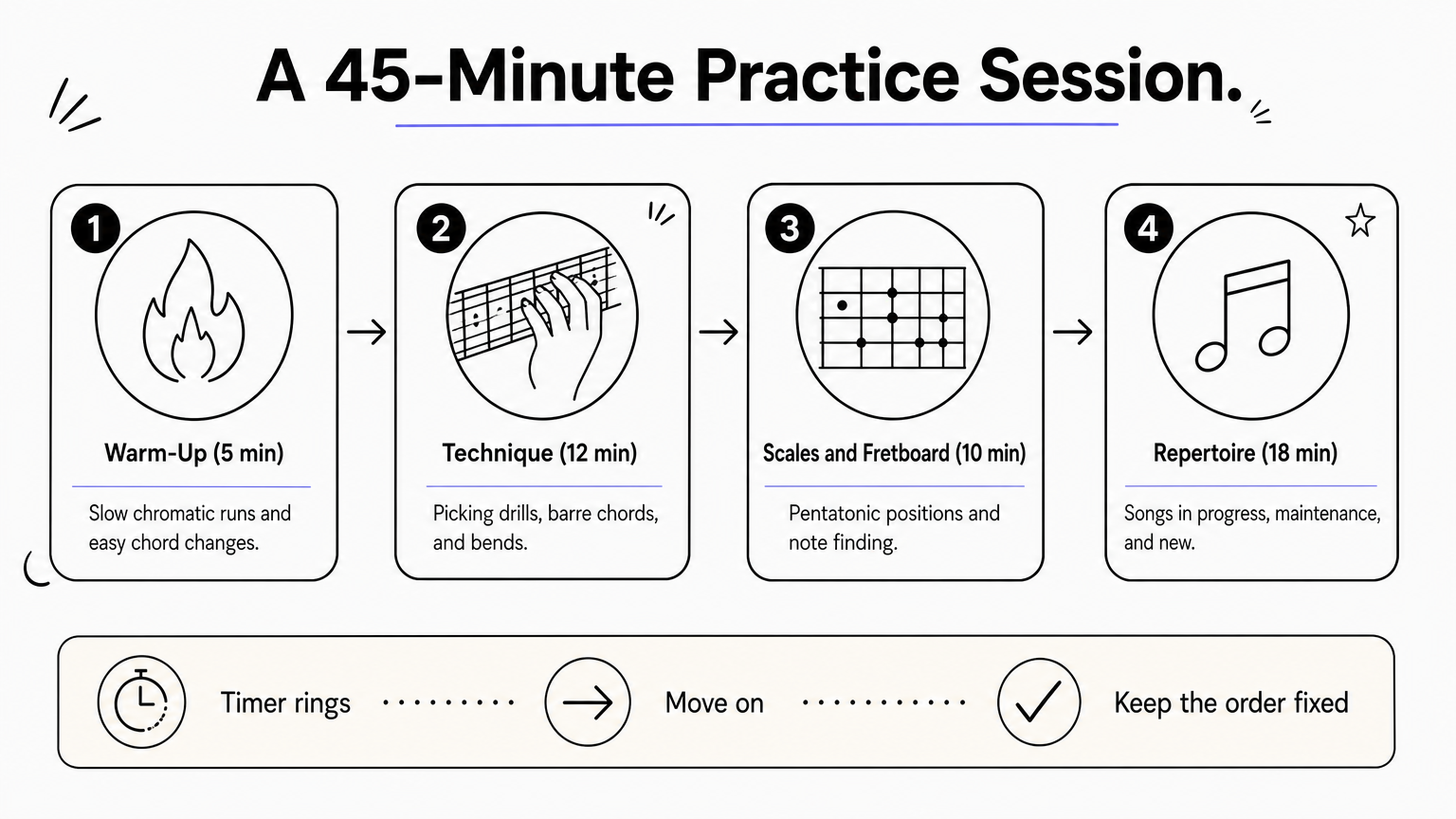
Your four areas from Step 1 now become four timed blocks. Choose the session length you can repeat most days, not the one you wish you had. A 30-minute session you actually play beats a 60-minute plan you skip. Use this split as the starting point for any intermediate guitar practice routine.
| Block | 30 min | 45 min | 60 min |
|---|---|---|---|
| Warm-up | 5 | 5 | 5 |
| Technique | 8 | 12 | 15 |
| Scales and fretboard | 7 | 10 | 15 |
| Repertoire | 10 | 18 | 25 |
Notice that repertoire gets the biggest share. Songs are where all your skills come together, so roughly 40 percent of your time belongs there. The warm-up stays at 5 minutes no matter how long you play.
Run the clock, not your mood
Set a timer for each block. When it rings, move on, even in the middle of an exercise. Stopping on time protects your weak spots, because without a limit the comfortable material expands to fill the hour. Keep the order fixed, warm-up first and repertoire last, so your hands are ready for the hardest playing.
Timed blocks stop your favorite song from eating the whole session.
Leave one minute between blocks to jot down what felt shaky. Those notes cost almost nothing, and they feed directly into the review schedule in Step 4.
Step 3. Choose your daily and rotating content
Split your items into daily and rotating
Not every item earns a place in every session. Sort your cards into two groups. Daily items are the anchors, such as your warm-up and the song you're actively learning. Rotating items take turns across the week, so a daily guitar practice routine for intermediate players stays inside its time limit.
Anchor a few items every day and let everything else take its turn.
Keep the daily group to three items:
- Your 5-minute warm-up
- The main song you're learning
- One shaky spot from yesterday's notes
Sample weekly rotation
Here is a five-day rotation built from the example items in Step 1. Use the weekend as optional review days for anything you marked shaky.
| Day | Technique | Scales and fretboard | Rotating song |
|---|---|---|---|
| Mon | Alternate picking drill | Pentatonic positions | Song in progress |
| Tue | Barre chord changes | Note finding on one string | Maintenance song |
| Wed | Bends | Major scale in two keys | New song |
| Thu | Alternate picking drill | Pentatonic positions | Song in progress |
| Fri | Barre chord changes | Note finding on one string | Maintenance song |
Swap in your own cards, but keep the structure. Because each item appears two or three times a week, nothing sits untouched for long, and you never face the question of what to play next.
Step 4. Track and schedule reviews over time
Rate each item after you play it

A rotation tells you what to play this week. It doesn't tell you what is fading. To fix that, rate every item right after you play it, using the same four-point scale each time. Your shaky-spot notes from Step 2 make the rating easy.
| Rating | What it means | What happens next |
|---|---|---|
| Again | It fell apart | Comes back very soon |
| Hard | You got through it with effort | Short gap |
| Good | Clean, with some focus | Normal gap |
| Easy | Smooth without thinking | Long gap |
Be strict. An inflated rating pushes the next review too far away, and the item rusts before you see it again.
Space reviews as skills hold up
Every "Good" or "Easy" stretches the gap before an item returns. Every "Again" shrinks it. This is spaced repetition, built on the Ebbinghaus forgetting curve and the SuperMemo SM-2 algorithm. The goal is to review each item just before it fades, which costs far less time than relearning it later.
Review a skill as it starts to fade, not after it's gone.
Hand the scheduling to a tool
You can run this in a spreadsheet with a "next due" column. It works, but you'll recalculate dates every day, and that overhead is where most people quit. In MemoRep, your cards live in a project, you tap Again, Hard, Good, or Easy after each one, and the schedule adjusts automatically. Reminders tell you what is due, so your intermediate guitar practice routine builds each session for you.
Putting your routine into practice
Your guitar practice routine for intermediate level comes down to four moves. Set goals you can measure, split the session into timed blocks, rotate daily and weekly content, and rate every item so reviews arrive right before skills fade.
Start small this week. Pick a session length you can repeat, write two to four cards per area, and run the timer for five days in a row. Then adjust. A plan you follow and tweak beats a perfect one that stays on paper.
Once the routine runs, the only chore left is scheduling. If you'd rather not track due dates by hand, see how MemoRep works, get a free-for-life subscription for a limited time, and let it tell you what to play next.