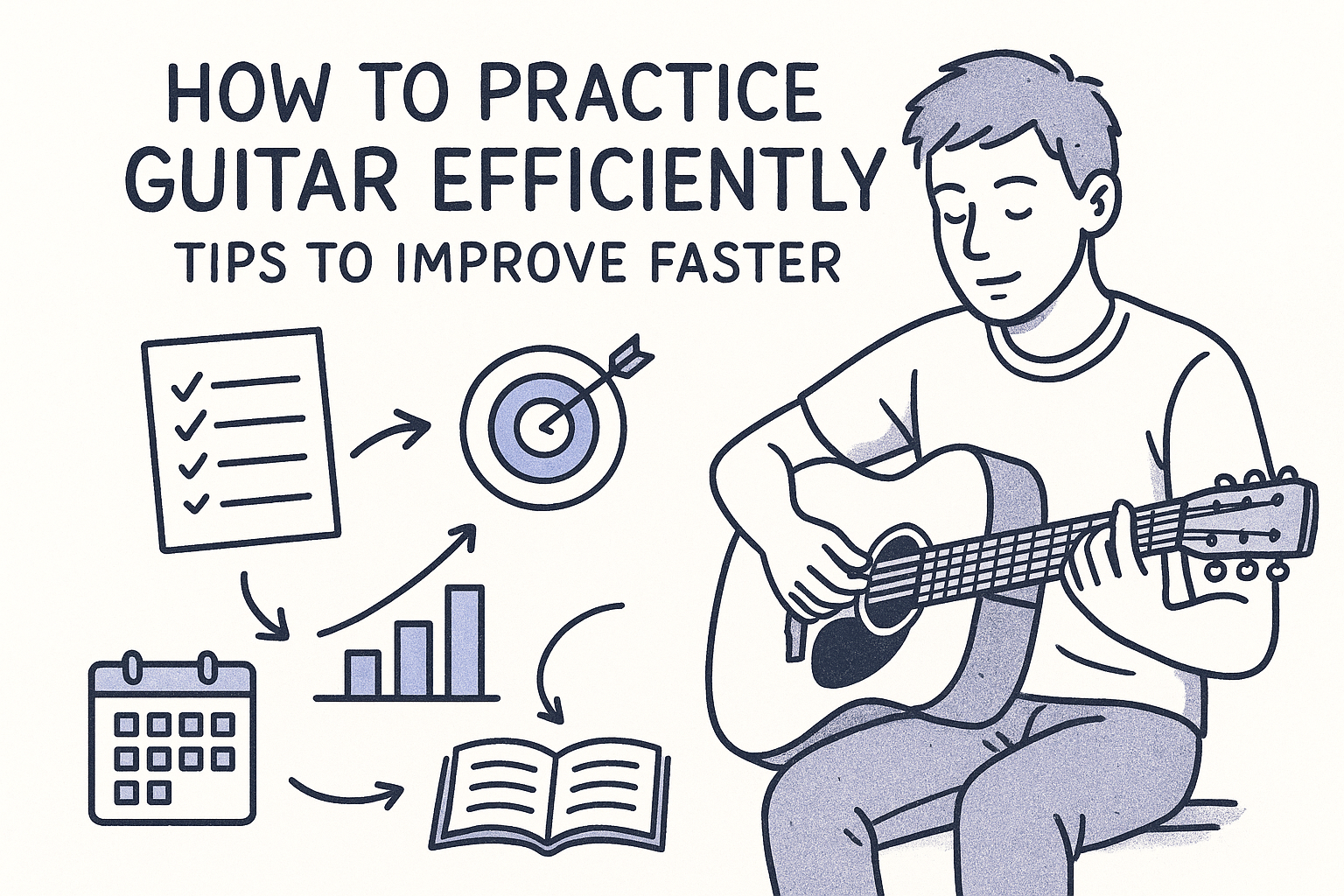
How to Practice Guitar Efficiently: Tips to Improve Faster
You pick up your guitar, run through the same three warm-up licks, noodle on a song you already know, and put it down forty minutes later without much to show for it. That's the trap most players fall into, and it's exactly why learning how to practice guitar efficiently matters more than how many hours you log. Time on the instrument only counts if you're spending it on the right things at the right moments.
Efficient practice comes down to two habits: knowing exactly what needs work today, and revisiting it before it slips away. That means breaking skills into specific drills instead of vague goals like "get better at chords," and using spaced review so old material doesn't rot while you chase new licks. Rating your own progress honestly after each attempt, rather than just repeating a passage until it feels done, is what actually moves the needle.
In this guide, you'll get a practical framework for structuring sessions, prioritizing what to work on, and tracking whether your practice is paying off. We'll cover how to plan session length, how to sequence technique versus repertoire, and how tools built around spaced repetition, like the approach MemoRep uses for musicians, can take the guesswork out of what to practice next.
Why efficient practice beats long practice sessions
Most guitarists assume more time on the instrument automatically means more progress, but that's not how skill actually builds. Attention and specificity matter far more than clock minutes, and a tightly focused twenty-minute session can outperform an unfocused two-hour one. The goal isn't to grind longer, it's to spend every minute on something that actually moves your playing forward.
Diminishing returns after 20-30 minutes
Your brain and hands both fatigue faster than you think, especially when you're repeating the same passage without a clear target. Once fatigue sets in, mistakes get rehearsed just as thoroughly as correct movements, which means you're practicing the wrong version of the lick. Research on skill acquisition backs this up: the National Institutes of Health has published work showing that spaced, attention-heavy practice sessions produce stronger motor learning than marathon sessions, because rest periods let the nervous system consolidate what you just did.
A focused twenty minutes beats a distracted two hours every time.
Quality of attention beats quantity of hours
Playing through a song for the tenth time while thinking about dinner doesn't count as practice, it counts as autopilot. Genuine improvement happens when you're actively listening for specific errors, adjusting in real time, and noticing small wins like a cleaner string change or a faster fret transition. That level of attention is tiring, which is exactly why shorter sessions with real focus outperform long ones where your mind checks out halfway through.
Short focused blocks fit real life
Breaking practice into 15 to 30 minute blocks also solves a scheduling problem most working adults and students face: finding a spare two-hour window most days is unrealistic, but fifteen minutes almost always fits. Shorter sessions are easier to repeat daily, and daily repetition is what actually locks in a skill, not the occasional heroic session before a gig or lesson. Consistency, not duration, is the real lever behind faster improvement.
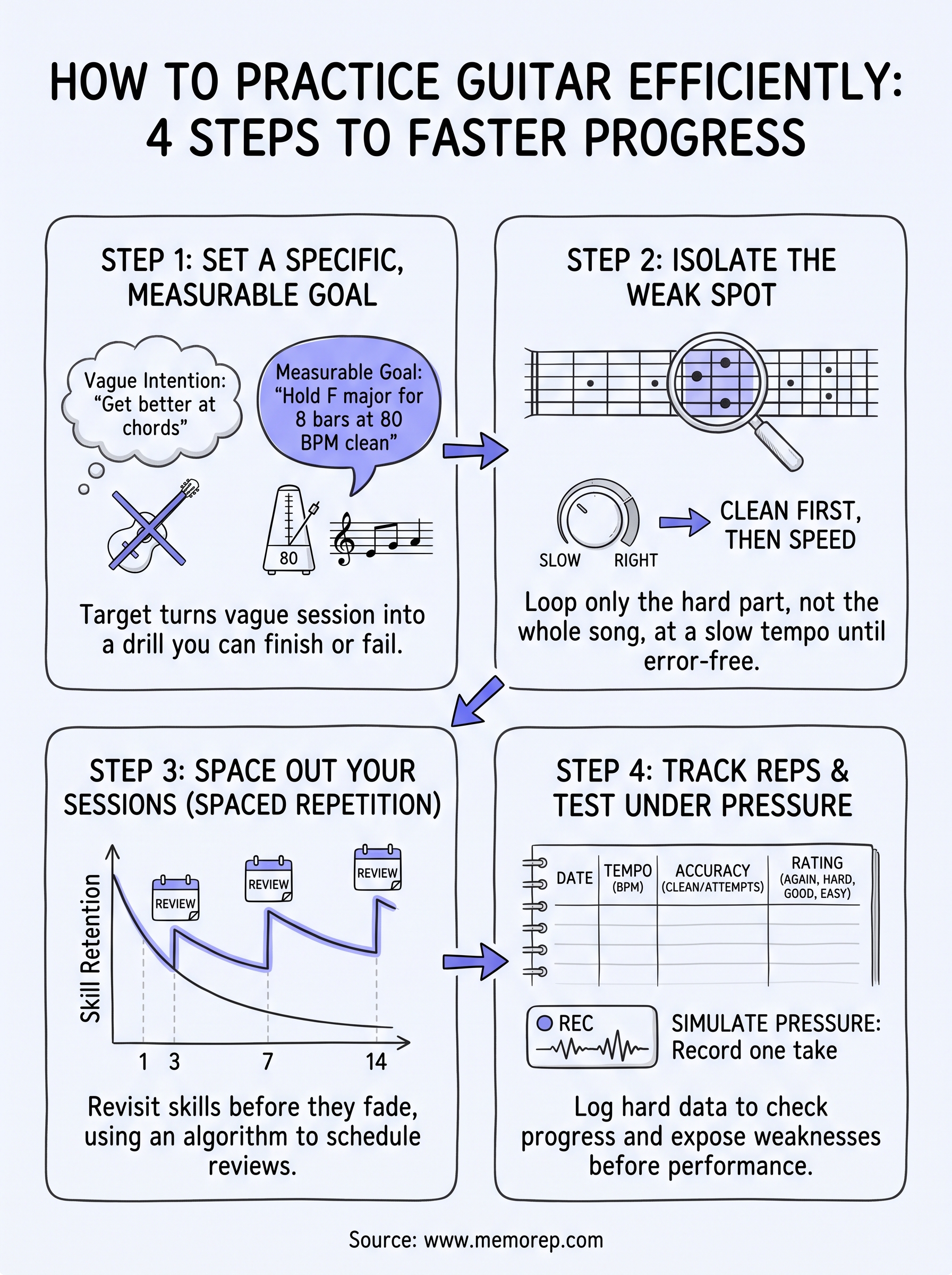
Step 1. Set a specific, measurable goal
Vague intentions like "work on solos" or "get better at rhythm" give your brain nothing to aim at, so you end up noodling instead of practicing. A measurable goal tells you exactly what success looks like today: play the bridge riff at 120 BPM cleanly four times in a row, or switch between three chord shapes without buzzing for a full minute. That kind of target turns a vague session into a specific drill you can actually finish or fail at, which is the whole point.
Turn a vague intention into a target
Writing the goal down before you pick up the guitar forces clarity you won't get by just starting to play. Compare the two approaches:
| Vague goal | Measurable goal |
|---|---|
| Get better at barre chords | Hold F major cleanly for 8 bars at 80 BPM |
| Improve my solo | Play measures 12-16 error-free 3 times at target tempo |
| Practice picking | Alternate pick 16th notes at 100 BPM without missed notes |
If you can't measure it, you can't tell if you improved.
Keep goals small enough to finish in one session
Ambitious goals that need six sessions to complete just create frustration and make it harder to know if today's practice actually worked. Shrinking the target to something you can realistically nail in 15 to 20 minutes gives you a clear pass or fail, and that immediate feedback is what keeps motivation high enough to show up again tomorrow.
Step 2. Isolate the weak spot before the whole piece
Playing a song start to finish feels satisfying, but it wastes time on the eight bars you already nailed and skims past the two bars that keep tripping you up. Isolating the weak spot means you find the exact beat, chord change, or fret transition that breaks down and drill only that, instead of running the whole piece hoping it fixes itself.
Fix the four bars that break, not the whole song that mostly works.
Find the exact bar that breaks down
Play the section slowly and listen for where your timing wobbles, your fretting hand hesitates, or a note buzzes. That's your target. Loop just those two to four bars, not the whole verse, so every repetition is training the actual problem.
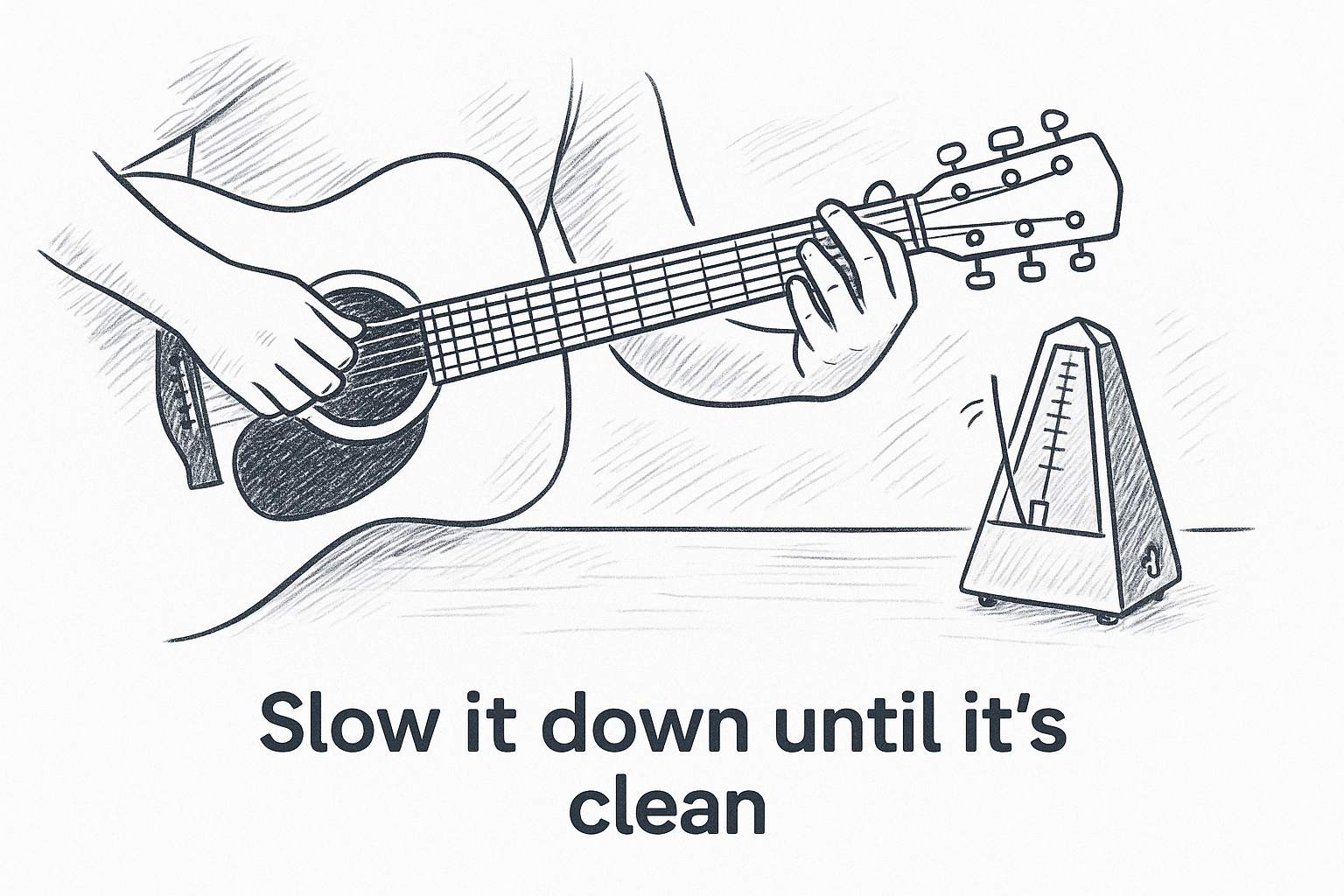
Slow it down until it's clean
Once you've found the trouble spot, drop the tempo until you can play it without a single mistake, then nudge it up in small steps.
- Set a metronome to 60 percent of your target tempo
- Play the isolated section five times clean before raising tempo
- Increase by 5 BPM only after a clean run
- Reset to a slower tempo if mistakes return
Rebuild context after the fix
After the isolated section is solid on its own, play it inside the surrounding bars so your hands relearn the transition in and out, not just the fix in isolation. This step matters because a lick that's perfect alone can still fall apart when it's sandwiched between the phrases before and after it. Once that connection holds at speed, you've actually closed the gap, not just patched it temporarily.
Step 3. Space out your sessions with spaced repetition
Drilling a lick until it feels solid today doesn't mean it'll still be there next week. Guitar skills fade the same way vocabulary does, following what's known as the Ebbinghaus forgetting curve, a well-documented pattern where memory drops sharply within days of learning something unless you revisit it. That's why cramming a passage for an hour once and moving on is one of the least efficient ways to practice.
Why revisiting beats cramming
Spacing your review sessions across days instead of piling repetitions into one sitting forces your brain to retrieve the skill from memory, not just repeat it while it's fresh. That retrieval effort is what actually strengthens the neural pathway. A passage you nail once and never touch again is a passage you'll be relearning from scratch in three weeks.
Review before you forget, not after.
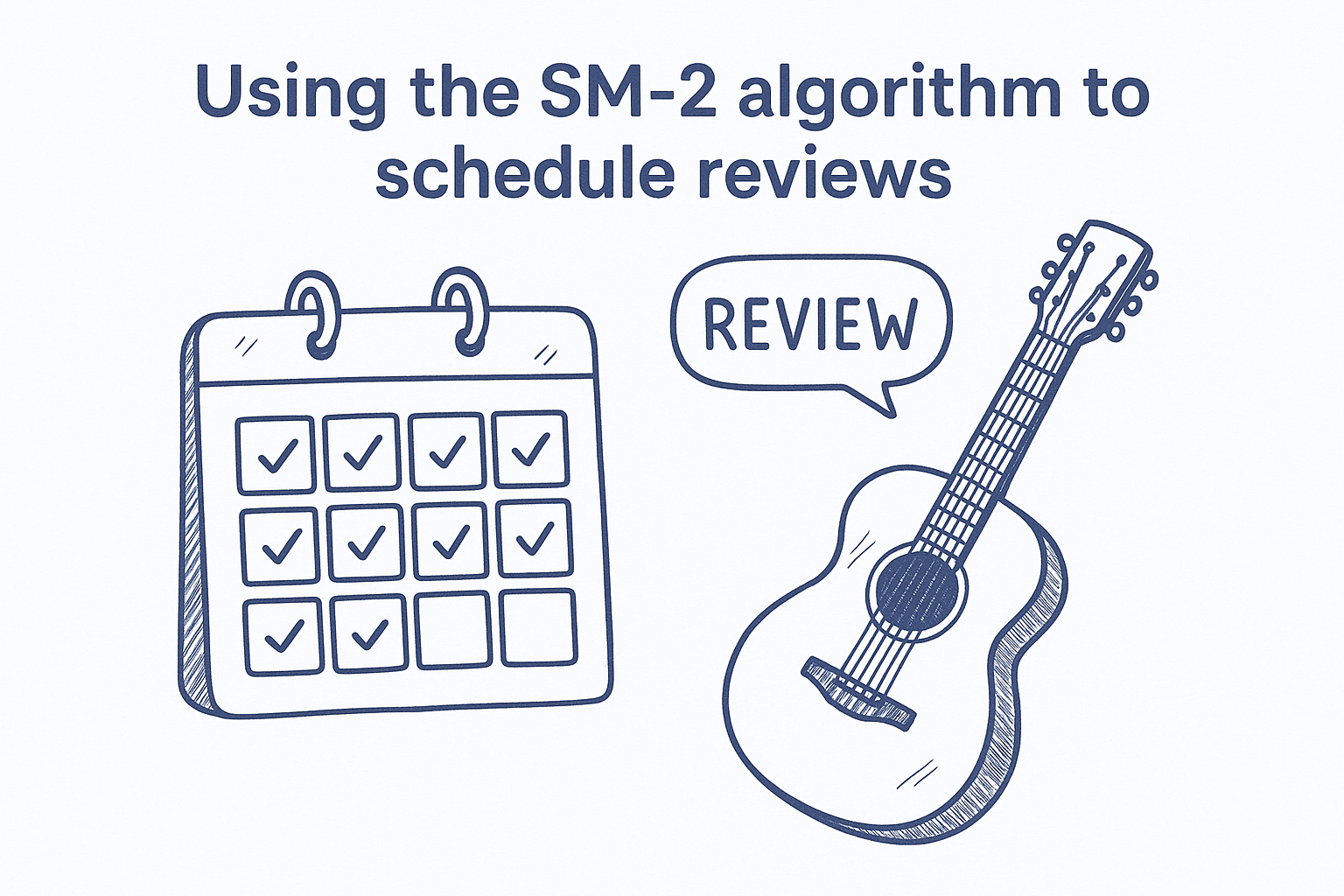
Using the SM-2 algorithm to schedule reviews
The SuperMemo SM-2 algorithm solves this by calculating the ideal gap before a skill starts slipping, then scheduling your next review right at that point. Instead of guessing whether to revisit that chord change tomorrow or next week, the system adjusts based on how well you performed last time:
- Rated it "Again" (failed): review tomorrow
- Rated it "Hard": review in 2-3 days
- Rated it "Good": review in 5-7 days
- Rated it "Easy": review in 10+ days
This is exactly the mechanism MemoRep automates for practical skills like guitar, so you're never stuck deciding what deserves today's session.
Step 4. Track your reps and test yourself under pressure
Guessing whether you've actually improved is a habit killer. Logging your reps turns fuzzy impressions like "I think that's cleaner" into hard data you can check against last week's numbers, and that data is what tells you whether your practice is actually working or just feels productive.
If you're not logging it, you're guessing, not practicing.
Log tempo, accuracy, and date every session
A simple log gives you the receipts. Keep it dead simple so you'll actually fill it in:
- Date of the session
- Section or skill drilled
- Tempo attempted (BPM)
- Clean passes out of total attempts
- Self-rating: Again, Hard, Good, or Easy
This is basically the same feedback loop MemoRep builds into its rating system, and it's what feeds the spacing algorithm from Step 3.
Simulate performance pressure before the real thing
Practicing a passage alone in a quiet room proves almost nothing about whether you can play it in front of people. Performance pressure exposes weaknesses that slow, careful practice hides completely, so you need to recreate some version of that stress on purpose.
Try recording yourself playing the passage in one take, no stopping, no redos. Watch it back immediately and note exactly where it fell apart. Do this once a week for anything you're planning to perform, and you'll catch the gaps between "I can play this" and "I can play this under pressure" long before a gig forces you to find out the hard way.
Making efficient practice a habit
None of these four steps works if you only use them once. Efficient practice is a habit built from setting a measurable goal, isolating the weak spot, spacing your reviews, and logging what actually happened, repeated session after session until it's automatic. Skip any one step and you're back to noodling with good intentions.
The hard part isn't understanding the method, it's remembering which skill needs revisiting today and which one can wait. That's the exact decision fatigue spaced repetition software was built to remove, and it's why MemoRep applies the SM-2 scheduling logic from Step 3 to every practice card you create, not just flashcards. Instead of guessing, you open the app and it tells you what's due.
If you want to see the algorithm behind that scheduling in more detail, check out how memoRep's science-backed approach works, then put it to work on your own routine.