
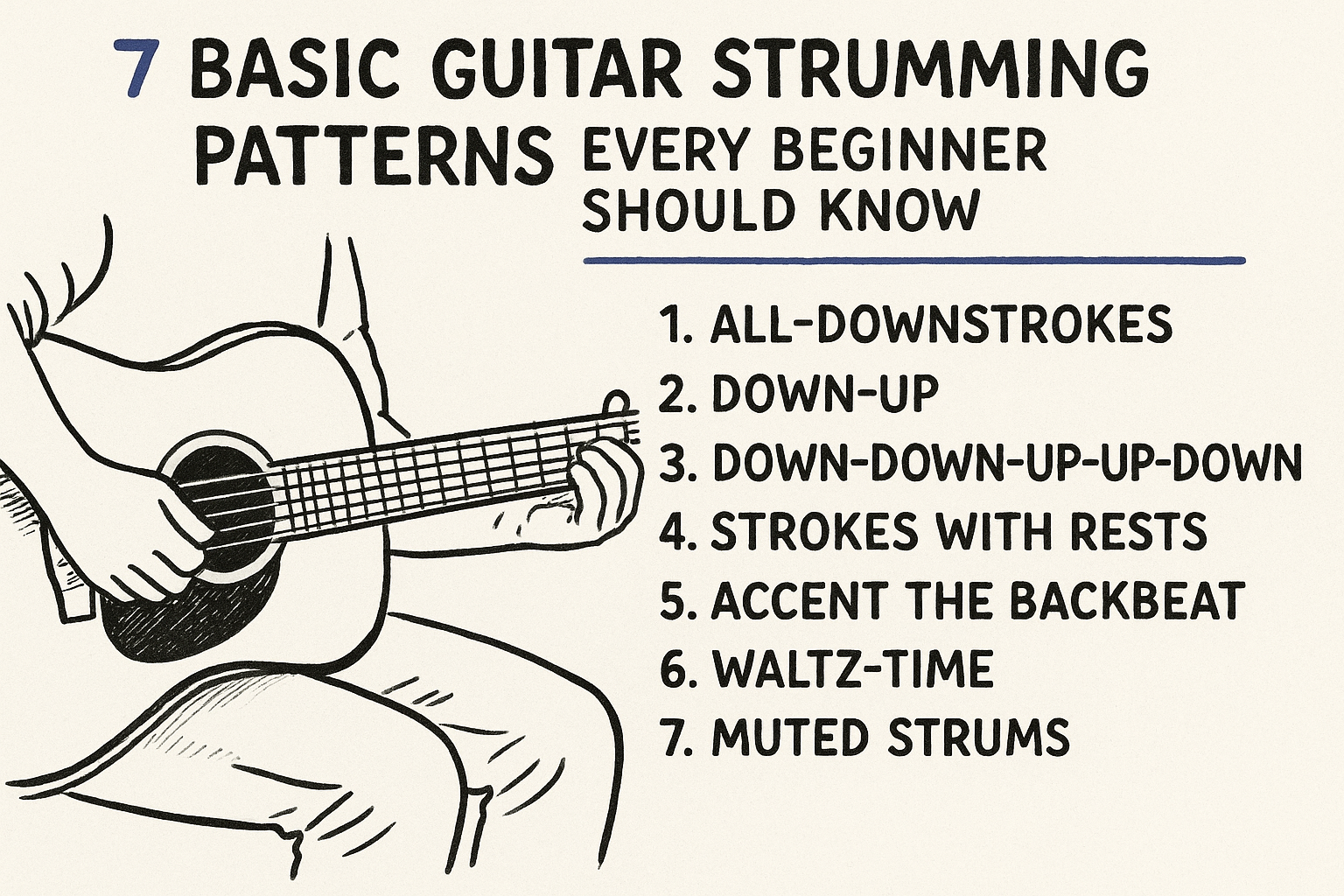
7 Basic Guitar Strumming Patterns Every Beginner Should Know
Every beginner guitarist hits the same wall: chords sound fine one at a time, but the moment you try to strum along to a real song, your hand freezes up. You know the shapes, but you don't know what your right hand is supposed to be doing. That's where basic guitar strumming patterns come in, and getting a handful of them under your fingers changes everything about how natural you sound.
This article gives you exactly that: seven beginner-friendly strumming patterns you can start using today, from simple down-up alternation to patterns with rests and syncopation that show up in hundreds of popular songs. Each one is broken down so you can count it out, feel the rhythm, and apply it right away instead of guessing at what you hear on a recording.
We'll walk through each pattern in order of difficulty, explain when you'd actually use it, and give you a sense of the muscle memory these patterns require to feel automatic. Learning the pattern is only step one. The real skill comes from consistent, spaced practice that keeps your strumming hand loose and your timing solid, which is exactly the kind of routine tools like MemoRep are built to support.
1. All downstrokes: the foundation of every strum
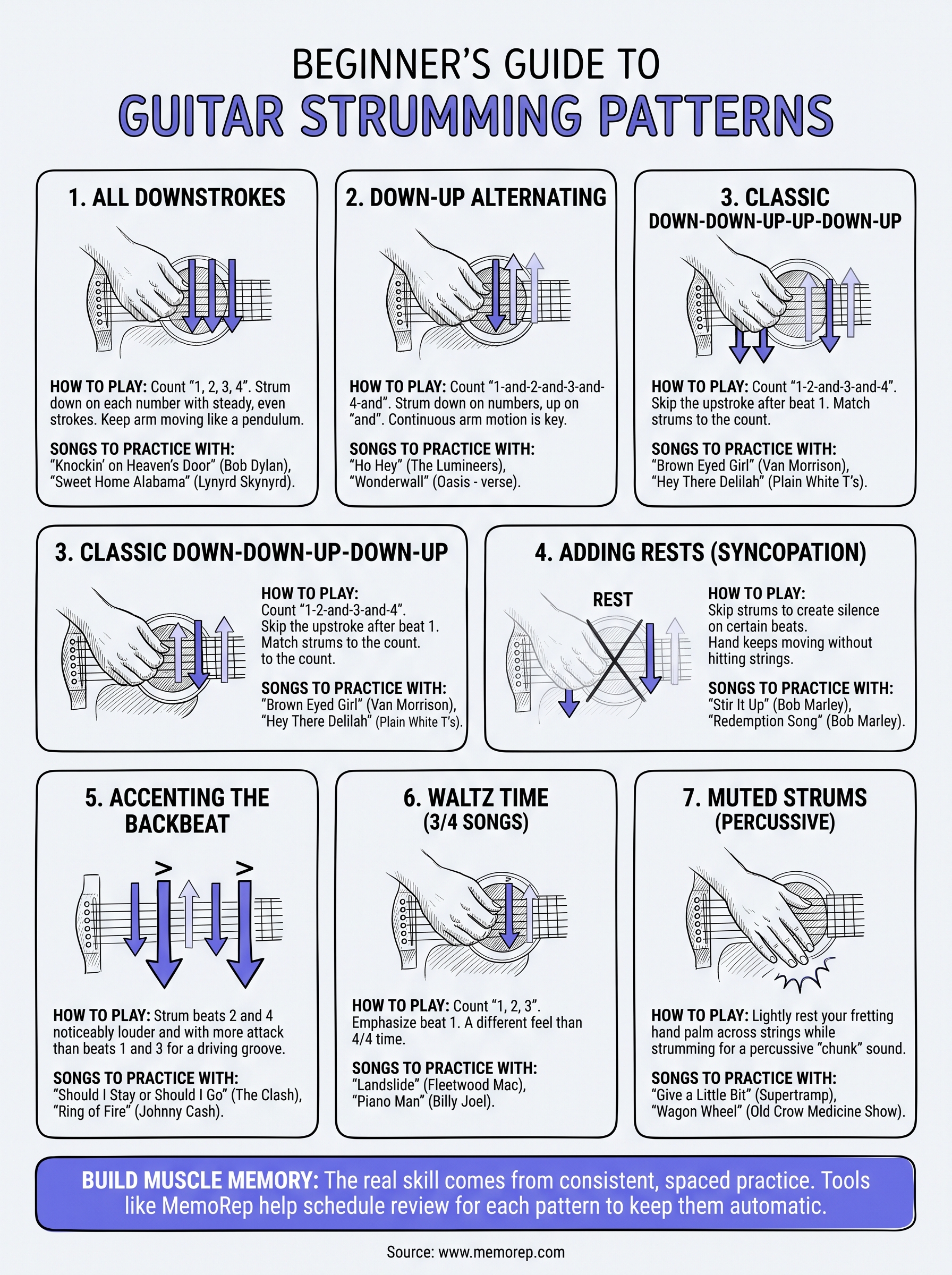
Before you try anything fancy, you need to be able to hit four steady downstrokes per bar without your hand tensing up or your timing wandering. This is the pattern almost every guitar teacher starts with, and for good reason: it forces you to lock in with a steady tempo before you add complexity. If you skip this step, every other pattern on this list will feel shaky because your right arm never learned to move like a metronome in the first place.
How to play it
Count out loud "1, 2, 3, 4" and strum down on each number, hitting all the strings in the chord evenly. Keep your strumming arm moving from the elbow, not the wrist, and let the motion stay loose and continuous even between strums, like a pendulum that never fully stops. The goal is four even downstrokes per measure, all the same volume, all landing exactly on the beat.
Four steady downstrokes teach your arm to keep time before your fingers ever have to think about rhythm.
Songs to practice with
This pattern works surprisingly well on more songs than you'd expect, especially anything with a simple, driving rhythm:
- "Knockin' on Heaven's Door" by Bob Dylan
- "Achy Breaky Heart" by Billy Ray Cyrus
- "Sweet Home Alabama" by Lynyrd Skynyrd (verse sections)
- Most punk and folk-punk rhythm parts, which lean on straight downstrokes for energy
Tips to master it faster
Set a metronome app to a slow tempo, something like 60 beats per minute, and don't rush it. Speed comes later; consistency comes first. Watch your strumming hand in a mirror if you can. Beginners often speed up without noticing, especially during chord changes, so a visual check catches what your ears miss.
Grab a chord you already know, like open G or E minor, and strum through it for two full minutes without stopping, even if a chord change gets sloppy. That sustained repetition is what actually builds the motion into muscle memory rather than something you have to consciously think through every time. If you're logging practice time across multiple skills, a spaced repetition tool built for musicians, like MemoRep, can schedule quick daily check-ins on this pattern so it doesn't slip once you move on to trickier rhythms.
2. Down-up alternating strums for steady rhythm
Once steady downstrokes feel automatic, add an upstroke between each beat. This is the pattern that unlocks most modern pop, rock, and acoustic songs, because it doubles your strumming speed without doubling the effort. Instead of thinking in quarter notes, you start thinking in eighth notes, which is the real building block behind almost every basic guitar strumming pattern you'll learn after this one.
How to play it
Count "1-and-2-and-3-and-4-and," strumming down on the numbers and up on each "and." Your arm should never stop moving, even on beats where you're not actually hitting the strings yet, since that continuous motion is what keeps the upstrokes evenly spaced. Keep the upstrokes lighter than the downstrokes; they naturally catch fewer strings, and that's fine.
The upstroke isn't an afterthought, it's what makes your rhythm sound like music instead of a metronome.
Songs to practice with
This alternating pattern shows up constantly once you start listening for it:
- "Ho Hey" by The Lumineers
- "I'm Yours" by Jason Mraz
- "Riptide" by Vance Joy
- "Wonderwall" by Oasis (verse strumming)
Tips to master it faster
Slow the metronome down to 50 or 60 beats per minute and resist the urge to speed up just because the pattern feels easy. Timing gets sloppy fastest when you're bored, not when you're challenged. Try muting the strings with your fretting hand and strumming the down-up pattern with no chord at all, just to isolate the arm motion.
Underline how this pattern differs from pure downstrokes by alternating practice sessions between the two, a few minutes each, so your hand learns to switch smoothly. Logging that switching drill inside something like MemoRep also helps you notice, over a few weeks, whether your upstrokes are actually getting more even or just feel that way.
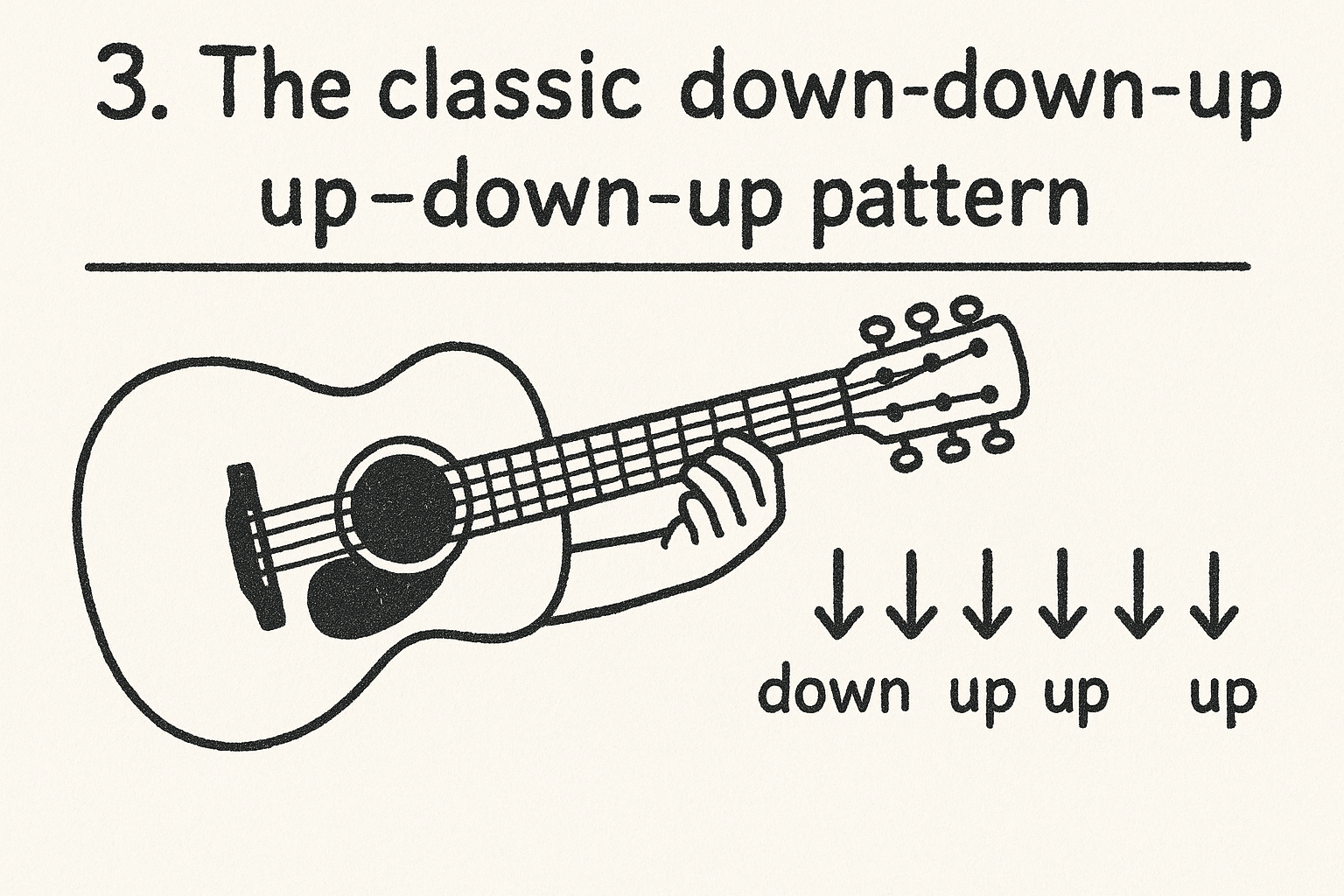
3. The classic down-down-up-up-down-up pattern
This is the pattern most beginners picture when they think of strumming a guitar, and it's probably the single most useful rhythm you'll ever learn. It fills out a full measure with six strums instead of four or eight, giving you a fuller sound without demanding lightning-fast hands. Once this one feels natural, you'll recognize it in songs you've heard a hundred times without ever noticing the pattern underneath.
How to play it
Count "1-2-and-3-and-4" and match your strums to: down on 1, down on 2, up on "and," down on 3, up on "and," then up on 4. Written out, it's down-down-up-up-down-up, repeated every measure. The trickiest part is skipping the upstroke right after beat 1, so slow down and isolate that gap before speeding up.
Skipping the right upstroke is what separates this pattern from a random jumble of strums.
Songs to practice with
This rhythm anchors a huge chunk of the acoustic and pop-rock songbook:
- "Brown Eyed Girl" by Van Morrison
- "Hey There Delilah" by Plain White T's
- "You're Beautiful" by James Blunt
- "Banana Pancakes" by Jack Johnson
Tips to master it faster
Zoom in on the gap between beats 1 and 2 first, since that missing upstroke trips up nearly everyone. Practice just those two beats on a loop before attaching the rest of the measure. Verbalize the pattern out loud, "down-down-up-up-down-up," while strumming, since saying it reinforces the timing faster than counting numbers alone.
Xylophone-style repetition works well here too: strum through the full pattern for 90 seconds, rest, then repeat. Spacing those short bursts out over several days, rather than cramming one long session, is exactly the kind of scheduling a practice tracking app handles automatically once you've logged the pattern once.
4. Adding rests for a syncopated feel
Rests are what separate a beginner strum from a musical one. Instead of hitting every beat, you deliberately skip a strum and let silence do the work, which creates the syncopated, bouncy feel you hear in tons of acoustic pop and reggae-influenced songs. This pattern trips people up at first because your arm still moves through the motion, you just don't let the strings ring on certain beats.
How to play it
Start from the down-up pattern and mute beat 2 by keeping your strumming arm moving but lifting it just enough to miss the strings, or by resting your palm lightly on them. A common version counts "1, (rest), and, 3, and, 4, and," skipping the downstroke on beat 2 entirely. Your hand still swings through that gap; it just doesn't make contact.
Silence is part of the rhythm, not a break from it.
Songs to practice with
This syncopated strumming pattern shows up in a lot of songs with a laid-back, groovy feel:
- "Stir It Up" by Bob Marley
- "Redemption Song" by Bob Marley
- "Banana Pancakes" by Jack Johnson (chorus)
- "I'm Yours" by Jason Mraz (bridge section)
Tips to master it faster
Exaggerate the rest at first, actually stopping your hand completely on the skipped beat, then gradually shrink that pause until your arm keeps swinging without hitting the strings. Recording yourself on your phone helps more here than almost anywhere else on this list, since syncopation is easy to feel wrong without noticing. Tracking this pattern separately in a practice log matters too, since it's easy to confuse with pattern three if you don't revisit it on its own schedule.
5. Accenting the backbeat for a driving groove
Rock, blues, and country rhythm all lean on the same trick: hitting beats 2 and 4 harder than the rest. This is called accenting the backbeat, and it's what makes a strumming pattern feel like it's driving forward instead of just keeping time. You already know the down-up motion from earlier patterns; this one just asks you to dig in harder on specific strums instead of adding new strums altogether.
How to play it
Strum the standard down-up-down-up eighth-note pattern, but hit beats 2 and 4 noticeably louder and with more attack than beats 1 and 3. Think of a drummer's snare hit landing on those same beats; your strumming hand is doing the same job. Keep the quieter strums light and controlled so the contrast actually registers instead of blurring together.
Accenting the backbeat turns a flat strum into a groove you can feel in your chest.
Songs to practice with
This accented pattern is everywhere once you start listening for the emphasis:
- "Should I Stay or Should I Go" by The Clash
- "Ring of Fire" by Johnny Cash
- "Fortunate Son" by Creedence Clearwater Revival
- "American Girl" by Tom Petty
Tips to master it faster
Yes, tapping your foot on beats 2 and 4 while you strum genuinely helps your arm feel where the accent belongs. Zero in on exaggerating the dynamic difference at first, even if it sounds cartoonish, then dial it back once the timing locks in. Building a strumming pattern practice routine that revisits this specific accent weekly keeps the dynamic contrast from flattening out again, which is a common backslide once you move on to the next pattern.
6. Strumming in waltz time for 3/4 songs
Most songs on this list live in 4/4 time, but plenty of ballads, folk tunes, and classic country songs count in three instead of four. Waltz time strumming feels completely different under your hand because the accent falls every third beat instead of every fourth, giving the rhythm a rocking, swaying feel rather than a driving one. Learning this 3/4 strumming pattern now saves you from getting completely lost the first time a song doesn't count in fours.
How to play it
Count "1, 2, 3" instead of "1, 2, 3, 4," and strum down on beat 1, then two lighter downstrokes or a down-up combo on beats 2 and 3. A simple version is down, down, down, with beat 1 hit harder than the other two. Once that feels steady, try down on 1, down-up on 2, down on 3, which adds a bit more texture without breaking the three-beat feel.
Waltz time only feels natural once your hand stops expecting a fourth beat.
Songs to practice with
This pattern shows up more often than beginners expect:
- "Landslide" by Fleetwood Mac
- "Piano Man" by Billy Joel (guitar arrangements)
- "Norwegian Wood" by The Beatles
- "Take It Easy" by the Eagles (bridge section)
Tips to master it faster
Tapping your foot on beat 1 only, rather than every beat, helps your body internalize where the strong beat lands. Practicing this pattern right after a straight 4/4 pattern, back to back, sharpens the contrast and keeps you from sliding back into four-beat habits by accident.
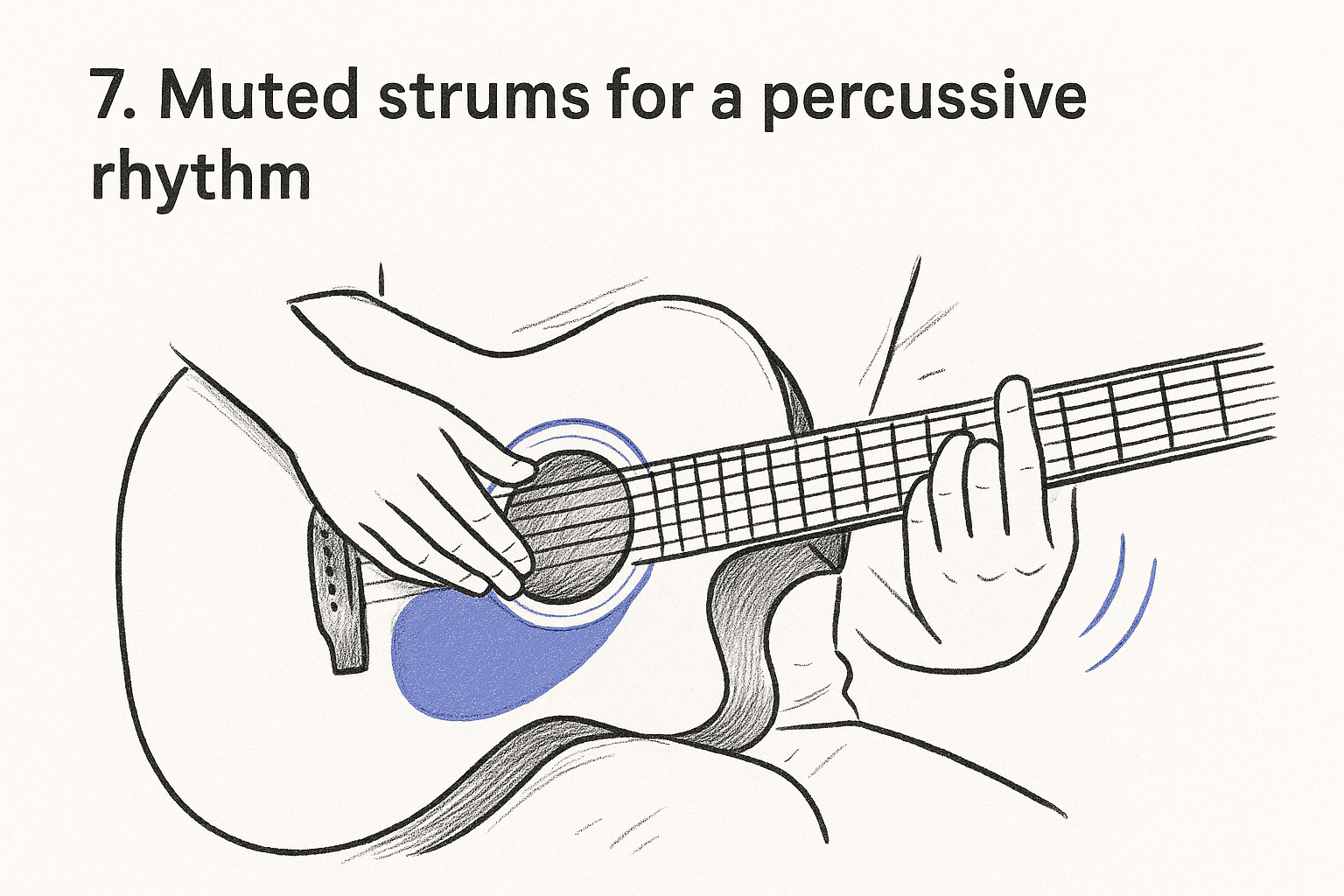
7. Muted strums for a percussive rhythm
Sometimes a guitar needs to sound like a drum. Muted strumming turns your right hand into a percussion instrument by deadening the strings so you get a tight, rhythmic "chunk" instead of a ringing chord. This percussive strumming technique shows up constantly in funk, flamenco-influenced pop, and modern acoustic songs where the guitar is doing double duty as rhythm section and melody at once.
How to play it
Rest the side of your fretting hand's palm lightly across the strings near the bridge, just enough pressure to kill the ring without stopping the strum entirely. Strum through your chosen pattern, whether that's straight downstrokes or the down-up-down-up you learned earlier, and you'll hear a percussive click instead of a full chord. Lift the mute completely for specific beats you want to ring out, then drop it back down, which is exactly how songs build that stop-start groove.
Muting doesn't kill the rhythm, it sharpens it into something you can feel in your gut.
Songs to practice with
This technique anchors a surprising number of well-known tracks:
- "Give a Little Bit" by Supertramp
- "Wagon Wheel" by Old Crow Medicine Show
- "Under the Bridge" by Red Hot Chili Peppers (intro)
- "Chop Suey!" by System of a Down (verse)
Tips to master it faster
Quietly practicing this one without an amp helps you actually hear the difference between too much pressure, which kills all sound, and just enough, which leaves that percussive thump. Vary the amount of mute you apply beat by beat until controlling it feels automatic rather than accidental.
Turning these patterns into muscle memory
Seven patterns won't make you a strong rhythm player overnight. What actually gets you there is revisiting each one enough times, spaced out over days and weeks, that your arm stops thinking and just moves. That's the part beginners skip: they learn a pattern once, feel good about it, and never come back to it until it's already gotten rusty. Basic guitar strumming patterns only become second nature through repetition that's spread out, not crammed into one long session.
Instead of guessing which pattern needs review today, let a system handle it. MemoRep schedules quick check-ins on each strumming pattern right when you're about to forget it, using the same spaced repetition science behind how memory actually works. You log a pattern once, rate how it went, and the app tells you exactly what to revisit and when. See how the scheduling works on the MemoRep science page, or just try MemoRep free while beta spots last.