
How to Build a Bass Guitar Practice Routine That Works
You picked up your bass an hour ago, ran through the same three scales you always run through, and now you're putting it down no more confident than when you started. That's the problem with most practice sessions: there's no plan, so there's no progress. A solid bass guitar practice routine fixes this by giving every session a purpose, whether that's locking in your right hand technique, learning a new song, or drilling arpeggios you keep fumbling live.
If you're wondering how to practice bass guitar in a way that actually sticks, the answer isn't more hours, it's better structure. You need a routine that mixes technique, theory, and repertoire, and revisits each skill before it gets rusty rather than after. That's the core idea behind spaced repetition and the schedules that make it work, and it's what separates players who plateau from players who keep improving month after month.
This guide walks you through building a beginner bass guitar practice routine step by step, including how to structure your time, which exercises deserve daily attention, and how to know when to move on to harder material. Along the way you'll get practical bass guitar practice tips you can apply tonight, whether you're working from memory or a printed bass guitar practice routine pdf taped to your amp.
How much time you really need to practice bass
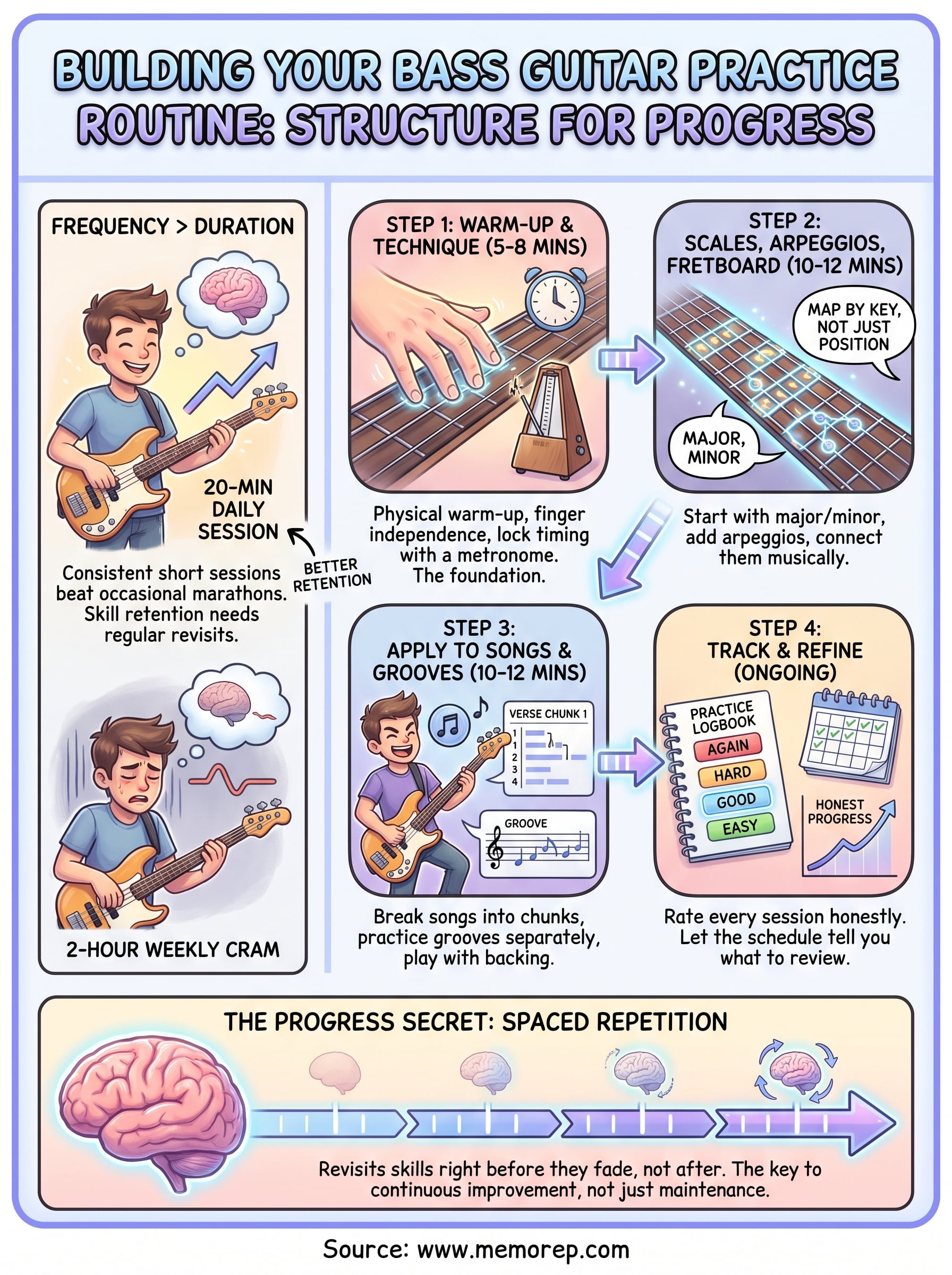
Most beginners think they need a two-hour block to make progress, so they skip practice entirely on the days they only have twenty minutes. That's backwards. Consistent short sessions beat occasional marathons every time, because skill retention depends on how often you revisit a movement, not how long you stare at it in one sitting. Twenty focused minutes, four or five days a week, will get you further in three months than one exhausted two-hour session every Sunday.
Twenty minutes a day beats two hours once a week, every single time.
Why frequency beats duration
Your hands and ears learn through repetition spaced out over time, not through cramming. This is the same principle behind what the forgetting curve says about fading memory: information and motor skills fade fast unless you revisit them right before they slip away. Practice a walking bass line once for an hour and you'll forget half of it by Thursday. Practice it for ten minutes today, ten minutes tomorrow, and ten minutes in three days, and it sticks. The Ebbinghaus forgetting curve isn't just academic theory, it's the reason your favorite riffs from years ago still come back instantly while last month's scale exercise feels foreign again.
How much time to budget by skill level
How much time you need depends on where you are and what you're chasing. A beginner building calluses and basic coordination needs less raw time than someone prepping for a gig with a 40-song setlist, and realistic timelines for each level make that gap obvious. Use this as a starting point and adjust based on your goals:
| Skill level | Daily practice time | Weekly frequency | Primary focus |
|---|---|---|---|
| Complete beginner | 15-20 minutes | 5-6 days | Finger technique, basic rhythm, open string exercises |
| Beginner with 3-6 months experience | 20-30 minutes | 5-6 days | Scales, simple songs, timing with a metronome |
| Intermediate | 30-45 minutes | 5-7 days | Arpeggios, fretboard mapping, groove-specific repertoire |
| Gigging or advanced | 45-60+ minutes | 6-7 days | Repertoire depth, improvisation, genre-specific techniques |
Notice the pattern: as your skill grows, the time increases gradually, not dramatically. Doubling your practice time as a beginner won't double your progress, it'll just burn you out faster.
Splitting your session into blocks
Rather than treating practice as one continuous blob, break it into three chunks: technique, theory application, and repertoire, which is the backbone of any bass guitar practice schedule that works. This keeps your brain from fatiguing on one type of task and mirrors how a bass guitar practice routine pdf worth following is usually laid out. Here's a simple split for a 30-minute session, and the same logic scales up into a weekly plan for organizing practice:
- 5-8 minutes: warm-up and finger technique drills
- 10-12 minutes: scales, arpeggios, or fretboard work tied to a specific song or key
- 10-12 minutes: applying that material to a song, groove, or improvised bass line
Spaced repetition works best when you're not guessing which exercises need another pass and which ones you've already nailed. That's exactly the gap MemoRep is built to close: instead of re-running the same three scales out of habit, you log each skill as a practice card, rate how it went, and let the scheduling algorithm decide what deserves your next session. You stop wasting minutes on things you've already mastered and start spending them where the forgetting curve says you need them most.
Once you've settled on how much time you're working with, the next question is what actually goes into those minutes. That starts with your hands, not your theory book.
Step 1. Warm up and build finger technique
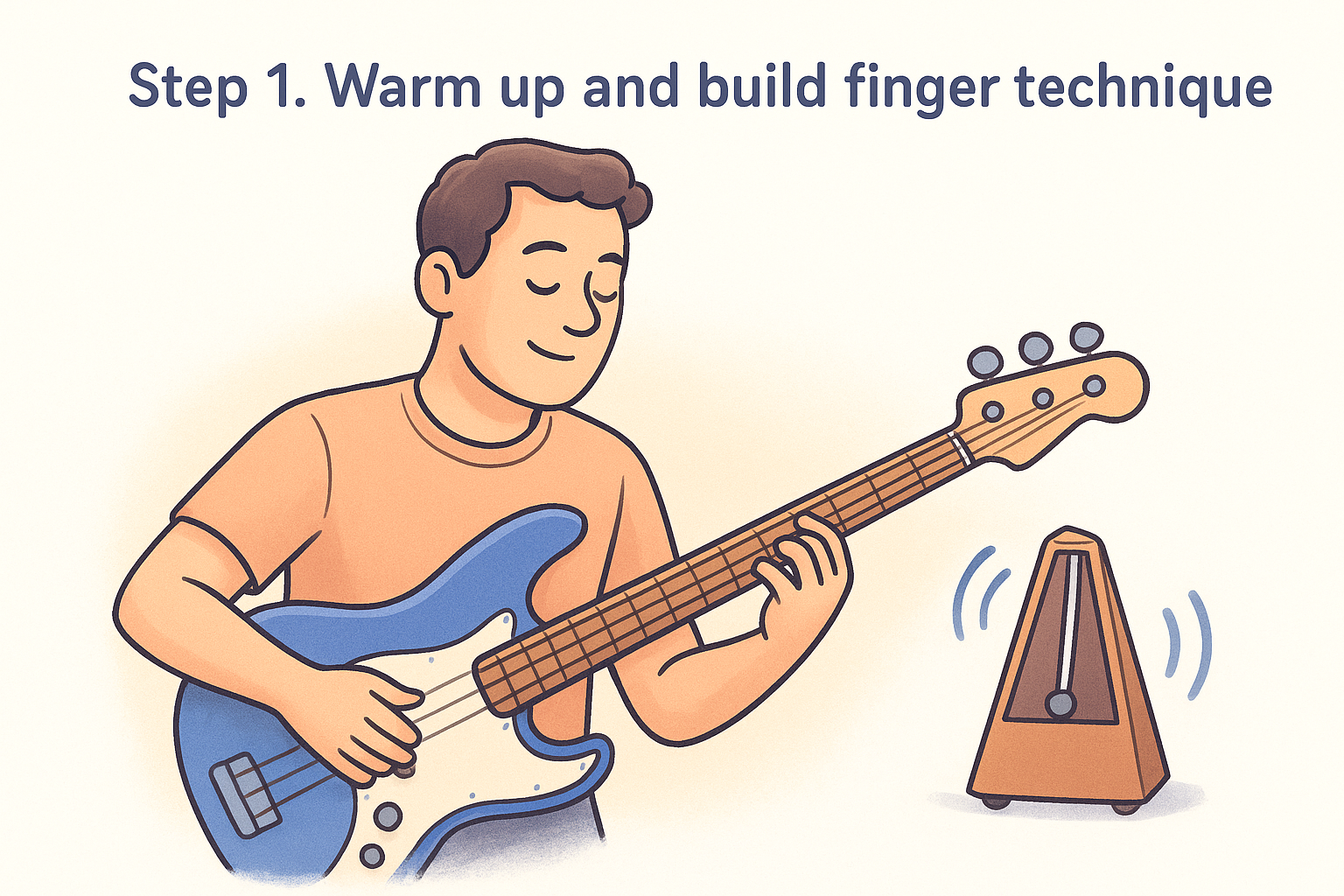
Before you touch a scale or a song, spend a few minutes waking up your hands. Cold fingers move slower, hit strings inconsistently, and tire faster, which means the first ten minutes of an unwarmed session teach your muscles bad habits instead of good ones. This is where how to practice bass guitar actually starts, not with theory, but with the physical mechanics of pressing, plucking, and moving between strings cleanly.
Start with a physical warm-up
Open your session with simple, low-pressure movement: play open strings with alternating fingers, then walk your fretting hand up and down one string using one finger per fret. Two or three minutes of this loosens your hands without wasting energy on anything that requires thinking. Keep the tempo slow and the motion relaxed, since tension here creates tension everywhere else in the session.
Build finger independence and strength
Once your hands are moving freely, shift to drills that isolate specific weaknesses. Most beginners have one or two fingers that lag behind, usually the ring and pinky, and those are exactly the ones that need daily attention.
- Chromatic exercise: play frets 1-2-3-4 on each string using one finger per fret, ascending and descending across all four strings
- String skipping: pluck the E string, skip to the D string, then skip to the G string, focusing on clean muting of the string you're not playing
- Alternating pluck pattern: practice index-middle-index-middle plucking on a single note until it feels automatic, then switch the lead finger
Run each drill for 60 to 90 seconds. You're not trying to master anything yet, you're building the raw coordination that everything else depends on.
Clean technique isn't a bonus skill, it's the foundation every scale, groove, and solo gets built on.
Lock in timing early
Technique without timing falls apart the moment you play with anyone else, so bring a metronome into this block from day one. Set it slow, somewhere around 60 BPM, and make sure every note lands exactly on the click before you speed anything up. This single habit, playing in time even during warm-ups, does more for your overall sound than any scale you'll learn next. Once your fingers move cleanly and your timing holds steady, you're ready to point that coordination at something more structured: scales, arpeggios, and the map of the fretboard itself.
Step 2. Learn scales, arpeggios, and the fretboard
Once your hands move cleanly and your timing holds, it's time to give your fingers something musical to say. Scales and arpeggios aren't academic exercises, they're the vocabulary you'll draw on every time you build a bass line, follow a chord chart, or improvise over a jam. Skipping this step is why so many players can move their fingers fast but freeze the moment a song calls for anything outside the one pattern they memorized.
Start with major and minor scale shapes
Begin with the major and minor pentatonic scales in one position, then expand to the full major and natural minor scales once the pentatonic shapes feel automatic. Practice each scale ascending and descending, slowly, with a metronome, until you can play it without looking at your fretting hand. Aim for one new scale shape every one to two weeks rather than cramming several at once.
A scale you can play without thinking is worth more than five scales you can barely stumble through.
Add arpeggios once scales feel automatic
Arpeggios teach you to outline chords, which is exactly what a bass player does under a song. Work through these in order:
- Major triad arpeggio (root, third, fifth)
- Minor triad arpeggio
- Dominant 7th arpeggio
- Minor 7th arpeggio
Play each one across two octaves where your instrument allows, then try connecting two arpeggios back to back, like moving from a G major arpeggio to a C major arpeggio, to mimic a real chord change.
Map the fretboard by key, not just position
Many beginners learn a scale shape but never learn where the notes actually are. Pick one key each week and find every occurrence of the root note across all four strings. Then play the scale starting from each of those root notes instead of always starting in the same spot. This single habit does more for fretboard fluency than months of shape-based memorization alone.
This is also where a bass guitar practice routine tends to fall apart, because scales and arpeggios pile up faster than you can revisit them all. Logging each one as a practice card built around spaced practice in MemoRep means you're not guessing which key needs review this week, the schedule tells you. With scales and arpeggios starting to feel like second nature, you're ready to put them to work inside actual songs and grooves.
Step 3. Apply your skills to songs and grooves
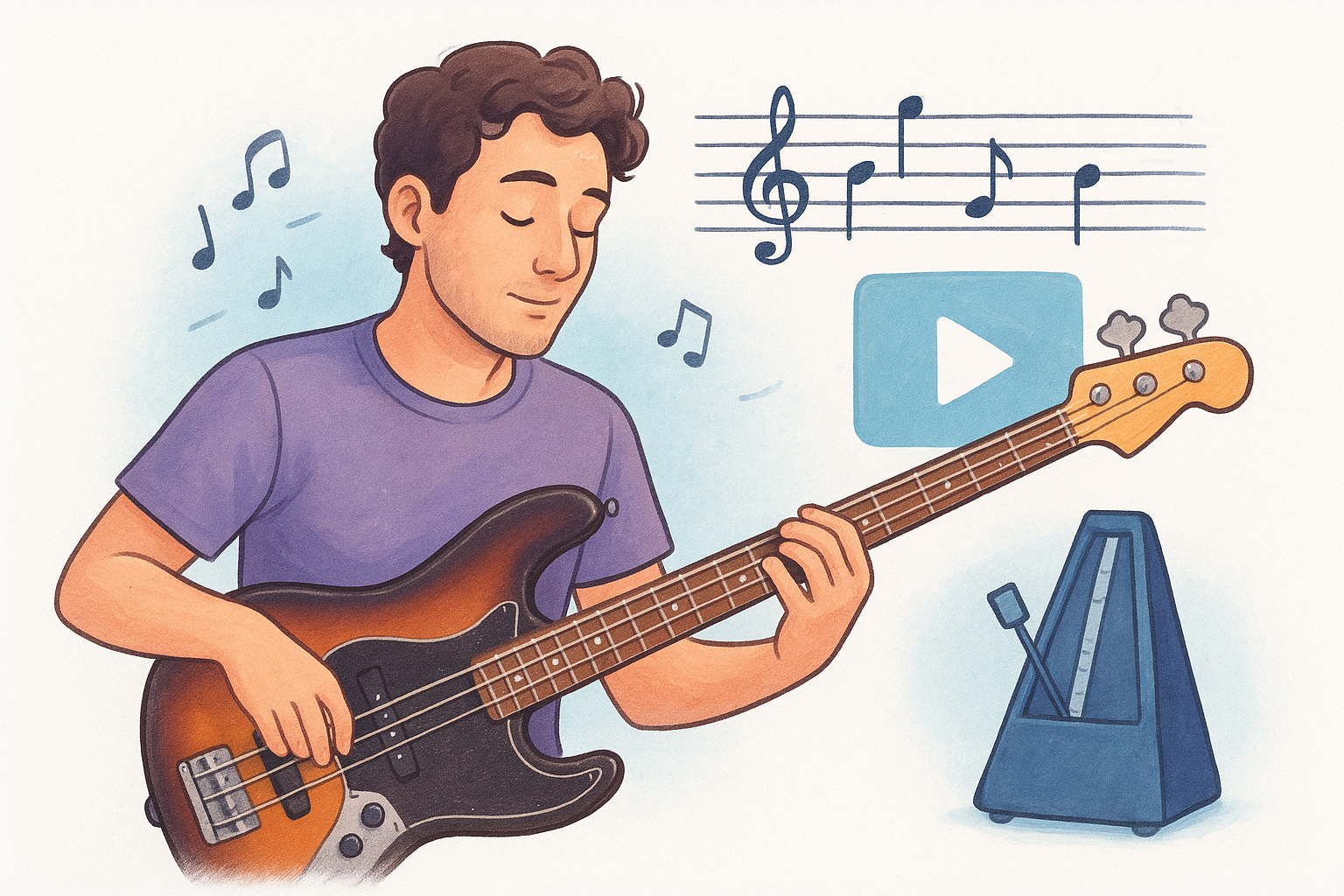
Scales and arpeggios only matter once they show up inside real music, so this is where your bass guitar practice routine starts paying off. Pick a song you actually want to play, not one you think you should play, since motivation drops fast when the material feels like homework. Learning by ear or from tabs both work, and training yourself to hear intervals makes the ear route far less painful, but try to identify at least one scale or arpeggio shape you already drilled hiding inside the bass line. That connection is what turns theory into instinct.
Break the song into workable chunks
Don't try to learn a song top to bottom in one sitting. Split it into four-to-eight bar sections and loop each one until it's clean before moving to the next.
- Isolate the verse groove first, since it usually repeats the most and locks in your timing
- Learn the chorus or hook section next, focusing on any rhythmic shift from the verse
- Save fills, transitions, and the bridge for last, since these sections change the least often
Running a song this way keeps you from reinforcing mistakes across an entire section just because you rushed past two bars you never fully learned.
Practice grooves separately from songs
Grooves are the rhythmic patterns underneath a song, and they deserve their own attention outside of any specific track. Spend five to ten minutes locking in a groove style you're weak on, whether that's a straight eighth-note rock pattern, a syncopated funk line, or a walking jazz feel. Loop it with a metronome or drum backing track until your right hand stops thinking about it. This separates the physical feel of a groove from the mental load of remembering which song it belongs to, so you can drop that groove into any tune later without relearning it from scratch.
A groove you can play without a song attached is a groove you actually own.
Play along with a backing track or metronome
Once a section feels solid on its own, test it against a backing track, drum loop, or metronome at performance tempo. This is where hidden timing issues surface, since playing alone hides mistakes that a steady pulse exposes instantly. If you stumble, slow the tempo back down by 10-15 BPM and rebuild from there rather than pushing through mistakes at full speed.
With songs and grooves layered on top of your technique and theory work, the last piece is knowing whether any of it is actually sticking, which is where tracking progress comes in.
Step 4. Track progress and refine your routine
Practicing without tracking is like driving without a fuel gauge, you're moving, but you have no idea how much further you can go before something stalls. The final piece of any working bass guitar practice routine is a feedback loop that tells you what's actually improving and what's quietly slipping. Without that loop, you'll keep drilling the same comfortable exercises while weak spots stay weak indefinitely.
Rate every session honestly
After each drill, scale, or song section, give yourself an honest rating instead of a vague gut feeling, ideally written down in a practice log you'll actually keep. A simple Again/Hard/Good/Easy scale works well here, since it forces a decision rather than a shrug. Honest self-rating is what makes a schedule useful, because a system can only space out your review intervals correctly if the difficulty data feeding it is accurate. Rate a shaky arpeggio as "Good" because you're tired of practicing it, and you'll see it again too late, right when it's finally forgotten.
Your rating is only as useful as your honesty about how the exercise actually went.
Watch for patterns across weeks, not single sessions
One bad run-through doesn't mean much. What matters is whether the same scale, groove, or song section keeps showing up as difficult three or four weeks in a row. That pattern tells you where your practice routine needs more repetition, or a different approach entirely, like slowing the tempo further or breaking the section into smaller chunks. Tracked patterns turn practice from guesswork into a diagnosis you can actually act on, which is the real line between deliberate practice and simply logging hours.
Let the schedule do the deciding
This is exactly the gap MemoRep closes for musicians. Instead of manually remembering which scale you struggled with two weeks ago or which song section needs another pass, you log each piece of material as a practice card and rate it after every attempt. The adaptive scheduling in MemoRep applies the same spaced repetition logic behind the SuperMemo SM-2 algorithm to bring material back right before it fades, not randomly, not too early, and not so late that you're relearning from scratch. Over a few weeks, your practice sessions stop feeling like a guessing game and start feeling like a plan someone else already built for you.
With progress tracked and your schedule adjusting itself, the routine stops being something you have to think about and starts becoming something you simply do.
Building a habit that lasts
A working bass guitar practice routine isn't complicated once you see it broken down: warm up, drill scales and arpeggios, apply them to real music, then track what's sticking and what isn't. Each step feeds the next, and skipping any one of them is usually why practice feels aimless. The players who keep improving aren't the ones with more talent or more free time, they're the ones who revisit the right skill at the right moment instead of guessing.
That's the part most routines get wrong, and it's exactly what spaced repetition fixes. You don't need a spreadsheet or a memorized schedule to make this work. See the science behind how MemoRep picks your next practice card, then start your free practice cards today and let the routine finally build itself around your progress instead of your guesswork.