How to Build a Beginner Guitar Practice Plan That Works
You picked up a guitar, watched a few YouTube lessons, and now you're stuck. Some days you noodle on chords for 20 minutes, other days you skip practice entirely, and your calluses and skills both feel stuck in place. A beginner guitar practice plan fixes that by giving you a clear structure instead of random noodling.
The fastest way to actually improve is to know exactly what to work on each day and for how long, not to practice longer or harder. That means splitting your time between chord changes, rhythm, and technique drills, and revisiting each skill before it goes rusty. This guide gives you a day-by-day framework you can start using today, no guesswork required.
Below, you'll find a 30 to 45 minute daily routine broken into warm-ups, chord work, strumming patterns, and a song you're actually learning. You'll also see how to track progress so you know what's improving and what needs more reps. If you've ever finished a practice session wondering what you actually accomplished, this plan changes that.
What a good beginner practice plan looks like
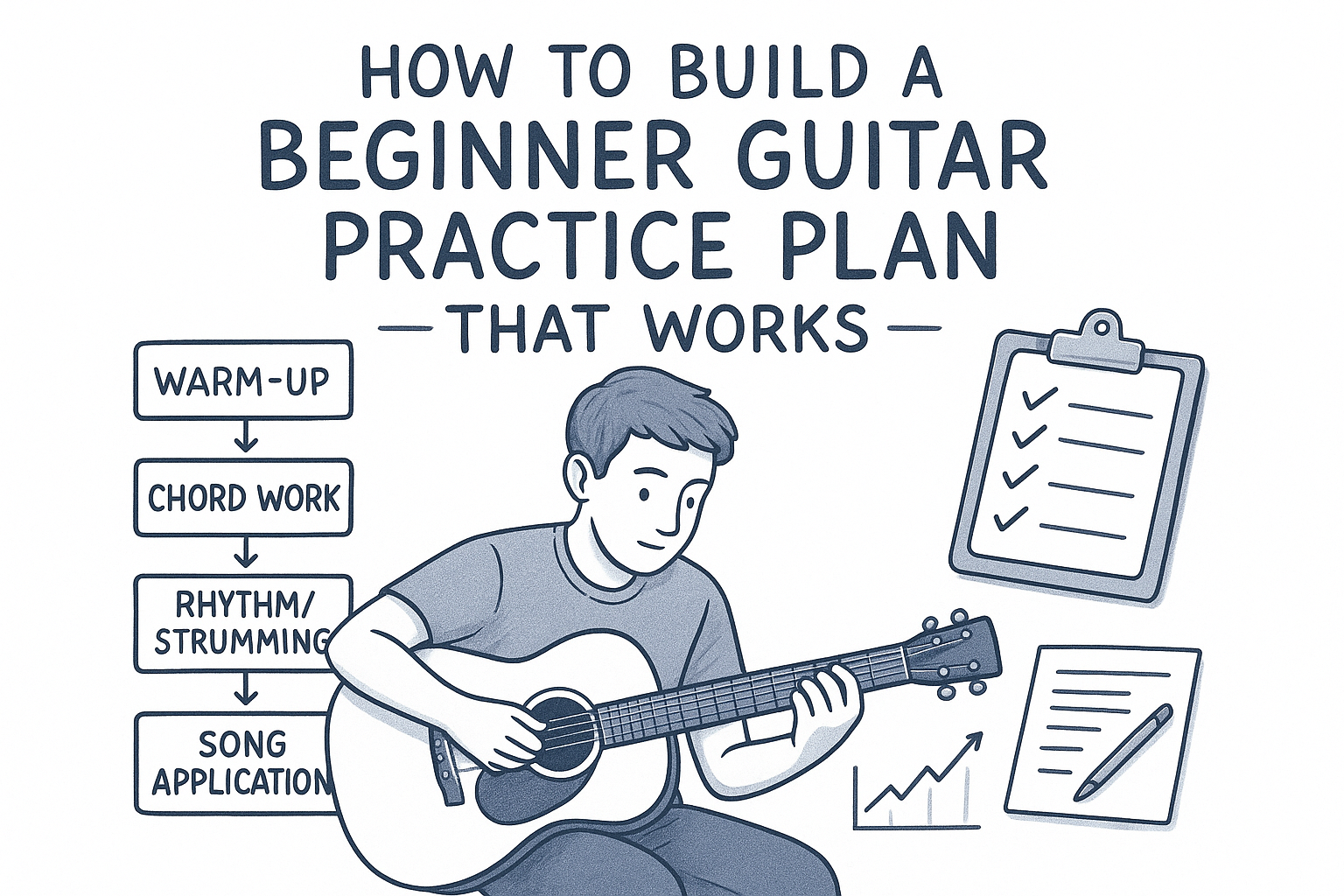
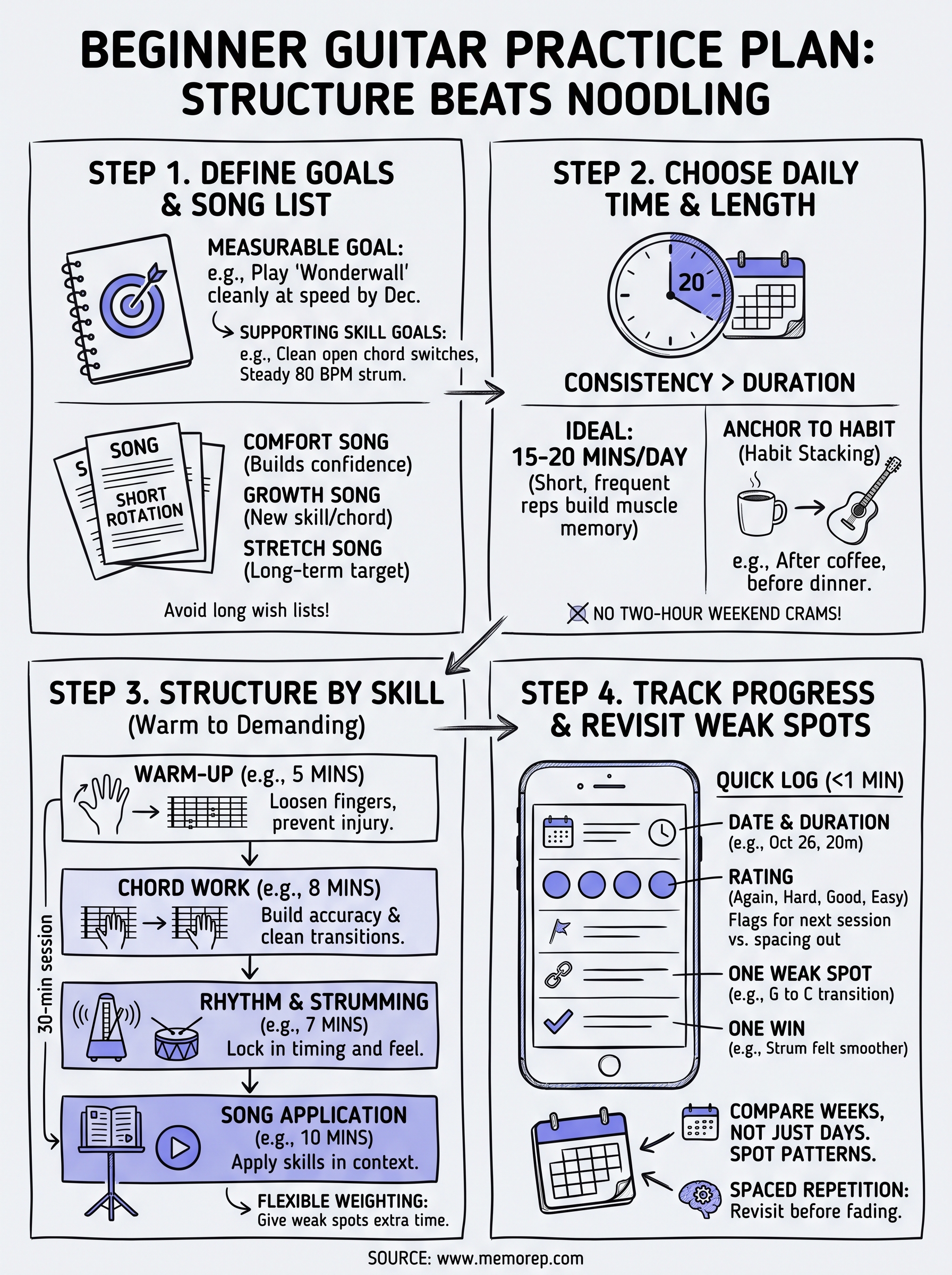
A good beginner practice plan isn't a strict checklist you grind through out of guilt. It's a repeatable structure that covers every skill a new guitarist needs, in an order that builds on itself day after day. Think of it like a workout split: you don't train every muscle randomly, you rotate through them with a plan. The same logic applies to guitar. Instead of picking up the instrument and playing whatever feels fun that day, you follow a sequence that warms up your hands, drills the fundamentals, and applies what you're learning to a real song.
The four pillars of every session
Every solid beginner session touches four areas, regardless of how much time you have. Skip one for too long and you'll notice the gap fast, usually as sloppy chord changes or a strum pattern that falls apart the moment you add a new chord.
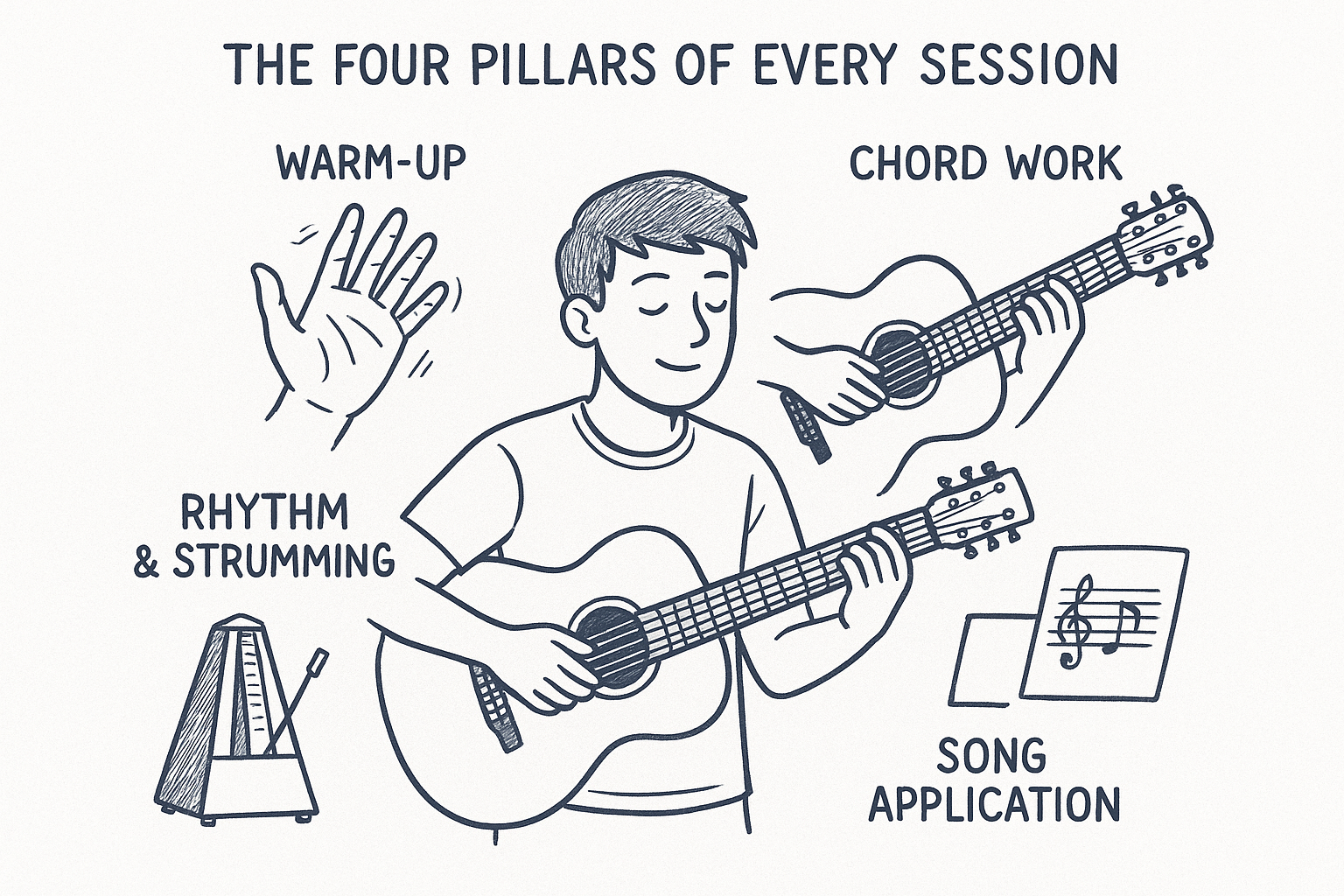
- Warm-up: finger stretches, simple scale runs, or chromatic exercises to loosen up before anything demanding
- Chord work: practicing individual chords and, more importantly, the transitions between them
- Rhythm and strumming: keeping time with a metronome or backing track, not just strumming freely
- Song application: taking what you drilled and using it in an actual piece of music you care about
Missing the last pillar is the most common beginner mistake. You can nail a G to C transition in isolation and still freeze up the first time you try it inside a song, because the song adds tempo pressure and lyrics or melody to track at the same time.
Consistency beats duration
Marathon sessions feel productive, but they don't build muscle memory the way short, frequent reps do. Twenty focused minutes every day will get you further in a month than one exhausting two-hour session on a Sunday. Your fingers need daily reinforcement to build the calluses and muscle memory that make chord changes automatic, and that reinforcement has to happen often enough that skills don't decay between sessions. This is the same principle behind spaced repetition in any skill domain: information and motor patterns fade on a predictable curve, and revisiting them just before they fade is far more efficient than cramming.
A structured 20-minute daily session beats an unstructured two-hour weekend cram every time.
Skipping days is where most beginners lose momentum, not because they lack talent, but because their chords get rusty and the next session feels like starting over. That frustration is exactly what a plan is designed to prevent.
A sample weekly time budget
Here's roughly how a 30-minute session should divide its time across the four pillars. Adjust the minutes up or down if you commit to a longer or shorter daily block, but keep the proportions similar.
| Pillar | Minutes (30-min session) | Purpose |
|---|---|---|
| Warm-up | 5 | Loosen fingers, prevent injury |
| Chord work | 8 | Build accuracy and clean transitions |
| Rhythm/strumming | 7 | Lock in timing and feel |
| Song application | 10 | Apply skills in context, stay motivated |
Notice that song application gets the largest slice. That's intentional. Drills build the raw material, but playing an actual song is what keeps you motivated and shows you the drills are working. The next four steps walk through how to build this structure around your own goals, schedule, and weak spots.
Step 1. Define your goals and song list
Before you touch a metronome or a chord chart, decide what "better" actually means for you. A specific target like "play Wonderwall cleanly at full speed by December" gives your practice direction that "get good at guitar" never will. Vague goals lead to vague sessions, and vague sessions are exactly what leave you noodling for 20 minutes with nothing to show for it.
Pick a goal you can measure
Grab a notebook or a notes app and write down one primary goal and two supporting ones. Supporting goals should be skill-based, not song-based, since they carry over to everything you play afterward.
- Primary goal: learn one full song well enough to play for a friend
- Supporting goal 1: switch cleanly between open C, G, D, and Em without stopping the strum
- Supporting goal 2: hold a steady down-up-down-up strum pattern at 80 BPM
A goal you can measure is a goal you can actually practice toward.
Build a short song list, not a wish list
Resist the urge to pick five songs you love if they're all too advanced. Instead, build a short rotation of two or three songs that stretch your current skill level without breaking it. One song should be comfortably within reach, one should push a new chord shape or strum pattern, and one can be a stretch goal you revisit every few weeks to measure progress.
| Song role | Purpose | Example difficulty |
|---|---|---|
| Comfort song | Builds confidence, reinforces mastered chords | Easy (3-4 open chords) |
| Growth song | Introduces one new skill (barre chord, new strum) | Medium |
| Stretch song | Long-term target, revisited monthly | Ambitious |
Rotating three songs instead of one keeps practice varied enough to stay interesting while still giving you a finish line to work toward each week. Once you have your goal and song list written down, everything else in this plan, your daily time budget, your drill order, and your progress tracking, has something concrete to organize itself around instead of guesswork.
Step 2. Choose your daily practice time and length
Once your goals are written down, the next decision is when and how long you'll actually pick up the guitar. Most beginners overestimate how much time they need and underestimate how consistently they need to show up. A beginner guitar practice plan works best when it fits into a slot you'll realistically protect every day, not the ambitious two-hour block you promise yourself on a Sunday night and abandon by Wednesday.
How long a session should actually run
Fifteen to twenty minutes is enough to make real progress if you show up daily, and thirty to forty-five minutes gives you room to add a second song or deeper technique work once your calluses and hand strength catch up. Longer than that, and returns drop fast for a beginner. Your fingers fatigue, your focus drifts, and the last fifteen minutes usually turn into aimless strumming instead of deliberate practice.
| Time available | What to prioritize |
|---|---|
| 15 minutes | Warm-up + chord transitions only |
| 20-30 minutes | Full four-pillar session at a light pace |
| 30-45 minutes | Full session plus extra song application time |
Fifteen focused minutes daily beats an hour you only manage twice a week.
Anchor practice to an existing habit
Practice sticks best when it's tied to something you already do without thinking, a technique habit researchers call habit stacking. Attach your session to brushing your teeth, finishing dinner, or your first coffee break, and the guitar becomes part of your routine instead of one more task competing for willpower. Pick a slot and test it for a week before deciding it doesn't work.
- Choose a time you control, not one dependent on other people's schedules
- Set a recurring phone reminder at that exact time, not a vague "sometime today"
- Keep the guitar out of its case and visible, since a hidden instrument is an easy one to skip
- Treat the first week as a trial run and adjust the slot if it keeps getting bumped
Giving practice a fixed home in your day removes the daily decision of "when will I fit this in," which is exactly the kind of decision fatigue that derails beginners before they build any real momentum.
Step 3. Structure your practice session by skill
Now that you know your goals and your daily time slot, the next question is what order to tackle things in. Random order wastes energy, because cold fingers can't execute a fast strum pattern and tired fingers can't nail a new chord shape. A beginner guitar practice plan works best when you move from low-demand to high-demand tasks, warming up the hands before asking them to do anything technical, then closing with the song that pulls everything together.
Order your drills from easy to demanding
Begin with movements that require no precision, then layer in complexity as your fingers loosen up. Jumping straight into a barre chord cold is how beginners strain tendons and get discouraged in the same session.
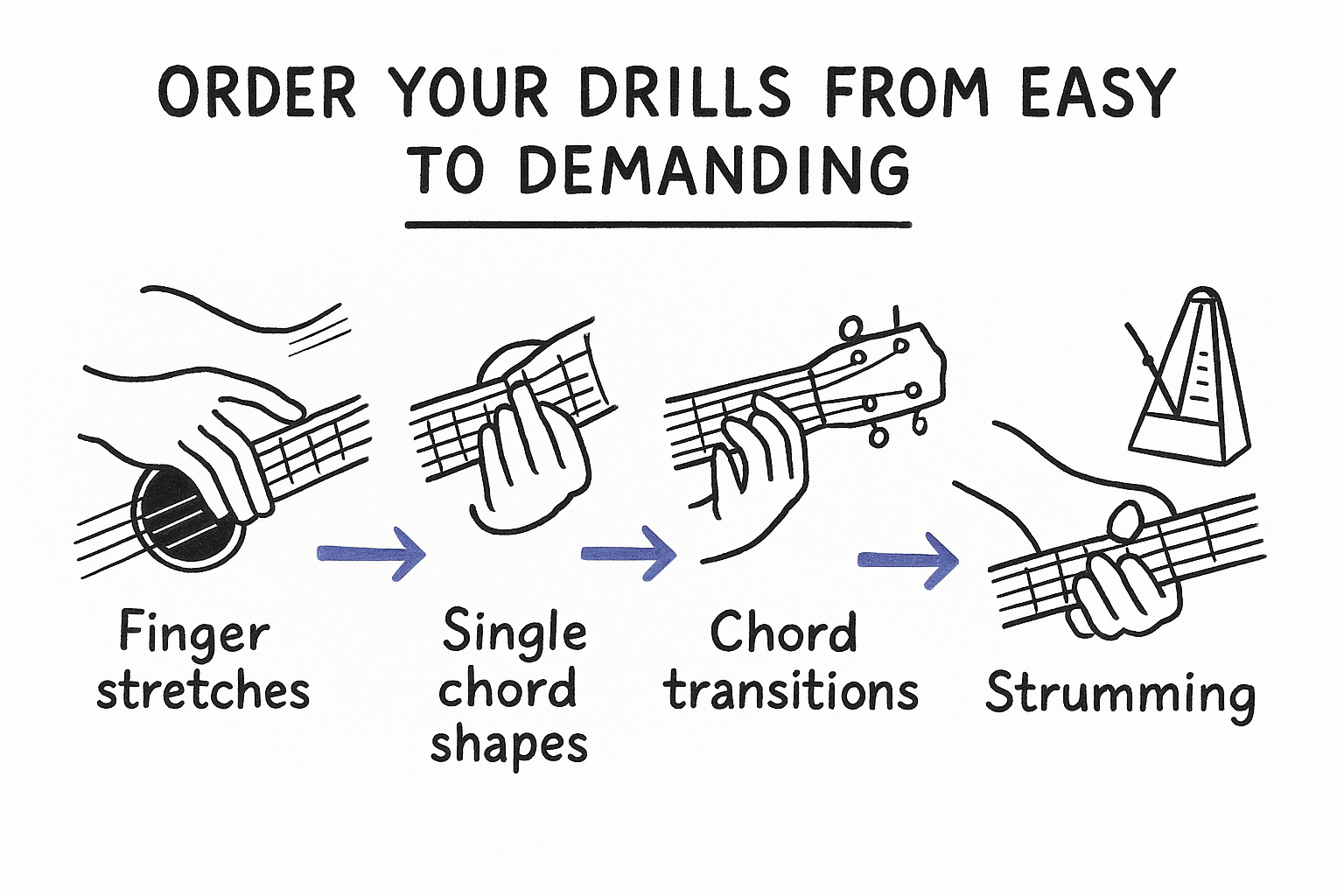
- Finger stretches and chromatic runs (frets 1-2-3-4 on each string)
- Single chord shapes held for a clean, buzz-free sound
- Chord-to-chord transitions at a slow, deliberate tempo
- Strumming pattern practice with a metronome or drum loop
- Applying the pattern and chords inside your chosen song
Warm, precise, then musical, that order prevents almost every beginner mistake.
Match skill blocks to your available minutes
How much time each block gets depends on the session length you settled on in Step 2, but the sequence itself doesn't change.
| Skill block | 20-minute session | 40-minute session |
|---|---|---|
| Warm-up | 3 min | 5 min |
| Chord accuracy | 5 min | 8 min |
| Transitions | 5 min | 10 min |
| Strumming | 4 min | 7 min |
| Song application | 3 min | 10 min |
Sticking to this order every day, even when the minutes shift, is what turns a vague intention to "practice guitar" into a repeatable session you can execute half asleep.
Rotate which skill gets extra attention
Every few days, give one block a little more time than usual instead of splitting everything evenly forever. If your G to C transition is still shaky, borrow two minutes from song application and put them into transitions until it smooths out. This flexible weighting keeps the structure intact while letting you respond to whatever is actually holding you back that week, rather than treating every skill as equally urgent when it isn't.
Step 4. Track progress and revisit weak spots
Without a record, you'll forget which chord tripped you up on Tuesday and end up guessing again on Friday. A beginner guitar practice plan only works long-term if you write down what happened in each session, even if it's just three lines in a notes app. Tracking turns "I feel like I'm improving" into "my G to C transition went from 8 seconds to 3 seconds this week," which is the kind of evidence that keeps you motivated when progress feels slow.
Log every session in under a minute
Skip anything that takes longer than a minute to fill out or you'll stop doing it within a week. A simple rating system works better than a paragraph of notes.
- Date and duration: when you practiced and for how long
- Rating per skill: Again, Hard, Good, or Easy for each pillar you drilled
- One weak spot: the single thing that felt shakiest today
- One win: anything that felt noticeably easier than last time
Let weak spots resurface on a schedule
Rating a skill "Again" or "Hard" should automatically flag it for tomorrow's session, not a vague "someday." Rating it "Good" or "Easy" means you can space it out further and spend that time elsewhere. This is exactly the logic behind spaced repetition: skills fade on a predictable curve, and revisiting them right before they fade is more efficient than either cramming daily or ignoring them until they collapse. The Ebbinghaus forgetting curve describes this decay, and it applies to motor skills like chord changes just as much as it applies to vocabulary.
Rate honestly, and your practice schedule writes itself.
Compare weeks, not just days
One bad session tells you nothing useful. A month of logged ratings tells you exactly which chords, strums, or songs need more reps and which ones you can safely stop drilling. Reviewing your log every Sunday for five minutes is enough to spot patterns, like a strum pattern that keeps getting rated "Hard" three weeks running, which means it needs a different approach, not just more repetition of the same drill.
Turning your plan into a daily habit
A plan only matters if you actually run it tomorrow, and the next day, and the day after that. You now have a repeatable structure: clear goals, a protected time slot, a skill order that goes from easy to demanding, and a log that tells you exactly what needs another rep. That's the whole system. Nothing here requires talent, just showing up with the same sequence often enough that it stops feeling like a decision.
Guessing what to practice is the fastest way back to random noodling, and manually tracking every chord and strum pattern in a notebook gets tedious fast. That's exactly the gap spaced repetition software was built to close. If you want the scheduling and weak-spot tracking done for you automatically, see how memoRep's algorithm decides what you practice next, then grab a free beta spot while they're still open.