5 Best Apps to Learn Music Theory in 2026
Learning music theory from a book is one thing. Remembering it three weeks later, when you actually need it to sight-read a chord progression or analyze a piece, is another problem entirely. If you've searched for the best apps to learn music theory, you're probably tired of apps that teach a concept once and then move on, leaving you to re-learn the same intervals and key signatures over and over.
This list covers the apps that actually work in 2026, based on how well they teach theory concepts, how they handle repetition and retention, and whether they fit into a real practice routine rather than a one-off study session. Some focus on ear training, others on notation and harmony, and each one has clear strengths depending on your goals and current skill level.
We'll break down what each app does well, where it falls short, and who it's best suited for. And since knowing theory isn't the same as applying it at your instrument, we'll also touch on how pairing theory apps with a spaced repetition system like MemoRep helps you turn what you've learned into practice you actually remember, so concepts stick instead of fading after the lesson ends.
1. MemoRep for spaced-repetition music theory practice
MemoRep isn't a theory course that walks you through key signatures or cadences from scratch. It's a practice management platform built specifically to fix the retention problem that theory apps ignore: you learn a concept, move on, and forget it three weeks later. MemoRep uses the SuperMemo SM-2 algorithm and the Ebbinghaus forgetting curve to schedule review of the theory drills, intervals, or chord progressions you're working on, so they resurface right before you'd otherwise forget them.
Learning a theory concept once isn't the same as being able to recall and apply it under pressure, and that's the gap MemoRep is built to close.
What it offers
You create practice cards for whatever theory concept you're drilling, whether that's identifying diminished chords by ear, naming intervals, or recognizing modes in a progression. MemoRep organizes these into projects and tells you exactly what to review each day based on how well you've been performing.
Who it's best for
MemoRep suits musicians who've already got a theory app or teacher feeding them concepts but need a system to make those concepts stick. It's especially useful for players juggling multiple skills at once, since it removes the guesswork of deciding what to review and when.
Key features
- Adaptive scheduling that adjusts intervals based on your Again/Hard/Good/Easy ratings
- Practice reminder notifications so review sessions don't get skipped
- Progress tracking and visualization across projects
- Card organization built for practical skills, not flashcard-style memorization
Pricing
MemoRep is currently running a limited beta program, giving the first 200 users free premium access. That makes now a low-risk time to try it alongside whatever theory app you're already using.
2. Musictheory.net for foundational lessons and drills
Musictheory.net has been the default starting point for self-taught musicians for years, and it still holds up in 2026. It's a free, no-frills website that walks you through the basics of notation, intervals, scales, and chords using clear diagrams and short explanations, then backs each lesson with a matching drill. There's no gamification or flashy design here, just solid foundational teaching that gets straight to the point.
What it offers
The site pairs written lessons with interactive ear training and identification exercises, covering everything from note reading to key signatures and chord construction. You work through material at your own pace, and each drill gives immediate feedback.
If you need to actually understand a concept before you can drill it, Musictheory.net is where that understanding usually starts.
Who it's best for
This app suits beginners and anyone brushing up on fundamentals before moving to more advanced material elsewhere.
Key features
- Lessons on notation, intervals, scales, and chords
- Matching exercises for each lesson topic
- Simple, distraction-free interface
- Free companion apps for iOS and Android
Pricing
The core lessons and exercises are entirely free, with optional paid mobile apps priced around $2 to $5.
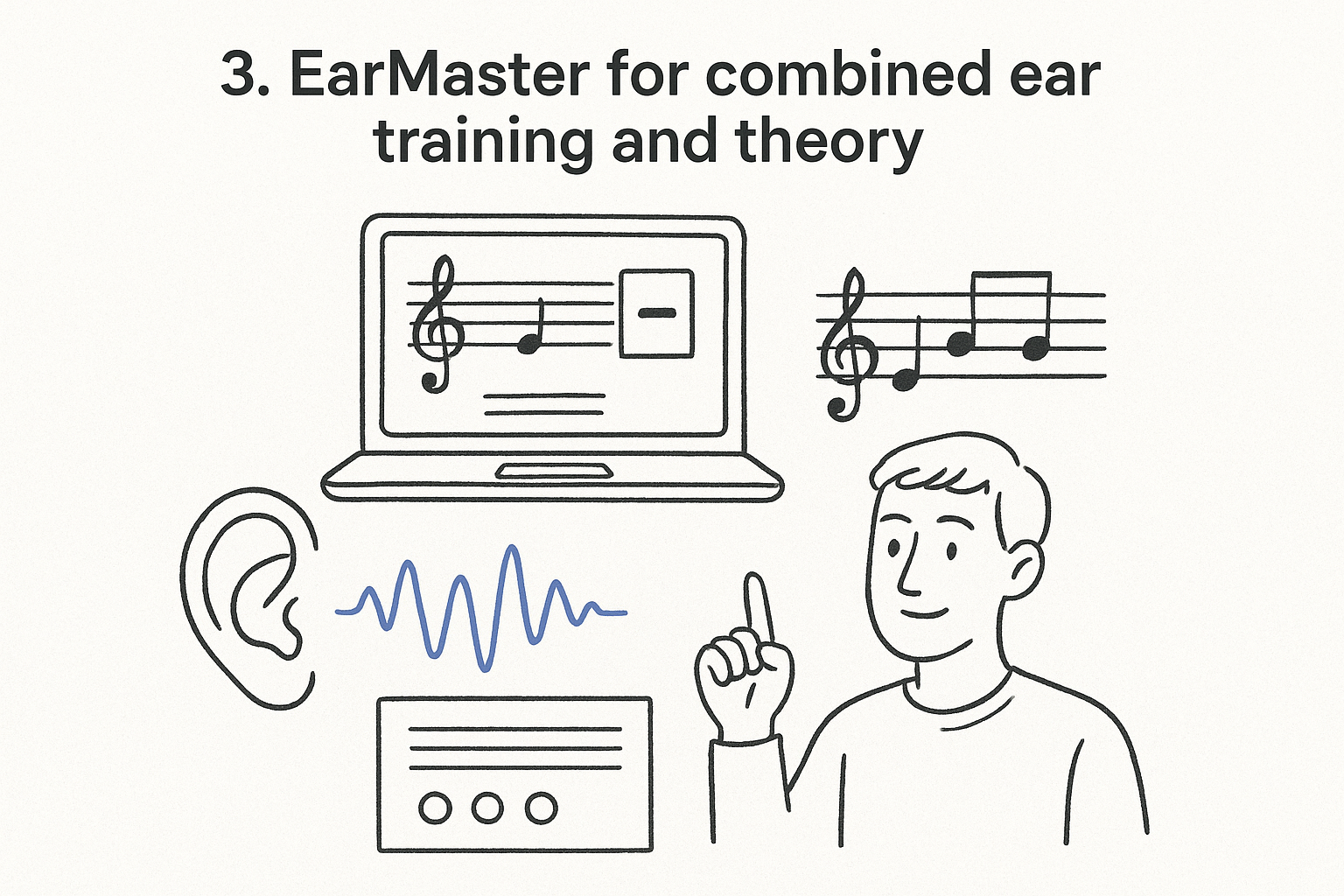
3. EarMaster for combined ear training and theory
EarMaster has been a staple in conservatories and self-study circles for over two decades, and its 2026 version still earns that reputation. It's built around the idea that theory and ear training aren't separate skills, so every lesson pairs a concept, like intervals or chord inversions, with listening exercises that force you to identify it by sound, not just on paper.
What it offers
The app runs you through structured courses covering intervals, scales, chords, and rhythm, each with progressive difficulty levels. You sing, clap, or answer multiple-choice prompts depending on the exercise, and EarMaster adjusts pacing based on your accuracy.
Theory only sticks when you can hear it, not just define it, and that's exactly where EarMaster earns its keep.
Who it's best for
EarMaster suits intermediate players and music students preparing for auditions or coursework that demands strong aural skills alongside theory knowledge.
Key features
- Interval, chord, and scale ear training drills
- Rhythm dictation and sight-singing exercises
- Progress reports by skill category
- Desktop, iOS, and Android versions
Pricing
EarMaster offers a free trial, with full access starting around $8 per month or a one-time license near $70.
4. ABRSM Music Theory Trainer for exam preparation
If you're working toward a graded music exam, ABRSM's own trainer app is worth checking before anything else. It's built directly from the ABRSM syllabus, covering grades 1 through 5, and mirrors the format and question style you'll actually face on test day. This isn't a general theory app trying to cover everyone's needs, it's a focused tool for one specific goal: passing your exam.
What it offers
The app delivers practice questions modeled on real exam papers, covering notation, key signatures, intervals, and terminology at each grade level. You get instant feedback and explanations, so wrong answers become learning moments instead of dead ends.
When your goal is a specific exam, practicing with questions built from that exact syllabus beats generic theory drills every time.
Who it's best for
This app suits students actively preparing for ABRSM grade exams, particularly those working with a teacher who wants a structured way to reinforce syllabus material at home.
Key features
- Practice questions by grade level, 1 through 5
- Instant feedback with explanations
- Progress tracking tied to exam readiness
- Content aligned directly with ABRSM's official syllabus
Pricing
The app is free to download, with grade-specific question packs available as in-app purchases, typically a few dollars each.
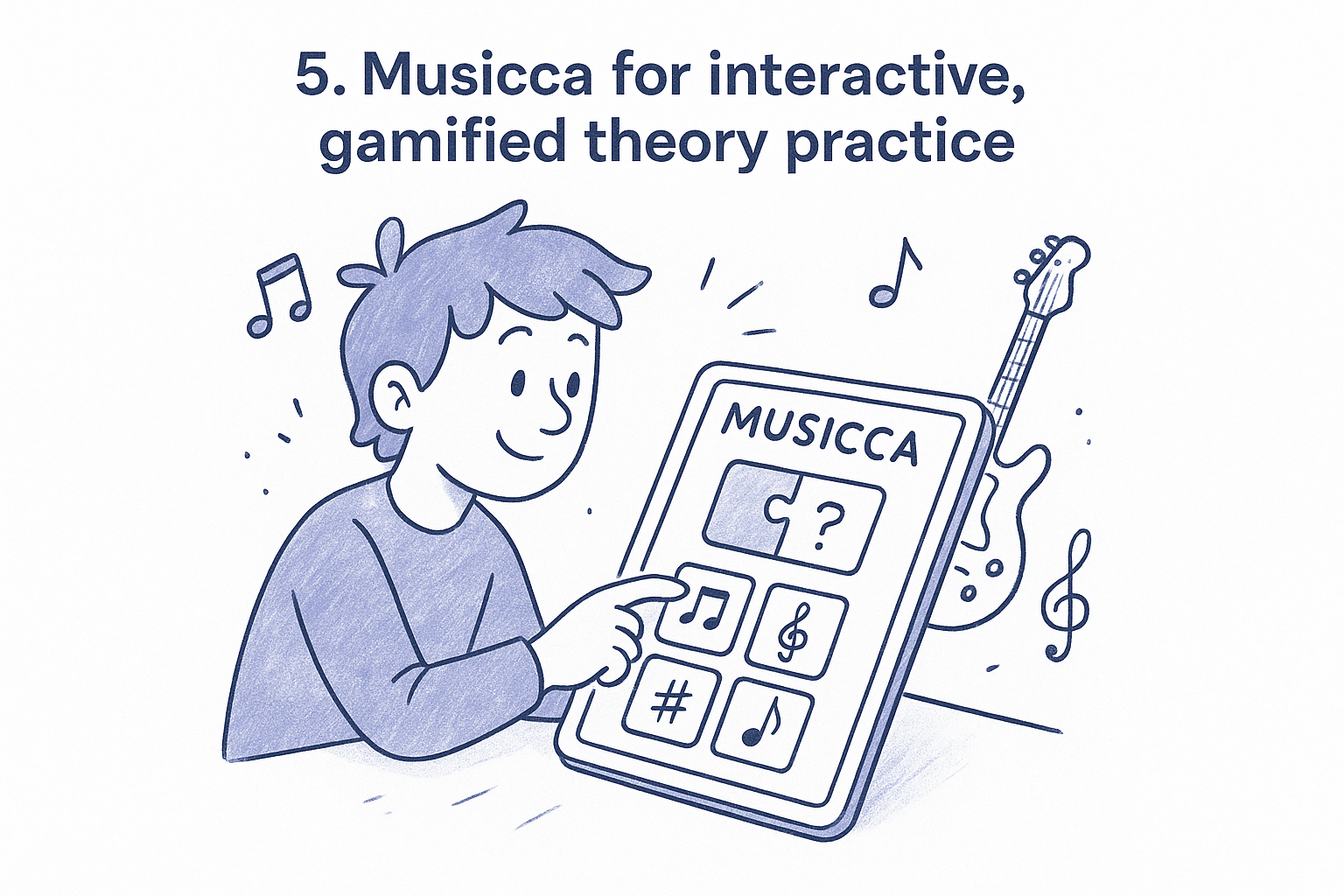
5. Musicca for interactive, gamified theory practice
Musicca takes a different approach than the others on this list, wrapping theory lessons in bite-sized, game-like exercises that feel more like a quick puzzle than a study session. It covers a wide range of topics, from rhythm and scales to chord construction and key signatures, and works entirely in the browser with no download required. The design leans casual, but the content underneath is solid enough for real progress.
What it offers
You get short interactive games and quizzes for each theory topic, plus a piano and guitar chord reference you can browse anytime. Everything runs in short bursts, so it fits into small pockets of free time.
Theory practice sticks better when it doesn't feel like homework, and that's Musicca's whole pitch.
Who it's best for
Musicca suits casual learners and younger students who want theory practice without the pressure of a structured course or exam deadline.
Key features
- Gamified exercises for rhythm, scales, chords, and key signatures
- Built-in chord and scale reference charts
- No account or download needed to start
- Works on desktop and mobile browsers
Pricing
Musicca is free to use, supported by ads, with no premium tier currently offered.
Choosing the right app for your practice routine
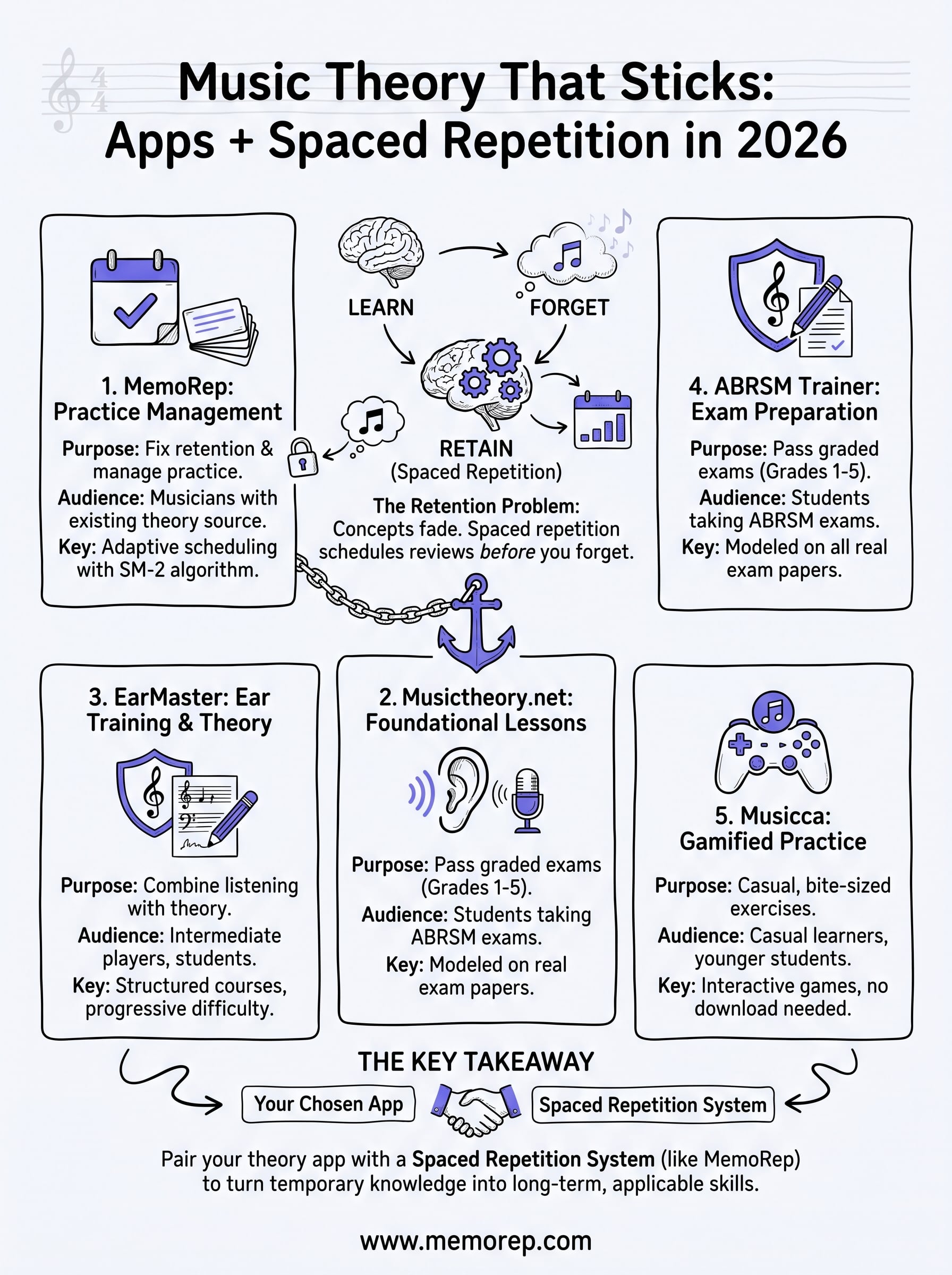
Each app on this list solves a different piece of the puzzle. Musictheory.net and Musicca build your foundation, EarMaster sharpens your ear, and ABRSM's trainer gets you exam-ready. None of them, though, solve the problem of forgetting what you learned once the lesson ends. That's the gap that matters most, because knowing a concept once isn't the same as being able to recall it under pressure weeks later.
Pick the theory app that fits your current goal, whether that's passing an exam or just understanding key signatures for the first time. Then pair it with a system built to keep that knowledge sharp long after the lesson is over. If you want to see exactly how spaced repetition keeps theory concepts and practice drills from fading, check out the science behind MemoRep and start building a practice routine that actually sticks.