How to Memorize Music Scales: A 4-Step Retention Plan
If you want to know how to memorize music scales, stop running them top to bottom every day and start retrieving them on a schedule. Give each scale its own practice card, play it from memory before you check anything, rate the result honestly, and review it again just as it starts to fade. That loop keeps a scale in your hands for months instead of days.
Most players know the problem. You learn A minor on Monday, it feels solid on Wednesday, and three weeks later you hesitate on the second note. Or you replay the three scales you like while the awkward ones quietly disappear. Then you spend the first ten minutes of each session deciding what to practice, and the decision itself wears you out.
This guide covers the memory side of scales: why they fade, then four steps that fix it. It does not teach scale theory, fingering, or technique. Your teacher is the right person for those, and this plan works with whatever scales they assign. It is the same approach we built MemoRep around, so you can run it on paper or in the app.
Why scales fade and what you control
You control when and how you retrieve a scale, and that matters more than how often you replay it. Memory fades quickly after you learn something and more slowly each time you successfully pull it back. Hermann Ebbinghaus described this pattern in 1885, and it is known as the forgetting curve. Your scales follow it like everything else.
Why scales slip away
Scales are exposed to forgetting because they feel easy. When you play one on autopilot, you are recognizing a familiar movement, not recalling it cold. Recognition feels like knowing, but it is a weaker test than starting from nothing and producing the scale yourself.
The second cause is uneven attention. You drift toward the scales you already play well and skip the ones that need work. A schedule removes that bias because it picks the next scale for you.
A scale you can only play after warming up on it is not memorized yet.
What this guide leaves to your teacher
You will find plenty of tricks online: mnemonics, interval formulas, the circle of fifths, shortcuts for minor scales. Those are ways to remember music theory, and which ones suit you depends on your instrument and level. Ask your teacher before you adopt any of them. They can help you understand a scale, but understanding is not retention. A scale you understand still fades if you do not retrieve it on a schedule.
So this plan takes three things from your teacher: which scales to learn, in what form, and what counts as good enough (a tempo, for example). Everything else is organization.
What you need before you start
Gather these four things:
- A list of the scales your teacher has assigned, with the forms and targets they want.
- Ten minutes a day for review. Five is enough at the beginning.
- A place to record each scale and its next review date. A notebook works, and so does a spreadsheet or an app.
- A willingness to rate yourself honestly, which matters more than any tool.
Step 1. Turn each scale into its own card
Create one practice card per scale, with a clear pass condition written on it. A card is a small, testable unit. Without a pass condition, "practice G major" means anything from a lazy run-through to a flawless performance, and you will always rate it generously.

Write one card per scale and form
If your teacher assigns more than one version of a scale, such as different forms or ranges, give each version its own card. Separate cards let the schedule treat each version according to how well you actually know it. You will often find that you know a scale well in one form and shakily in another.
Use a template like this:
Card: G major
Form: as assigned by my teacher
Pass: played from memory at the agreed tempo, no restarts, no peeking
Notes: anything my teacher told me to watch for
Define what "memorized" means
The pass line is the most important part of the card. Write it in terms you can judge in two seconds: no restarts, no looking at notation or a chart, and the tempo your teacher set. If you cannot tell whether you passed, the rating in the next step becomes a guess.
Here is a worked example. Suppose your teacher assigned five scales: C major, G major, D major, A major, and A minor. You write five cards, one per scale. If the teacher later adds a second form of A minor, you add a sixth card, not a note on the existing one. After ten minutes of setup you have a complete practice inventory, and every later decision about what to play comes from it.
One scale, one card, one pass condition you can judge instantly.
Step 2. Play from memory, then rate it honestly
Play the scale before you look at anything, then rate how it went using four fixed ratings. This step turns practice into retrieval. Pulling a scale out of memory strengthens it far more than rereading or replaying it with the answer in front of you. Research on retrieval practice has shown this repeatedly.
Play it cold
Take the card, put the notation and any chart away, and play the scale straight away. No warm-up run, and no "let me just check the first note". If you need a hint, that is useful information, and the next sub-step records it.
Shuffle the order of your due cards so you cannot predict what comes next. In real playing, a scale does not announce itself. Cards that come up in a random order test whether you can start one cold.
Rate with four honest options
Use the Again, Hard, Good, Easy scale that spaced repetition tools use. Here is what each means for a scale card:
| Rating | What happened | What it tells the schedule |
|---|---|---|
| Again | You restarted, stalled, peeked, or could not finish | Bring it back soon |
| Hard | You finished, but with clear hesitation or errors | Review it sooner than usual |
| Good | You met the pass condition with a normal amount of effort | Move to the next interval |
| Easy | You met it instantly and with no doubt | Stretch the interval |
The common mistake is rating Good because you got there eventually. Use a simple rule instead: any restart or peek is an Again or a Hard. It feels harsh for a week, but it makes the schedule accurate.
Your rating is the only data the schedule has, so make it true.
Keep each card to one or two minutes. If a scale needs more work than that, the rating has already told you so. Take that card to your teacher and let them decide what to change.
Step 3. Let a schedule decide when to review
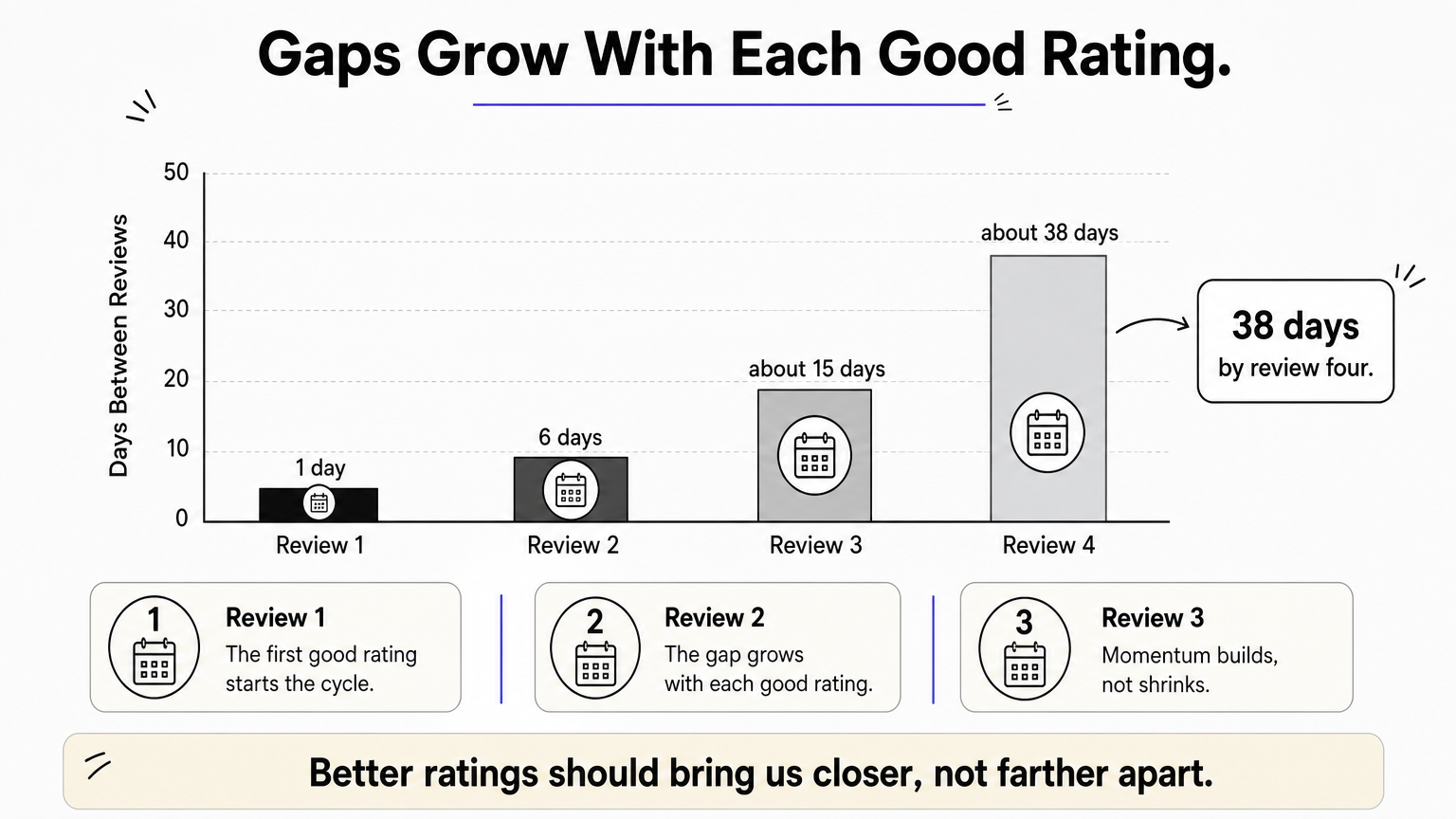
Review each card just before you would forget it, and let the gap grow every time you pass. This is the spaced repetition method, and it replaces the daily guessing game of "what should I play today?" with a short list of cards that are actually due.
How review intervals grow
The classic SuperMemo SM-2 algorithm starts with a one-day gap, then six days, then multiplies each gap by an ease factor, 2.5 by default. If you rate Good every time, a card follows this ladder:
| Review | Gap before it | Days since you learned the card |
|---|---|---|
| 1 | 1 day | 1 |
| 2 | 6 days | 7 |
| 3 | about 15 days | 22 |
| 4 | about 38 days | 60 |
Treat these as a textbook illustration, not a promise. Real intervals shift with your ratings, and MemoRep adjusts each card to how you experience it. A card you rate Hard comes back sooner than one you rate Easy. In classic SM-2, an Again sends the card back to the start of the ladder.
What the schedule saves you
Take the five-scale example from Step 1. If you replayed every scale daily for 60 days, that would be 300 runs. At about a minute each, that is five hours. On the ladder above, with Good ratings throughout, each card needs only four reviews in 60 days, so 20 reviews, or about 20 minutes in total.
The gap is not that dramatic in real life. Some cards will drop back to Again, and you will still play scales in lessons and inside your pieces. But the principle holds: most of your daily scale time was never doing anything, and a schedule gives it back.
What to do when you miss days
Missed days are normal. A good schedule does not punish them. When you come back, the overdue cards are simply the first ones in line. Play them cold, rate them honestly, and let the intervals adjust. Do not try to catch up by replaying everything.
Review a scale when it is about to fade, not when it feels like time.
You can run this ladder in a notebook, but tracking due dates for dozens of cards by hand gets tedious. That is the job MemoRep does: it schedules the cards, sends a daily practice notification, and shows you what is due.
Step 4. Add scales slowly and track what slips
Add new scales at a steady, capped pace, and watch your ratings for the cards that keep failing. Memorizing fails when the review pile grows faster than you can clear it. A small, steady intake keeps your daily session short enough to repeat for months.
Set a pace for new cards
A good starting rule is one new scale every two or three days, and none on a day when your due list already fills your time. Suppose you have 12 scales to learn and add one every three days. That is 36 days to put all 12 into rotation, with each early card already well into its ladder by the time you add the last one.
Hold the daily session to a fixed size, such as 10 to 15 minutes. If the due cards exceed your time for three days running, pause new cards until the pile shrinks. Your teacher's plan may include more scales over time. The pace rule lets you absorb them without panic.
Read your own data
After a few weeks, your ratings show you something no amount of feeling can: which scales are actually weak. Look for cards you rate Again twice in a row. A card that keeps failing is not a memory problem you can fix with more reviews. It is a question for your teacher.
Bring that short list to your next lesson. Your teacher spends the time on the exact scales that need help instead of re-testing everything. That is also how the practice side and the teaching side stay separate and useful to each other.
Run a cold check once a month
Once a month, pick three random cards and play them with no warm-up and no prior review that day. If all three pass, your schedule is working. If one or two fail, check your ratings. You have probably been rating Good where Hard was the honest answer. Adjust the rule from Step 2, not the schedule.
Cap how many new scales you add, so reviews always stay shorter than your session.
Start with five cards this week
To memorize music scales, put each assigned scale on its own card, play it from memory before checking anything, rate it honestly, and review it on a growing schedule. Add new scales slowly, and take the cards that keep failing to your teacher. The method is simple, and it works because it asks you to retrieve a scale, not just replay it.
You can start tonight with five cards and a notebook. If you would rather have the scheduling, the due list, and the daily reminders handled for you, see how MemoRep works. It is free during the beta, with a limited number of spots, and it gives you a calm routine that tells you what to practice next.