How to Make an Active Recall Sheet and Study with It
To make an active recall sheet, draw a page with a question column, a column for your answer from memory, a column to mark right or wrong, and a column for the next review date. Write questions from your notes, answer them with the notes closed, check yourself, and re-test the misses first. Four steps are enough, and the layout works on paper, in Excel, or in Notion.
Rereading feels productive because the page looks familiar. Familiar is not the same as remembered, and you only find the gap in the exam. Searching for a template usually turns up pinned layouts or paid downloads. A template is just a frame. The learning happens in how you fill it and how often you come back to it.
This guide shows the exact columns to copy, a filled-in example, and a schedule for re-testing. At MemoRep we build spaced repetition for practice routines, so when you revisit material is something we think about daily. The same logic makes a plain sheet work far better.
Why an active recall sheet works
An active recall sheet works because it forces you to pull answers out of memory instead of looking at them. Retrieval is the effort that strengthens memory, and a sheet gives that effort a structure you can repeat.
What an active recall sheet is
It is a table of questions with blank space for answers. You cover the answers, write what you remember, then compare against your notes. The sheet turns studying into a quiz you give yourself, and the quiz doubles as a record of what you still get wrong.
Why it beats rereading
Researchers call it the testing effect. In a well-known 2006 study by Roediger and Karpicke, students who tested themselves on a text remembered more a week later than students who reread it, even though the rereaders felt more confident. Retrieval practice beats rereading for lasting memory, and your own sheet shows you the proof every time you score it.

What you need before you start
You need four things:
- Your notes or textbook chapter
- A pen and paper, or a spreadsheet
- A timer
- About 45 minutes for the first build
Rereading shows you the answer. A recall sheet makes you produce it.
Step 1. Set up your sheet
Set up the sheet with six columns: topic, question, your answer from memory, result, fix, and next review. Each column has one job, and none can be skipped without weakening the sheet.
The columns to copy
Paste this header row into Excel or Google Sheets, or into a Notion table as column names:
Topic,Question,My answer (from memory),Result (correct / partly / wrong),Fix,Next review
The "My answer" column is the heart of the active recall template. Leave it blank when you build the sheet. On paper, fold the page or use a sticky note to hide your notes while you fill it.
Paper, Excel, or Notion
Pick the format you will actually open. The content matters more than the tool.
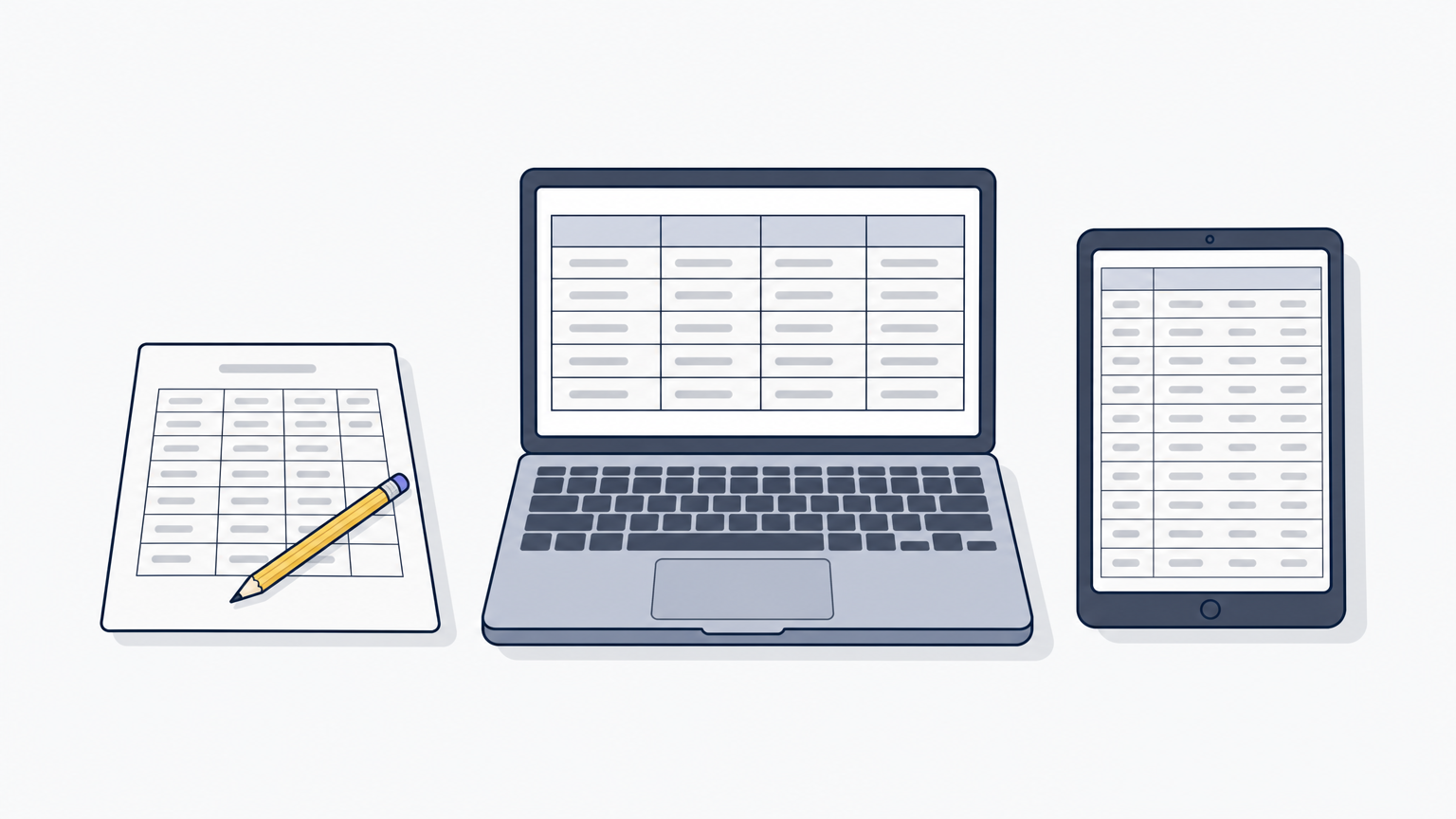
| Format | Best for | Watch out for |
|---|---|---|
| Paper, printed grid | Handwriting, no distractions | Hard to sort or move rows |
| Excel or Google Sheets | Sorting by result or date | Easy to peek at answers |
| Notion table | Filtering by next review date | Setup takes longer |
In a spreadsheet, hide the "Fix" column while you answer, then unhide it to check. In Notion, a "Next review" date property lets you filter for today's rows.
Choose the format you will open daily, because a perfect sheet you never use teaches nothing.
Step 2. Turn your notes into questions
Turn each note into a question that has one clear answer, written before you ever look at the answer. A good sheet is mostly good questions, so spend your effort here.
Write questions that force recall
Keep each question to one fact or one idea. "Explain photosynthesis" is too broad to score. "What are the two products of the light-dependent reactions?" is specific. Prefer "why" and "how" questions over yes/no ones, since a guess can pass a yes/no question.
Avoid multiple choice. When the answer sits next to the question, you only recognize it, which is easier than recalling it. If your notes are thin, borrow questions from end-of-chapter exercises, learning objectives, or past papers.
A filled-in example
Here is what three rows look like after one test. The subject is biology, but the layout fits any text-based subject.
| Question | My answer (from memory) | Result | Fix |
|---|---|---|---|
| What does the mitochondrion do? | Makes ATP through respiration | Correct | None |
| Why does an enzyme reaction rate level off as substrate rises? | Enzymes get tired | Partly | Active sites are all occupied, so the enzyme is saturated |
| How do mitosis and meiosis differ? | (blank) | Wrong | Mitosis makes two identical cells. Meiosis makes four cells with half the chromosomes |
Notice the wrong answer is useful. A blank cell tells you exactly where to study next.
One fact per question is the rule that makes scoring honest.
Step 3. Answer from memory and score yourself
Close your notes, answer every question in writing, and only then check. Writing the answer, even a messy one, is what makes this active recall instead of a mental skim.
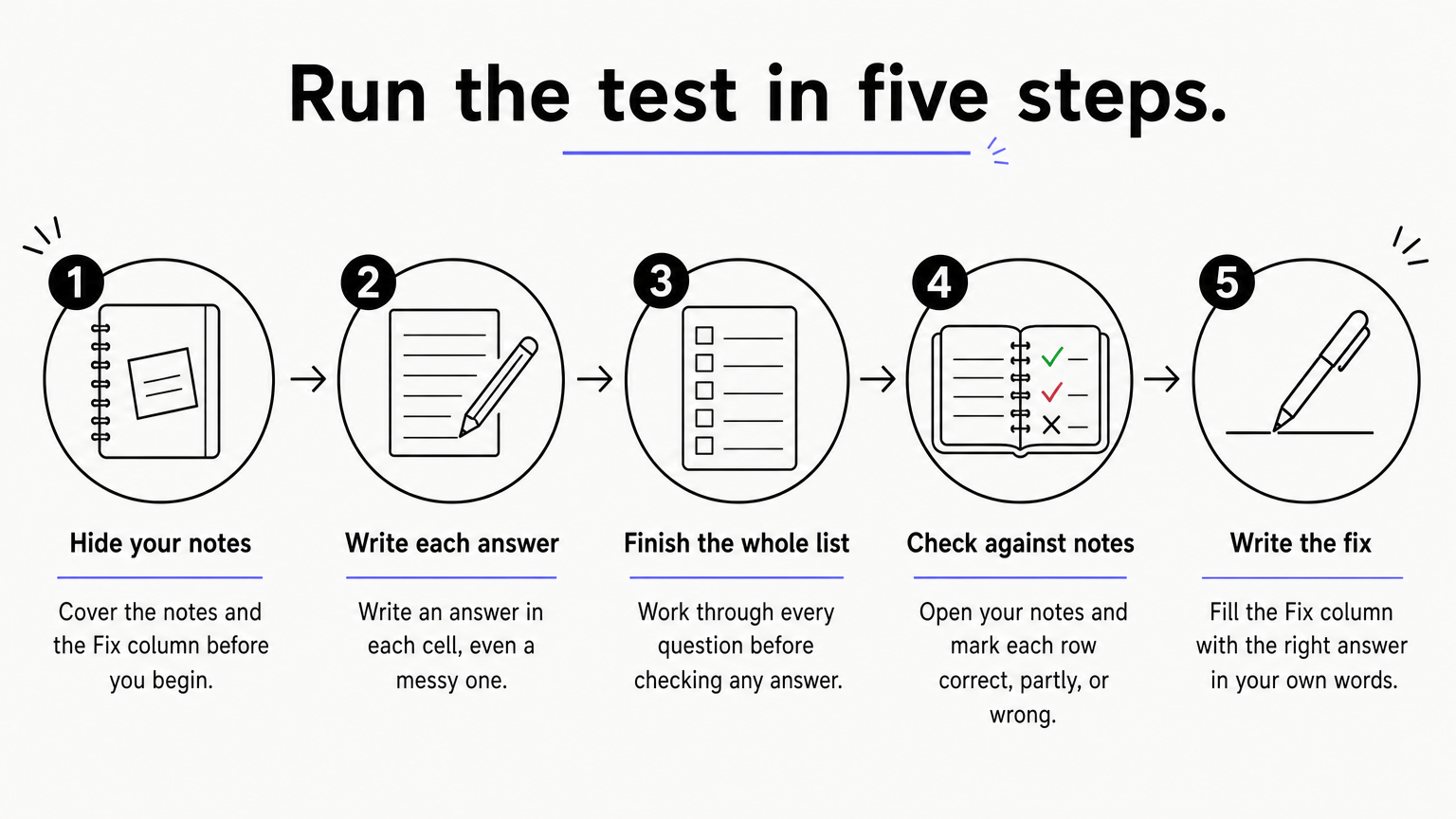
Run the test
- Hide your notes and the Fix column.
- Read a question and write your answer in the "My answer" cell. Leave it blank if you have nothing.
- Work through the whole list before checking anything.
- Open your notes and mark each row correct, partly, or wrong.
- Fill the Fix column with the right answer, in your own words.
If you want a faster variation, try blurting. Write everything you remember about a topic on a blank page, then compare it with your notes and turn the gaps into new rows.
Does active recall actually work?
Yes, and the evidence is old and consistent. Testing yourself improves long-term retention compared with rereading, and getting an answer wrong is not a failure. The check-and-fix step gives the correction more attention than a passive read ever would. It will feel harder than rereading. That difficulty is the point.
Do not check an answer until you have written one, even a bad one.
Step 4. Re-test your sheet on a schedule
Re-test the rows you missed tomorrow and push the ones you got right to longer gaps. Spaced repetition adds the "when" to your sheet, and it is what turns one good session into lasting memory.
A simple review schedule
Use the result column to set the next review:
| Result | Next review |
|---|---|
| Wrong | Tomorrow |
| Partly | In 2 days |
| Correct | In 3 days, then 7, then 14 |
Take a sheet with 20 questions. After the first test you get 14 correct, 4 partly, and 2 wrong. Tomorrow you re-test 2 questions, in 2 days you re-test 4, and in 3 days you re-test the 14. The first full pass takes roughly 15 minutes, and later sessions get shorter as rows pass.
When a sheet is not enough
A sheet suits written material, and you maintain the dates by hand. Anki's desktop app is free and handles scheduling automatically if you would rather not track dates yourself.
For practical skills, a Q&A sheet is the wrong tool. Songs, drills, and exercises do not fit in a question cell. MemoRep covers that gap. It turns pieces and exercises into practice cards, asks you to rate each pass as Again, Hard, Good, or Easy, and schedules the next pass just before the skill fades. It does not teach technique, and it is not a flashcard app. It decides what to practice and when.
The schedule matters as much as the questions, because a recall sheet you never revisit is just another set of notes.
Start with one page
An active recall sheet needs six columns, questions with one answer each, a closed-book test, honest scoring, and a re-test schedule. Build the first page from the chapter you are most worried about. Twenty questions are plenty to begin with.
If your goal also includes keeping songs, exercises, or drills from fading, you need a schedule more than a sheet. You can try MemoRep free for life during the limited beta and let it decide what to practice next.