Deliberate Practice in Psychology: What It Is and Its Key Components
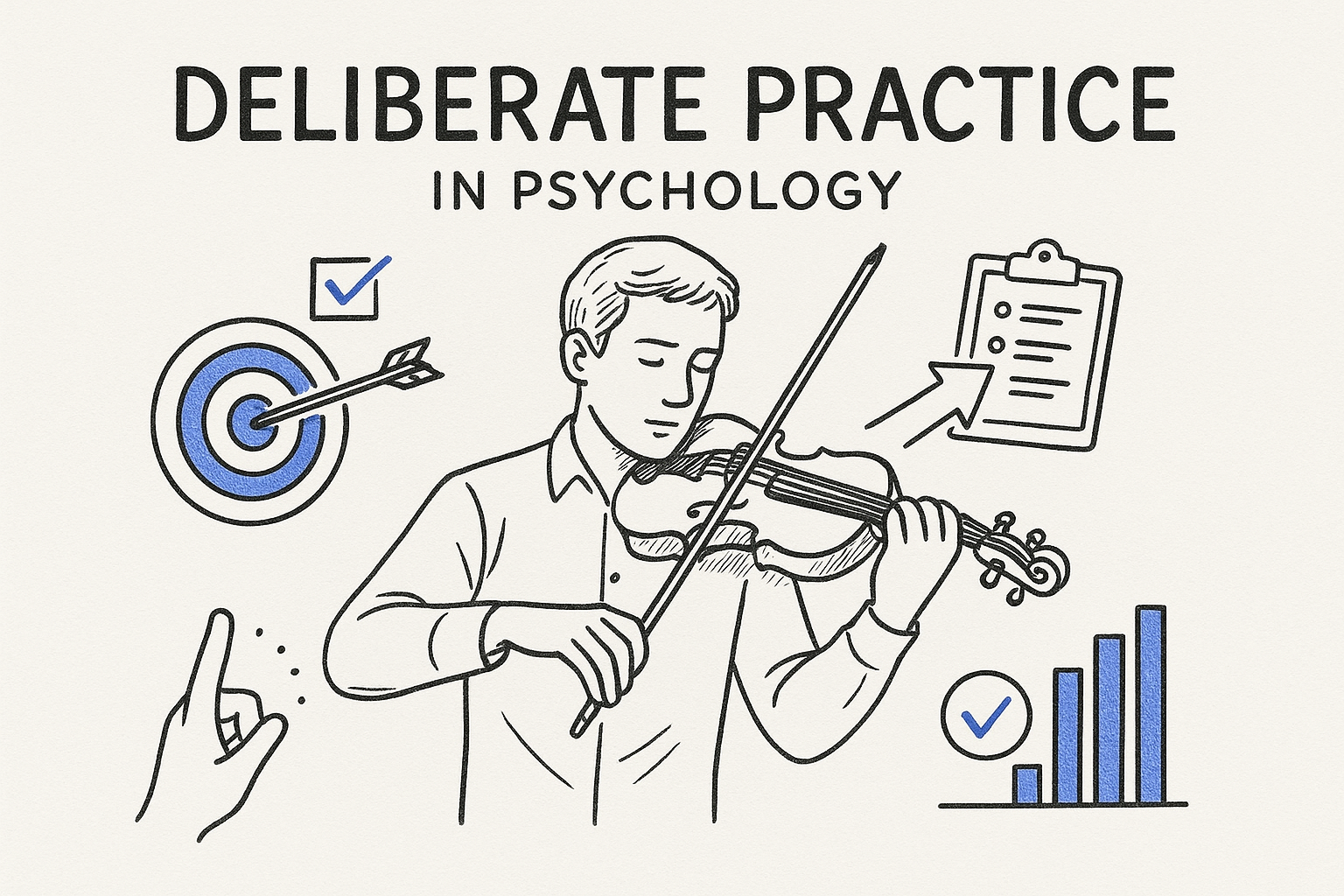
You have probably heard that 10,000 hours make an expert. That number gets thrown around a lot, but it misses the point. Deliberate practice psychology is not about clocking hours, it is about how you spend them. Anders Ericsson, the researcher behind the concept, found that top performers in music, chess, and sports practice in a specific, structured way that most people never learn.
So what actually separates deliberate practice from just showing up and playing through your piece a few times? In psychology, deliberate practice in psychology refers to a deliberate, effortful process built on clear goals, immediate feedback, and constant repetition of the exact thing you struggle with, not the parts you already do well.
In this article, you will get a full breakdown of the components of deliberate practice, from goal-setting and feedback loops to the mental focus it demands. You will also see how this compares to casual, unstructured practice, and why the difference matters if you are trying to actually get better at a skill instead of just spending time on it.
Why deliberate practice matters more than regular practice
Most people who practice a skill for years still plateau. A guitarist who has played for a decade might not be meaningfully better than one who has played for three years, because repetition alone does not build skill. Regular practice feels productive because you are doing something, but if you are just running through pieces you already know, you are reinforcing existing habits rather than building new ones. Deliberate practice psychology explains this gap: skill growth requires targeted effort aimed at your weaknesses, not comfortable repetition of your strengths.
The plateau problem
Anyone who has practiced without a plan hits the same wall eventually. You get decent, then progress slows, then it stalls completely. This happens because your brain and muscles adapt quickly to familiar demands, and once a task stops feeling hard, it stops driving improvement. Ericsson's research on expert performers found that automatic, mindless repetition actually locks in mediocre technique rather than fixing it. Musicians who practiced their scales the same way for years often performed no better than musicians with half their experience, simply because they never pushed past what already felt easy.
Repetition without a target just makes you consistent at your current level, not better than it.
What the research actually shows
Ersson's landmark studies compared amateur and expert violinists and found the difference wasn't raw practice time but how that time was spent. Top performers spent far more hours in focused, effortful sessions targeting specific weaknesses, guided by a teacher or a clear internal standard for what "correct" sounded like. This is the foundation of deliberate practice in psychology: it treats skill development as a targeted problem-solving activity, not a matter of accumulated hours. You can find a summary of this research in Ericsson's peer-reviewed work published through the American Psychological Association, which remains one of the most cited frameworks in performance psychology (https://www.apa.org/pubs/journals/releases/prj-ericsson).
Regular practice vs. deliberate practice
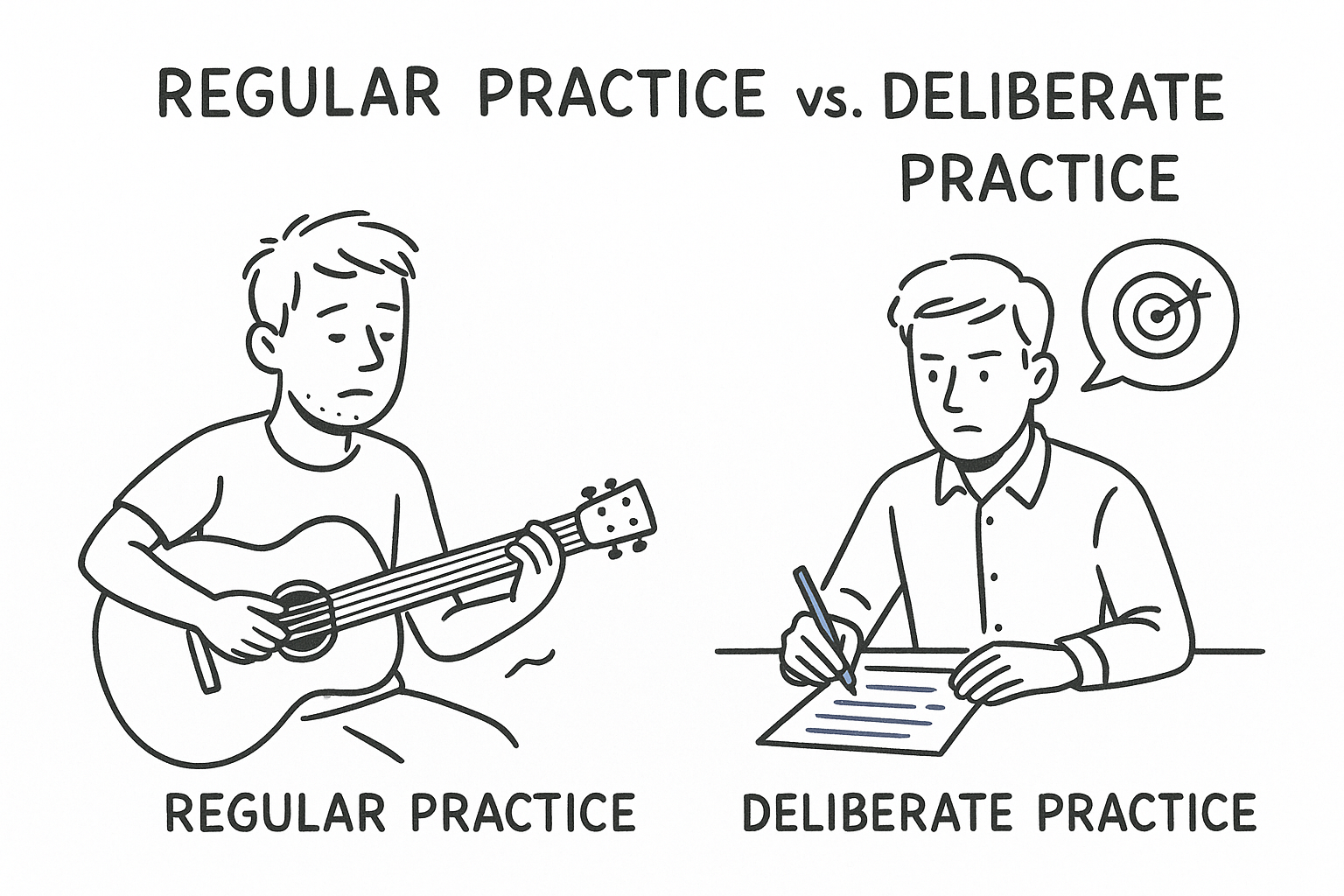
Seeing the two side by side makes the difference concrete:
| Aspect | Regular practice | Deliberate practice |
|---|---|---|
| Focus | Whatever feels comfortable | Specific weak points |
| Feedback | Little or delayed | Immediate, targeted |
| Structure | Loose, repetitive | Goal-driven, planned |
| Mental effort | Low, often automatic | High, requires concentration |
| Outcome | Maintains current level | Builds new capability |
Once you see this table, it becomes obvious why two people with identical practice hours can end up at wildly different skill levels. One person spends an hour reinforcing what they already know. The other spends that same hour attacking the exact technique that is holding them back, tracking whether today's attempt was better than yesterday's.
This matters because your time is limited. If you are a working musician, a hobbyist learning woodworking, or an athlete training between shifts, you do not have unlimited hours to throw at a skill. Deliberate practice gives you a way to make each session count, instead of hoping that enough repetition will eventually produce results on its own.
The key components of deliberate practice
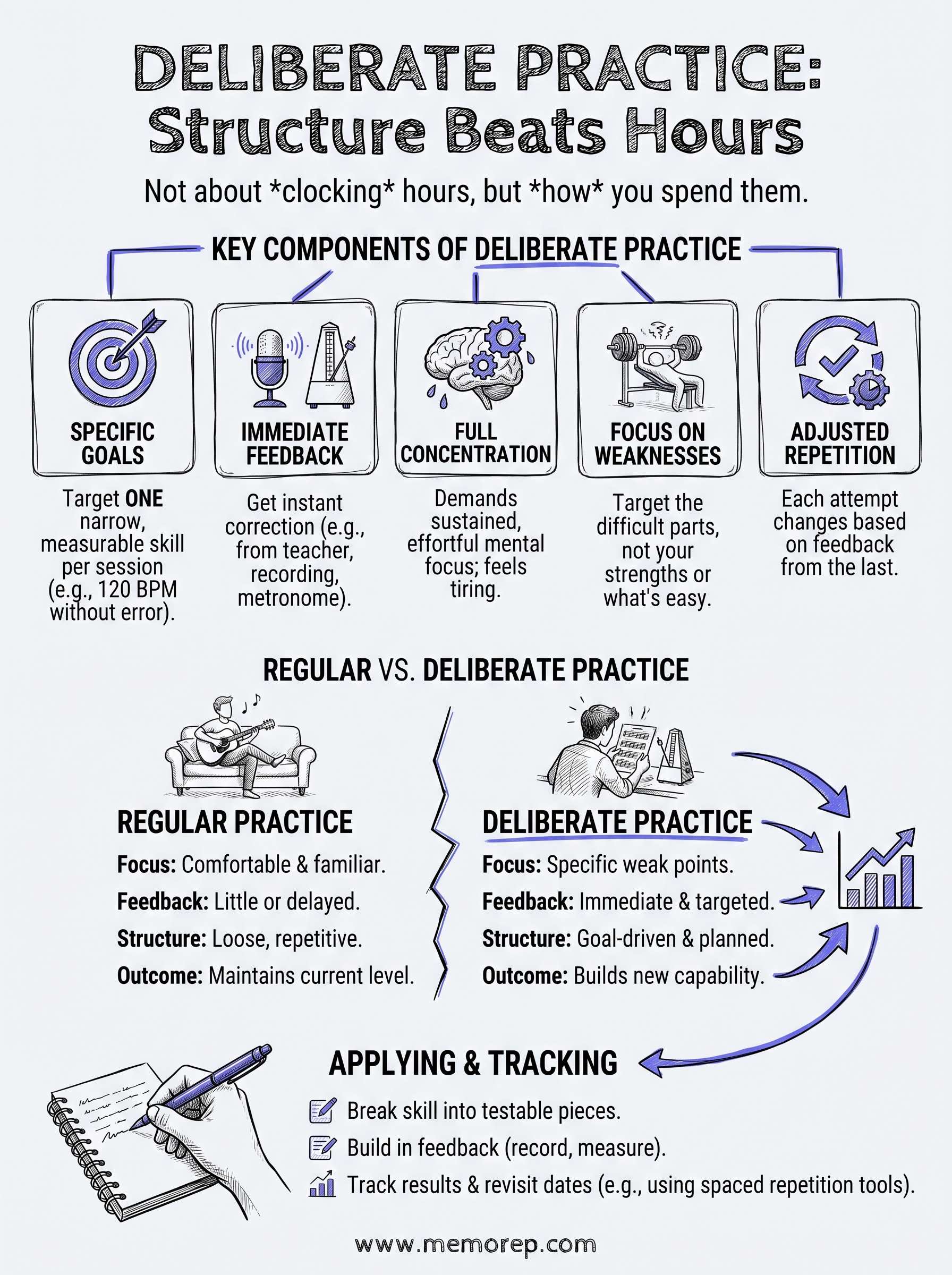
Ericsson's framework breaks deliberate practice into a handful of specific ingredients, and skipping any one of them turns your session back into regular practice. These components of deliberate practice work together, not in isolation, so understanding each one helps you spot what is missing from your own routine.
Specific, well-defined goals
Vague intentions like "get better at piano" do not give your brain anything to aim at. A useful goal targets one narrow thing: play the bridge section at 120 BPM without hesitating on the chord change. Specific goals turn a practice session into an experiment with a clear pass or fail outcome.
Immediate feedback
You cannot fix what you cannot measure in the moment. Deliberate practice depends on immediate feedback, whether that comes from a teacher, a recording device, or a metronome that exposes timing errors instantly. Waiting until next week to find out you have been practicing a passage wrong wastes every repetition in between.
Full concentration and effort
Mindless repetition, even of the right material, does not count. This component demands sustained mental effort, the kind that feels tiring after 20 or 30 minutes. If a session feels easy, you are probably not practicing at the edge of your current ability.
Focus on weaknesses, not strengths
Growth happens at the boundary of what you can already do. Deliberate practice concentrates on the specific passage, movement, or technique that keeps failing, rather than the parts that already sound polished.
Repetition with adjustment
Repeating a task only helps if each attempt responds to the feedback from the last one. This is repetition with a purpose, not repetition on autopilot.
Deliberate practice is not one habit, it is five habits working together at once.
| Component | What it looks like in practice |
|---|---|
| Specific goals | Target one measurable skill per session |
| Immediate feedback | Recording, teacher, or metronome check |
| Full concentration | Sessions that feel mentally demanding |
| Focus on weaknesses | Practicing the hard passage, not the easy one |
| Adjusted repetition | Each attempt changes based on the last |
Miss even one of these and you slide back toward casual repetition, no matter how disciplined your schedule looks on paper.
How to apply deliberate practice to your own skill training
Knowing the theory is one thing, but turning it into a routine you actually follow is where most people get stuck. You do not need a lab or a coach standing over your shoulder to practice deliberately, you just need a structure that forces the five components into every session.
Break your skill into testable pieces
Start by breaking your instrument, sport, or craft into small, testable pieces instead of treating practice as one long blob of time. Pick one weakness, give it a number you can measure (tempo, accuracy, consistency), and work only on that for the session. This is where applying deliberate practice starts to feel different from your old routine, because you walk in with a target instead of a vague plan to "practice for an hour."
Build in feedback before you start
Record yourself, use a metronome, or ask someone who knows the skill to watch and correct you in real time. Without this step, you are back to guessing whether today's repetition was actually better than yesterday's.
Track what happens so nothing repeats blindly
Tracking matters just as much as the practice itself. Note what you worked on, how it went, and when you should revisit it, because your memory of a technique fades on a predictable curve even after it feels solid.
Session log example:
Skill: G major scale, 3 octaves
Goal: 140 BPM, zero fingering errors
Result: 120 BPM, 2 errors on descent
Next session: retry at 125 BPM, isolate descent
Revisit in: 3 days
This is exactly the gap that spaced repetition software was built to close for practical skills. A tool like MemoRep takes this log-and-revisit habit off your plate by scheduling each weak point at the interval when you are about to forget it, using the same forgetting-curve math researchers use to study skill retention. Instead of guessing when to circle back to that shaky chord change, you get told, and the decision fatigue that kills most practice routines disappears.
A practice session without a written target and a recheck date is just time spent, not progress made.
Once you have a goal, a feedback loop, and a way to track revisits, you have built the full deliberate practice cycle, whether you run it on paper or let software handle the scheduling for you.
Real-world examples of deliberate practice in action
Theory only sticks once you see it applied by people whose careers depend on getting it right. Musicians, athletes, and surgeons all lean on the same five components, even though their fields look nothing alike on the surface. Looking at how each group structures practice makes the abstract framework concrete.
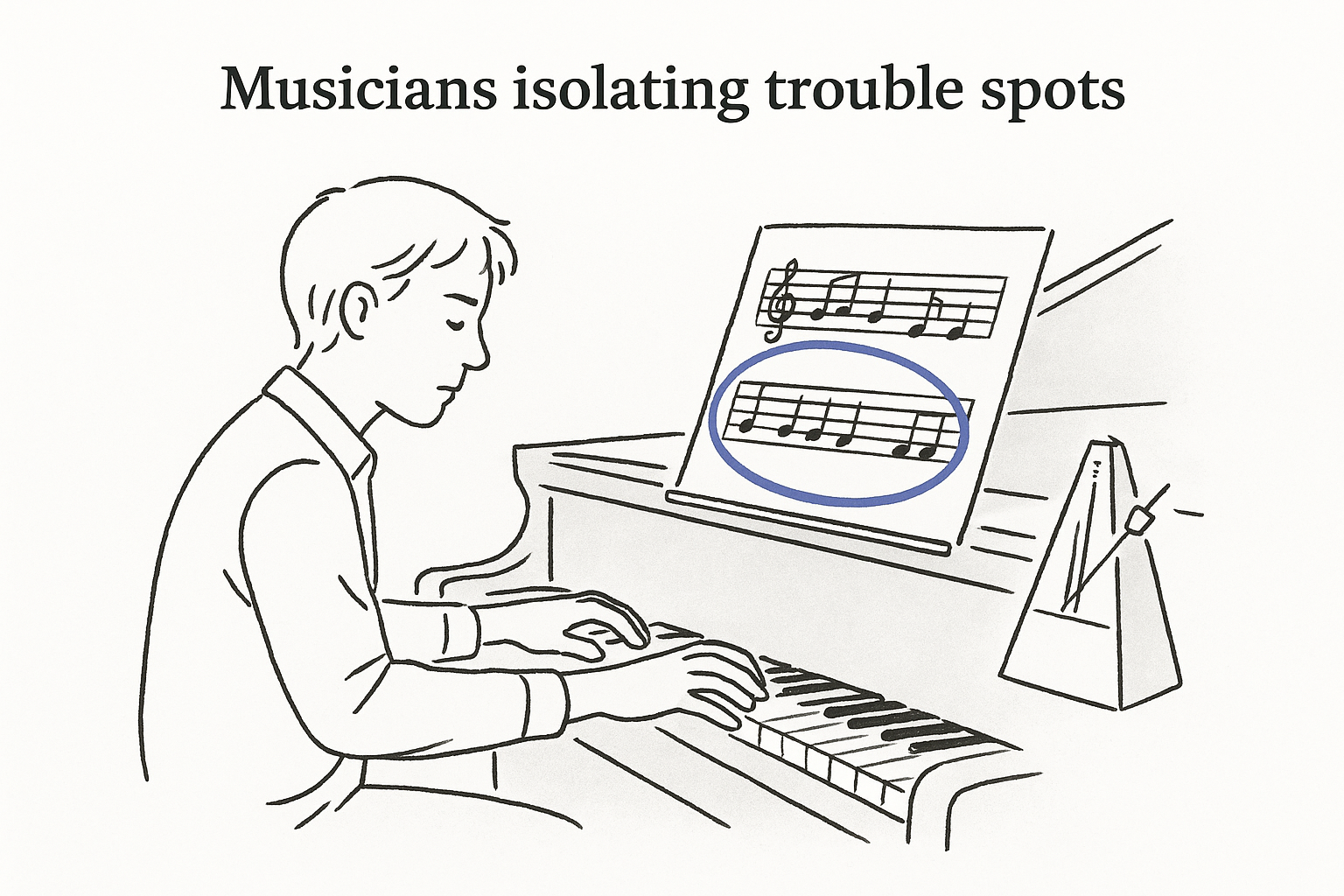
Musicians isolating trouble spots
Classical musicians rarely play a piece start to finish during practice, despite what a beginner might assume. A concert pianist working on a Chopin étude will loop a four-bar passage at half tempo for twenty minutes, gradually raising the metronome only after every note lands cleanly. This is deliberate practice psychology in its purest form: one measurable target, immediate feedback from the metronome, and repetition that adjusts based on the last attempt.
Athletes drilling one movement
Basketball players who shoot free throws for an hour without tracking makes are not practicing deliberately, they are just tired afterward. Elite shooters instead track make percentage in blocks of ten, adjust foot position or release angle based on misses, and repeat only the adjusted version. The NBA's own coaching resources emphasize tracked, feedback-driven repetition over raw volume, a point echoed in research the American Psychological Association has published on expert performance across domains.
Surgeons rehearsing under pressure
Surgical residents train on simulators specifically because live feedback during an actual operation is far too late. A resident practicing suturing gets immediate correction on hand position and thread tension from an instructor, then repeats the exact motion that failed, dozens of times, before ever touching a patient. Immediate feedback here isn't optional, it's the entire reason simulation training exists.
The best performers in any field spend less time playing through and more time replaying the exact moment they got wrong.
What these fields have in common
None of these examples involve more hours than casual practice, they involve narrower targets. A violinist, a shooter, and a surgical resident all break their skill into a testable slice, get feedback fast, and repeat only the adjusted version. That pattern, repeated across completely unrelated fields, is the strongest evidence that deliberate practice works because of structure, not effort alone.
Turning practice into real progress
Deliberate practice psychology comes down to one idea: structure beats hours every time. Specific goals, fast feedback, full concentration, targeting weaknesses, and repetition that adjusts based on results, these five components of deliberate practice turn ordinary practice time into measurable skill growth. Skip any one of them and you slide back into the comfortable repetition that keeps musicians, athletes, and hobbyists stuck at the same level for years.
Goals and feedback are only half the system, though. The other half is knowing what to revisit and when, before a skill fades past the point of easy recovery. That is the exact problem spaced repetition scheduling solves, and it is why the framework works better with a tool tracking your weak points than with a notebook you forget to update. If you want to see the algorithm behind this in plain terms, check out how memoRep works and start applying deliberate practice the way it was designed to work.