How to Overcome the Forgetting Curve: 7 Proven Strategies
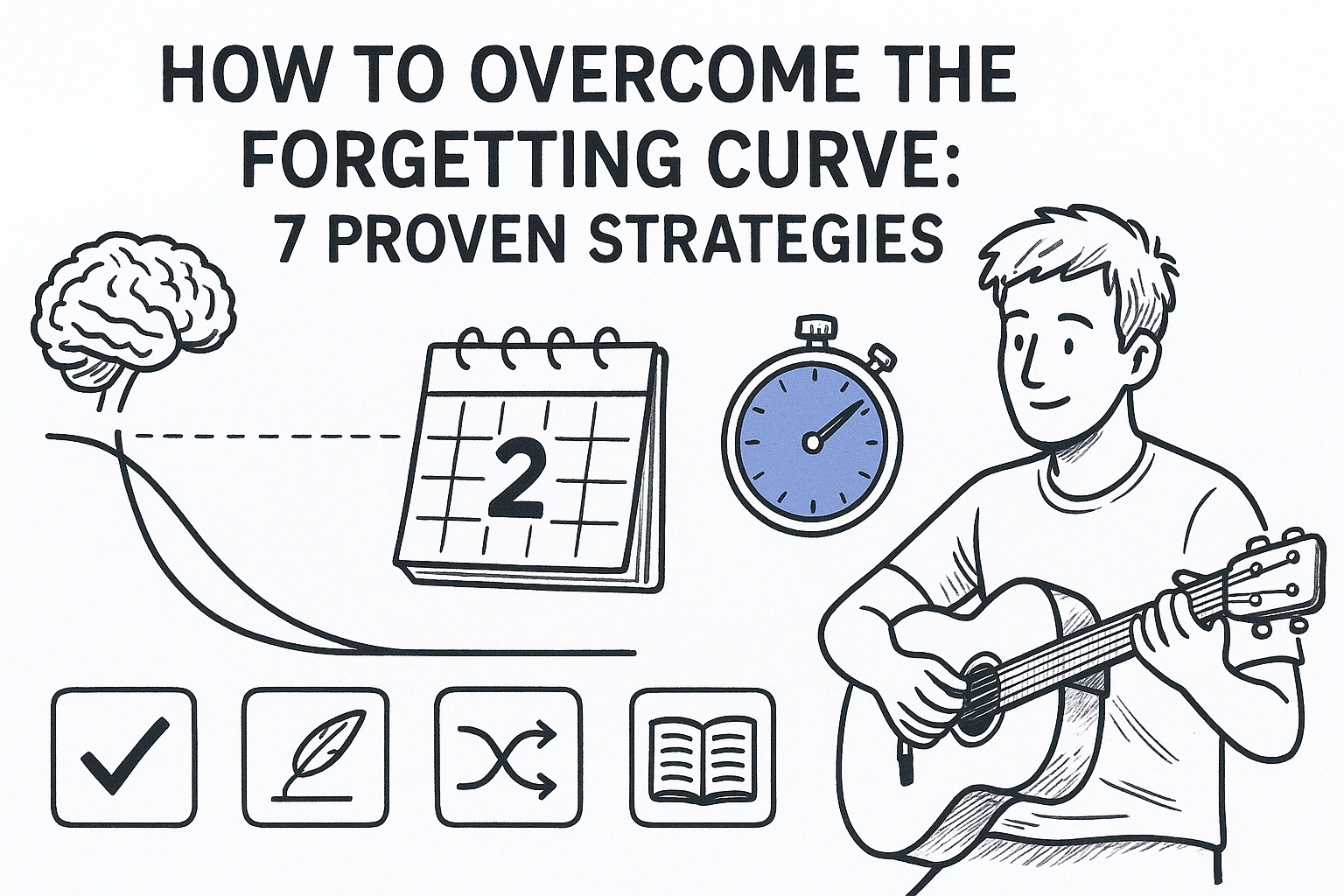
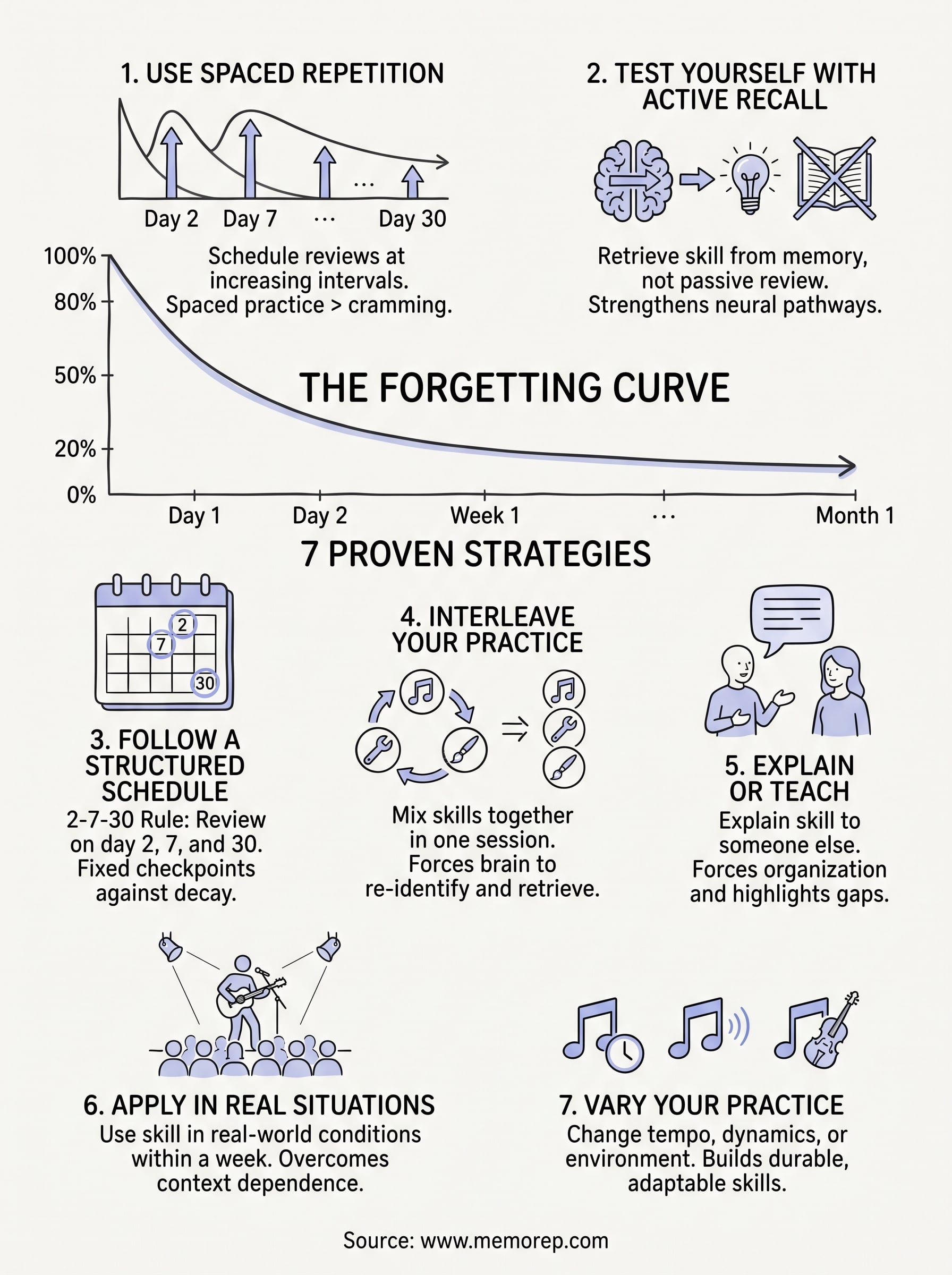
You practice a piece for weeks, feel solid on it, then set it aside for a month. When you come back, half of it is gone. That's not a lack of talent or discipline, it's biology. Ebbinghaus mapped this decay back in the 1880s, and if you want to know how to overcome the forgetting curve, you first need to accept that forgetting is the default, not the exception.
The good news is that the curve is predictable, which means it's beatable. Spaced repetition and active recall are the two techniques with the strongest research behind them, and they work whether you're memorizing vocabulary or drilling a guitar solo. The trick is timing your review sessions to hit right before a skill fades, not after.
Below are seven strategies that put this science into action, from spacing your sessions correctly to testing yourself instead of just re-reading notes. Each one addresses a specific reason practice fails to stick. If you're a musician or practical-skill learner tired of guessing what to revisit, structured scheduling and deliberate review will change how you practice, not just how much you practice.
1. Use spaced repetition to schedule your practice
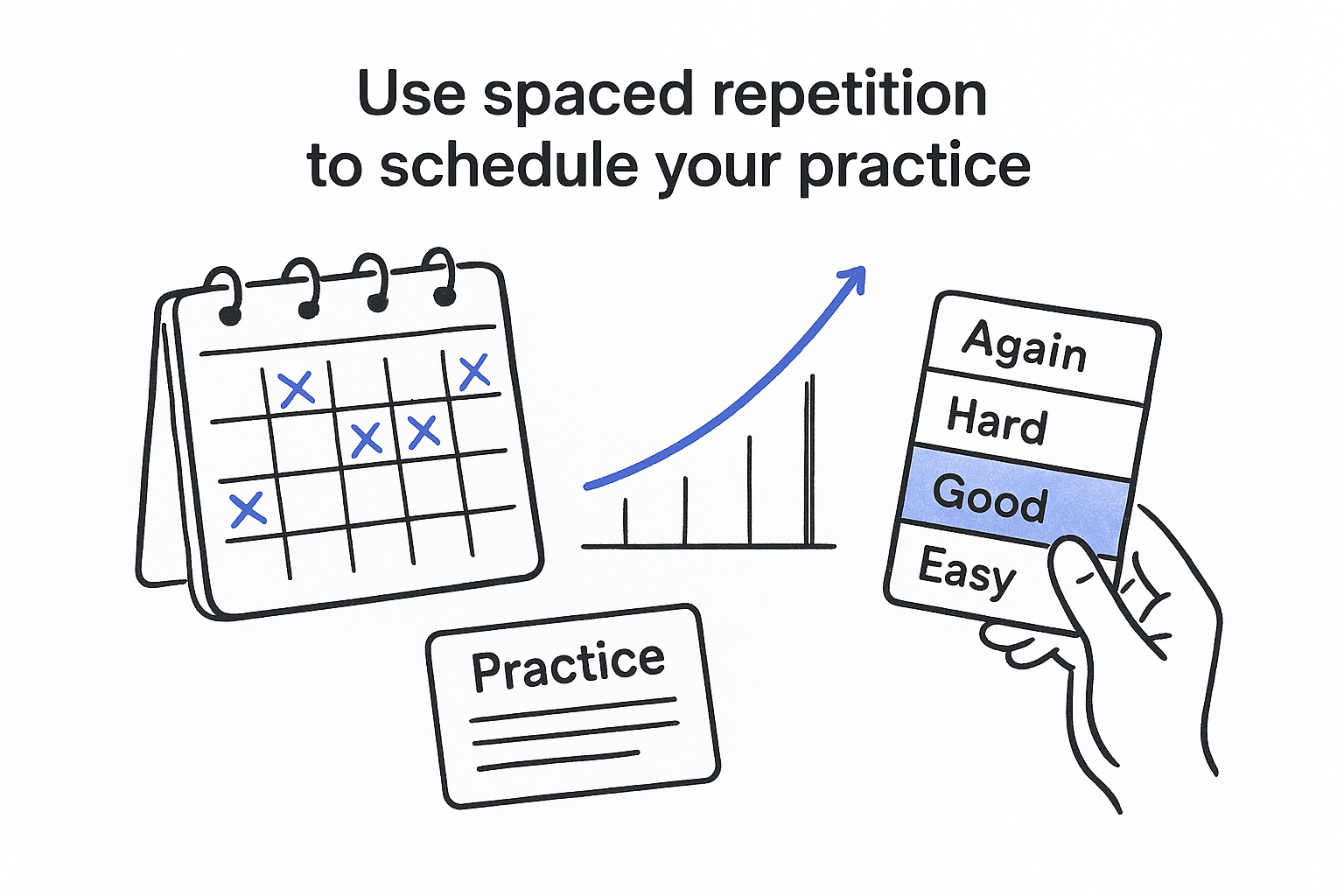
Spaced repetition is the practice of reviewing a skill at increasing intervals instead of cramming it into one long session. Instead of playing a scale 50 times in a row on Monday and never again, you'd play it Monday, then Wednesday, then the following Monday, then two weeks later. Each interval gets longer as your performance improves, because a skill that's solid needs less frequent touch-ups than one you just learned.
How it works
The method rests on two ideas: the Ebbinghaus forgetting curve, which shows memory decays fastest right after learning and then levels off, and the SuperMemo SM-2 algorithm, which calculates the next review date based on how well you performed last time. If you nailed the exercise, the algorithm pushes the next review further out. If you struggled, it pulls the review closer. This is the same logic that powers most modern spaced repetition software, and it's the engine behind how MemoRep schedules practice cards for musicians and skill learners.
Why it works against forgetting
Cramming feels productive because you can play something well right after ten repetitions, but that fluency is temporary. Spaced repetition forces you to retrieve the skill just as it starts slipping, which is exactly the moment your brain reinforces the memory trace most strongly. Researchers call this the spacing effect, and it's one of the most replicated findings in memory research, going back to work summarized by the National Institutes of Health. Reviewing too early wastes time on something you already know. Reviewing too late means you've already forgotten it and have to relearn it from scratch.
Spaced repetition doesn't reduce how much you forget, it schedules your reviews for the exact moment forgetting would otherwise happen.
How to apply it to your practice
You don't need to guess intervals by hand. Here's a simple way to start:
- Create a practice card for each skill, lick, passage, or technique you're working on.
- Rate your performance after each attempt using something like Again, Hard, Good, or Easy.
- Let a scheduling tool adjust the next review date automatically based on that rating.
- Group related cards into a project so you can see everything due on a given day.
- Trust the schedule instead of practicing whatever feels most urgent in the moment.
This removes the daily decision of what to practice, which matters more than most learners realize. Decision fatigue from juggling a dozen exercises is often what causes skills to slip through the cracks in the first place.
2. Test yourself with active recall
Active recall means forcing yourself to produce a skill from memory instead of reviewing it passively. For a musician, that's playing a passage from memory instead of following the sheet music one more time. For a practical skill, it's performing the movement without a tutorial running in the background. The distinction sounds small, but it changes what your brain actually does during practice.
How it works
Passive review, like re-reading notes or watching a video again, creates a false sense of fluency because recognition is easier than retrieval. Active recall skips recognition and jumps straight to retrieval, which is the same mental action you'll need when performing under real conditions, on stage or in the moment you actually need the skill.
Why it works against forgetting
Every time you retrieve a skill from memory, you strengthen the neural pathway that stores it. This is sometimes called the testing effect, and it consistently outperforms passive review in memory studies, including work referenced by the National Institutes of Health. Passive review feels comfortable because it avoids the friction of possibly failing. That friction is precisely what builds durable memory.
If you can review it without struggling at all, you're not building memory, you're just confirming what you already know.
How to apply it to your practice
Build retrieval into every session, not just the final run-through:
- Attempt the passage or movement from memory before checking notes or a recording.
- Rate the attempt honestly, even if it means marking it Hard.
- Wait a beat longer than feels comfortable before checking yourself.
- Pair this with a spaced schedule so retrieval happens right when the skill starts fading.
3. Follow a structured review schedule like the 2-7-30 rule
The 2-7-30 rule is a simple fallback for anyone who wants spaced repetition without software crunching the numbers. You review new material on day 2, day 7, and day 30 after first learning it. No algorithm, no ratings, just three fixed checkpoints that roughly match how memory decays.
How it works
Each checkpoint targets a different stage of forgetting. The day 2 review catches the steepest part of the curve, when most of what you learned would otherwise vanish within 48 hours. The day 7 review locks in what survived the first pass, and the day 30 review confirms the skill has moved into longer-term storage. Three touchpoints instead of one long cram session.
Why it works against forgetting
Fixed intervals work because they roughly mirror the natural decay pattern Ebbinghaus documented, hitting you right before each drop-off point rather than after. This is why the rule still shows up in memory research and training guides referenced by institutions like the National Institutes of Health. It's not as precise as an adaptive algorithm, but it beats no schedule at all by a wide margin.
A fixed schedule beats no schedule, but an adaptive one beats a fixed schedule every time your performance changes.
How to apply it to your practice
Start with a calendar or reminder app if you're not ready for dedicated software:
- Mark day 2, day 7, and day 30 for every new skill you learn.
- Log a quick note on how each review went.
- Shift a skill to more frequent review if day 2 or day 7 goes poorly.
- Move to adaptive scheduling once you're juggling more than a handful of skills at once, since fixed dates get hard to track manually.
4. Mix skills together with interleaved practice
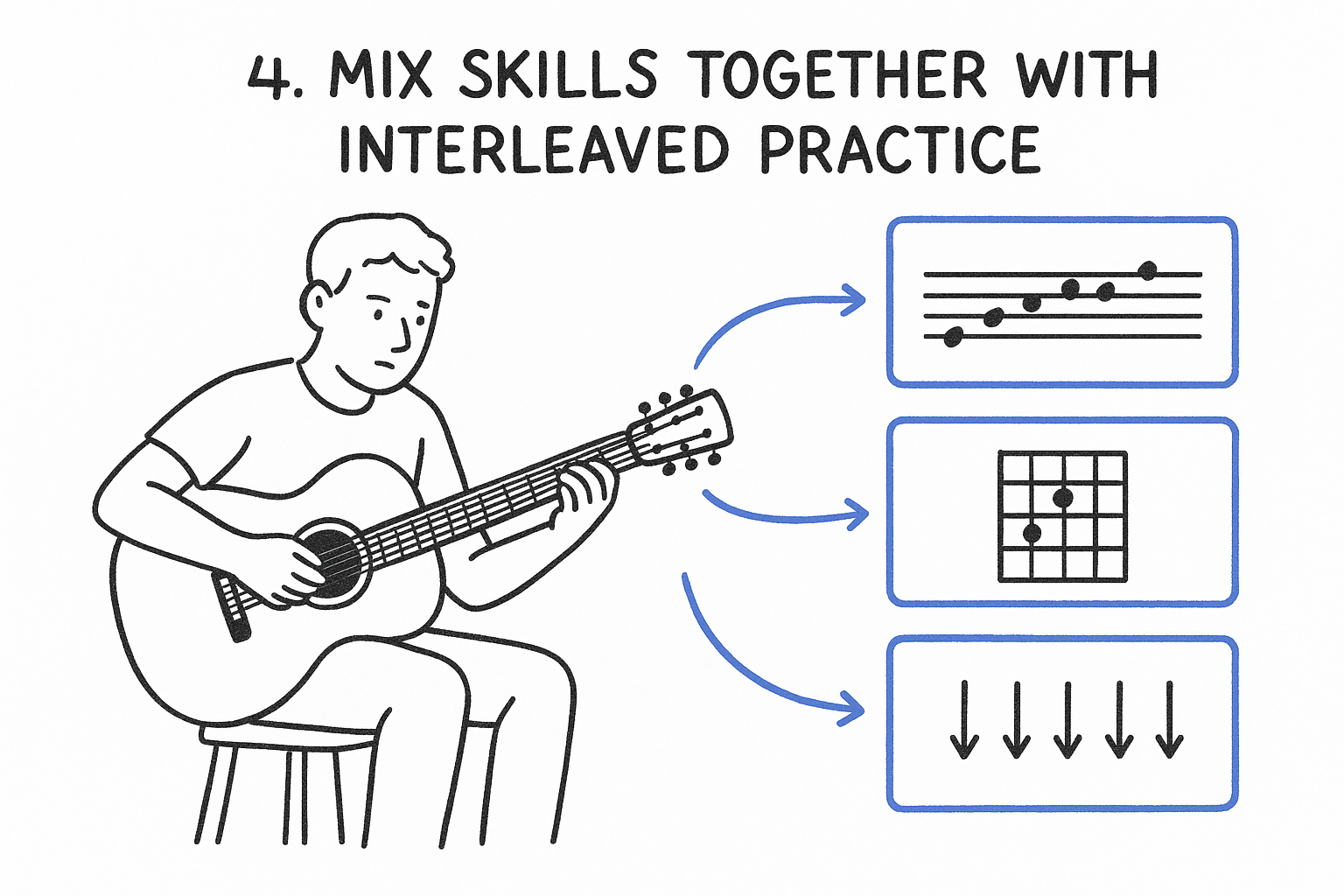
Interleaved practice means working on several different skills within one session instead of drilling one thing until it's polished. A guitarist might rotate between a scale, a chord transition, and a strumming pattern within twenty minutes rather than spending the whole block on one exercise. It feels less tidy than blocked practice, but that discomfort is the point.
How it works
Most learners default to blocked practice, repeating one skill until it feels smooth before moving to the next. Interleaving breaks that pattern by forcing you to switch contexts every few minutes, which means your brain has to re-identify which skill it's dealing with each time. That re-identification step is where the real learning happens.
Why it works against forgetting
Blocked practice creates fluency that doesn't survive contact with real performance conditions, where skills never show up in a predictable order. Interleaving trains you to retrieve the right skill on demand, which mirrors how skills actually get called on outside of practice. Memory research summarized by the National Institutes of Health consistently shows interleaved sessions outperform blocked ones on long-term retention, even though they feel harder in the moment.
Practice that feels easy in the room and practice that survives outside the room are rarely the same thing.
How to apply it to your practice
Swap your session structure instead of your content:
- Pick three to four skills instead of one to focus on per session.
- Rotate between them every five to ten minutes rather than finishing one before starting the next.
- Let a scheduling tool queue up the day's mix so you're not deciding the order yourself.
5. Explain or teach what you just learned
Teaching forces you to organize a skill well enough that someone else could follow it, which is a much higher bar than just performing it yourself. A drummer who can play a fill is one thing. A drummer who can break down that fill for a beginner, counting out the subdivisions and explaining the sticking, has to understand it at a completely different level. This is sometimes called the protégé effect, and it applies just as well to physical skills as it does to facts.
How it works
When you explain something, you're forced to translate muscle memory or intuition into words, which exposes the gaps you didn't know were there. You can't hand-wave through a section you don't actually understand once someone is watching and asking questions.
Why it works against forgetting
Explaining a skill is a form of elaborate retrieval, and it's harder than simply performing the skill in isolation. That extra difficulty is what makes the memory stick longer. Studies referenced by the National Institutes of Health show that people who expect to teach material retain more of it than people who only expect to be tested on it.
If you can't explain a skill simply, you haven't fully learned it yet, you've just gotten used to it.
How to apply it to your practice
Build teaching into your review, even without a real student:
- Record a short voice memo explaining a technique as if teaching a beginner.
- Write a one-paragraph explanation for your practice notes.
- Explain a passage to a bandmate or friend, even informally.
6. Apply new skills right away in real situations
Practicing a skill in isolation only gets you halfway there. If you learn a new chord voicing in your practice room, the real test is whether you can drop it into a song you're playing with a band that same week. Real-world application forces a skill out of the controlled conditions where it was learned and into the messier environment where it actually needs to work.
How it works
Skills learned in one context often don't transfer automatically to a different one, a problem researchers call context-dependent memory. A passage you can nail alone in a practice room might fall apart on stage with a drummer, an audience, and adrenaline in the mix. Applying a skill right away, in as close to real conditions as you can manage, closes that gap before it becomes a habit.
Why it works against forgetting
Every time you use a skill under real conditions, you attach it to more cues: sound, pressure, timing, other people. Those extra cues give your brain more paths back to the memory later, which is one reason applied learning tends to outlast passively drilled learning, a pattern documented in retention research from the National Institutes of Health.
A skill that only exists in practice conditions isn't finished, it's just rehearsed.
How to apply it to your practice
- Book a jam, gig, or informal session within a week of learning something new.
- Use the skill in a slightly harder context than where you learned it.
- Log how it held up so you know what still needs review.
7. Vary how you practice each skill
Playing the same passage the same way every time trains one specific version of that skill, not the skill itself. Change the tempo, the room, the instrument setup, or even the order of your practice session, and you force your brain to hold onto the underlying pattern rather than one narrow rehearsal of it. This is called varied practice, and it's the difference between knowing a piece and only knowing it under one exact set of conditions.
How it works
Instead of repeating a passage identically twenty times, you change one variable each rep: slower one time, louder the next, standing instead of sitting, on a different instrument if that's possible. Your brain has to rebuild the motor plan slightly each time instead of running the same groove on autopilot.
Why it works against forgetting
Skills practiced under varied conditions generalize better and resist decay longer than skills drilled identically every time, a finding that shows up repeatedly in motor learning research summarized by the National Institutes of Health. Identical repetition builds a narrow memory that breaks the moment conditions shift, which is exactly what happens on stage or under pressure.
A skill rehearsed only one way is a skill that's only half learned.
How to apply it to your practice
- Change tempo, dynamics, or starting point each time you revisit a passage.
- Practice in a different room or with different gear at least once a week.
- Note which variations exposed weaknesses so future reviews target them directly.
Making retention part of your routine
None of these seven strategies work as a one-time fix. Spaced repetition, active recall, interleaving, teaching, real-world application, and varied practice all depend on repetition over weeks and months, not a single motivated afternoon. Overcoming the forgetting curve isn't about finding one clever trick, it's about building a routine that automatically puts the right skill in front of you at the right time.
That's the part most learners get stuck on. You can know every technique in this article and still fail, simply because tracking dozens of skills by hand becomes its own full-time job. This is exactly the gap MemoRep was built to close, using the same SM-2 scheduling logic described above to tell you what to practice today, without you having to remember any of it yourself.
If you want to see the mechanics behind that scheduling, check out how MemoRep's science-backed algorithm works. And if you'd rather just start practicing smarter today, try MemoRep free for life during the beta.