How to Practice Sight Reading: A Daily Routine That Works
You sit down with a new piece, and your eyes freeze the moment the rhythm gets tricky or the key signature has four sharps. If you've been asking how to practice sight reading without seeing real progress, the problem usually isn't talent. It's that most musicians treat sight reading like an afterthought instead of a skill that needs its own daily practice routine.
Sight reading improves through consistent, varied exposure to new material, not through replaying the same three pieces until they're memorized. That distinction matters: the moment you recognize a passage, you're no longer sight reading, you're recalling. Real progress comes from short daily sessions with fresh music, deliberate tempo choices, and honest tracking of where you stumble.
This guide walks through a structured daily routine you can start today, including how much time to spend, what kind of material to choose, and how to sequence exercises so your eyes learn to read ahead of your hands. We'll also cover common mistakes that stall progress, like practicing too slowly or skipping the beat when you make an error, and how spaced, scheduled repetition keeps these skills from fading between sessions.
Why most sight-reading practice fails
Most musicians who struggle with sight reading aren't lacking practice time, they're spending that time the wrong way. They open the same folder of pieces, play through familiar passages, and call it practice. That approach builds finger memory, not reading speed. Sight reading practice only works when the material stays unfamiliar, because the skill you're training is pattern recognition under pressure, not recall.
The repetition trap
When you replay a piece you've already sight read once, your brain starts predicting notes from memory instead of decoding them from the page. This feels productive because the playing sounds smoother, but it's the wrong kind of smooth. You need fresh scores every session, even simple ones, so your eyes keep doing the actual work of translating notation into motion. A structured daily routine built on constantly rotating material trains the skill you actually want.
Sight reading only improves when every session uses music your hands have never touched before.
Stopping at every mistake
The second failure mode is halting the moment something goes wrong. Real performance never allows a pause to fix a fingering or replay a bar, so practicing that way teaches the opposite habit you need on stage. Stopping breaks the forward momentum that sight reading depends on and reinforces perfectionism over flow.
A few other habits quietly sabotage progress:
- Practicing too slowly to "get it right," which removes the time pressure that sight reading actually trains
- Skipping rhythm work and focusing only on pitch accuracy
- Choosing pieces above your level, which forces guessing instead of reading
- Practicing inconsistently, so gains from one session fade before the next
Each of these habits feels reasonable in isolation, but together they explain why so many players plateau. The fix isn't more hours, it's a different sequence, which is exactly what the next four steps lay out.
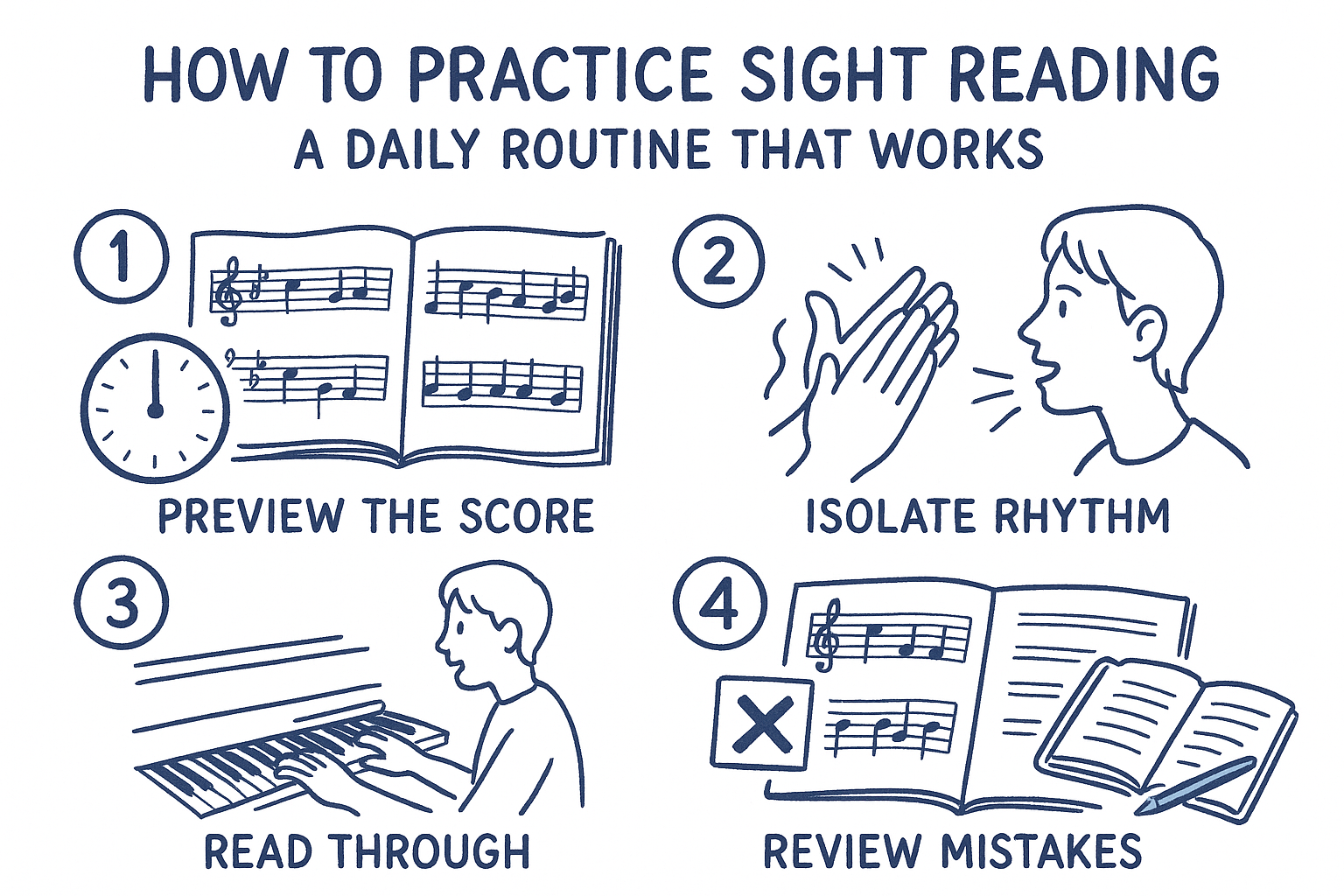
Step 1. Preview the score before you play
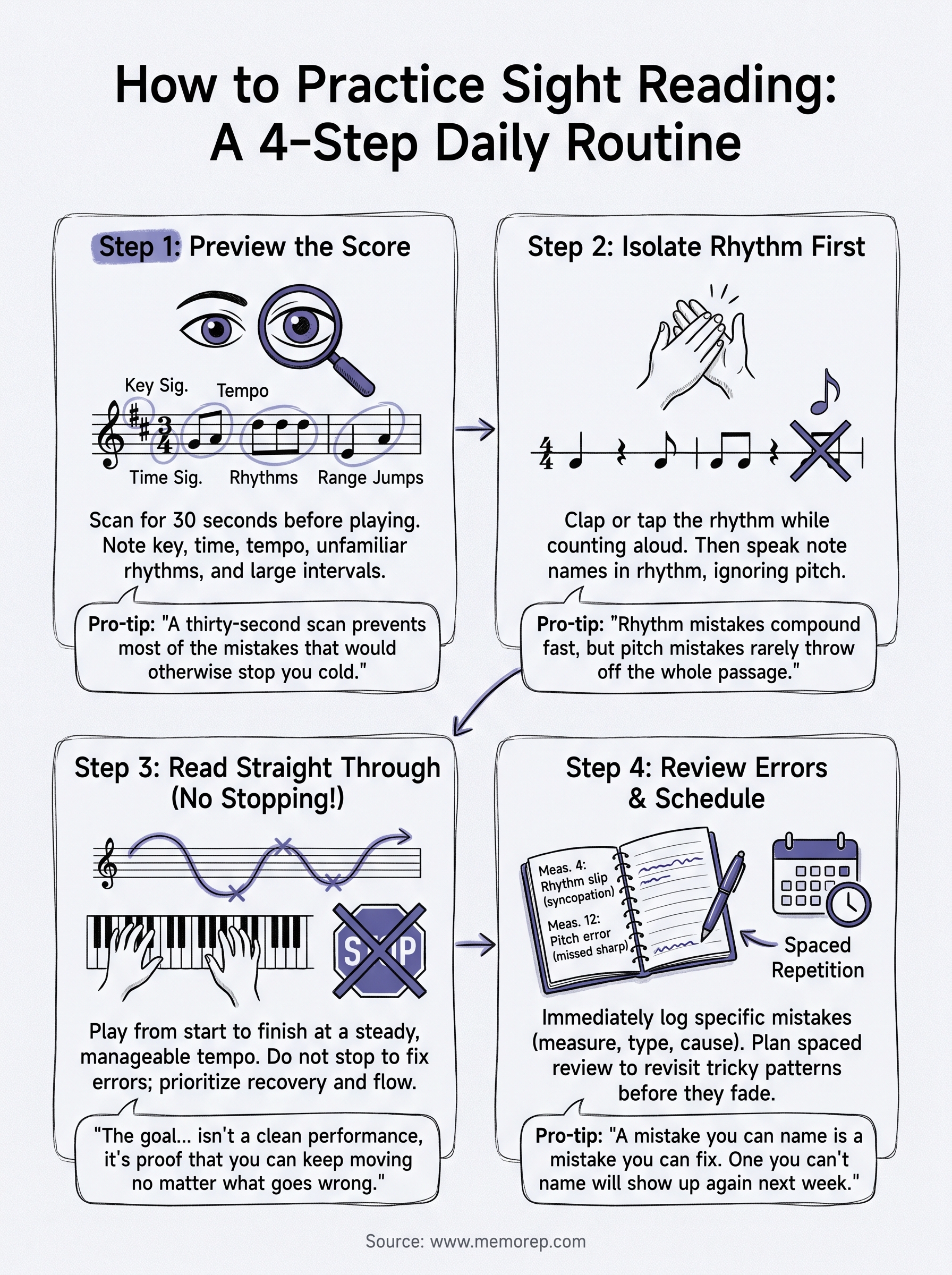
Before your hands touch the instrument, spend thirty seconds scanning the page. This pre-reading scan is what separates confident sight readers from those who freeze mid-phrase. You're not memorizing the piece, you're gathering the information your eyes will need once the tempo starts moving faster than your brain can process one note at a time.
What to scan for
Glance at these five things every time, in this order:
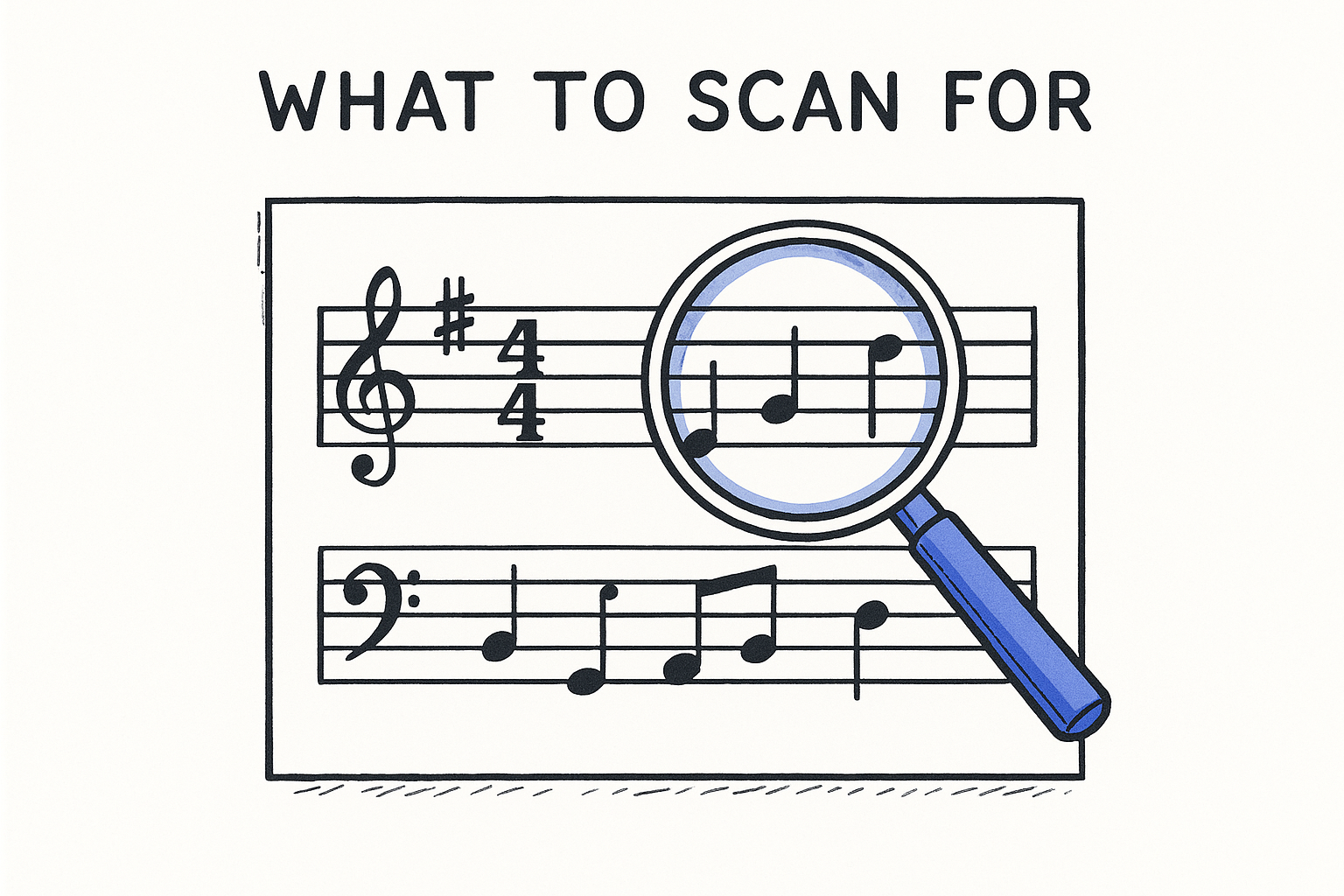
- Key signature, so you know which notes are already sharp or flat
- Time signature, so you can feel the pulse before the first beat
- Tempo marking, so you pick a realistic starting speed
- Rhythmic patterns, scanning for anything unfamiliar like syncopation or tuplets
- Range jumps, noting any large leaps between staves or clefs
A thirty-second scan prevents most of the mistakes that would otherwise stop you cold at measure four.
Running this checklist trains your eyes to read ahead of your hands, which is the entire point of sight-reading practice. Skipping it is why so many players get blindsided by a key change three lines in, even though the information was sitting right there on the page. Over time, this scan becomes automatic and takes only a few seconds, but it never becomes optional if you want clean first passes.
Step 2. Separate rhythm from pitch
Rhythm errors derail a sight-reading pass far more than wrong notes do, yet most players try to solve both problems at once. Untangle them instead. Before playing the piece on your instrument, clap or tap the rhythm alone while counting out loud. This rhythm-first drill removes the guesswork your fingers would otherwise create when they hit an unfamiliar pattern mid-phrase.
A quick two-pass method
Try this sequence on any new piece:
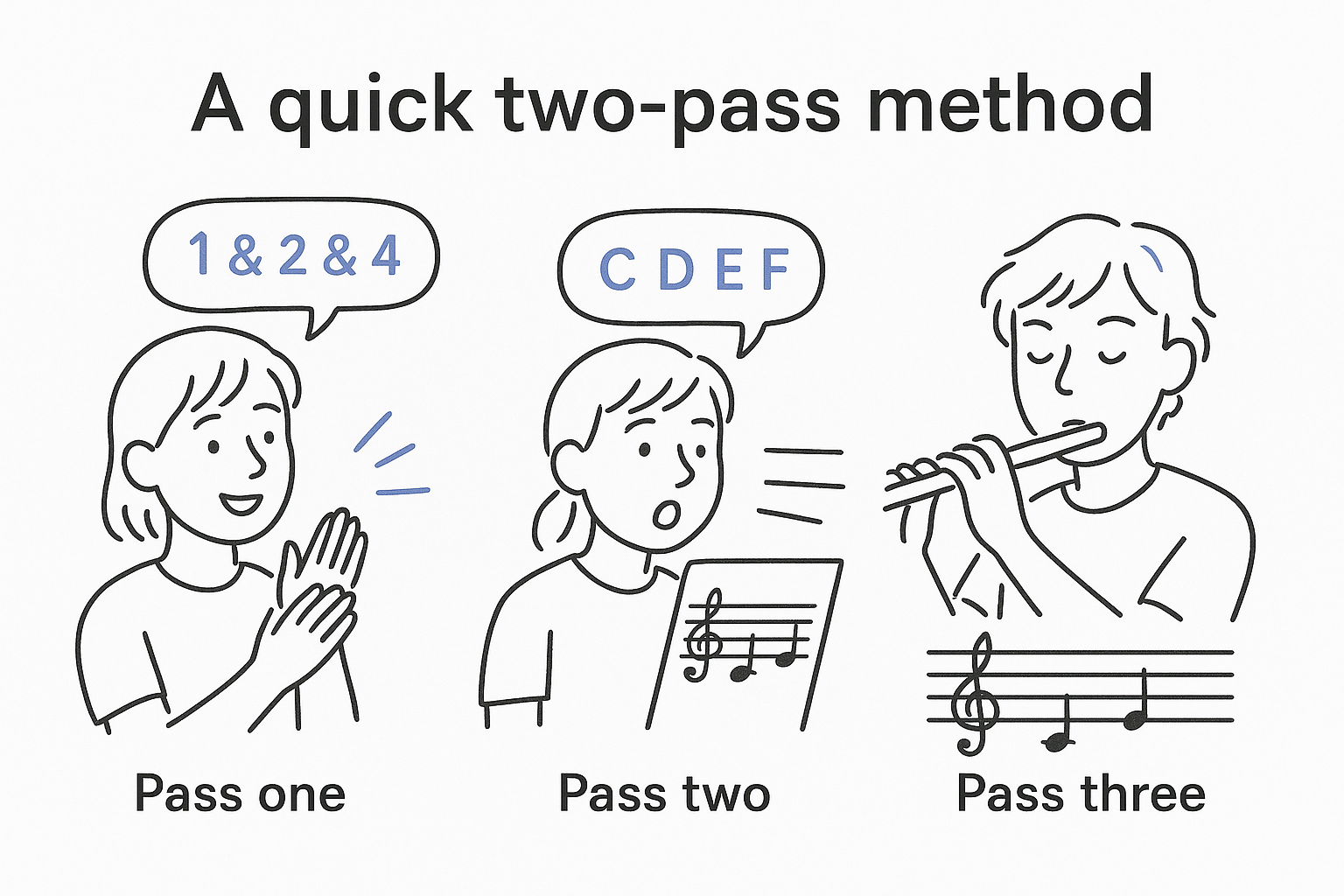
- Pass one: Clap or tap the rhythm while counting subdivisions aloud, ignoring pitch entirely
- Pass two: Speak or sing the note names in rhythm, still away from the instrument
- Pass three: Combine both on your instrument at a slow, steady tempo
Rhythm mistakes compound fast, but pitch mistakes rarely throw off the whole passage.
Why this order matters
Pitches you can correct on the fly with a half-step adjustment. A dropped beat, on the other hand, pulls every note after it out of place, which is why rhythm deserves the first pass. Isolating it also exposes exactly which patterns trip you up, whether that's dotted rhythms, syncopation, or a shift in meter. Once the pulse feels automatic, adding pitch on top becomes far less overwhelming, and your first full read-through sounds noticeably steadier.
Step 3. Read straight through without stopping
Now play the piece from beginning to end, no matter what happens. This is the step where how to practice sight reading actually gets tested, because a single unbroken pass mimics the real conditions you'll face in a rehearsal or audition. If you fumble a note, keep the beat moving and let it go. Stopping to fix an error trains hesitation, not recovery, and recovery is the skill that separates strong sight readers from everyone else.
Pick a tempo you can sustain
Choose a speed slower than the marked tempo, one you can hold steady for the entire piece without rushing or dragging. A continuous read-through at a manageable tempo teaches your brain to keep pace with the notation instead of freezing when it falls behind. If you're unsure where to start, cut the marked tempo by roughly a third and build from there over future sessions.
The goal of this pass isn't a clean performance, it's proof that you can keep moving no matter what goes wrong.
Treat every error as information, not a failure
When you slip, note mentally what happened, wrong finger, missed accidental, lost beat, and keep going. You'll use these observations in the next step, where you turn today's stumbles into tomorrow's targeted practice.
Step 4. Review mistakes and schedule your next session
Right after your read-through, while the mistakes are still fresh, write down exactly what went wrong. This error review is where sight reading actually turns into improvement, because a mistake you can't name is a mistake you'll repeat next week. Grab a notebook or a practice log and jot down the specifics before you move to the next piece.
What to log after every pass
Keep it short and specific:
- Measure number where the slip happened
- Type of error: rhythm, pitch, fingering, or dynamics
- Likely cause: unfamiliar key, awkward interval, fast subdivision
- Tempo you played at, for comparison next time
A mistake you can name is a mistake you can fix. One you can't name will show up again next week.
Build in spaced review, not random repeats
Don't just move on to a fresh piece and forget the one you struggled with. The patterns that tripped you up today, a tricky syncopation or an awkward key change, need to resurface before they fade from memory. This is where spaced repetition earns its place in a sight-reading routine: instead of guessing when to revisit a weak spot, schedule it at the interval where you're about to forget it. That's a harder thing to track by memory alone, which is exactly the gap a tool built around adaptive scheduling is meant to close.
Making sight reading a daily habit
Consistency beats intensity here. Fifteen focused minutes a day, run through the four steps above, will move your reading faster than an occasional hour-long cram session ever will. Preview, isolate rhythm, read straight through, review your mistakes: that sequence works because it mirrors how sight reading actually happens on stage, one unbroken pass with no do-overs.
Getting the sequence right solves half the problem. The other half is remembering which passages need to resurface and when, before they fade and you're relearning them from scratch. That's tedious to track in a notebook, which is exactly why spaced repetition software built for practical skills exists. If you want the scheduling handled for you instead of guessed at, see how memoRep's adaptive scheduling works and try it while free lifetime access is still open to new beta users.