
Jazz Guitar Practice Routine: How to Build One That Lasts
A good jazz guitar practice routine splits your session into timed blocks: a short warm-up, one core skill, chords and comping, one standard, and a little ear work. You rotate the core focus every few weeks and revisit older material on a schedule so it does not fade. Thirty to sixty minutes a day is enough. Structure matters more than hours.
The problem is rarely effort. Jazz guitar asks you to keep many things alive at once: scales, arpeggios, voicings, comping, tunes, vocabulary. Without a plan, you practice what feels good, skip what feels hard, and lose whatever you stopped touching two weeks ago. Deciding what to play also eats the first ten minutes of every session.
This guide walks you through building the routine in four steps. It covers structure only: how to divide your time, how to rotate, how to space your reviews, and how to adjust. What you play inside each block is a job for your teacher. At MemoRep, we build spaced repetition tools for musicians, so scheduling is the lens we use throughout.
Why a jazz guitar practice routine needs structure
A jazz guitar practice routine needs structure because jazz is a stack of separate skills, and each one fades on its own schedule. Skip chord work for two weeks and your comping gets rusty, even while your soloing improves. A plan keeps every skill in rotation.
What the routine has to cover
Five areas show up in almost every jazz curriculum. Your teacher may weight them differently, but your routine needs a home for each:
- Warm-up and maintenance: short, easy, and the same every day
- Core skill: scales and arpeggios, one focus at a time
- Chords and comping: voicings and rhythm in context
- Standards: the tunes you are learning or polishing
- Ear work: transcribing, listening, and playing along with recordings
This article does not tell you how to play any of these. How you approach scales or voicings is your teacher's call, and a good teacher beats any article on that. What you build here is the container, so that whatever your teacher assigns gets practiced at the right time.
A routine is a container for your teacher's instructions, not a replacement for them.
How much time you actually need
Thirty to sixty focused minutes a day is enough for steady progress. Two hours a day is fine if you stay sharp, but two shorter sessions usually beat one long, tired one. Six days of 40 minutes beats one three-hour Sunday.
The famous 10,000 hours figure comes from research by psychologist Anders Ericsson, and Malcolm Gladwell popularized it. Ericsson himself stressed that the quality of deliberate practice matters, not the raw hour count. The 80/20 rule is more useful here. Treat it as a prompt: find the few items that drive most of your progress and give them your biggest blocks.
Step 1. Choose your practice blocks
Choose four or five blocks and give each one a single job. The five areas above are a solid default: warm-up, core skill, chords and comping, a standard, and ear work. Fewer blocks mean deeper practice, so cut ear work first on short days.
Give each block one job
A block with two jobs turns into neither. "Chords and standards" is really two blocks. Write one sentence per block that says what it is for, and do not let it drift. If you catch yourself soloing during the chord block, stop and move that work to the standard block.
Turn each block into small practice cards
Next, fill each block with small items you can finish in one sitting. "Chords" is a topic. "Tune X, A section, comping" is an item you can play, rate, and schedule. Pull items from your teacher's assignments, a method book, or your own repertoire list, then write each one down in this format:

Block: Chords and comping
Item: [Tune name], A section, comping
Source: [Teacher assignment / method book / own list]
Done when: I can play it cleanly twice in a row
Keep the list short. A dozen active cards is a workable start, because too many items bring back the decision fatigue you were trying to escape. You can always add a new card once an old one is stable.
Specific items can be scheduled. Vague topics can only be avoided.
Step 2. Set the time for each block
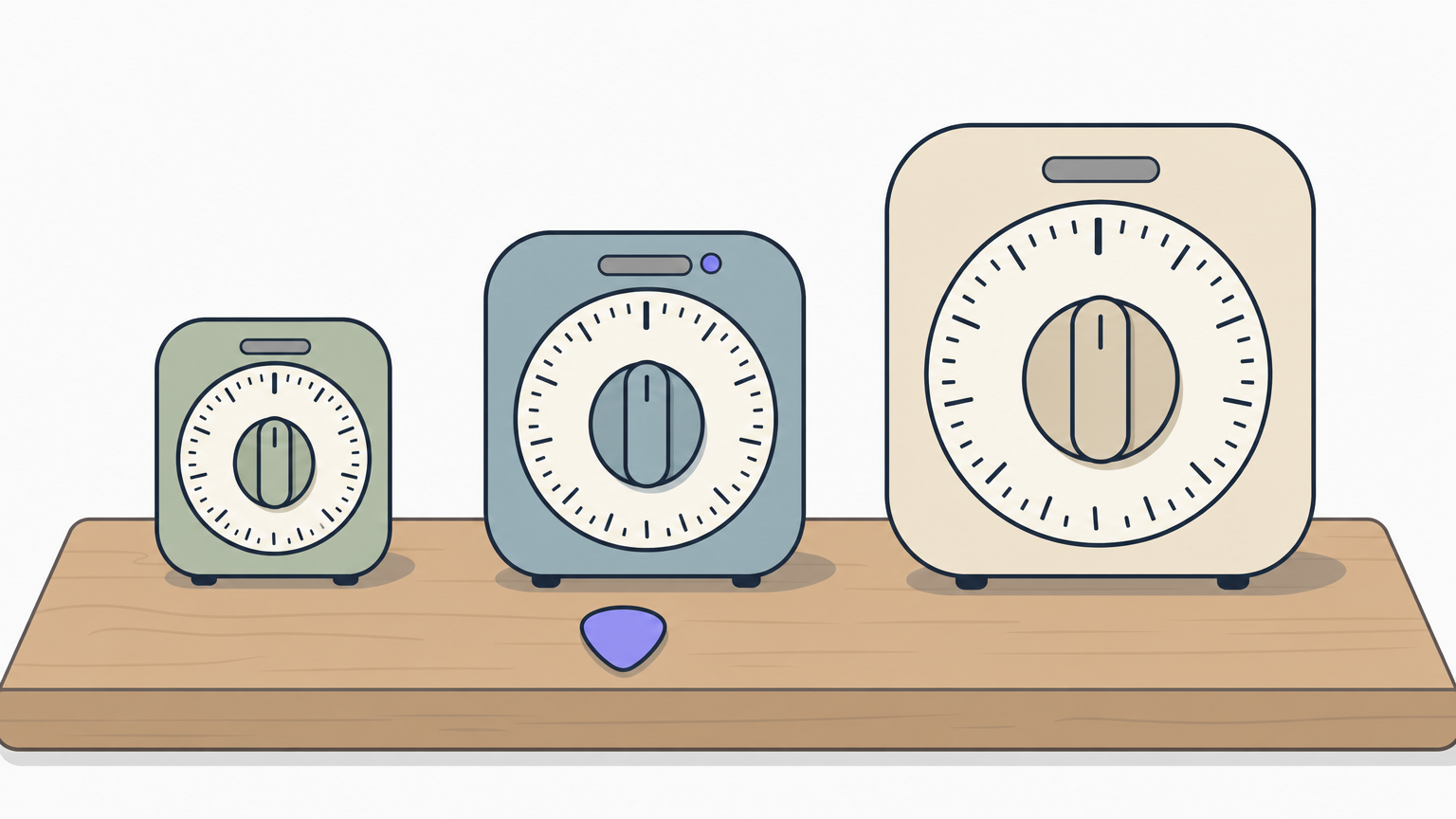
Give every block a fixed number of minutes, and make the total match the session you can keep on your worst day. The table shows three templates for a daily jazz guitar practice routine. Pick one column and stick with it.
Three daily templates
| Block | 30 minutes | 60 minutes | 90 minutes |
|---|---|---|---|
| Warm-up and maintenance | 5 | 5 | 10 |
| Core skill | 10 | 15 | 20 |
| Chords and comping | 5 | 10 | 15 |
| Standard | 10 | 20 | 30 |
| Ear work | 0 | 10 | 15 |
Notice that the standard gets the largest share at every length. That is deliberate. A tune is where scales, chords, and ear work all show up together, so it is the best place to check that your other blocks are paying off.
Rules that keep the clock honest
Templates fail when the rules around them are loose. These four keep the session predictable:
- Set a timer for each block and move on when it rings, even mid-phrase.
- On short days, shrink every block proportionally instead of deleting one.
- Attach the session to something you already do daily, such as after work or after dinner.
- Put the block you avoid most before the one you enjoy most.
Habit stacking is the quiet hero here. A session tied to an existing routine needs no willpower, and after a couple of weeks skipping it feels strange. Your jazz guitar practice routine only works if it happens, so make starting the easy part.
Choose the template you can hit on your worst day, not your best.
Step 3. Rotate focus and schedule reviews
Rotate your core-skill focus every two to three weeks, and revisit everything you have already covered at growing intervals. Rotation gives you depth. Spacing keeps the older material alive. Together they stop the cycle of learning something, dropping it, and relearning it.
Rotate one core focus at a time
Pick one core item and make it the star of your core block for two to three weeks. It might be a single scale pattern, one chord quality, or one set of arpeggios, as your teacher decides. Everything else moves to maintenance, which means it gets touched but not pushed.
Go deep, not wide. If a gig or an ensemble deadline lands in the middle of a cycle, pivot to it, then return to the rotation afterward. If three weeks feels long, start with one or two.
Space your reviews
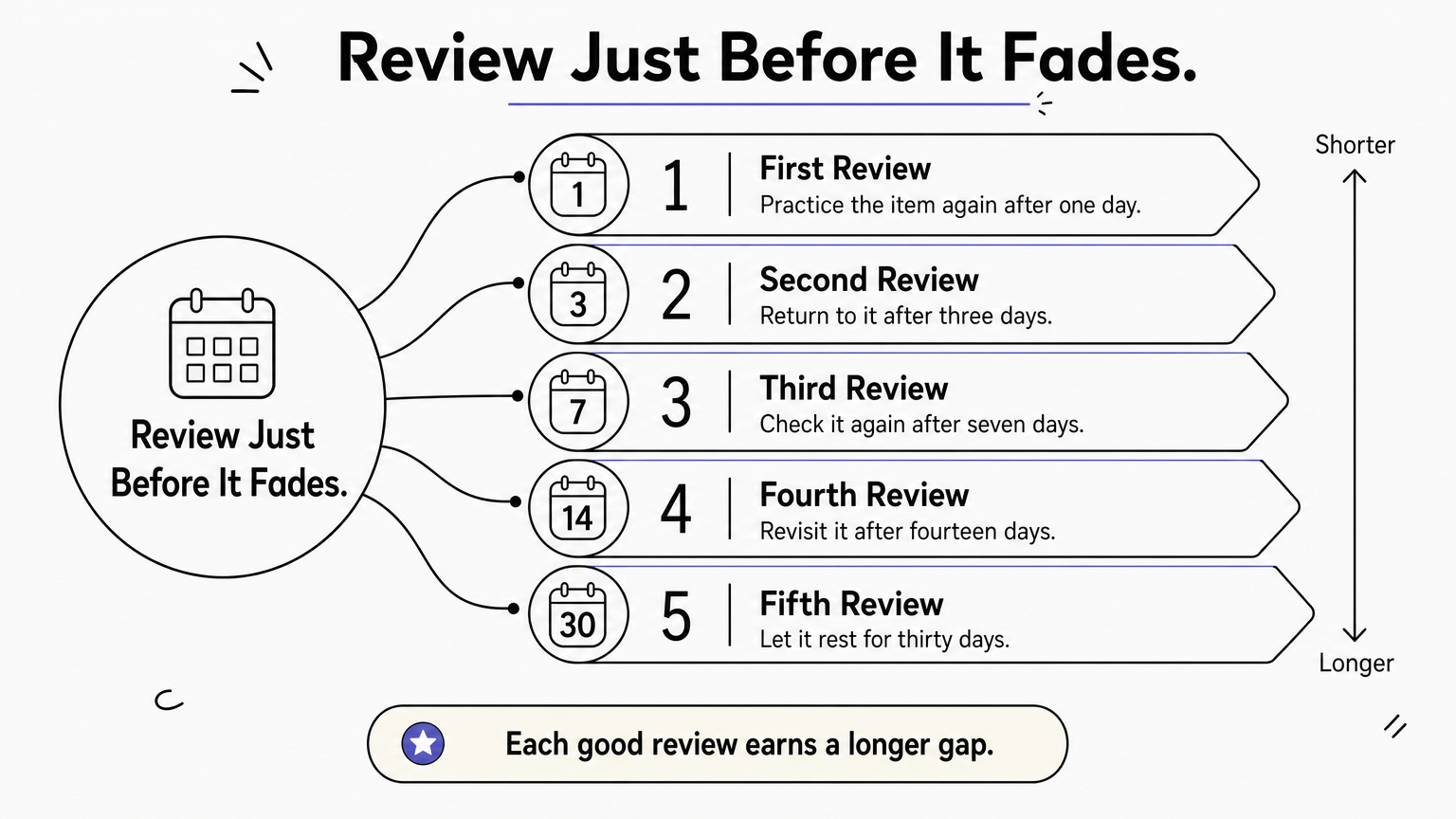
Hermann Ebbinghaus's forgetting curve shows that recall drops quickly after learning, and that each well-timed review slows the drop. For your routine, that means an item you nailed yesterday needs a look soon, while an item you have nailed five times can wait weeks. A simple manual schedule looks like this:
| Successful review | Next review after |
|---|---|
| First | 1 day |
| Second | 3 days |
| Third | 7 days |
| Fourth | 14 days |
| Fifth | 30 days |
Treat this as a starting point, not a law. If an item goes badly, send it back to one day. The goal is to review a skill just before it slips, which is the most efficient moment to practice it.
Review a skill just before it fades, not after it is gone.
Step 4. Rate each block and adjust
After each block, rate how it went with four words: Again, Hard, Good, or Easy. Then set the item's next review date based on that rating. This turns a vague feeling about your jazz guitar practice routine into a decision you can act on.
Rate honestly in four words
| Rating | What it means | What happens next |
|---|---|---|
| Again | You could not play it cleanly | Review tomorrow |
| Hard | You got there, but with effort | Shorter interval than planned |
| Good | It went as expected | Next step in the schedule |
| Easy | It felt effortless | Skip ahead to a longer interval |
Rate the playing, not the effort. Twenty minutes of struggle on a passage that still falls apart is an Again, however hard you worked. Honest ratings are what make the schedule work, because inflated ratings push reviews too far out.
Let software handle the dates
Tracking dates by hand works for a dozen cards. It gets painful at fifty. MemoRep handles the bookkeeping: you create practice cards inside projects, rate each one, and the scheduler, built on the SM-2 spaced repetition algorithm, tells you what to practice next. It also sends reminders and shows your progress over time. You can read how MemoRep works before you decide.
MemoRep never gives theory or technique instructions. It organizes the practice your teacher assigns, and that is the point.
Bring the data to your lessons
Once a month, look at which cards you rated Again most often. Those are the best questions you can bring to your teacher. "I keep losing this voicing change in bar 5" is far more useful than "I feel stuck." Your ratings become a map of where you need guidance.
Your ratings show your teacher exactly where to look.
Start small and keep it moving
A jazz guitar practice routine is a few simple pieces: timed blocks, one core focus at a time, spaced reviews, and honest ratings. Pick the 30-minute template if you are unsure. Write ten to twelve specific cards, run the routine for three weeks, and adjust from there.
The routine will not tell you what to play. Your teacher does that. What it does is make sure nothing you have learned quietly disappears, and that you never waste a session deciding where to start. If you want the scheduling handled for you, try MemoRep and claim your free-for-life subscription while the limited offer lasts.