What Is Spaced Repetition? Science + Schedules That Work
You sit down to practice guitar, and the first question hits: what is spaced repetition, and could it fix the fact that you keep forgetting pieces you learned two weeks ago? The short answer, it's a learning technique that schedules review sessions at strategic intervals, right before your brain starts to forget. It works for memorizing vocabulary, sure, but it's equally powerful for practical skills like playing an instrument, running drills, or building muscle memory.
The science behind it isn't new. Researchers have studied memory decay since the 1880s, and the core principle has held up across hundreds of experiments: spacing out your practice beats cramming every single time. The challenge has always been implementation, figuring out the right intervals on your own is tedious and error-prone, which is exactly the problem we built MemoRep to solve for musicians and skill practitioners.
This article breaks down how spaced repetition works at a neurological level, why the forgetting curve matters, and gives you actual schedules you can start using today. No theory without application, just the science and the practical steps to make your practice sessions count.
Why spaced repetition works
To understand what is spaced repetition at a deeper level, you need to look at what your brain does between practice sessions. Memory isn't stored like a file on a hard drive. It's a biological process that depends on repeated activation of neural pathways. Every time you revisit a skill just before it fades, your brain strengthens the connections tied to it, making retrieval faster and more automatic the next time.
The Ebbinghaus forgetting curve
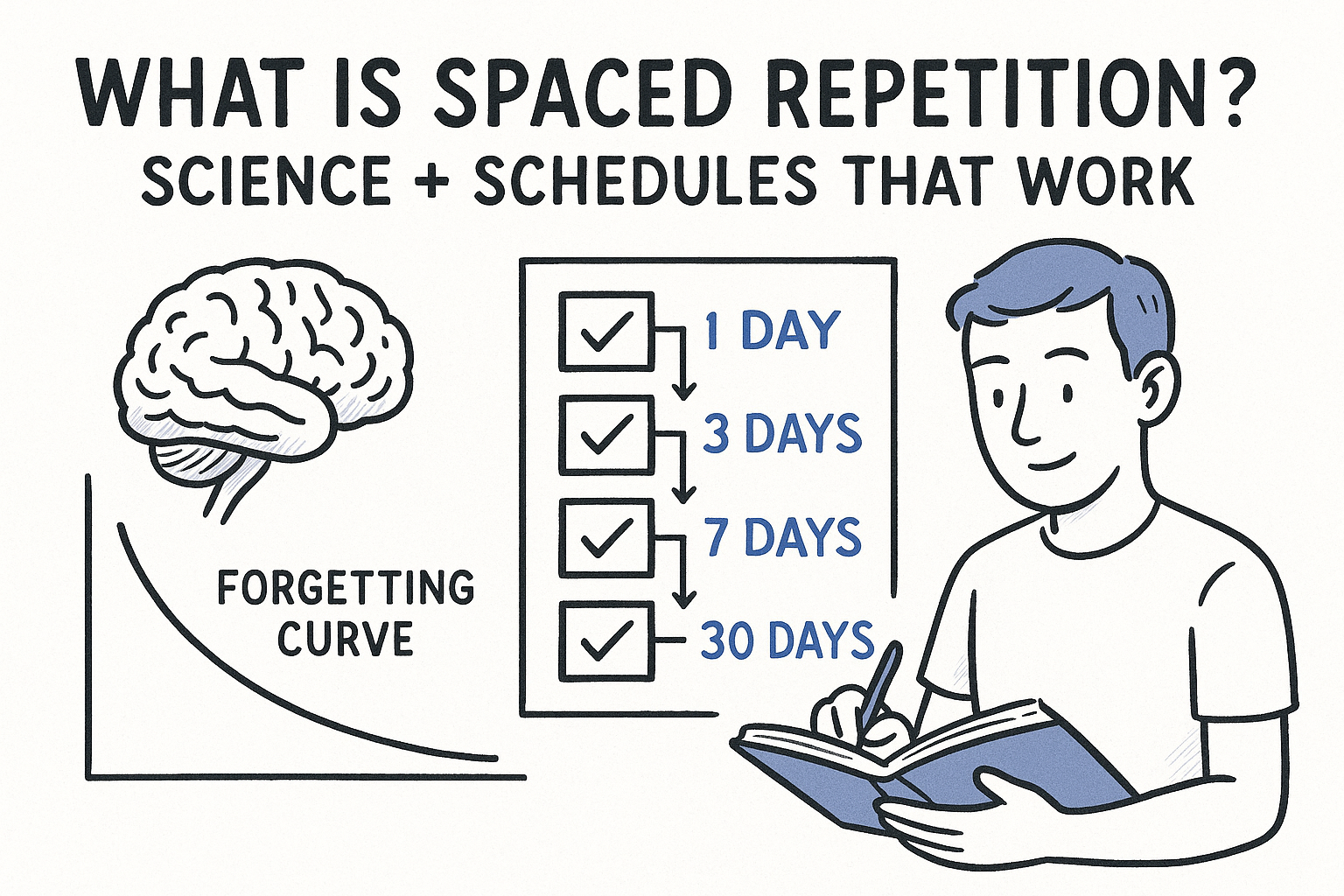
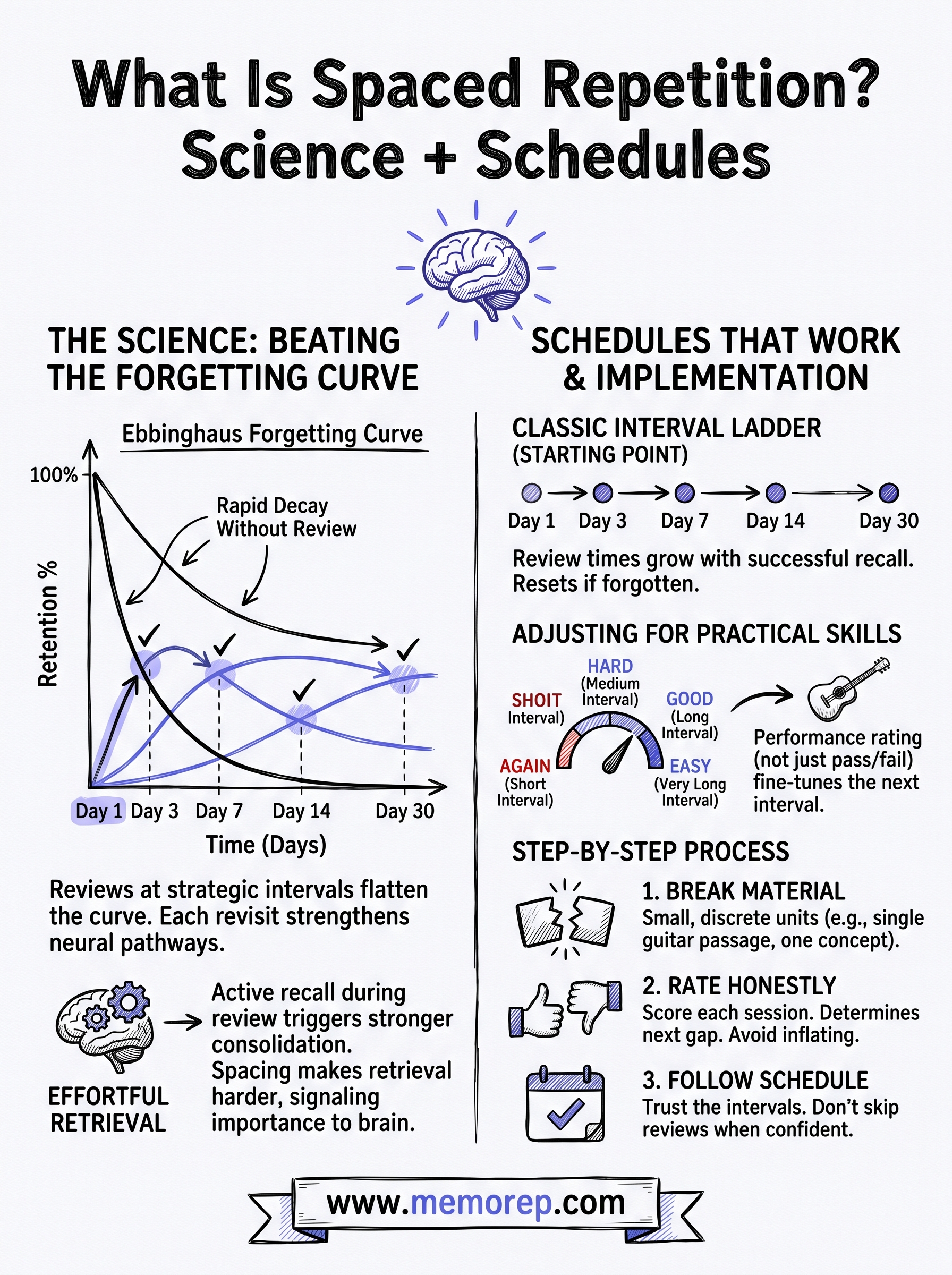
In the 1880s, psychologist Hermann Ebbinghaus tracked how quickly memory decays without reinforcement. He found that forgetting follows a predictable exponential curve: you lose roughly half of what you learned within the first hour, and that decay continues rapidly over 24 hours. Each time you review at the right moment, though, the curve flattens and the interval before the next forgetting gets longer.
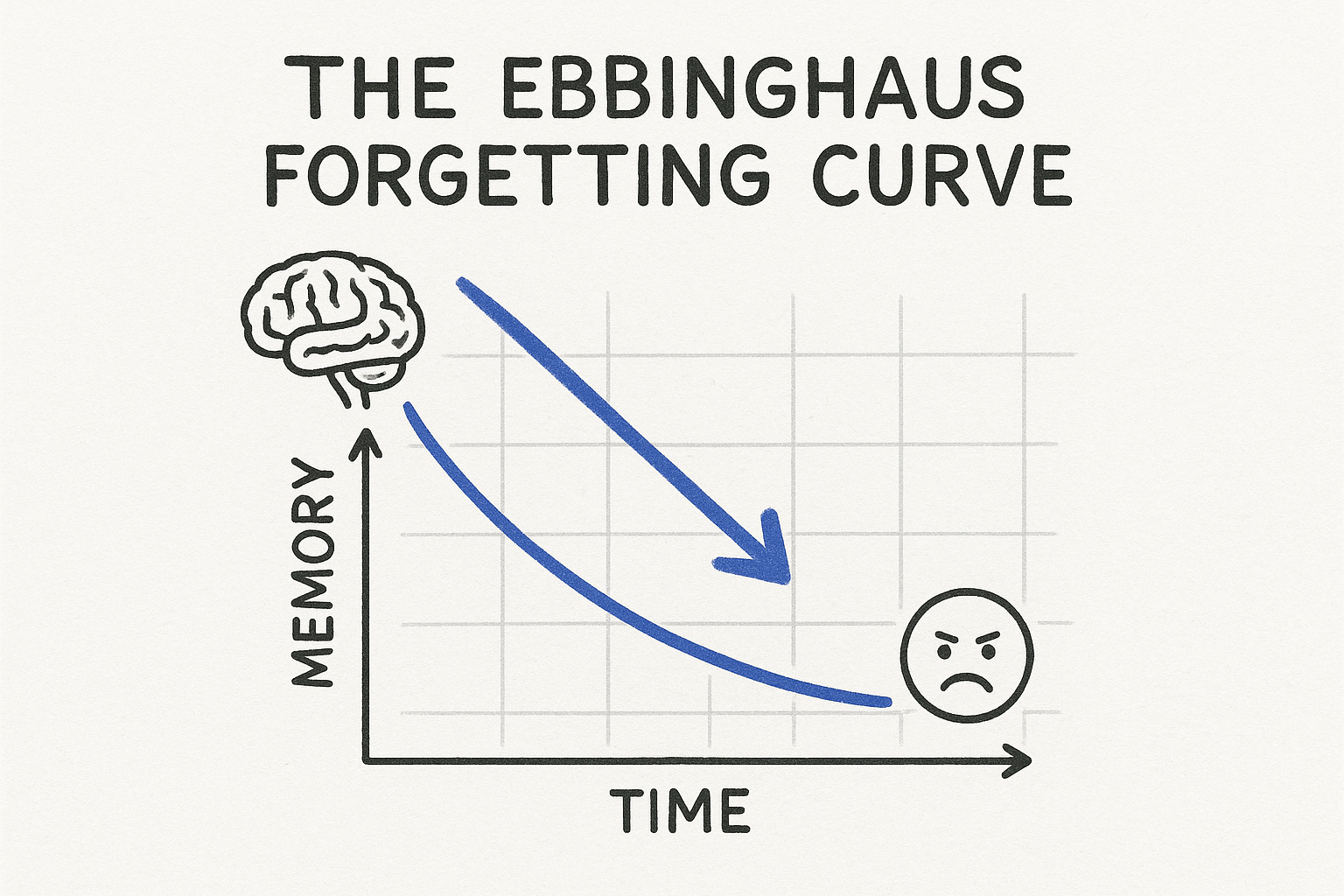
The key insight isn't that forgetting is bad. It's that forgetting is the exact mechanism spaced repetition exploits to build stronger, longer-lasting memory.
How retrieval effort builds skill
Your brain doesn't strengthen a memory just from re-exposure. It strengthens when you actively retrieve the skill, especially when retrieval feels slightly effortful. When you play a guitar passage after a two-day gap, your motor cortex works harder to reconstruct the movement than it would after back-to-back repetitions. That extra retrieval effort signals to your brain that the skill is worth keeping, triggering stronger neural consolidation.
Massed practice, doing the same thing repeatedly in one session, creates an illusion of learning because performance improves temporarily. Spaced practice feels harder in the moment but produces durable retention because each retrieval is genuinely effortful. That gap between sessions is not wasted time. It's the mechanism your brain uses to decide what deserves long-term storage.
Spaced repetition schedules that work
Understanding what is spaced repetition is one thing; knowing which intervals to use is another. Most schedules start with short gaps and extend them as your retention improves. The exact numbers vary by system, but the underlying logic stays consistent: review before forgetting happens, and the next review window grows longer.
The classic interval ladder
The most widely used starting point is a simple fixed ladder: review on day 1, day 3, day 7, day 14, and day 30. Each successful recall pushes the next session further out. If you struggle, the interval resets to the beginning. This approach gives you a concrete schedule without requiring any software.
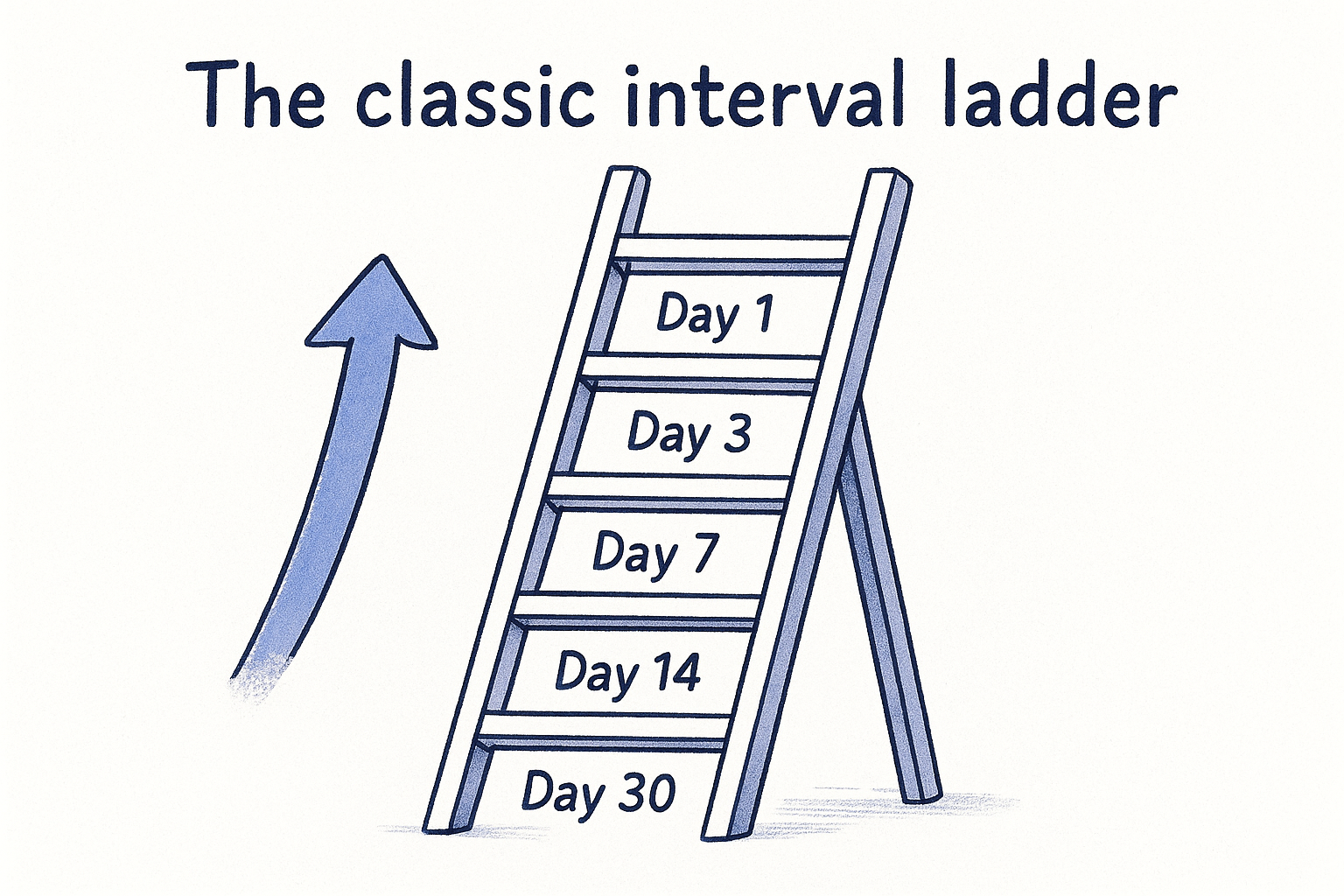
| Review | Day |
|---|---|
| First review | Day 1 |
| Second review | Day 3 |
| Third review | Day 7 |
| Fourth review | Day 14 |
| Fifth review | Day 30 |
Adjusting for practical skills
Text-based recall and physical skill recall behave differently. A vocabulary word either comes to mind or it doesn't, but a guitar passage might feel 60% there, which means the interval should shorten rather than reset entirely. For practical skills, you benefit from rating your performance on a scale so the algorithm can fine-tune the next session date instead of forcing a binary pass/fail.
Rigid schedules work well as a starting point, but performance-weighted intervals keep your practice aligned with how your skills actually develop.
How to do spaced repetition step by step
Knowing what is spaced repetition means little without a clear process to follow. Setup takes under 30 minutes, and once you establish the routine, the schedule manages itself.
Break your material into small, discrete units
Split your skill into reviewable pieces small enough to assess accurately in a single focused session. For guitar, that means individual passages or chord transitions rather than full songs. For academic subjects, it means single concepts rather than entire chapters.
Here's what a useful unit looks like:
- Specific enough to pass or fail cleanly
- Short enough to review in under two minutes
- Distinct enough from other units to track separately
Rate your performance and follow the schedule
After each session, score how it went honestly using a simple scale: again, hard, good, or easy. This rating directly controls the next interval, so inflating scores pushes reviews too far apart and your skills fade before you return to them.
Honest self-rating is the single most important habit in spaced repetition. Without it, the algorithm schedules the wrong thing at the wrong time.
Trust the interval the system assigns, even when a skill feels fresh. Reviewing slightly before forgetting hits reinforces memory at its peak consolidation window.
Examples for studying and practical skills
What is spaced repetition in action? It looks different depending on whether you're studying facts or building a physical skill, but the core mechanism stays the same: review at increasing intervals and rate your performance honestly after each session.
Academic studying
For students, spaced repetition works well on discrete, testable concepts like formulas, historical dates, or vocabulary definitions. After your first study session, review the material the next day, then wait three days before the third session. Each successful recall extends the gap. If you blank on a concept, reset the interval and treat it like new material.
Good subjects to apply spaced repetition to:
- Science formulas and definitions
- Foreign language vocabulary
- Historical events and dates
- Medical or legal terminology
Practical and physical skills
Practical skills like playing an instrument, hitting a tennis serve, or running a coding drill require the same interval logic but with performance-based ratings instead of binary recall. After you run through a guitar passage, score it honestly. A shaky run earns a shorter next interval; a clean, confident run pushes the review further into the future.
The interval isn't a reward for doing well. It's a calibration tool that keeps you returning to each skill at exactly the right moment.
Tools and common mistakes to avoid
Understanding what is spaced repetition gives you the framework, but the tool you use and the habits you build around it determine whether you actually stick with the system. Paper-based tracking works for small skill sets, but once you manage more than 10 to 15 items, manual interval math becomes a burden and sessions start slipping.
Picking the right tool
For general flashcard-based recall, apps like Anki offer a free, customizable option backed by the SM-2 algorithm. If you practice a physical skill like an instrument, look for a platform built around performance ratings and skill-specific scheduling rather than text-based recall. MemoRep is built exactly for that use case, letting you rate each practice item and automatically adjusting your next session date.
Mistakes that break the system
The most common mistake is reviewing too frequently out of anxiety, which removes the effortful retrieval that makes spaced repetition effective. Another is creating units that are too broad, like scheduling "practice scales" instead of a specific scale in a specific position.
Skipping sessions when you feel confident is the fastest way to undo months of consistent progress.
Treat every scheduled review as non-negotiable, even when a skill feels completely solid.
Keep the momentum going
Now you know what is spaced repetition and exactly how to apply it, the only thing left is to start. Consistent, scheduled practice beats every burst of motivation you'll ever feel, and the system works only when you trust it enough to show up for every session it assigns you.
Pick one skill you've been struggling to retain, break it into specific, reviewable units, and run your first session today. Rate your performance honestly after each review and let the intervals do the rest. The gap between sessions isn't downtime; it's the mechanism that makes each return more powerful than the last.
If you practice a physical skill like an instrument and want your scheduling handled automatically, try MemoRep's free beta access before the first 200 spots fill. Structured practice removes the guesswork so you can spend every session actually improving rather than wondering what to work on next.