What Is Spaced Repetition Software? Definition + Examples
You've probably experienced this: you spend hours practicing a skill, feel confident, and then a week later it's like you never touched it. That gap between learning and retaining is exactly the problem that spaced repetition software was built to solve. It's a category of tools that uses memory science to schedule your reviews at precisely the right moments, right before you're about to forget.
The concept isn't new. Psychologists have studied the spacing effect for over a century. But the software that puts it into action has evolved dramatically, moving from simple flashcard apps to platforms like MemoRep that apply these algorithms to practical skill training, things like instrument practice, technique drills, and repertoire maintenance.
This article breaks down what spaced repetition software actually is, the science that powers it, how different tools approach the problem, and what to look for when choosing one. Whether you're new to the concept or comparing options, you'll walk away with a clear understanding of how these systems work and why they're worth building your practice routine around.
What spaced repetition software does
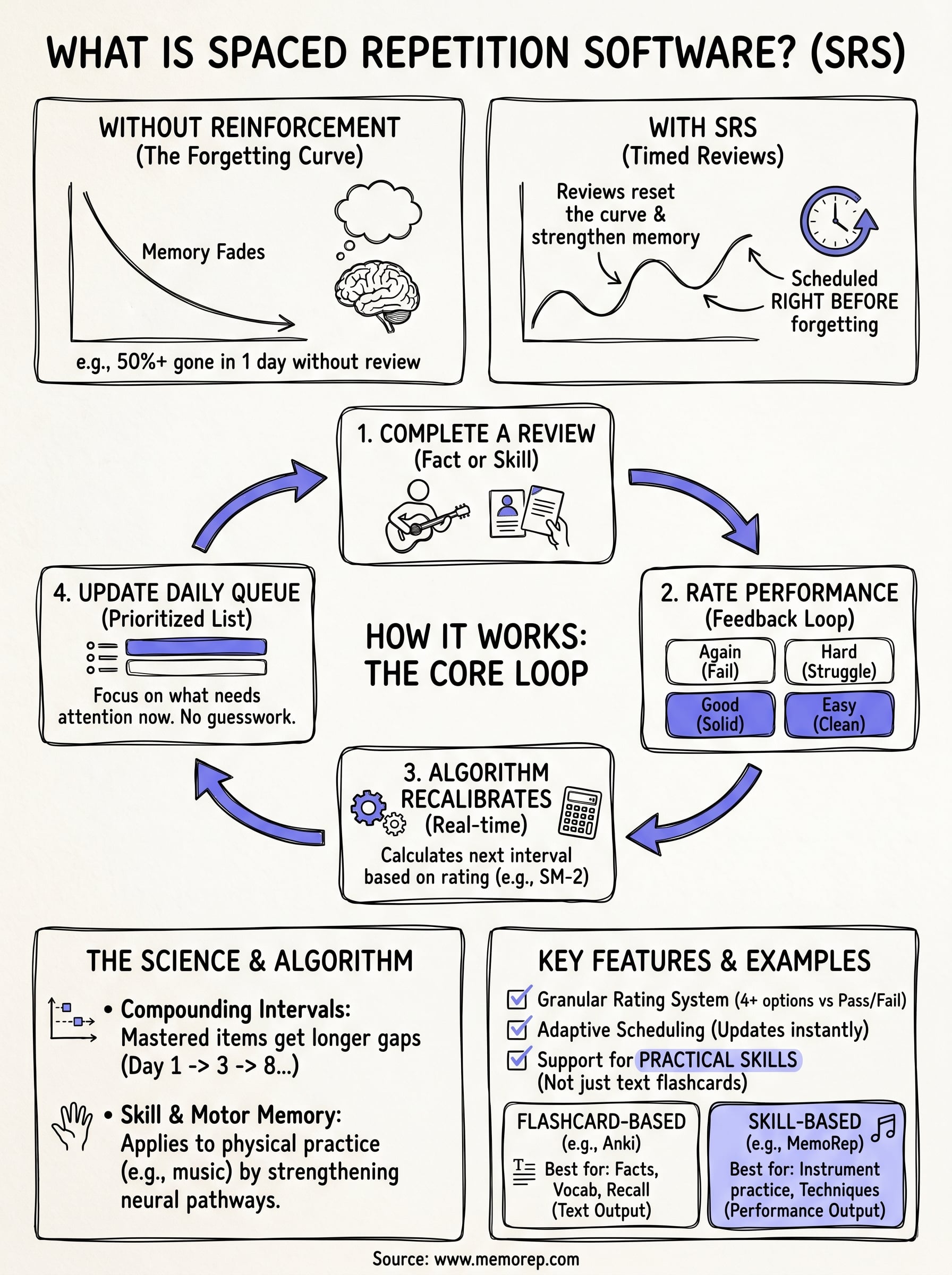
At its core, spaced repetition software takes the manual work of deciding what to practice and when out of your hands. Instead of you guessing which skill needs attention, the software tracks your past performance and builds a personalized schedule that tells you exactly where to focus each session. If you nail a technique, the software pushes it further into the future. If you struggle, it brings it back sooner.
Tracking your practice items
Every piece of content you want to retain, whether that's a chord progression, a technical drill, or a musical phrase, becomes a practice item inside the software. The system logs every review you complete, including how well you performed and when you performed it. Over time, this creates a full history of your interaction with each item, which the algorithm uses to predict when you're most likely to forget it.
Keeping this data removes the guesswork from your practice routine entirely. You don't need a notebook, a spreadsheet, or a mental log to figure out what you last worked on three weeks ago. The software already knows.
Scheduling the next review
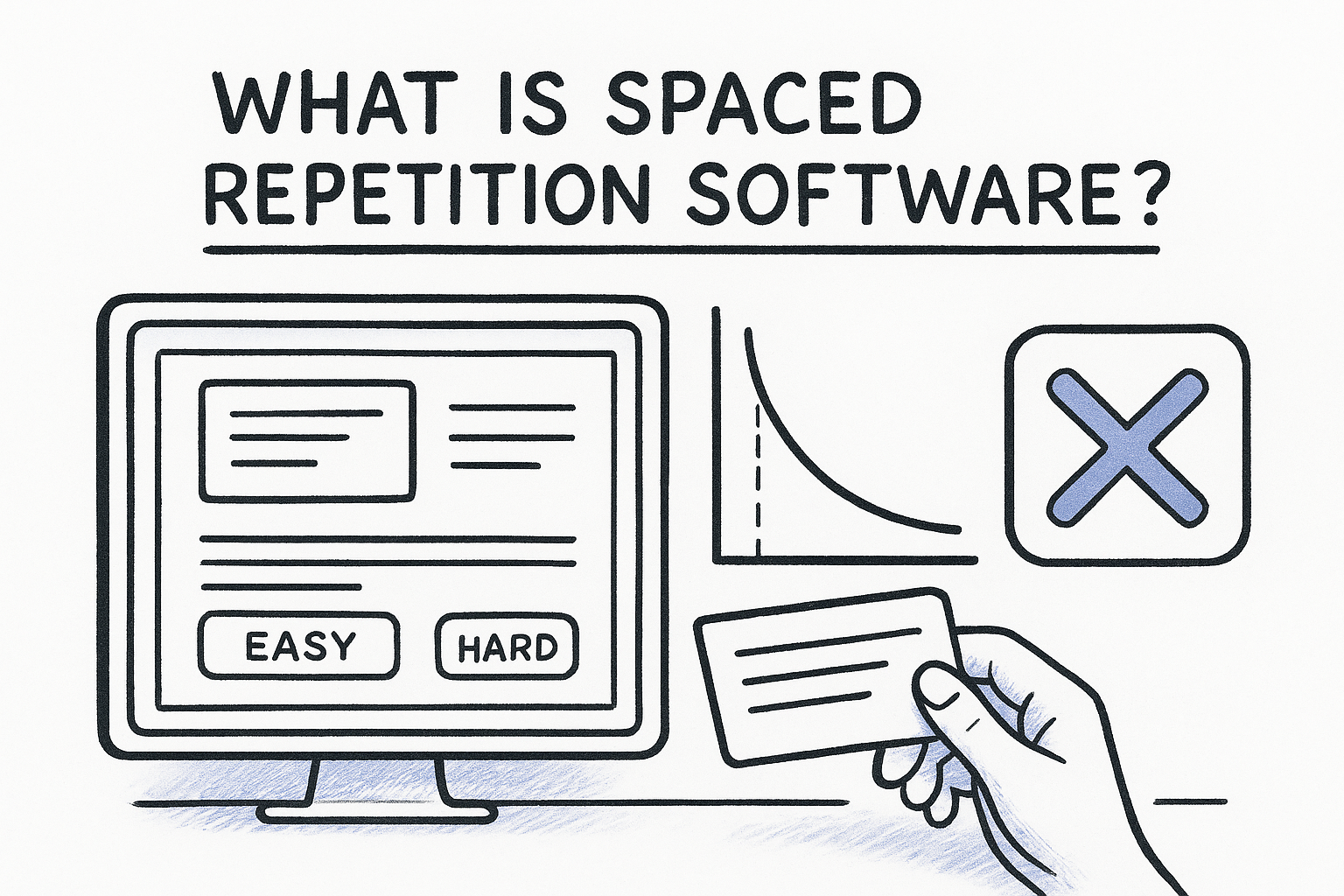
Once the software has your performance data, it calculates a review interval for each item. If you rated something as easy, the next review might be a week away. If you marked it as hard, the software schedules it for tomorrow. This is the core mechanic that defines what is spaced repetition software at a functional level: reviews happen at increasing intervals, timed to catch the skill right before it fades.
The interval grows each time you successfully recall or perform a skill, which means you spend less time on what you already know and more time on what actually needs work.
Giving you a daily queue
Each time you open the software, you get a prioritized list of what's due for review. You don't decide the order. The algorithm does. This structure removes decision fatigue from practice entirely. You show up, work through your queue, and submit a performance rating (typically something like Again, Hard, Good, or Easy) after each item. The software then recalculates intervals based on your input and updates tomorrow's queue automatically.
That feedback loop is what separates spaced repetition software from a simple to-do list or practice journal. The system adapts to you in real time, not the other way around.
Why it works for long-term memory and skills
The science behind spaced repetition comes down to one uncomfortable truth: your brain actively discards information unless you reinforce it at the right time. Understanding this mechanism helps explain why tools built around it produce results that feel almost disproportionate to the effort you actually put in each session.
The forgetting curve
Hermann Ebbinghaus mapped out how memory decays over time in the 1880s, producing what's now called the forgetting curve. His research showed that without reinforcement, you can lose more than 50% of newly learned material within a single day. The curve doesn't flatten on its own, but every successful review resets it and reduces the slope going forward, meaning each repetition buys you more time before the next one is necessary.
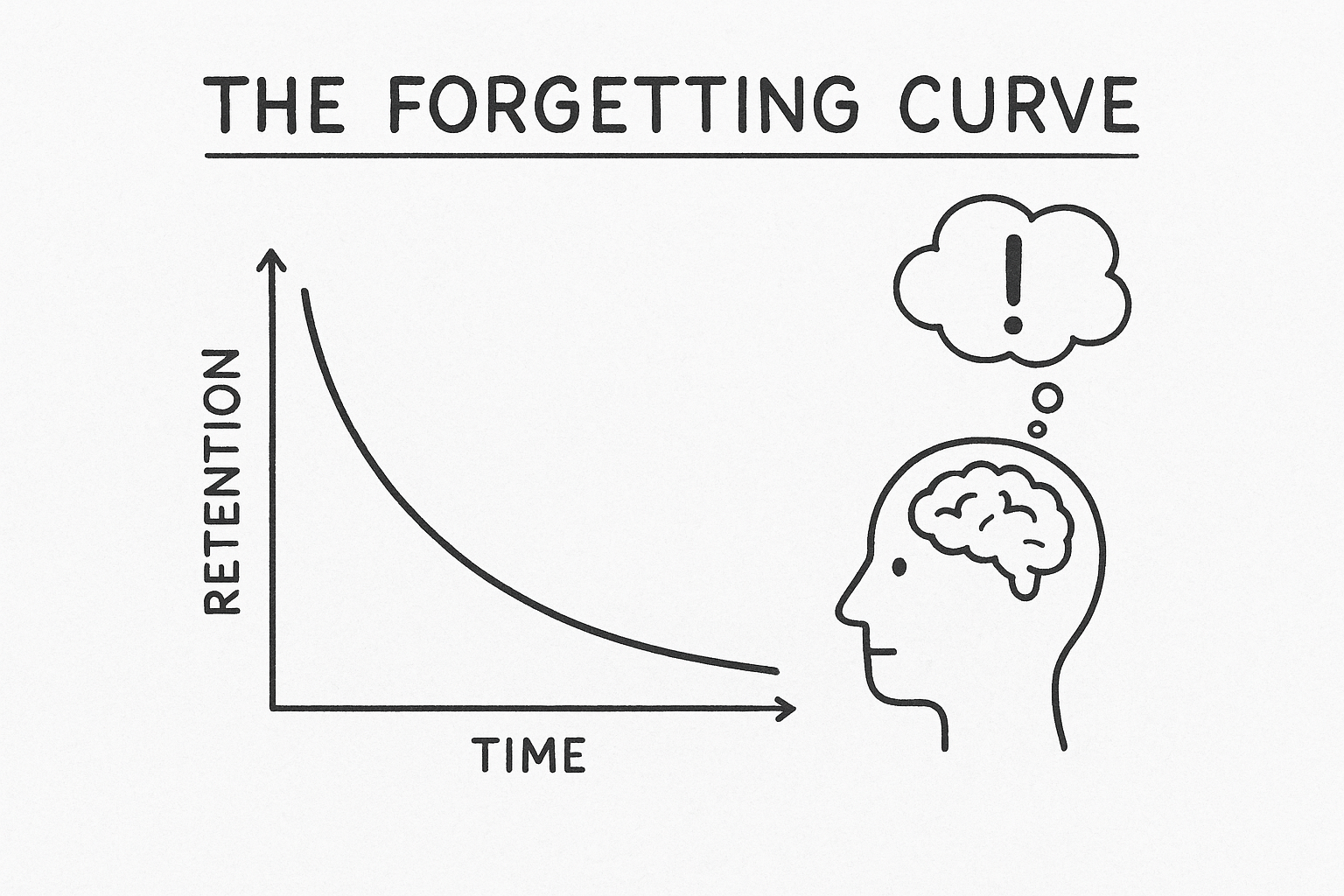
Each time you review a skill at the right moment, your brain rebuilds the memory trace stronger than before, and the next forgetting curve becomes noticeably less steep.
Why practical skills respond the same way
Most people assume the forgetting curve applies only to facts or vocabulary, but motor skills and muscle memory follow the same decay pattern. A guitar phrase you nailed last month can feel unfamiliar after two weeks without practice, not because you're a poor learner, but because your brain deprioritizes neural pathways it hasn't used recently. This is precisely what is spaced repetition software built to address: it catches skills right before that decay accelerates, keeping them accessible without requiring constant daily drilling.
Deliberate, timed retrieval also strengthens the physical execution pathways, not just conscious recall. When you return to a technique just before it fades, your brain works slightly harder to reconstruct it, and that retrieval effort is what drives durable retention. Frictionless practice doesn't build strong memories the same way.
Key features to look for in spaced repetition software
Not all tools that claim spaced repetition actually deliver it well. When you evaluate what is spaced repetition software in practice, the difference between a useful platform and a frustrating one comes down to a handful of features that directly shape how the algorithm serves your practice goals.
A granular feedback rating system
How you rate each review determines everything the algorithm does next. Look for software that offers at least three or four distinct rating options rather than a simple pass/fail toggle. Finer rating granularity lets the algorithm make more precise interval adjustments, which compounds over time into a far more accurate schedule.
The more accurately you can describe your performance after each review, the better the software calibrates your next interval.
A well-designed rating system typically includes:
- Again: couldn't execute the skill at all
- Hard: completed it with significant struggle
- Good: solid performance with minor hesitation
- Easy: clean execution with no effort required
Adaptive scheduling that updates in real time
Strong spaced repetition software doesn't follow a fixed review calendar. It recalculates your next session dynamically after every rating you submit, so if you struggle with a specific skill, the system surfaces it again quickly rather than waiting for a preset date.
This real-time adjustment is what keeps your practice load aligned with your actual retention, not just an arbitrary plan.
Support for practical, skill-based items
Many tools are built exclusively around text-based flashcards, which works for vocabulary but falls short for musicians and hands-on learners. Look for a platform that lets you build skill-focused practice items around techniques, drills, or repertoire.
A well-structured platform should match how physical practice actually works, not just how text recall works.
How spaced repetition scheduling works
Most spaced repetition software runs on the SM-2 algorithm, developed by Piotr Wozniak in 1987. Understanding what is spaced repetition software at a mechanical level means understanding how this algorithm turns your performance ratings into a precise, personalized schedule. The system assigns each item an ease factor that reflects how difficult it is for you specifically, then uses that number to calculate exactly how long to wait before your next review.
Your ease factor updates after every single session, so the schedule adapts to your real performance rather than a fixed plan someone else designed.
The SM-2 algorithm in action
The SM-2 algorithm starts every new item with a short initial interval, typically one or two days. After each review, it multiplies the current interval by your ease factor to generate the next one. Rate a skill Easy and your ease factor climbs, making future intervals grow faster. Rate it Hard and the factor drops, keeping reviews closer together until your performance stabilizes.
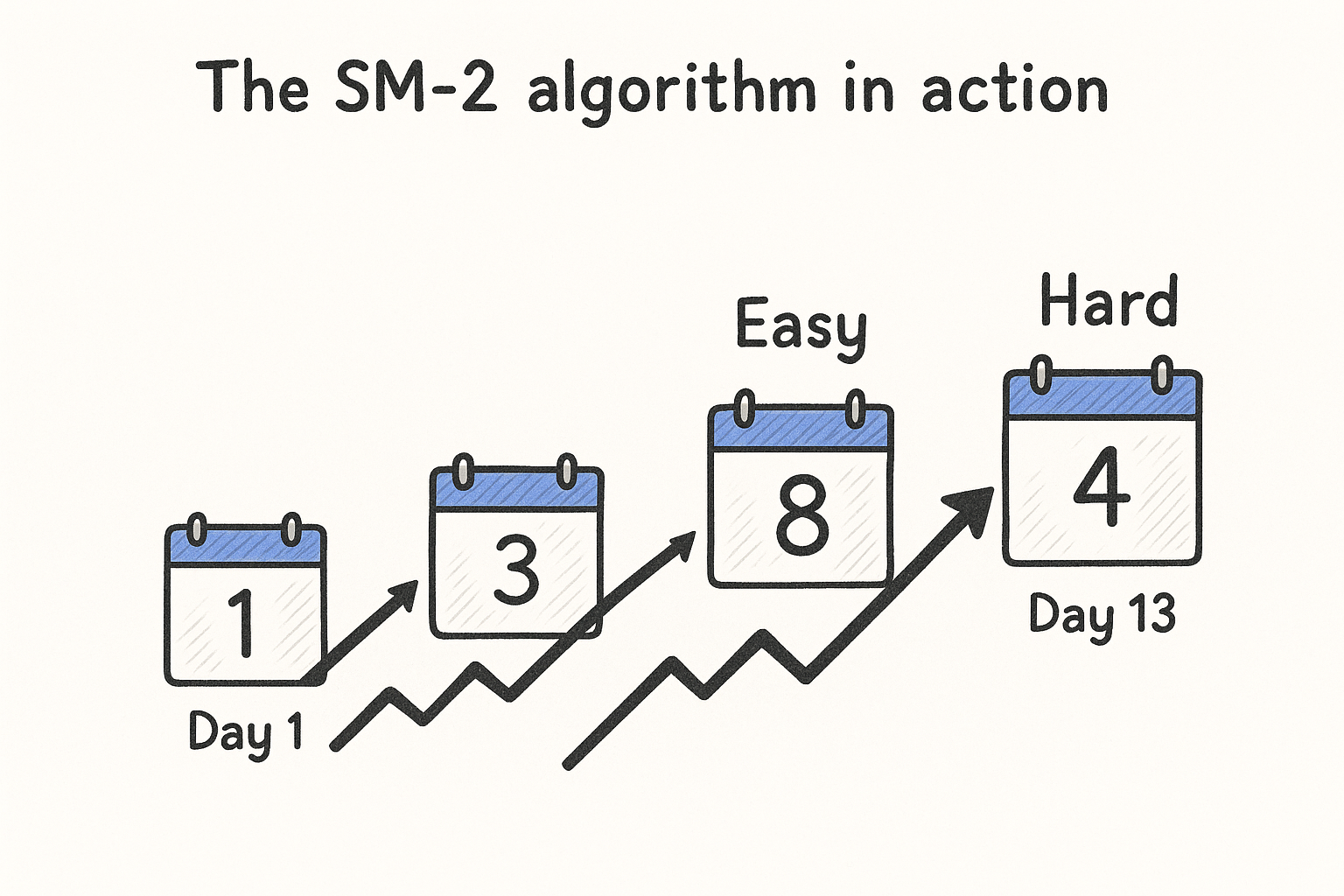
Here's how a single item might progress through early reviews:
- Day 1: First review, interval set to 1 day
- Day 2: Rated Good, interval moves to 3 days
- Day 5: Rated Easy, interval jumps to 8 days
- Day 13: Rated Hard, interval resets to 4 days
Why intervals compound over time
The compounding nature of interval growth is what makes spaced repetition scheduling efficient over weeks and months. A skill you perform consistently earns longer and longer gaps between sessions, which frees up daily practice time for items that actually need attention. You stop re-drilling something you already perform cleanly.
Your daily queue shrinks naturally for mastered skills and expands only for items that need genuine work. That dynamic keeps your practice load manageable without sacrificing long-term retention.
Examples of spaced repetition software and apps
Understanding what is spaced repetition software becomes clearer when you look at the actual tools available. Different platforms target different types of learners, and the right choice depends heavily on whether you're memorizing facts or building hands-on, physical skills.
Flashcard-based SRS tools
Anki is the most widely used spaced repetition tool in this category. It runs on the SM-2 algorithm and lets you build custom decks for vocabulary, medical terminology, and any fact-based content you want to retain long-term. The interface is minimal, and the desktop version is free, though the iOS app carries a one-time cost. Other tools in this space offer cleaner interfaces and more built-in content but follow the same core flashcard logic: you see a prompt, recall an answer, and rate how well you did.
These tools work well for text recall, but they are not designed for learners who need to evaluate physical performance rather than a written or spoken answer.
Skill-based platforms like MemoRep
MemoRep takes a fundamentally different approach. Rather than typing an answer and checking if it matches, you perform a skill and rate your own execution using a four-tier feedback system (Again, Hard, Good, Easy). The algorithm adjusts your intervals based on that rating, using the same underlying math as flashcard tools but applied to practical skill training for musicians, instrument technique, and repertoire maintenance.
This distinction matters if your goal is sustaining a physical practice routine. Flashcard tools assume the output is text; skill-based platforms assume the output is performance. Picking the wrong category means the tool's structure actively works against your practice goals rather than supporting them.
Key takeaways
Spaced repetition software schedules your practice using performance data rather than guesswork or habit. Every review you complete feeds the algorithm, which calculates exactly when to bring each skill back before it fades. That timing is what separates this approach from random, unstructured practice sessions that leave skills inconsistently maintained over time.
Understanding what is spaced repetition software means recognizing it as more than a scheduling tool. It's a system that pushes your brain to retrieve skills at precisely the moment retrieval is hardest, and that difficulty is what makes retention stick. You spend less time on what you've already mastered and more time on the skills that genuinely need work, which keeps your practice sessions productive without making them longer.
Picking the right platform matters as much as picking the method. If you practice a physical skill like an instrument, try MemoRep and get free lifetime access during the beta before the program closes to new users.