What Is The Forgetting Curve? How Memory Fades Over Time
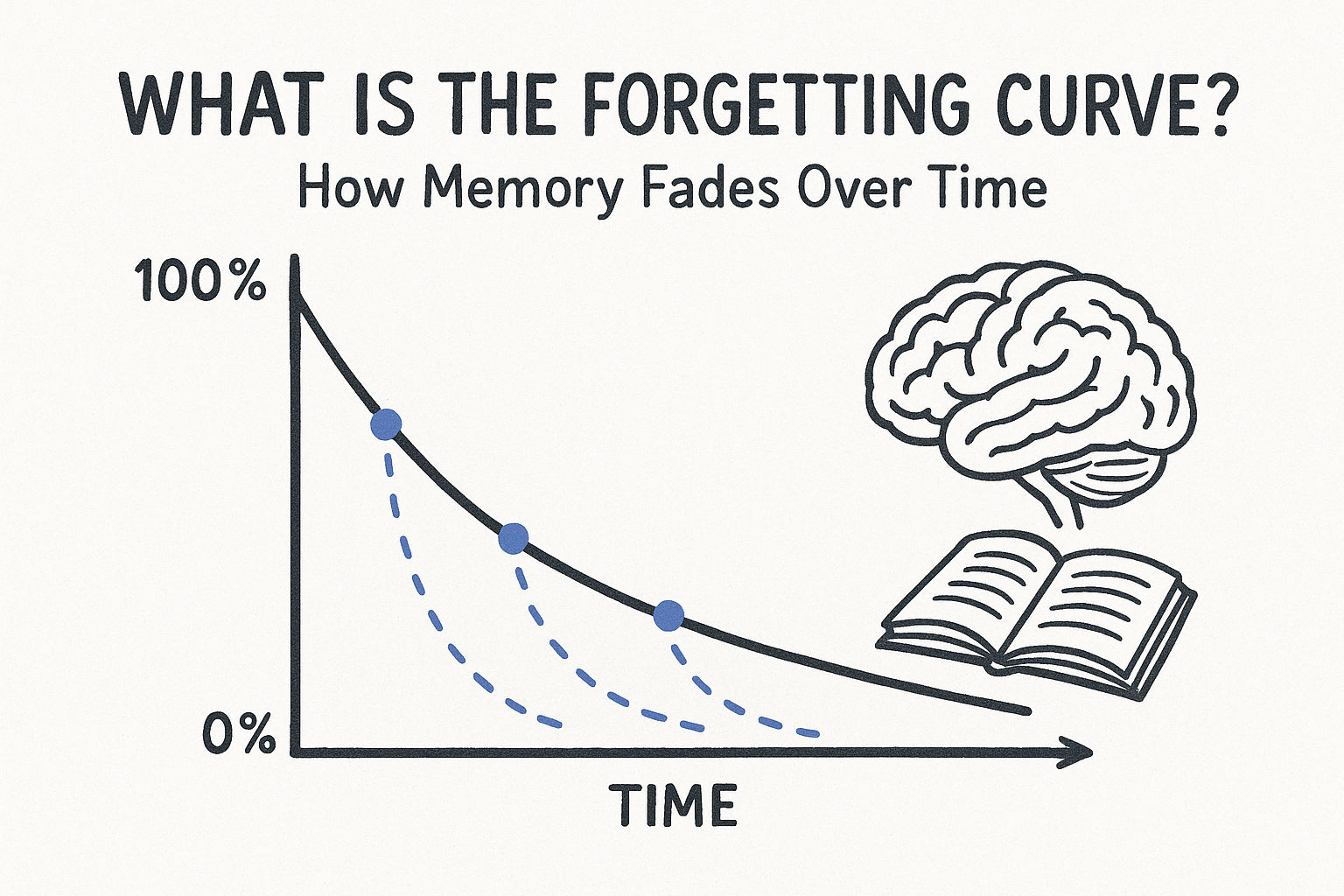
You spent an hour yesterday drilling a new chord progression or nailing a tricky passage. Today, it feels like you never touched it. That frustrating experience has a name in psychology: the forgetting curve. First documented by Hermann Ebbinghaus in 1885, it describes the predictable rate at which newly learned information slips out of memory when you don't actively revisit it.
For anyone building practical skills, guitar, piano, drums, or any discipline that demands repetition, the forgetting curve isn't just an abstract concept. It's the reason your repertoire goes stale, your technique regresses, and your practice sessions feel like you're starting over instead of moving forward. The good news: once you understand how memory decay actually works, you can use targeted strategies to interrupt it before it erases your hard work.
This article breaks down exactly what the forgetting curve is, why Ebbinghaus's research still holds up, and the specific methods proven to flatten the curve. We'll also look at how tools like MemoRep apply these principles directly, using spaced repetition algorithms to schedule your practice sessions at the precise moments when a skill is about to fade, so you retain more while practicing less aimlessly.
Why we forget so quickly after learning
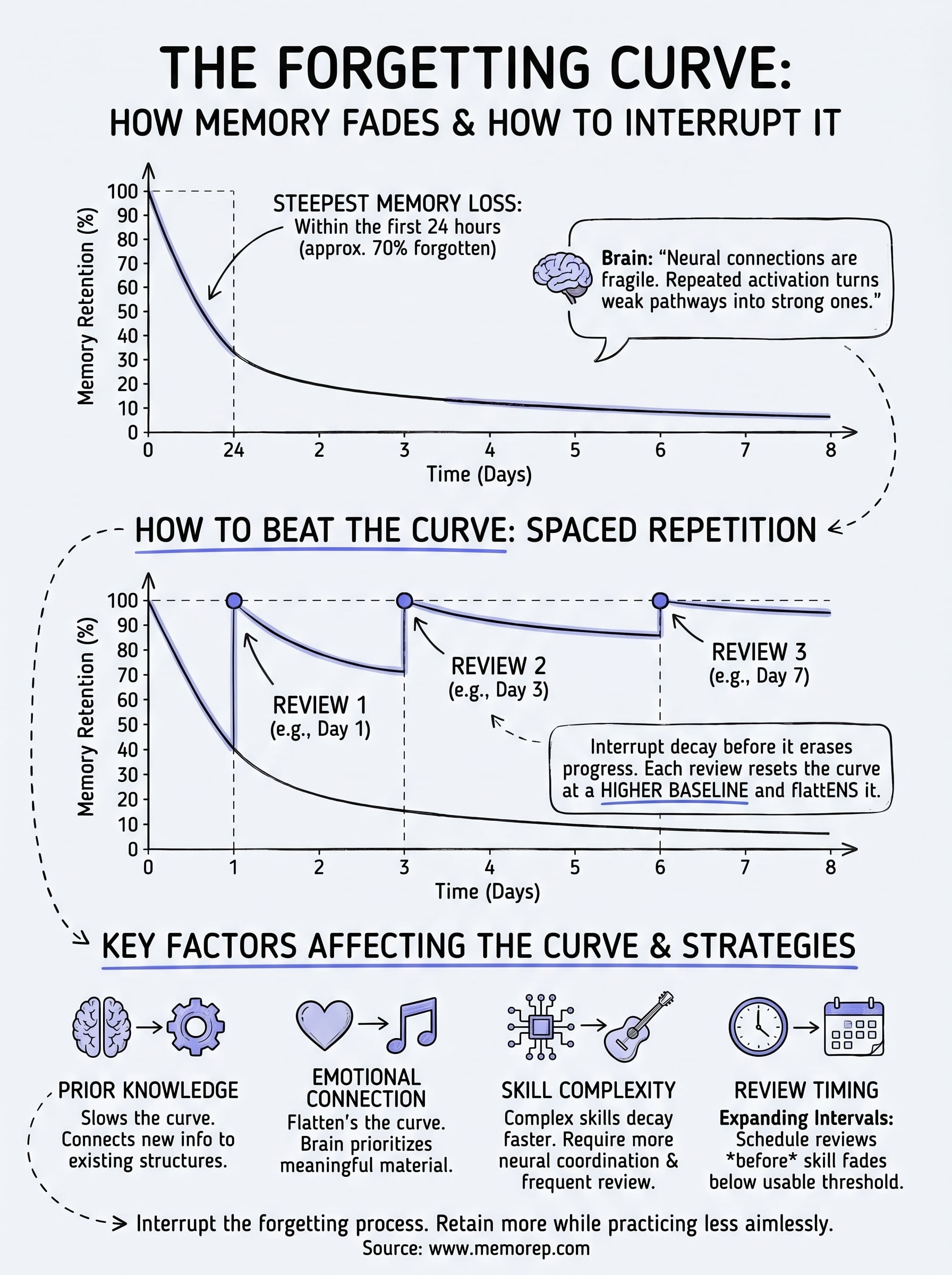
When you learn something new, your brain doesn't automatically file it away in permanent storage. Memory formation is a biological process that takes time, and most of what you absorb in a single session never makes it past short-term storage. Research in cognitive psychology consistently shows that the steepest memory loss happens within the first 24 hours of learning, often before you even have a chance to revisit the material. Understanding this process helps explain why running through something once rarely produces lasting retention.
The biology behind early memory loss
Your brain encodes new information through a process called memory consolidation, where neural connections are strengthened over repeated activation. When you first encounter a skill or piece of information, those connections are fragile and easily disrupted. Repeated activation is what turns a weak neural pathway into a strong, durable one, and without it, the brain treats the new input as low priority and allows it to decay. This isn't a flaw in your memory system. It's actually an efficient filtering mechanism that prevents cognitive overload by clearing out what you don't use.
The brain doesn't forget by accident. It forgets by design, discarding information that hasn't been flagged as worth keeping through repeated use.
Think about the last time you learned someone's name at a social event. You heard it once, maybe used it once, and by the next day it was gone. A single exposure rarely creates strong enough encoding to survive beyond a few hours, and the same principle applies when you learn a new guitar scale or a complex passage on any instrument.
Why practical skills are especially vulnerable
Motor skills and practical techniques face a challenge that pure fact recall doesn't. When you practice a physical skill, your brain coordinates multiple regions simultaneously, including the motor cortex, cerebellum, and basal ganglia, to build procedural memory. That coordination requires consistent reinforcement, not just one focused session.
Procedural memory is highly dependent on recency and repetition. If you nail a passage on Monday but don't return to it until Friday, the neural pattern that produced that performance has already started to weaken. You're not exactly starting from scratch, but it can feel that way. This is exactly why understanding what is the forgetting curve is so practical for musicians and skill learners: once you see how fast decay happens in real time, you can schedule practice to interrupt the forgetting before it compounds into a full regression.
Interference adds another layer of difficulty. Every new skill you practice can disrupt the consolidation of skills you worked on earlier in the same session. Practicing too many things in one block without any spacing means each item competes with the others for consolidation resources during sleep, which is when the majority of long-term memory storage actually takes place. Without a structured plan for revisiting material, your brain simply cannot determine which skills are worth keeping sharp.
How the forgetting curve works in psychology
Ebbinghaus's original experiments involved memorizing nonsense syllables and testing his own recall at precise, documented intervals. What he found was a clear mathematical pattern: retention drops steeply within the first hour after learning, then continues declining at a slower rate over the following days. By 24 hours without any review, he had forgotten roughly 70% of what he had studied. This data became the foundation for what is the forgetting curve, and it remains one of the most replicated findings in cognitive psychology.
The Ebbinghaus retention formula
Ebbinghaus expressed memory retention as a mathematical function: R = e^(-t/S), where R is memory retention, t is time elapsed, and S represents the relative strength of memory. What this formula captures is that forgetting follows an exponential decay pattern, not a gradual linear fade. You don't lose a steady 5% each day. You lose a large portion almost immediately after learning, and then the rate of loss slows considerably as time goes on.
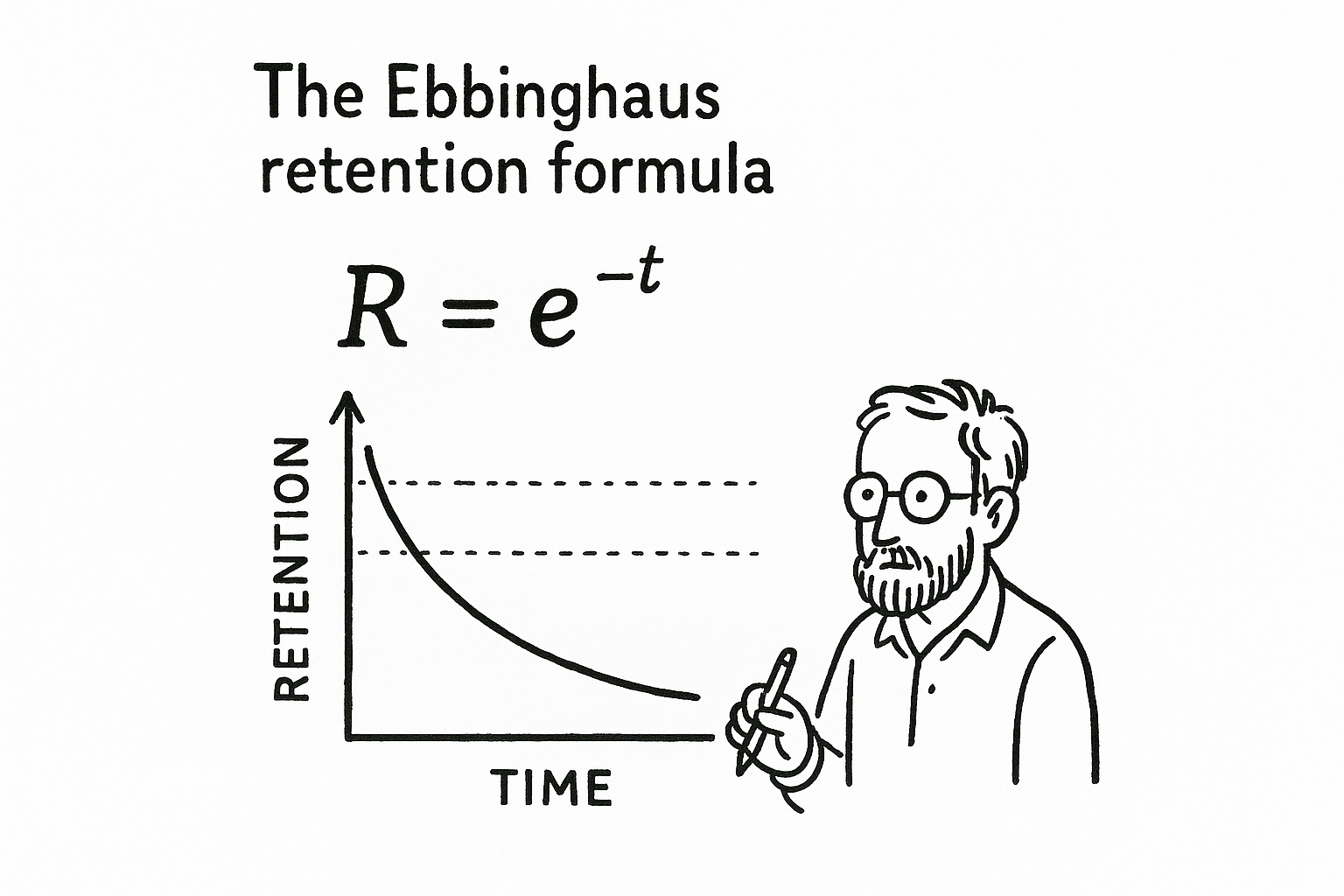
That initial steep drop is exactly what makes single-session practice so unreliable for building durable skills.
How repetition reshapes the curve
Each time you revisit a skill before it fully fades, you reset the forgetting curve at a higher baseline of retention. Your brain registers the repeated encounter as a signal that this information matters, and the neural pathways encoding it grow noticeably stronger. The result is that each subsequent curve becomes flatter and longer, meaning you retain the skill for a greater period before it starts to decay again.
This compounding effect explains why structured review schedules consistently outperform random, reactive practice. Rather than waiting until a skill feels rusty and then drilling it hard, you review it at strategic intervals while your memory is still mostly intact. That timing preserves the memory trace and dramatically reduces the total practice time needed to keep a skill performance-ready over the long term.
What changes the curve for different people and skills
Understanding what is the forgetting curve gives you a useful baseline, but the curve doesn't behave identically for everyone. Several variables shift how fast memory decays, including your personal history with a subject, the type of skill you're building, and how meaningful the material feels to you. Recognizing which factors work in your favor helps you set realistic expectations for how often you need to revisit specific skills.
The role of prior knowledge and emotional connection
Prior knowledge dramatically slows the forgetting curve because your brain has existing neural structures to attach new information to. When you already understand basic music theory, a new chord voicing connects to a framework you've already built rather than sitting in isolation. This anchoring effect speeds up initial encoding and reduces how steeply retention drops after a session.
The more your brain can link new material to something it already knows and cares about, the flatter your forgetting curve becomes from the start.
Emotional significance works in a similar way: material tied to a song you love or a performance goal you genuinely care about tends to stick longer because the brain assigns it higher priority during memory consolidation. Skills practiced with clear purpose consolidate more effectively than those drilled out of obligation.
How skill complexity affects memory decay
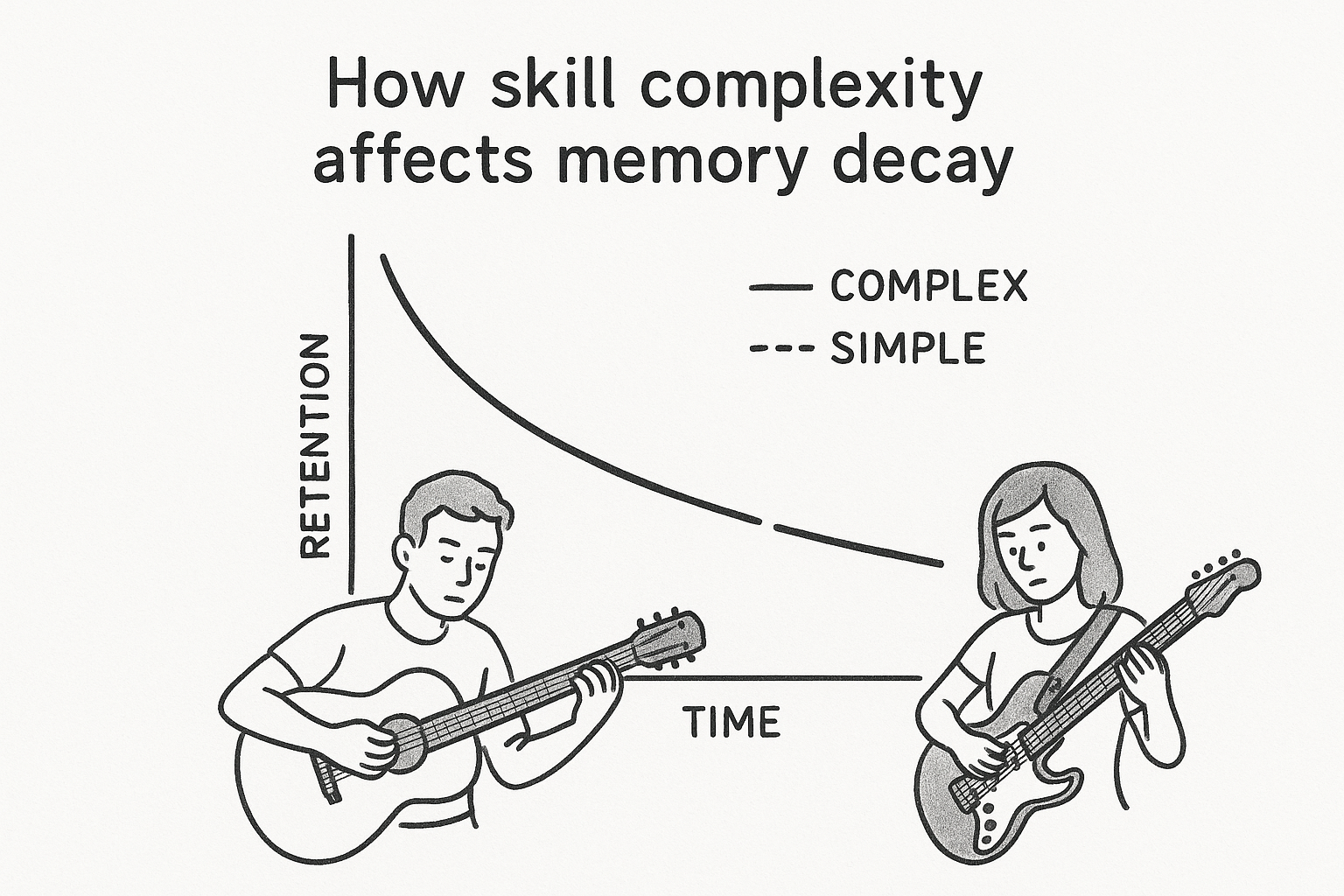
Complex motor skills decay faster than simple ones when left unreviewed, because they require the coordination of more neural systems simultaneously. A basic open chord shape degrades more slowly than a demanding sweep-picking sequence, because the simpler skill involves fewer interdependent pathways. Difficulty also affects consolidation time: harder skills need more sleep cycles to embed properly, which means skipping practice days costs you more for complex techniques than for foundational ones.
Your current skill level also matters. A beginner experiences a steeper initial curve because the neural pathways are fragile and unproven. An intermediate player revisiting a partially learned technique starts at a higher retention baseline and rebounds faster after each review session, which is why tracking your actual proficiency with each skill makes a measurable difference in how efficiently you can structure your practice.
How to beat the forgetting curve with spaced practice
Now that you understand what is the forgetting curve and why it varies between people and skills, you can take direct action against it. Spaced practice is the single most effective method cognitive science has identified for slowing memory decay. Instead of massing all your repetitions into one long session, you distribute them across carefully timed intervals so each review lands just before the skill fades below a usable threshold.
Schedule reviews before the skill feels lost
Most musicians wait until a skill feels rusty before returning to it, which means they're already working against significant decay. Reviewing a skill while retention is still high resets the forgetting curve at a stronger baseline, requiring less effort to restore the same level of performance. Research consistently shows that review timing matters more than total review volume, meaning five short, well-timed sessions outperform one long catch-up session every time.
Practicing at the right moment preserves the memory trace; practicing after it has already degraded forces your brain to rebuild from a weaker foundation.
Increase intervals gradually as retention strengthens
Once you've reviewed a skill successfully, extend the gap before your next session. Your first review might come after one day, then three days, then a week, then two weeks. This expanding interval pattern matches the flattening curve: as the neural pathway grows stronger, it needs less frequent reinforcement to stay intact. Pushing the interval too short wastes practice time on material that doesn't need attention yet. Pushing it too long lets decay advance past the point where a single session can fully recover the skill.
A practical way to manage this is with a structured tracking system that monitors each skill's individual history and calculates when the next review is due. MemoRep's scheduling algorithm handles exactly this, applying the SM-2 spaced repetition formula to your specific practice cards so the system tells you what to work on and when, removing the guesswork and keeping every skill in your repertoire on a reliable consolidation track.
Key takeaways for lasting memory
Understanding what is the forgetting curve gives you a practical framework for every practice decision you make. Memory decay is not random; it follows a predictable exponential pattern that drops steeply within the first 24 hours and then flattens as neural pathways grow stronger through repeated use. Reviewing skills before they fade, rather than after, resets the curve at a higher baseline each time and compounds into durable long-term retention.
Your biggest lever is timing. Prior knowledge, emotional connection, and skill complexity all shift how fast your curve drops, so no single review schedule fits every skill you're building. The most efficient approach distributes practice across expanding intervals matched to each skill's individual history, which is exactly what spaced repetition tools are built to automate for you.
Stop rebuilding skills from scratch every session. Start using MemoRep's spaced repetition scheduler and get free lifetime access while the beta is still open.