Cognitive Load Theory Explained: Principles, Types, Examples
You sit down to practice guitar. You've got a new scale to learn, a chord progression to memorize, a song section to polish, and a rhythm exercise your teacher assigned last week. Twenty minutes in, nothing sticks. Your brain feels like it's running on fumes, not because you're lazy, but because you've overwhelmed your working memory. This is exactly what cognitive load theory explained as a formal framework helps you understand: there's a hard limit on how much new information your brain can process at once, and ignoring that limit makes practice inefficient or even counterproductive.
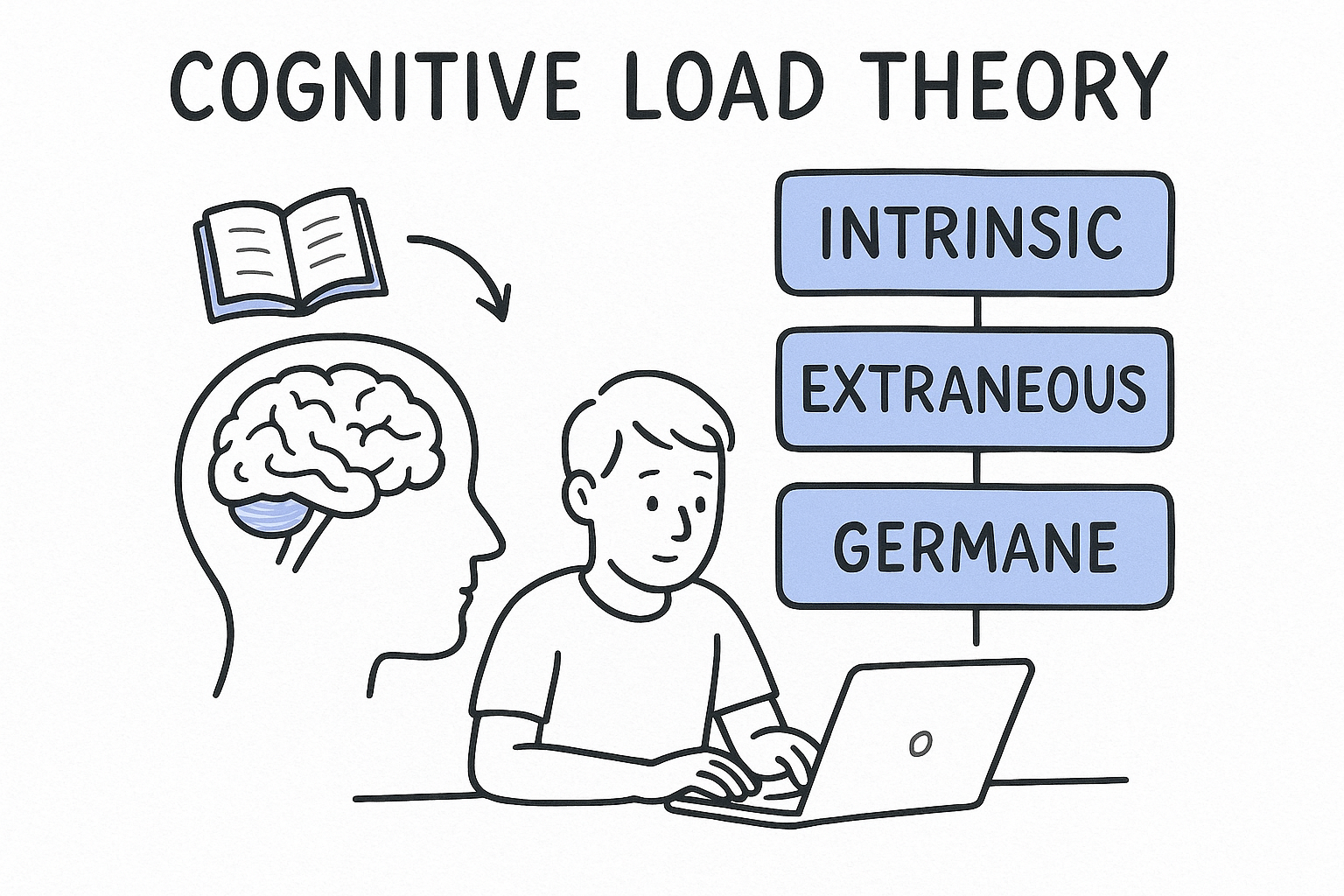
Cognitive Load Theory, originally developed by educational psychologist John Sweller in the 1980s, describes three distinct types of cognitive load that affect how we learn. It's not just an academic concept for classroom instructors, it has direct, practical implications for anyone building skills through deliberate practice. Understanding how your working memory gets taxed (and what you can do about it) changes the way you structure every practice session.
That's a core reason we built MemoRep. Our platform uses spaced repetition algorithms to decide what you should practice and when, so you're not juggling that mental overhead yourself. By spacing out skill reviews at optimal intervals, MemoRep reduces the unnecessary cognitive load that comes from managing your own practice schedule, freeing your working memory to focus on the skill itself. This article breaks down Cognitive Load Theory's principles, its three types, and concrete examples so you can apply it to your own learning.
Why cognitive load theory matters for learning
Most learners operate with a false assumption: more effort equals more progress. They pile on new material, practice multiple skills in a single session, and wonder why results don't match the hours they've logged. Cognitive load theory explained this gap decades before brain imaging could confirm it. The brain has a bottleneck, specifically your working memory, and when you exceed it, learning doesn't just slow down. It stops.
Your attention has a hard ceiling
Research consistently shows that working memory can hold roughly four chunks of information at any given time. George Miller's famous "magical number seven" from 1956 has been revised downward by more recent work, but the core principle holds: the ceiling is low, and it doesn't stretch. When you ask your brain to process too many new inputs simultaneously, older items get displaced before they have a chance to consolidate into long-term memory.
The bottleneck isn't your intelligence or your motivation. It's the structural limit of working memory, and it applies equally to everyone.
Consider a beginner guitarist who switches between six different exercises in a single 30-minute session. That learner is almost guaranteed to retain less than someone who spends the same time on two exercises with focused, spaced repetitions. The load exceeds capacity, and the brain discards material before it can stick.
Why overload leads to frustration, not growth
When your cognitive load is pushed past its limit, the experience doesn't feel neutral. It feels like confusion, mental fatigue, and eventually frustration. Many learners interpret that frustration as a signal that they lack talent, when the real problem is poor task design, not poor ability. Cognitive load theory shifts the blame from the learner to the structure of the learning experience itself.
That reframing is practically useful. If you've ever walked away from a practice session feeling like you worked hard but absorbed nothing, you probably weren't dealing with a motivation problem. Your working memory was saturated. Recognizing that the structure of your practice session directly controls how much you retain gives you a concrete lever to pull. You can reduce complexity, isolate skills, and space out review intervals to match what your brain can actually handle.
Skill learning compounds this challenge. Unlike reading text, where you can re-read a sentence, physical and procedural skills require real-time coordination of multiple mental processes. A musician tracking pitch, timing, finger position, and dynamics simultaneously is asking their brain to manage several cognitive streams at once. Cognitive load theory explained this as a fundamental design problem, not a talent problem, and the practical solution is to reduce simultaneous demands until each sub-skill becomes automatic enough to free up capacity for the next layer of complexity.
How working memory and long-term memory interact
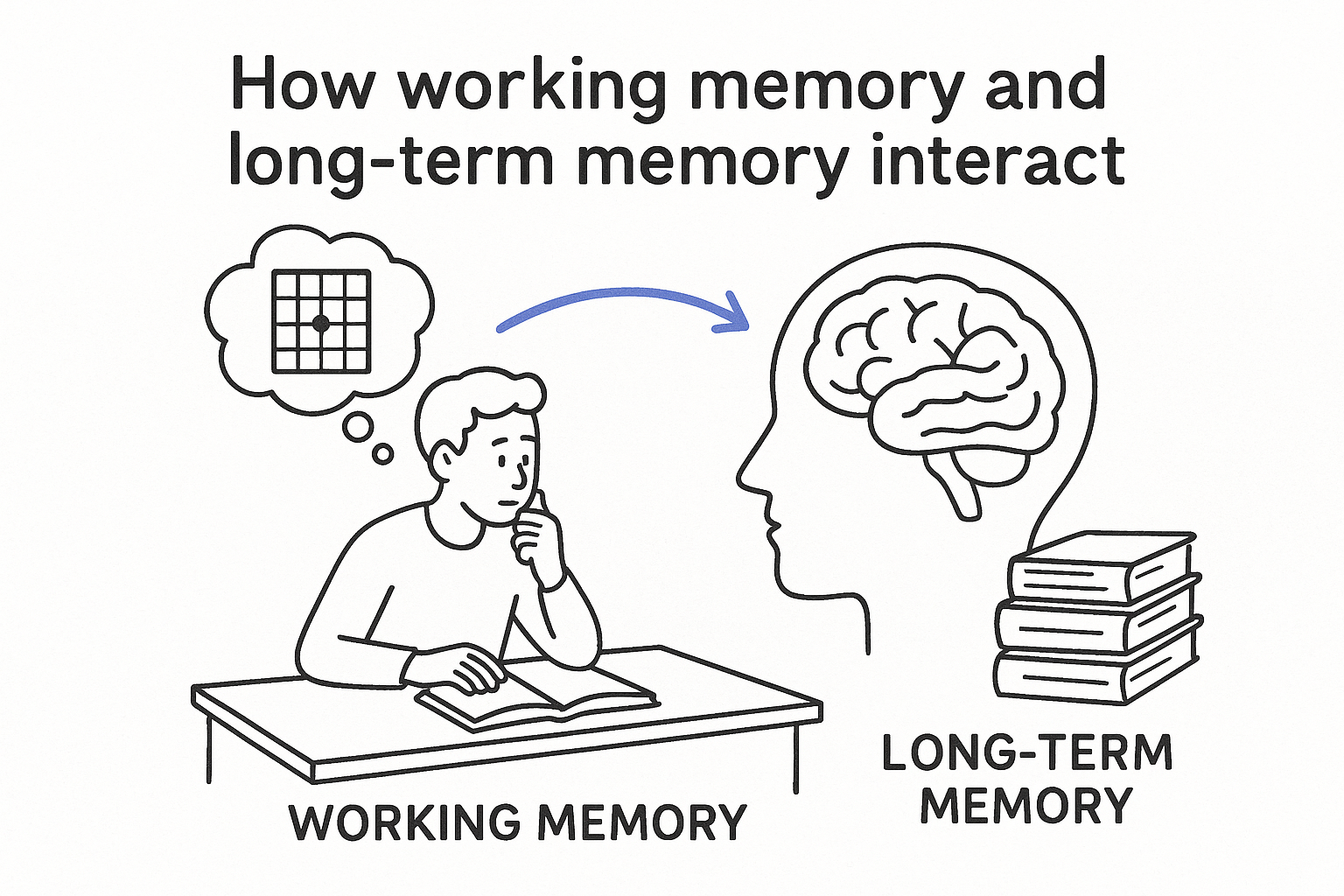
Cognitive load theory explained the brain's architecture in a way that made practical sense of a frustrating learning reality: working memory and long-term memory are not separate buckets competing for the same resource. They're a system, and how well they communicate determines how fast you improve at any skill. Understanding this relationship is what separates structured, efficient practice from repetitive, low-retention effort.
Working memory: your brain's processing desk
Think of working memory as the desk where active thinking happens. It's the space where you read, interpret, combine, and execute new information. The problem is that it's small. When you encounter an unfamiliar chord shape, your brain has to hold the finger positions, the sound you're targeting, the rhythm, and the context within a song all at the same time. Each of those demands occupies space on that mental desk, and when the desk fills up, new information falls on the floor.
The size of your working memory doesn't change, but how efficiently it operates depends entirely on what you've already automated through practice.
Long-term memory: the storage that expands your capacity
Long-term memory stores everything you've already learned, from recognizing the alphabet to riding a bicycle to fingerpicking a chord you've practiced hundreds of times. Critically, those stored patterns don't consume working memory space when you retrieve them. A chord you've internalized doesn't require conscious thought. Your fingers move, and your attention is free to focus on the next challenge.
This is why experienced musicians can think about phrasing and expression while beginners are still thinking about where to place their fingers. The beginner's working memory is saturated with basics that the experienced player has offloaded to long-term memory. The practical goal of any deliberate practice system is to automate sub-skills through repetition, so each one becomes a chunk stored in long-term memory and no longer burns working memory capacity.
Why spacing accelerates that transfer
Repetition alone doesn't reliably transfer skills to long-term memory. Spaced repetition, specifically timing your review sessions to match when a skill begins to fade, forces the brain to reconstruct the memory, which strengthens the neural pathway and makes retrieval faster and more automatic. Each successful retrieval at the right interval moves the skill closer to effortless, automatic recall, freeing your working memory for the next layer of complexity.
The three types of cognitive load
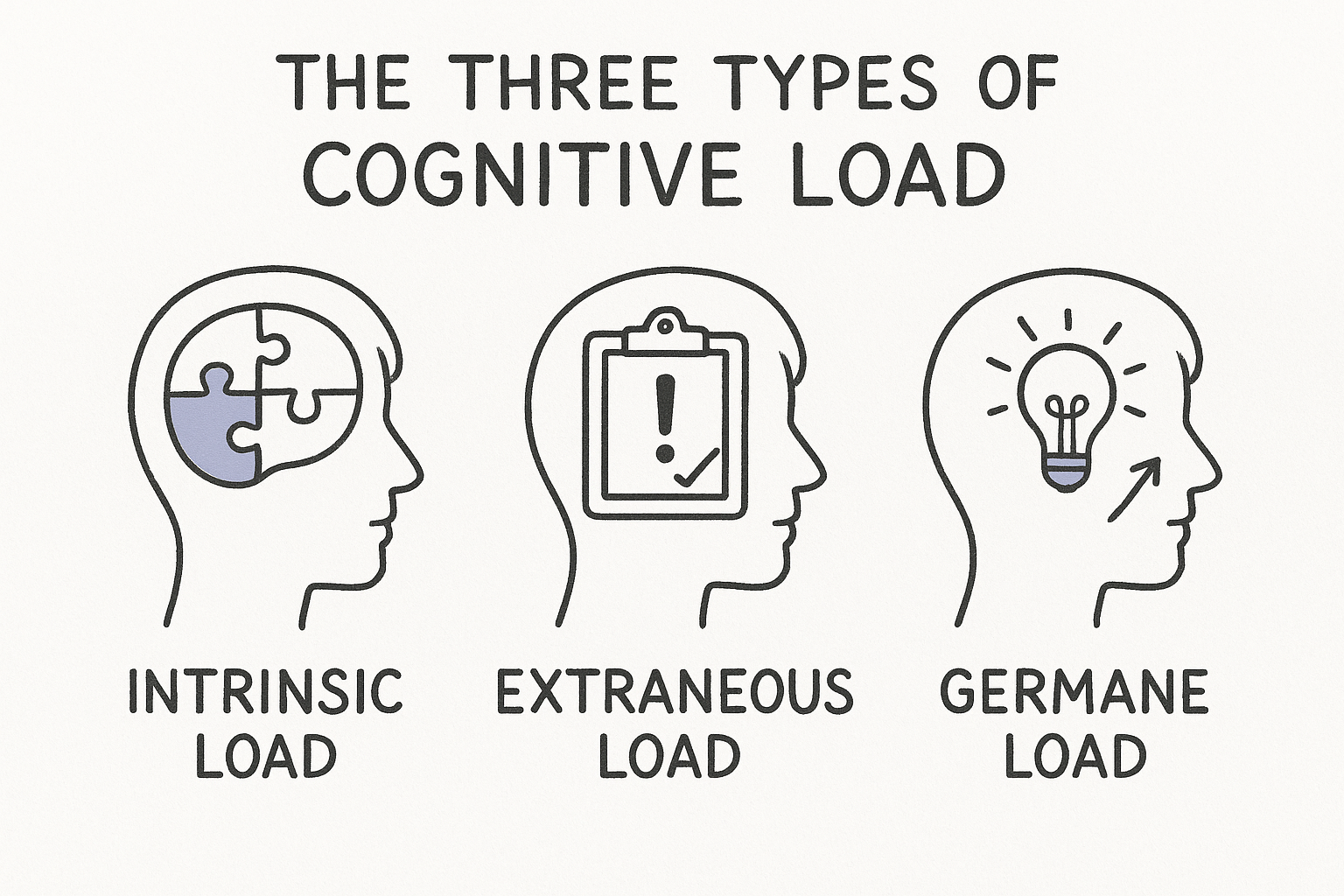
Cognitive load theory explained the relationship between working memory and skill acquisition by breaking mental demand into three distinct categories. Each type operates differently, and each one responds to different design choices in how you structure your practice. Knowing which type is taxing you at any given moment tells you exactly where to intervene.
Intrinsic load
Intrinsic load is the inherent difficulty of the material itself. It comes from the number of interacting elements a task requires you to process simultaneously. A simple open chord carries low intrinsic load for most guitarists. A jazz chord with unfamiliar extensions played in an unfamiliar position carries high intrinsic load because more elements interact in ways you haven't yet automated.
You can't eliminate intrinsic load without changing the task, but you can sequence material so complexity increases gradually. Start with the simplest version of a skill, automate it, then add the next layer. This approach reduces what researchers call element interactivity, and it forms the structural basis of effective progressive practice.
Extraneous load
Extraneous load is the cognitive burden created by poor design, not by the material itself. It's the mental overhead that comes from unclear instructions, cluttered notation, deciding what to practice next, or tracking which skills you haven't reviewed in weeks. None of that effort teaches you anything. It just consumes working memory that should go toward the skill.
Extraneous load is the most controllable type, and reducing it consistently has the highest return on your cognitive investment.
This is where structured practice tools directly reduce your learning friction. When a system like MemoRep automatically schedules your next review based on your last performance rating, you eliminate the extraneous load of managing your own practice queue. Your working memory stays focused on execution rather than administration.
Germane load
Germane load refers to the mental effort that actually produces learning. It's the processing that builds and strengthens schemas in long-term memory. Germane load is productive, but it still draws from the same limited pool of working memory capacity as the other two types, which means you need enough cognitive room for germane load to operate.
Reducing extraneous load is the fastest way to create that room. When you stop spending mental energy on decisions and logistics, your brain can redirect that capacity toward the deep processing that converts practice repetitions into durable skill.
Core principles and effects you can apply today
Cognitive load theory explained several research-backed effects that show up in real practice and learning environments. These aren't abstract principles you file away and forget. Each one translates directly into a concrete change you can make to how you structure your sessions and what materials you use. Applying even one of them consistently will shift how much you retain from each practice block.
The worked example effect
Beginners learn faster when they study worked examples rather than attempting to solve new problems from scratch. When you're early in learning a skill, your working memory fills up quickly with the mechanics of execution. Watching or following a demonstration reduces that burden by giving your brain a template to match against, rather than requiring it to build the solution from nothing.
This principle applies directly to physical skills. Before you attempt a new technique on your instrument, study a clear model of the correct movement first. Once the shape of the skill becomes familiar, your working memory has more room to focus on refining your own execution rather than constructing the target from scratch.
The split-attention effect
Split-attention occurs when you're forced to mentally integrate two separate sources of information that should be presented together. If your sheet music sits on a stand while a separate fingering diagram sits across the room, your brain burns capacity toggling between them instead of processing the skill itself.
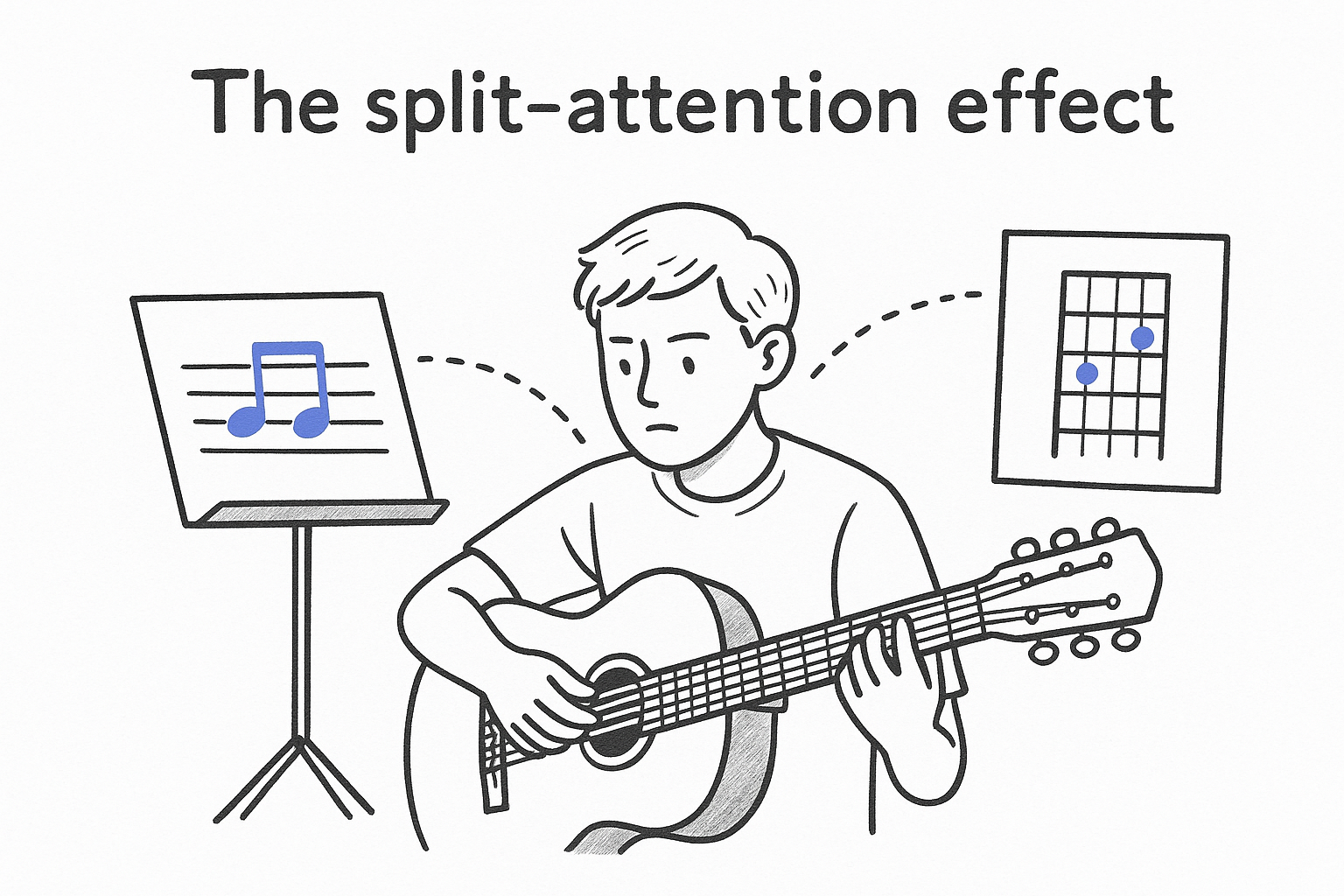
Combining related information into a single, integrated source reduces split-attention and frees your working memory for actual learning.
When you design your practice materials, keep all relevant information visually unified. Annotate your sheet music directly rather than referencing a separate sheet. Use a single practice card that contains the context, the technique, and the target standard in one place.
The redundancy effect
Redundancy load occurs when you present the same information in multiple formats simultaneously and the duplication forces the brain to process and reconcile both versions. Reading text aloud while a learner also reads it silently is a classic example. Each channel consumes working memory without adding new information.
For your own practice, remove duplicate cues once a skill reaches a basic level of fluency. If you can read the chord symbol confidently, hide the fingering diagram. Let your long-term memory carry what it already knows, so your working memory stays focused on the next layer of complexity.
Examples of cognitive load in real learning tasks
Cognitive load theory explained in abstract terms only takes you so far. Seeing it play out in specific learning tasks makes the principles immediately actionable. The following examples show exactly where working memory gets saturated and what that moment actually looks and feels like during practice.
A beginner reading notation while playing
When you first learn to read sheet music while playing an instrument simultaneously, you're running two cognitively demanding processes at once. Decoding notation requires translating symbols into finger positions, while executing those positions in real time demands coordination, timing, and physical control. Neither task is automatic yet, so both compete for the same limited working memory space.
The result is predictable: your tempo collapses, your fingers hesitate, and your reading falls behind the beat. This isn't a sign that you lack coordination. It's a split-attention problem that prevents your brain from reconciling two separate streams of non-automated information fast enough to keep up. The solution is to separate the tasks: read through the piece without your instrument first, build the notation-to-position mapping into long-term memory, then add the physical execution layer once the reading feels lighter.
Stacking too many new skills in one session
Suppose you plan a session covering a new scale, an unfamiliar chord progression, a rhythm pattern, and a technique drill you've never attempted. Each item carries high intrinsic load individually, and none of them are automated yet. Stacked together, the total cognitive demand exceeds what your working memory can handle, and none of the items gets the focused repetition it needs to consolidate.
Spreading your attention across four new skills in one session almost guarantees you retain less than you would by spending the same time on one.
The experienced version of this mistake looks slightly different but works the same way. Advanced players sometimes add complexity before sub-skills are fully automated, jumping to a faster tempo or a more intricate variation before the foundational movement has been offloaded to long-term memory. In both cases, the cognitive load of the new layer prevents the existing skill from consolidating. Mastering one layer before adding the next is not a shortcut. It's the most direct route to durable improvement.
How to design instruction with cognitive load in mind
Designing instruction well means building the learning environment before the learner ever starts. When you apply cognitive load theory explained principles at the design level, you stop relying on the learner's willpower to push through confusion and instead remove the conditions that cause unnecessary overload before they occur. Good instructional design treats working memory as a fixed resource to protect, not a challenge to overcome.
Sequence complexity from simple to hard
The most reliable rule in instructional design is to isolate one sub-skill at a time and build automaticity before introducing the next element. This directly reduces intrinsic load because fewer elements interact simultaneously in working memory. A guitarist learning fingerpicking, for example, should master the thumb pattern for bass strings before adding the index and middle fingers. Adding complexity before the foundation is automatic forces the brain to juggle unfinished processing across multiple layers, which guarantees shallow retention across all of them.
Your job as a designer or self-directed learner is to control what enters working memory and in what order, not to test how much the learner can handle at once.
Keeping instructions integrated and physically close to the task material also cuts split-attention load. Annotate your practice materials directly on the page instead of pointing learners to a separate reference. Every time someone has to toggle between two sources to reconstruct meaning, they burn working memory that belongs to the skill.
Use feedback to calibrate the next step
Feedback timing matters more than most learners realize. Immediate, specific feedback after each repetition tells your brain whether the schema it just constructed is accurate, and it closes the gap before a wrong pattern gets reinforced. Vague feedback like "that sounded off" gives the brain nowhere useful to go. Precise feedback tied to a specific element, such as timing or finger placement, targets the exact layer of cognitive demand that needs adjustment.
Building a structured rating system into your practice routine formalizes that feedback loop. When you rate each repetition on a simple scale and let that rating drive your next review interval, you shift the decision-making overhead entirely out of working memory. That overhead is extraneous load, and removing it consistently frees up cognitive space for the skill itself.
How to apply cognitive load theory to practice routines
Applying cognitive load theory explained principles to your own practice routine starts with treating each session as a working memory budget. You have a fixed amount of cognitive capacity available, and every decision you make before you pick up your instrument determines how much of that budget goes toward actual skill building versus overhead.
Limit the number of new skills per session
Working memory saturates quickly when you introduce multiple unfamiliar skills at once. A practical rule is to introduce no more than one or two new items per session and spend the remaining time reinforcing material you've already begun to automate. That ratio keeps intrinsic load manageable while still moving your overall skill set forward.
The fastest way to improve is to practice fewer things more carefully, not more things more quickly.
When you review material you've partially learned, your brain strengthens existing neural pathways rather than splitting its resources across too many fresh demands. Each session should feel focused, not scattered, and the ratio of review to new material should skew heavily toward review, especially early in learning a skill.
Use a rating system after every repetition
Rating each practice repetition immediately after you complete it turns vague impressions into useful data. A simple scale, such as Again, Hard, Good, or Easy, captures how much cognitive effort the skill required and how accurately you executed it. That rating then drives your next review interval, so skills you find difficult get revisited sooner and skills that feel automatic get spaced further out.
This is exactly how MemoRep structures your practice queue. Rather than asking you to remember which exercises need attention or how long it's been since you last reviewed a technique, the platform calculates your next session automatically based on your performance ratings. Your working memory stays entirely focused on executing the skill in front of you, not on managing a mental tracking system across dozens of practice items.
Keep your practice cards focused on a single skill
Each practice item you track should target one specific, testable skill, not a cluster of related techniques bundled together. When a single card covers too much ground, you lose the ability to rate it accurately, and your scheduling data becomes unreliable. Narrowly scoped cards work best. For example:
- A specific scale position at a target tempo
- One fingerpicking pattern applied to a single chord shape
- A chord transition between two named chords
Keeping cards this tight gives the spaced repetition algorithm precise feedback to work with, which produces more accurate review timing and faster long-term retention.
What to do next
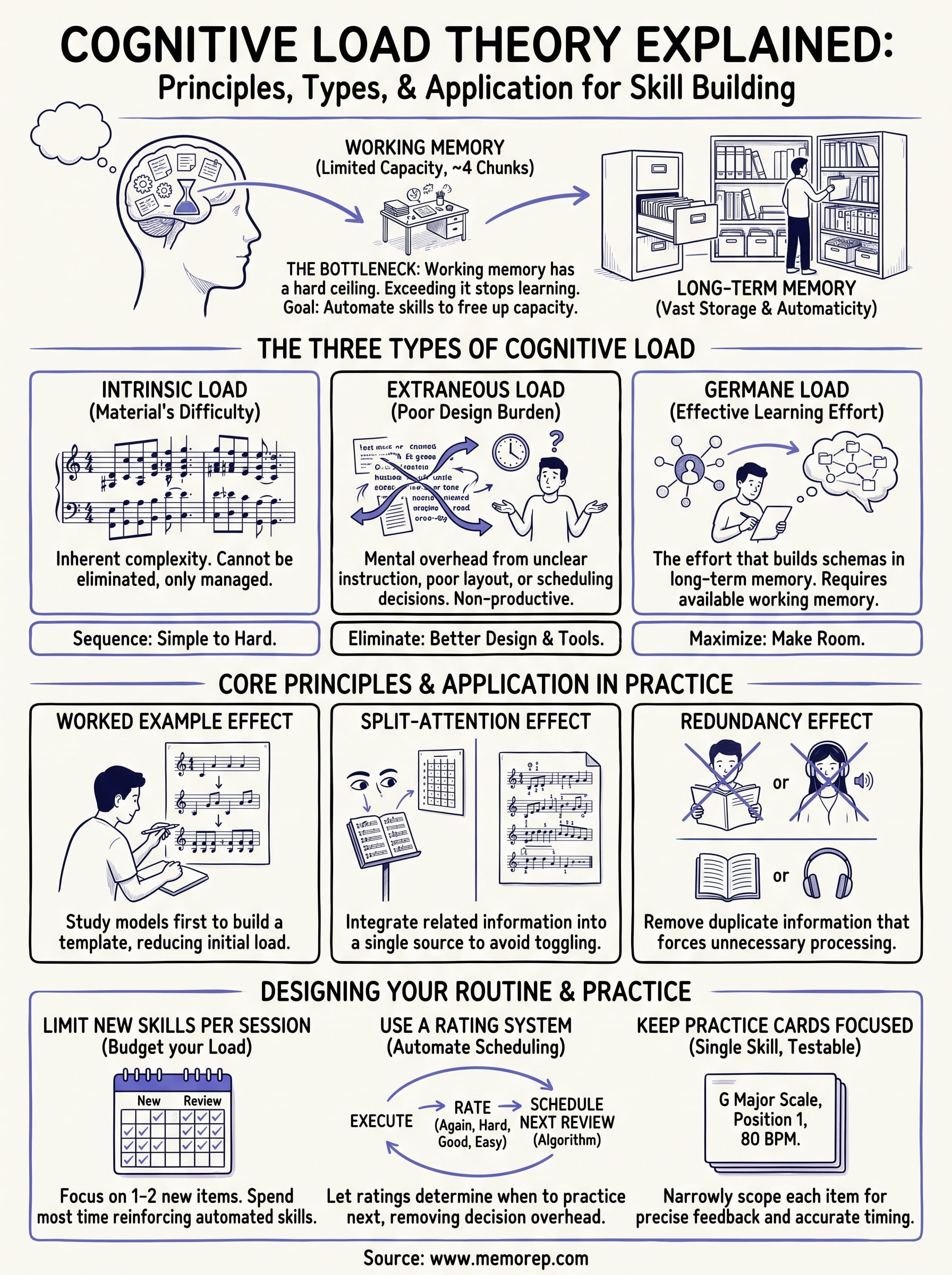
Cognitive load theory explained one core truth: your working memory is a fixed resource, and how you structure practice determines how much of it goes toward actual skill building versus overhead. The three types of load, intrinsic, extraneous, and germane, each respond to specific design choices. Sequence material from simple to complex, isolate one skill per session, and keep your practice items tightly scoped so your brain can consolidate what it's learning rather than scatter attention across too many demands at once.
The fastest lever you can pull right now is eliminating the extraneous load of managing your own practice schedule. When you stop deciding what to practice and when, your working memory focuses entirely on execution. MemoRep handles that scheduling automatically, using spaced repetition to queue the right skill at the right moment based on your own performance ratings. Try MemoRep free and put your practice on autopilot so your cognitive budget goes where it belongs: on the skill itself.