Science of Skill Acquisition: Principles for Faster Mastery
Most people practice skills the same way they always have: pick something up, repeat it until it feels okay, move on, and hope it sticks. When it doesn't, when that guitar piece falls apart a week later or that technique feels foreign again, they chalk it up to not having enough talent. But the real problem isn't ability. It's method. The science of skill acquisition reveals that how you structure your practice matters far more than how many hours you log. And the gap between efficient learners and frustrated ones almost always comes down to whether they're applying these principles or ignoring them.
Researchers like Anders Ericsson, Hermann Ebbinghaus, and Robert Bjork have spent decades studying how the brain encodes, retains, and retrieves skills. Their findings are practical and specific: spaced repetition beats massed practice, interleaving outperforms blocked practice, and feedback loops accelerate growth in ways that passive repetition never will. These aren't abstract theories, they're mechanisms you can build a practice routine around, starting today.
That's exactly the problem MemoRep was built to solve. Rather than leaving you to guess what needs revisiting and when, MemoRep applies these same evidence-based algorithms, specifically the Ebbinghaus forgetting curve and the SM-2 scheduling algorithm, to tell you what to practice at the moment it matters most. It takes the science discussed in this article and turns it into a system that runs automatically.
This article breaks down the core principles behind skill acquisition science, explains why each one works, and shows you how to apply them, whether you're learning an instrument, training a physical skill, or building any practice-dependent ability.
What the science of skill acquisition includes
The science of skill acquisition pulls from cognitive psychology, motor learning research, and neuroscience to explain how people move from clumsy beginner to capable practitioner. It's not a single theory but a set of overlapping findings that, taken together, describe what actually happens in your brain and body when you learn something new, and what conditions make that learning stick. Every component, from memory formation to feedback processing, plays a specific role, and understanding those roles lets you design practice that works with your biology rather than against it.
The cognitive and neurological side
When you practice a skill, your brain isn't just storing information, it's physically changing. Myelin, the insulating sheath around nerve fibers, builds up with repeated, focused practice, making neural signals faster and more reliable. This is why a movement that once required conscious effort eventually becomes automatic. Researchers call this process procedural memory consolidation, and it explains why consistent, structured practice beats massed cramming. Your brain needs time between sessions to actually build those pathways.
Sleep plays a bigger role here than most people realize. Studies on motor skill learning consistently show that performance improves overnight, even without additional practice. Your rest periods aren't wasted time. They're when consolidation actually happens, and cutting them short genuinely slows your progress.
Skill learning is a biological process. The structure of your practice determines the quality of the brain changes you produce.
The training principles researchers have identified
Decades of research have surfaced several principles that consistently separate effective learners from ineffective ones. These aren't soft suggestions. They come from controlled studies, longitudinal data, and direct observation of both experts and novices across domains. Each principle targets a specific failure point in how most people train.
The most significant findings cluster around four core ideas:
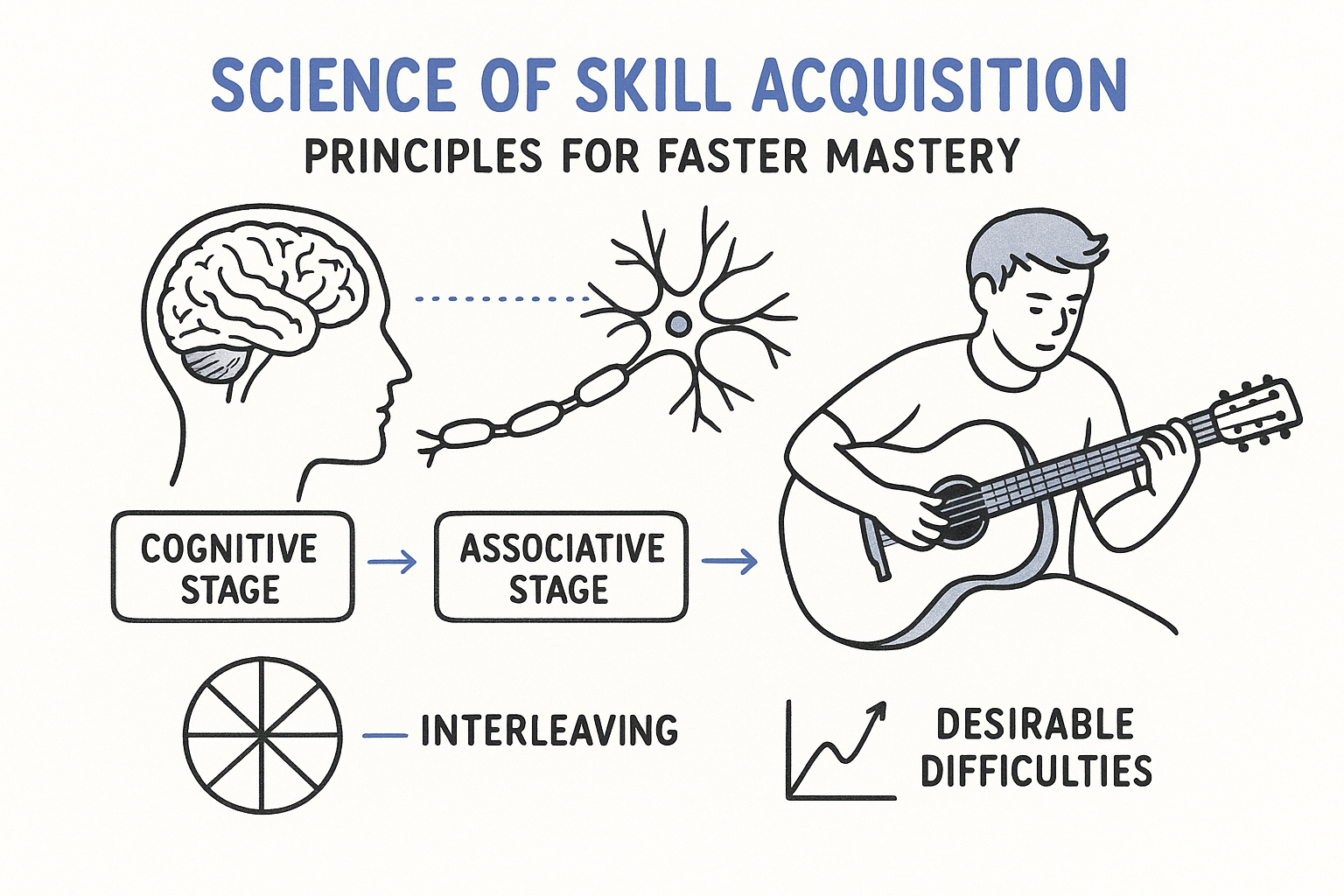
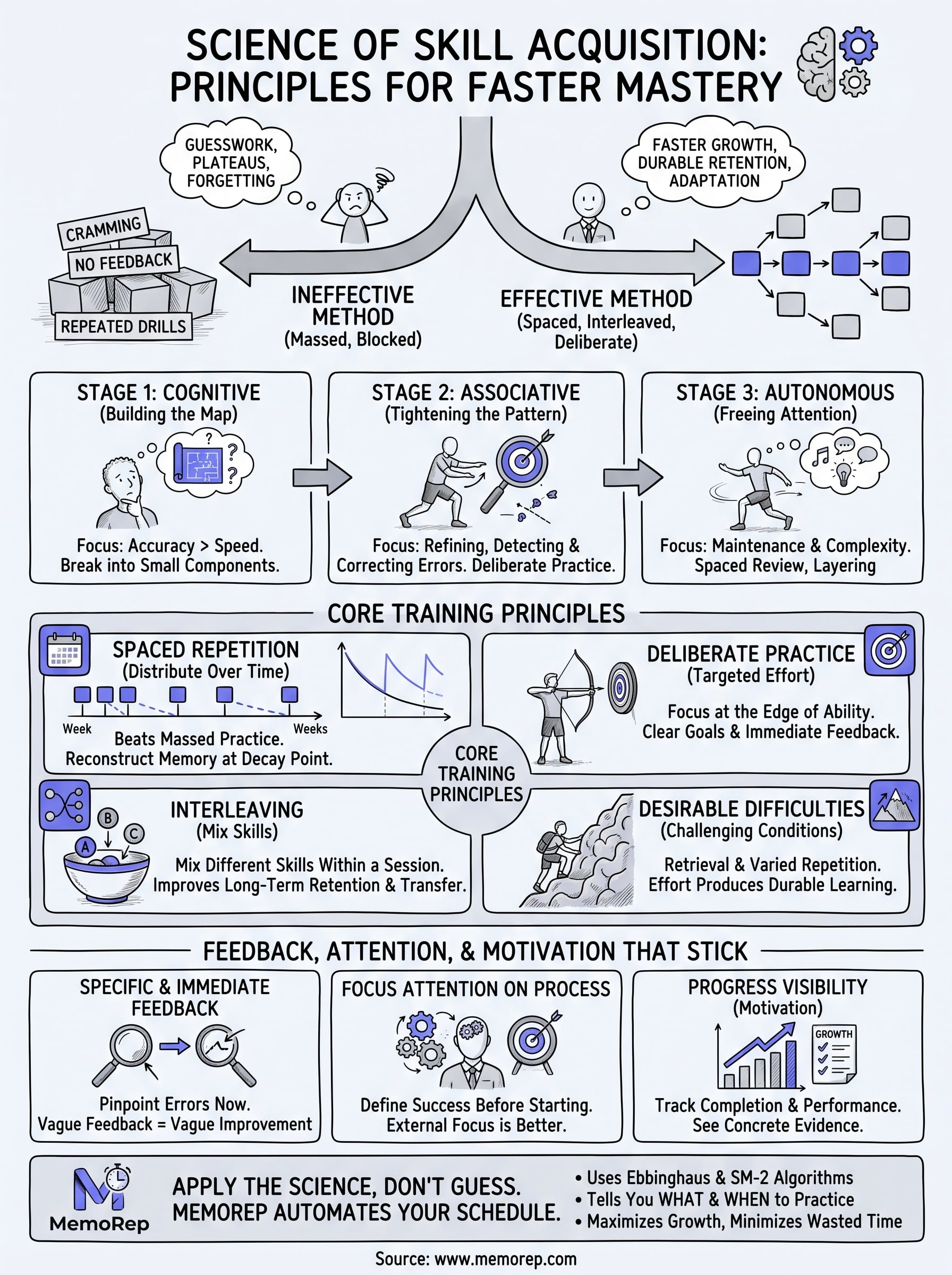
- Spaced repetition: Distributing practice over time produces stronger retention than massing it into a single session. Ebbinghaus's forgetting curve shows exactly how quickly skills decay without timely review.
- Deliberate practice: Simply repeating a skill doesn't build expertise. You need targeted effort focused at the edge of your current ability, with clear goals and immediate feedback on what went wrong.
- Interleaving: Mixing different skills or variations within a session improves long-term retention, even though it feels harder in the moment compared to blocking one skill at a time.
- Desirable difficulties: Bjork's research shows that practice conditions that feel challenging, like retrieval and varied repetition, produce more durable learning than smooth, effortless repetition.
How these pieces connect in practice
Understanding these principles individually is useful, but the real payoff comes from seeing how they work together. Spaced repetition sets your schedule, deliberate practice fills those sessions with the right kind of effort, and interleaving keeps your brain working hard enough to adapt. Remove any one piece and the whole system weakens.
For practical skill learners, especially musicians, this means your practice structure needs to account for what you practice, how you practice it, and when you return to it. Most people only control the first variable and wonder why progress stalls. Applying the full framework means your effort compounds over time rather than resetting every time a skill starts to fade.
Why skill acquisition science matters
Most learners don't fail because they lack dedication. They fail because unstructured repetition produces the illusion of progress without building durable skill underneath. You might feel like you're improving during a session, but when you return a week later and the skill has deteriorated, that's not bad luck. That's what the brain does when learning conditions are wrong. The science of skill acquisition matters because it replaces guesswork with a model that actually reflects how human memory and motor systems work.
The cost of practicing without a framework
When you practice without applying research-backed principles, you spend a disproportionate amount of time re-learning things you've already covered. Cognitive science identifies this as the forgetting curve effect: skills decay at a predictable rate, and if you don't return to them at the right intervals, you lose what you built. This isn't a personal failing. It's a biological reality, and the only way around it is to build your schedule around it.
The learners who make consistent, lasting progress aren't necessarily the most talented. They're the ones whose practice structure works with memory science, not against it.
The practical cost shows up in wasted hours. Studies in motor learning show that blocked repetition, where you drill one thing repeatedly before moving on, produces strong short-term performance but weak long-term retention. You walk away from a session feeling capable, but the gains fade faster than they should. That gap between how you feel and how much you actually retained compounds every week you continue the same pattern.
What changes when you apply the research
Applying the research directly changes what your practice looks like. You schedule review sessions before skills fully fade, you introduce variation to keep your brain adaptive, and you focus effort at the edge of your current ability rather than inside your comfort zone. These aren't minor adjustments. They change the rate at which you retain and build skills over months and years.
Your progress also becomes more predictable. Instead of wondering why something feels shaky again after two weeks away, you have a framework that anticipates decay and builds in the review at exactly the right time. That predictability is what turns practice from a frustrating cycle into a system that genuinely compounds.
The stages of skill learning and what to do in each
The science of skill acquisition identifies a predictable progression that every learner moves through, regardless of the skill. Psychologists Paul Fitts and Michael Posner mapped this out in their three-stage model: cognitive, associative, and autonomous. Each stage has different demands, and what works at one stage can actively slow you down at another. Knowing where you are in this progression lets you match your practice to what your brain actually needs.
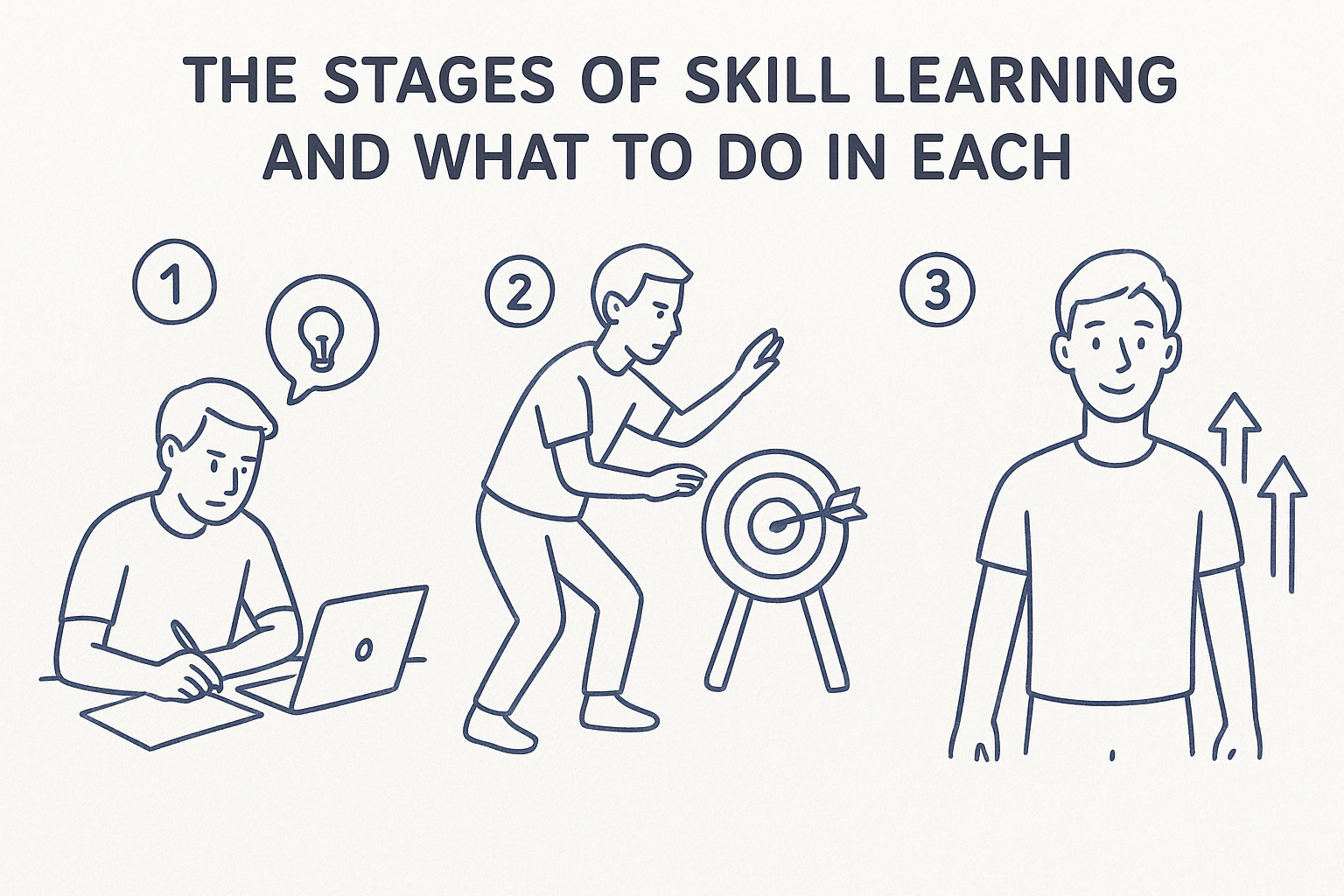
Applying the wrong strategy for your current stage is one of the most common reasons skilled learners plateau without understanding why.
Stage 1: Cognitive (building the map)
In the cognitive stage, your brain is constructing a mental model of what the skill looks and feels like. Everything is slow, deliberate, and error-prone, and that is completely normal. Your priority here is accuracy over speed, and understanding the structure of what you're learning before you drill it. Moving too fast through this stage builds flawed patterns that take far longer to fix than they would have taken to avoid.
Focus your practice on these actions during the cognitive stage:
- Break the skill into the smallest workable components
- Work at a tempo or intensity where you can observe what you're doing
- Prioritize getting the shape of the movement right, not how fast you can do it
- Use external feedback, like video or a teacher, to catch errors early
Stage 2: Associative (tightening the pattern)
Once you have the basic shape of a skill, you move into the associative stage, where repetition starts refining the pattern. Errors become smaller and more specific. Your focus shifts from understanding the skill to detecting and correcting mistakes in real time. This is where deliberate feedback becomes the most valuable input you can get, whether from a recording, a teacher, or a clear performance standard.
This stage is also where most learners stall. They repeat the skill enough to feel comfortable but never push past the edge of their current ability into the kind of challenge that drives further adaptation. Staying comfortable here is how progress plateaus without you realizing it.
Stage 3: Autonomous (freeing up your attention)
At the autonomous stage, the skill runs largely without conscious effort. Your brain has automated the core pattern, which frees up cognitive resources for expression, nuance, or applying the skill under real conditions. Your practice focus shifts toward maintaining the skill through spaced review and layering complexity on top of an already stable foundation, rather than rebuilding the basics every time.
In this stage, the biggest risk is neglect. Automated skills decay without regular review, and the gap between "feeling solid" and actual retention is wider than most people expect.
Practice principles that speed up mastery
The science of skill acquisition doesn't just explain why learning breaks down. It gives you a set of practical principles you can apply directly to your routine. These aren't vague suggestions about practicing harder or longer. They're specific mechanisms that change how your brain encodes and retains skills over time.
Space your practice, don't stack it
Massed practice, where you drill a skill for a long block and then don't return to it for weeks, feels productive but produces weak long-term retention. Spaced repetition works by returning to a skill just before it fades, forcing your brain to reconstruct the memory under slight strain. That reconstruction effort is what makes the memory stronger and more durable.
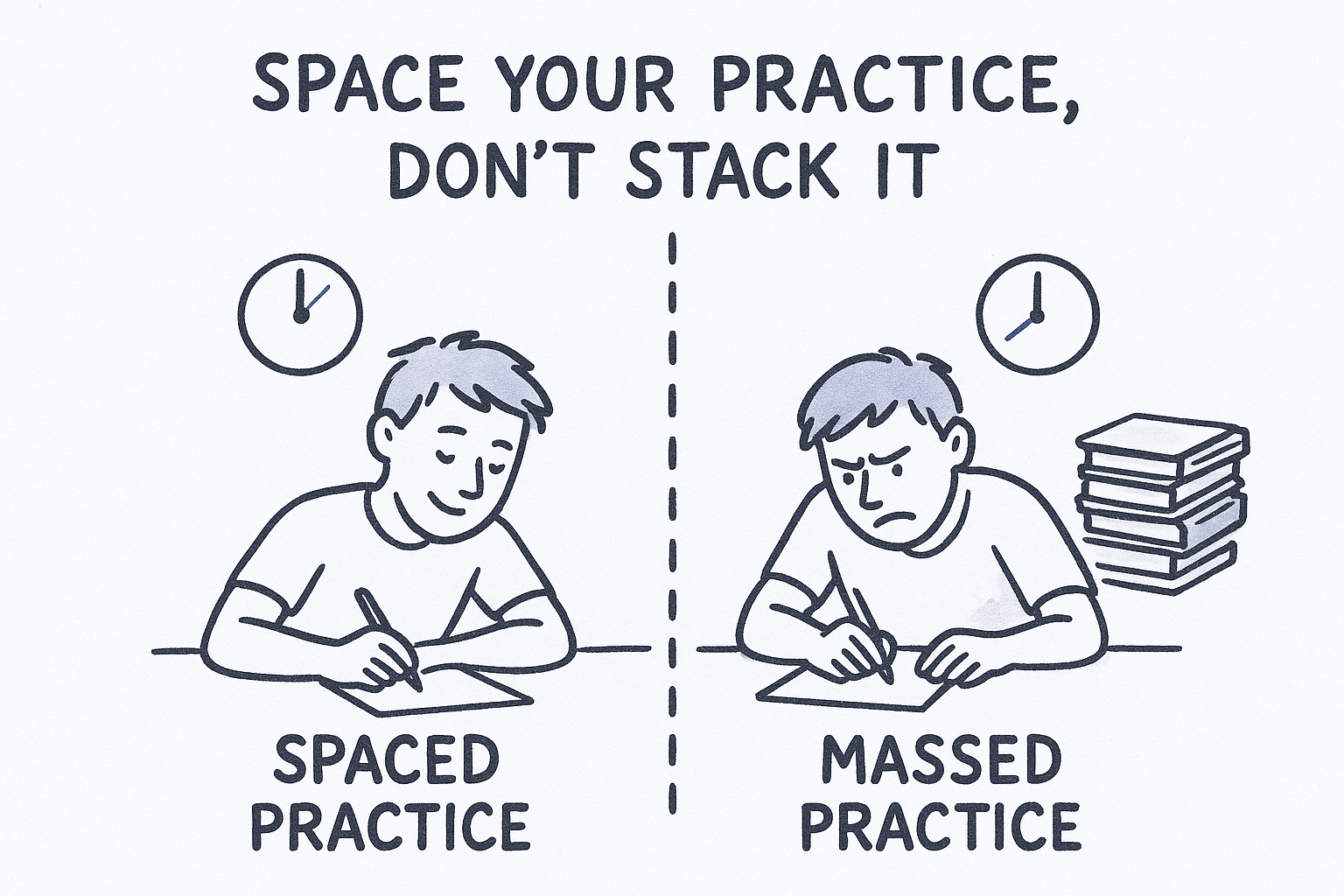
The timing of your review sessions matters as much as the content of your practice.
When you apply spaced repetition, you don't need more total practice time. You need better-timed practice time, distributed across sessions rather than crammed into one sitting.
Practice at the edge of your ability
Staying inside your comfort zone during practice produces fluency without growth. Deliberate practice targets the specific point where your current skill breaks down, which is exactly where adaptation occurs. You identify what you can't do reliably, drill that specific gap, and measure your improvement against a clear standard.
This principle applies whether you're working on a difficult passage in a piece of music or a technical movement pattern in any other skill. The goal isn't to feel capable during the session. The goal is to feel challenged enough that your brain is forced to adapt. Research consistently shows that learners who work at their ability threshold improve faster than those who repeat what they already do well.
Mix skills within a session
Interleaving, or mixing different skills within a single practice session rather than blocking one at a time, feels harder in the moment but produces stronger retention over time. Your brain works harder when it has to switch between tasks, and that extra cognitive effort translates directly into better long-term recall and transfer. Try rotating between two or three related exercises rather than drilling one to exhaustion before moving to the next.
Feedback, attention, and motivation that stick
The science of skill acquisition makes one thing clear: practice without feedback is practice without direction. You can repeat a skill hundreds of times and build fluency in the wrong movement pattern if nothing corrects you along the way. Feedback, attention, and motivation aren't soft add-ons to your practice. They're the mechanisms that determine whether your effort produces real adaptation or just comfortable repetition.
Use feedback that's specific and immediate
Vague feedback produces vague improvement. Knowing that something "felt off" is less useful than knowing your timing breaks down at a specific point or that your technique collapses under pressure. The more precisely you identify what failed and why, the faster you can target it. Use recordings, clear performance benchmarks, or teacher input to convert impressions into actionable data.
Delayed feedback weakens the learning signal. Research on motor skill development shows that the closer feedback is to the performance, the more effectively your brain connects the correction to the action. When you review a recording a week after the fact, the connection between what you did and what you need to change is far weaker than when you catch it in the moment.
Feedback works best when it's specific enough to change one thing at a time.
Focus attention on process, not outcome
Scattered attention during practice produces scattered results. When your mind drifts to unrelated thoughts mid-session, the quality of motor encoding drops significantly. Research distinguishes between internal focus, attending to your own body movements, and external focus, attending to the effect of those movements. For most practical skills, external focus produces better outcomes, but either beats distracted repetition.
Structured sessions with a clear objective for each block keep attention engaged far more effectively than open-ended drilling. Instead of practicing a skill in the abstract, define what success looks like for that specific block before you start.
Motivation that sustains consistent practice
Progress visibility is one of the strongest motivators in long-term skill building. When you can see exactly where you've improved and which areas still need work, you maintain momentum far more easily than when you're guessing. Tracking completion, rating your performance, and reviewing your history turns vague effort into concrete evidence of growth that keeps you returning to the work consistently.
How to apply it to music and practical skills
The science of skill acquisition translates directly into music and any other practice-dependent skill if you apply its principles at the level of your actual routine, not just as abstract ideas. Musicians and practical skill learners share a specific challenge: their skills are built from many small components, each of which can fade independently. That means a general strategy of "practicing more" misses the point entirely.
The most effective musicians don't practice longer. They practice what's actually decaying, at the exact moment it needs attention.
Break your skill into reviewable pieces
Music in particular benefits from granular practice structure. Rather than running through a full piece and hoping weak spots sort themselves out, you isolate specific passages, techniques, or chord transitions as individual practice targets. Each one becomes a unit you can rate, schedule, and return to on its own timeline. This approach directly mirrors how spaced repetition works: small, well-defined items schedule far more precisely than broad, undifferentiated practice blocks.
Once you have discrete practice items, you can track which ones are solid and which ones are slipping. That visibility changes how you allocate your session time, shifting effort away from what you already do well and toward what actually needs work.
Match your practice method to your current stage
Your stage of skill development should determine how you practice each item. A technique you're learning for the first time needs slow, accurate repetition with external feedback. A technique you've already automated needs timed review before it fades, not another deep-drill session. Mixing these two approaches wastes time and slows your overall progress.
For practical skills outside music, the same logic applies. Whether you're building a physical technique, a sport-specific movement, or any repeatable procedure, breaking it into components and matching each one to the right practice method produces faster and more durable gains than treating the whole skill as one undifferentiated block. Your practice becomes something you can track, adjust, and improve over time rather than something you simply endure and hope produces results.
Next steps for your practice
The science of skill acquisition gives you a clear picture of what works: space your practice, target your weak points, use specific feedback, and return to skills before they fade. Knowing these principles is the straightforward part. Applying them consistently, across every skill you're building, is where most learners struggle without the right system in place. The gap between understanding the research and actually using it in your daily routine is wider than it sounds.
MemoRep closes that gap by automating the hardest decision in practice: what to work on and exactly when to return to it. Instead of guessing which skills need attention today, you get a schedule built directly around your performance ratings and the Ebbinghaus forgetting curve. Your effort lands where it produces the most growth, every session. If you're ready to put these principles into action right now, try MemoRep and start your first structured practice routine.