Guitar: How to Practice Effectively and Make Progress
You pick up your guitar, play the three things you already know, and put it down 20 minutes later. A week passes, and you feel about the same. If that sounds familiar, the problem usually isn't talent or time. It's that guitar how to practice is a question about structure, not effort.
Here is the short answer. Practice most days for 15 to 30 minutes, and plan what you work on before you sit down. Short, regular sessions beat one long weekend marathon, because skills fade between sessions and need to be revisited at the right moment. Deciding what to play on the spot is where most self-taught players lose their time.
This guide covers how long and how often to practice, how to build a simple routine you can keep, and how to track progress so you can see it. We won't tell you what to play or how to play it, since that is a teacher's job. Instead, we'll focus on organizing your practice, using the same spaced repetition principles that MemoRep is built on.
Why how you practice matters more than how long
Two players can each log five hours a week and end up in very different places. One plays whatever feels good. The other works from a plan. After three months, the first has a comfortable set of familiar pieces. The second has a growing list of things they can actually play on demand.
The trap of playing what you already know
Most self-taught players drift toward the comfortable. Running through a song you've played fifty times feels productive because it sounds good and nothing goes wrong. But comfortable repetition is maintenance, not progress. The material that needs attention is usually the material you quietly avoid.
Deciding also costs energy. Sit down with a dozen things you could work on, and you spend the first few minutes choosing, often badly. This is decision fatigue, and it eats a big share of a short session. With only 20 minutes to spare, you can't afford to lose them to indecision.
What forgetting does between sessions
Hermann Ebbinghaus mapped the forgetting curve in the 1880s. He found that memory fades fastest right after learning, then more slowly. His experiments used word lists, not guitar, but anyone who has returned to a piece after a month off knows the feeling. The fix is to revisit material just before it fades, instead of grinding it once and hoping it sticks. That is the core of spaced repetition.
A skill you revisit at the right moment stays with you. A skill you grind once and leave alone fades.
Compare three ways of spending a week:
| Pattern | Total time | Sessions | Gap between visits |
|---|---|---|---|
| One long session on Sunday | 150 min | 1 | 7 days |
| Five sessions of 30 min | 150 min | 5 | About 1 day |
| Seven sessions of 15 min | 105 min | 7 | 1 day |
The last row uses the least time and revisits the material most often. That is the whole argument for how you practice beating how long you practice.
Three signs your practice needs structure
Check yourself against the list below. Most players who search for guitar how to practice advice recognize at least two of these, and each one has a fixable cause.
- Skills get rusty. Pieces you learned a month ago feel shaky again.
- Sessions feel random. You can't say what you worked on last Tuesday.
- Choosing takes too long. You hop between exercises without finishing any of them.
The steps below address each one in order. You don't need new gear or a bigger time budget. You need a way to decide what comes next before you pick up the guitar.
Step 1. Set a clear goal for each session
Every session needs a finish line. Without one, guitar practice drifts into noodling, and you leave unsure whether anything changed. The fix takes about 30 seconds: write one goal before you pick up the instrument.
Make the goal something you can check
Good goals are specific and binary. At the end of the session, you either did it or you didn't. A goal like "get better at my song" can never be finished, so it can never feel finished either. Name the passage, the count, and the standard, and the goal becomes a test you can pass.
| Vague goal | Clear goal |
|---|---|
| Work on my new song | Play the first eight bars from memory, twice in a row |
| Practice the chorus | Play the chorus start to finish without stopping, three times |
| Get faster | Play my assigned exercise at the tempo my teacher marked, once cleanly |
| Review old pieces | Play through the two pieces I haven't touched in two weeks |
A good practice goal is one you can answer with yes or no at the end of the session.
Limit each session to one or two goals
Two goals is plenty for a 20-minute session. More than that and you're back to decision fatigue, hopping between tasks without finishing any. Pick the goals the night before, or right after your last session ends, so the choice is already made when you sit down.
Where do goals come from? Take them from your teacher's assignments, from a piece you want to play at a gathering, or from the spot in a song where you always stumble. If you're teaching yourself, the third source is the easiest to find. Write down where you stopped last time and start there.
One more habit helps. Put the goal somewhere visible, like a sticky note on your music stand or the first line of a notes app. Seeing it keeps you on task. It also gives you something to rate in Step 4, because you can't judge how a session went if you never said what it was for.
Step 2. Decide how long and how often to practice
Once you have a goal, give it a time slot. Most beginners do well with 15 to 30 minutes a day. That is a working rule from teaching practice, not a hard scientific number. The right amount is the one you will actually repeat.
Match session length to your level
Start small. A session you finish beats one you abandon, and a short block keeps your focus on the goal you wrote down. Add time only when 20 minutes starts to feel cramped, not because a chart says so.
| Stage | Session length | Days per week |
|---|---|---|
| Just starting | 15 to 20 min | 5 to 7 |
| A few months in | 20 to 30 min | 5 to 6 |
| Working on longer pieces | 30 to 45 min | 4 to 6 |
If you're asking how long you should practice guitar each day, read the middle column as a ceiling you grow into, not a target to hit on day one.
Favor frequency over length
Spacing does the heavy lifting. Two 15-minute sessions on different days give your memory more chances to be refreshed than one 30-minute block. Gaps are where forgetting happens, so shorter gaps mean less rust to clear off each time you sit down.
Five short sessions will do more for you than one long one.
Missing a day is not a failure. Just don't let a missed day become a missed week. When life gets busy, cut the session to five minutes instead of skipping it, and play through your one goal.
Make the schedule easy to keep
A schedule only works if it survives a normal week. Use these three habits to protect it:
- Pick a fixed time. Tie practice to something you already do, like right after coffee or right before dinner.
- Keep the guitar in sight. A stand in the living room beats a case in the closet.
- Set a reminder. A phone alert removes the daily question of whether today is a practice day.
Plan the week on Sunday, or let a tool plan it for you. Either way, the question "when do I play?" should be answered before the day starts.
Step 3. Build a session plan with a mix of material
A goal tells you where you're headed. A session plan tells you what to do with the minutes. When you plan how to practice guitar, the easiest mistake is spending the whole session on one thing, usually the newest piece or the most familiar one. Mix three kinds of material in every session, and you cover more ground without relying on willpower to choose on the spot.
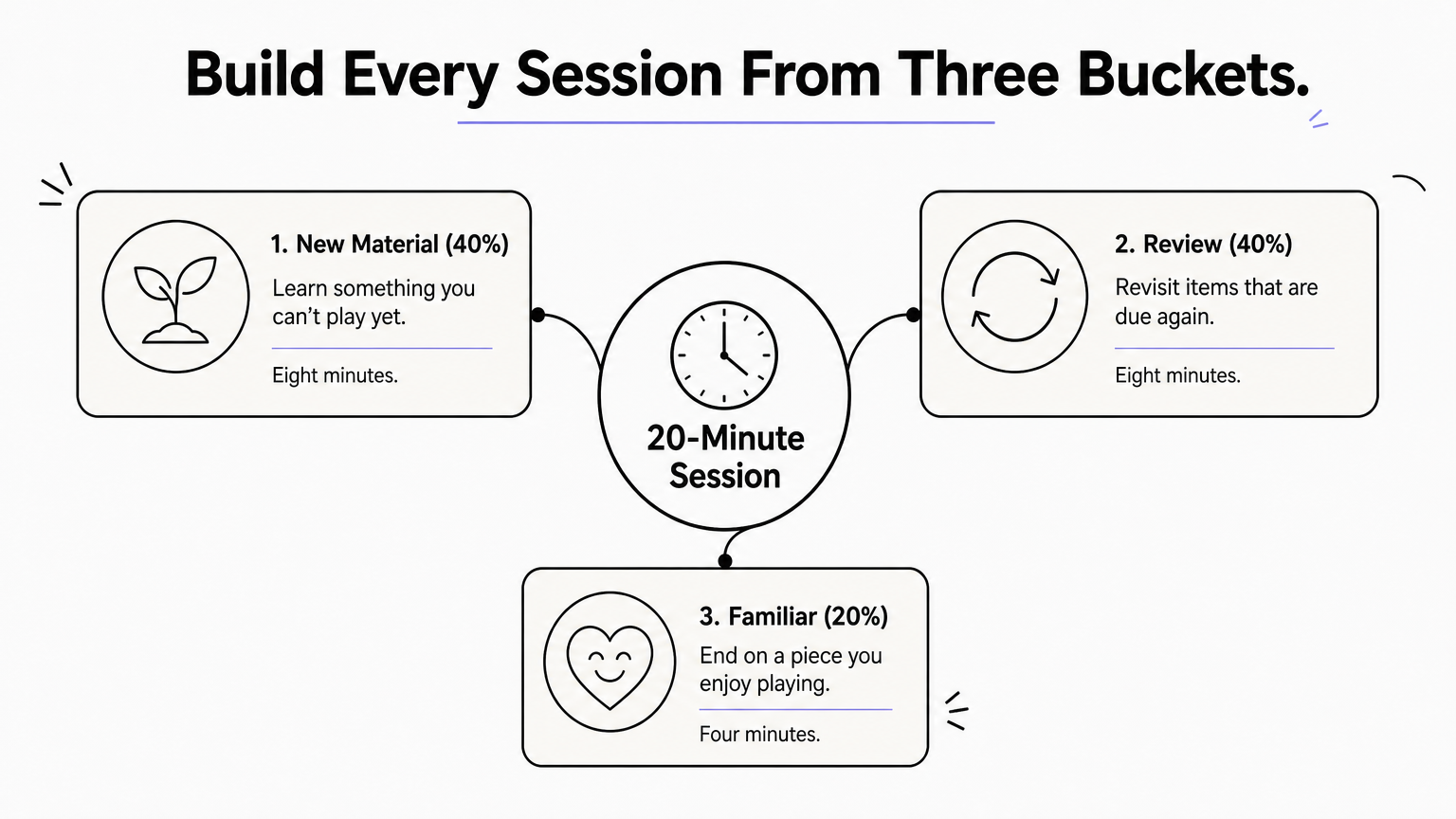
Sort your material into three buckets
Sort everything you're working on into the buckets below, then give each one a slice of the session. This split fits a 20-minute session.
| Bucket | What goes in it | Share | Minutes |
|---|---|---|---|
| New | Material you're still learning | 40% | 8 |
| Review | Items from recent sessions that are due again | 40% | 8 |
| Familiar | Pieces you already play and enjoy | 20% | 4 |
Review is the bucket most players skip, and it's the one that stops rust before it starts. Keep the familiar bucket small but real. Ending on something you enjoy gives you a reason to come back tomorrow.
Every session needs something new, something due for review, and something you simply enjoy.
Write the plan down before you sit
Keep the list to three to five items, each with a time next to it. More than that and you'll rush through everything. Here is an example you can copy into a notes app:
Goal: Play the first eight bars from memory, twice in a row

1. New: first eight bars of the new song (8 min)
2. Review: chorus from two weeks ago (5 min)
3. Review: last month's exercise (3 min)
4. Familiar: favorite song, start to finish (4 min)
Order matters too. Put new material first, while your attention is fresh, and save the familiar piece for last. If a phone timer helps you move on when a block ends, use it. Finishing every item briefly beats finishing one item and never touching the rest.
Step 4. Track progress and rate how each item went
A plan tells you what to do. A record tells you whether it worked. Without one, guitar how to practice advice turns into guesswork, because you can't recall how Tuesday's chorus felt by Friday. Spend 30 seconds after each item to rate how it went, and your next session almost plans itself.
Use a four-point rating
Give each item a rating the moment you finish it, using the same four labels every time. The scale below mirrors the one spaced repetition tools use.
| Rating | What it means | When to see it again |
|---|---|---|
| Again | You couldn't do it, or it fell apart | Next session |
| Hard | You got there, but with effort or mistakes | In a day or two |
| Good | You met the goal comfortably | In several days |
| Easy | It felt effortless | In a week or more |
Judge the result, not the effort. An hour of struggle that ends in a broken passage is an Again, however hard you tried. Be honest, not generous too. Rating everything Good feels nice, but it pushes review too far out and the rust returns. When you're unsure, pick the lower rating.
Rate what happened on the instrument, not how hard you worked.
Keep the log small
A practice journal that takes five minutes will get skipped. Aim for under one minute: date, item, rating. A notes app works fine, and here is a sample you can copy:
Oct 7  First eight bars, from memory   Hard
Oct 7  Chorus from two weeks ago       Good
Oct 7  Last month's exercise           Again
Once a week, scan the log. Items marked Again or Hard twice in a row go to the top of your next plan. Ratings that climb over several weeks are your proof of progress, and they are far more convincing than a vague feeling of getting better. MemoRep uses these same four ratings and schedules the next review for you, so the log does the planning too.
Step 5. Space out your review so skills don't fade
Ratings only matter if they change when you see an item again. This step turns them into a schedule. The rule is simple: each success pushes the next review further out, and each miss pulls it back. It is the forgetting curve applied to your own repertoire.
Stretch the gap after each success
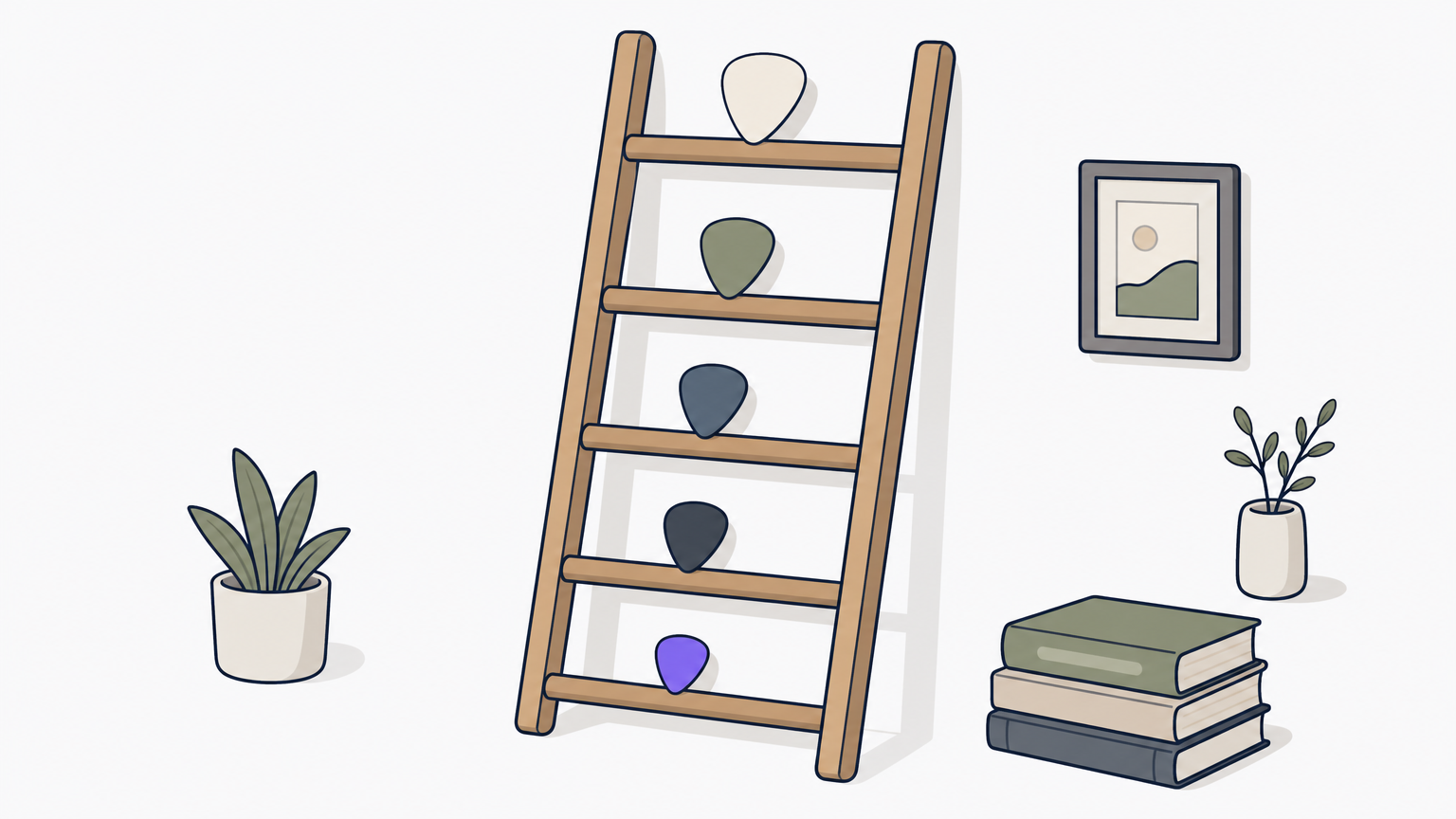
Begin with a short gap, then lengthen it every time the item goes well. The SM-2 algorithm that MemoRep builds on works this way, with 1 day, then 6 days, then longer gaps each time. You can run a rougher version by hand with this ladder:
| Times rated Good in a row | Next review |
|---|---|
| 1 | 1 day |
| 2 | 3 days |
| 3 | 7 days |
| 4 | 14 days |
| 5 | 30 days |
Add a due date to each line of your log, and only pull an item into your plan when it comes due. That keeps the review bucket from Step 3 small, so you spend your minutes on what is about to fade instead of what you played yesterday.
Pull it back when something slips
Anything rated Again goes back to the first rung, so you see it next session. An item rated Hard stays on its current rung instead of climbing. A miss tells you the gap was too long for that item. It does not mean you failed.
Stretch the gap after a good session and shrink it after a bad one.
Resist the urge to "fix" a shaky piece by drilling it for an hour. Rate it honestly, let the schedule bring it back soon, and trust the repeated short visits. Over a few weeks, pieces that kept landing on Again start to climb the ladder.
Know when to stop doing this by hand
Running a ladder in a notes app works for about a dozen items. Past that, the bookkeeping starts to cost more time than the practice. That is the point where a scheduling tool earns its place, because it recalculates every due date after each rating and hands you the day's list. If you keep your log for a month, you'll know how many items you can track yourself before you need one.
Start your next practice session with a plan
Good answers to guitar how to practice come down to one idea: decide before you sit down. Set one clear goal, keep sessions short and frequent, and mix new, review, and familiar material in every session. You don't need more hours, only a better plan for the ones you have.
Rate every item honestly after you play it. Then let the gaps between reviews grow after each success and shrink after each miss. That is how skills stay with you instead of fading between sessions, and it gives you a record that shows real progress.
Tonight, write one goal and a three-item plan, then play for 15 minutes. If you'd rather not run the schedule by hand, try MemoRep while free access is still open. It tells you what to practice and when, so your time goes into playing instead of deciding.