
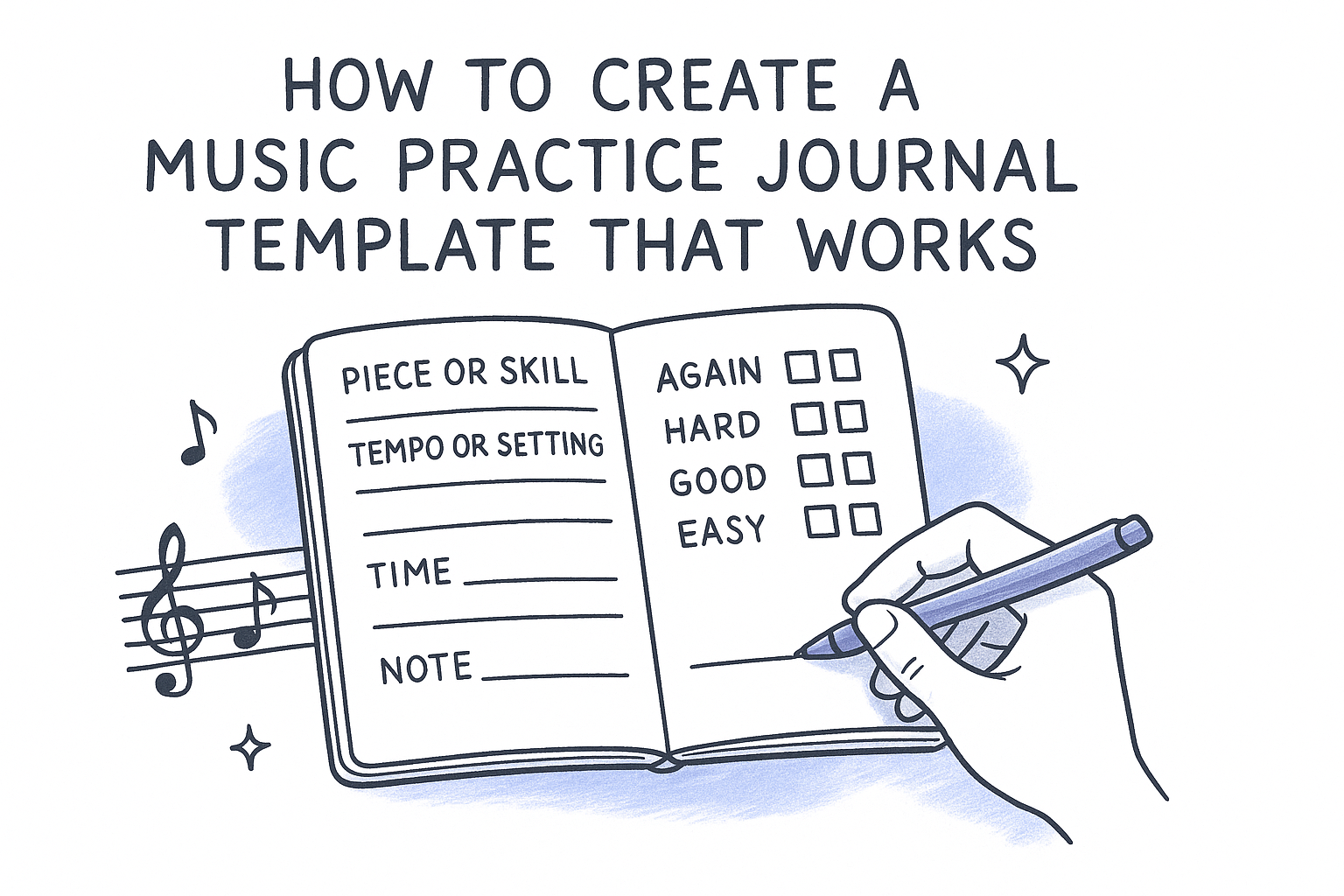
How to Create a Music Practice Journal Template That Works
You've probably searched for a music practice journal template because your practice feels scattered. You sit down, play through whatever you remember, and walk away unsure if you actually improved anything. A blank notebook doesn't fix that. Neither does a generic printable you find online and abandon after three days.
This guide shows you how to build a practice journal template that actually holds up over weeks and months, not just one you fill in once and forget. You'll learn exactly what fields to include, how to structure entries so tracking takes seconds instead of minutes, and how to set up a rating system that tells you what needs more attention tomorrow.
We'll walk through the template piece by piece: session goals, tempo notes, problem spots, and a simple feedback loop borrowed from spaced repetition research. By the end, you'll have a format you can print, copy into a notebook, or adapt digitally. And if paper starts feeling limiting, you'll see why some musicians eventually move to automated scheduling instead of manually rewriting the same skills week after week.
What makes a practice journal template actually work
Most practice journals fail for one simple reason: they ask you to write too much. You open the notebook after a long day, see six empty columns and a blank paragraph field, and either skip logging entirely or scribble something vague like "worked on scales." That entry tells you nothing three weeks later when you're trying to figure out why your sight-reading stalled. A practice journal template that works has to survive contact with a tired musician at 9pm, not just look good on the page.
A practice log only works if filling it out takes less time than the problem it's meant to solve.
It captures decisions, not just activity
Writing "practiced 30 minutes" tells future-you nothing useful. What you need logged is what you worked on, how it went, and what to do next time. That third part is the piece most templates skip entirely. A useful entry answers three questions: What did I practice? How did it go? What's next? If your template doesn't force an answer to that last question, you'll end every session with the same vague sense of progress and no real plan for tomorrow.
It uses consistent fields, not open paragraphs
Open-ended journal entries feel natural to write but are nearly impossible to scan later. Compare these two approaches:
| Approach | Time to log | Time to review later | Pattern spotting |
|---|---|---|---|
| Free-form paragraph | 3-5 minutes | Slow, requires re-reading | Hard |
| Structured fields (piece, tempo, rating, note) | 30-60 seconds | Instant scan | Easy |
Structured fields win because you can flip back through ten entries in under a minute and immediately see which passage keeps showing up as a problem. That's the entire point of keeping a journal in the first place: spotting recurring weak spots before they become bad habits baked into your playing.
It has a built-in feedback loop
Here's where most templates fall short even when they're well organized: they log what happened but never turn that log into a decision about what happens next. A field that just says "good" or "needs work" is a start, but it works far better when it maps to an actual interval. If a passage went badly today, you should see it again tomorrow. If it went well, you can safely wait three or four days before revisiting it. This is the same logic behind the Ebbinghaus forgetting curve and the SM-2 algorithm used in spaced repetition software, tools built specifically to schedule review at the point right before something fades from memory. The NIH's overview of memory consolidation research backs up why timing revisits matters more than just repeating something often.
It fits your actual practice length
A template built for two-hour daily sessions will feel absurd if you only have 20 minutes most days. Before you build anything, be honest about your real practice window. A short, honest template you fill out every day beats an elaborate one you abandon by week two. The next four steps walk through building fields that scale to whatever time you actually have, not the time you wish you had.
Step 1. Choose the format that fits how you practice
Before you draw a single column, decide where this template is actually going to live. The best practice journal format is the one you'll open without thinking twice, not the one that looks impressive on Pinterest. If you practice at a desk with a music stand and a pencil already in hand, paper makes sense. If you're constantly moving between rooms, instruments, or lesson locations, a digital version saved on your phone will survive far longer than a notebook you keep forgetting at home.
Paper works when it's simple
Paper has one real advantage: zero friction. You don't unlock a phone, open an app, or wait for anything to load. Grab a pencil, jot three numbers, done. But paper punishes complexity. If your template needs more than one page per session, you'll start skipping days. Keep printable versions to a single half-page per entry, and print a week's worth at a time so you're not searching for a blank sheet mid-session.
Digital works when you need history
A spreadsheet or notes app earns its keep once you want to look back over a month of entries. Typing is faster than flipping through a stack of paper, and you can sort or filter by piece name in seconds. The tradeoff is setup time: a spreadsheet with dropdowns and formulas takes an hour to build right, and most people never finish that hour.
Pick the format you'll still be using in week six, not the one that looks best on day one.
Match the format to your practice length
Your available time each day should decide the format as much as your personal preference does. Use this as a rough guide:
- Under 15 minutes a day: paper index card, three fields max
- 15 to 45 minutes: printable sheet or simple spreadsheet row
- 45+ minutes, multiple pieces: digital template with separate sections per piece
Whatever you land on, resist the urge to combine formats right away. Switching between a notebook and an app mid-week is how tracking dies. Settle into one format for at least two weeks before deciding it needs an upgrade. Once you've locked in the format, the next step is deciding exactly what goes inside each entry.
Step 2. Build your core tracking fields
Once you've picked a format, the fields you put on the page decide whether your practice journal template actually earns its keep. Keep the list short. Every extra field is another reason to skip logging on a tired night. Five fields cover almost everything you need, and none of them should take more than five seconds to fill in.
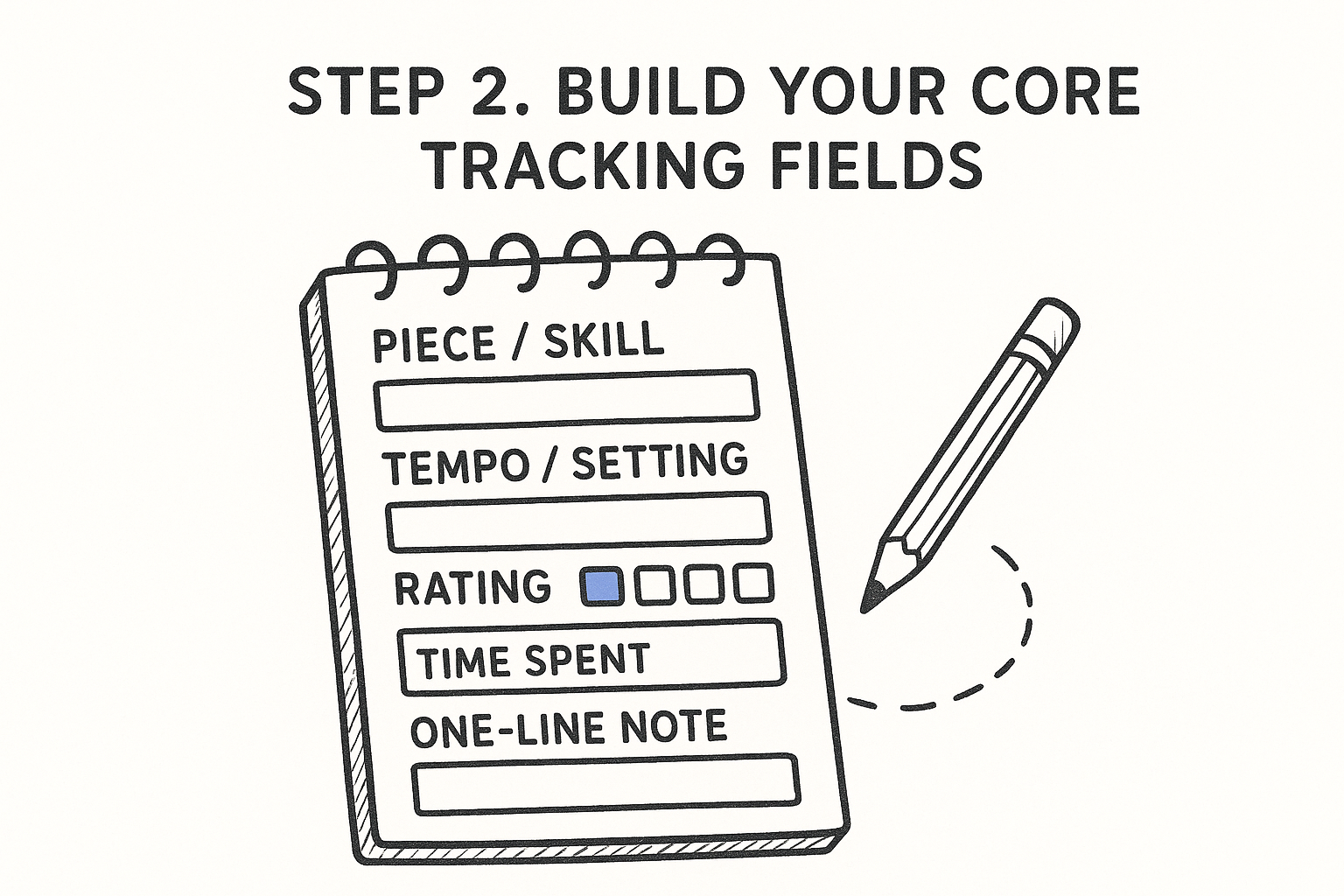
The five fields that matter
Stick to these, in this order, and resist adding more until you've used them for at least two weeks:
- Piece or skill: name it exactly the same way every time ("Bach Minuet, mm. 12-20" beats "scales again")
- Tempo or setting: a BPM number, a page range, or whatever variable actually changes week to week
- Rating: a simple Again / Hard / Good / Easy scale, borrowed straight from spaced repetition systems
- Time spent: just minutes, no need for start and end times
- One-line note: the single thing that mattered most in that repetition
Notice what's missing: no mood tracker, no motivation score, no lengthy technique breakdown. Those belong in a lesson notebook, not a daily log.
Why the rating field carries the most weight
Of the five fields, the rating scale does the heaviest lifting. A binary good/bad note tells you almost nothing about when to come back to a passage. Four levels give you enough resolution to actually schedule a next look:
| Rating | What it means | Rough next review |
|---|---|---|
| Again | Fell apart, barely functional | Tomorrow |
| Hard | Got through it, shaky | 2 days |
| Good | Solid, minor slips | 4-5 days |
| Easy | Clean, no hesitation | 7+ days |
The rating field is the one column that turns a diary into a schedule.
Those intervals aren't arbitrary. They mirror the logic behind the SM-2 algorithm that spaced repetition tools use, spacing reviews further apart as performance improves and pulling them closer when it doesn't. You don't need software to apply this by hand, a printed table with a rating column does the same job on a smaller scale. Once these five fields feel automatic, you're ready to add the layer most templates skip entirely: goals and reflection.
Step 3. Add space for goals and reflection
Tracking fields tell you what happened. Goals and reflection tell you why it mattered. Without this layer, you end up with a stack of accurate but disconnected entries, no sense of whether the last two weeks actually moved you closer to playing that piece cleanly at tempo. Adding a small goals and reflection section closes that gap without turning your journal into a diary.
Set one goal before you play, not after
Write your goal for the session before you pick up the instrument, not after you've already noodled through whatever felt easy. A single line works fine: "Get the bridge section to 100 BPM without stopping." That one sentence changes how you practice for the next 20 minutes because it gives every repetition a target. Skip the vague versions like "get better at the piece," they don't tell you what to do differently tomorrow.
A goal you write down before you play is worth more than a paragraph you write after.
Reflect in one line, not one paragraph
At the end of the session, answer one question: did today's practice get you closer to the goal you wrote down? A single line covers it: "Yes, hit tempo twice out of five tries" or "No, still falling apart at measure 40, try slower tomorrow." This single sentence works because it forces a decision, not a summary. Compare that to a full paragraph reflection, which takes longer to write and rarely gets read again.
A simple template for this layer
Add these two lines above or below your core tracking fields:
Goal for today: ___________________________
Did I get there? Yes / No / Partly - one line why: ___________________________
That's it. Two lines, maybe 15 extra seconds per session. Over a month, flipping back through those lines shows you a pattern your rating column alone can't: whether you're setting realistic goals or the same unmet goal keeps repeating week after week. If it does, that's your signal to break the goal into something smaller, not proof that you're a bad practicer. Once goals and reflection feel natural, you're ready to stress-test the whole template against a real week of practice.
Step 4. Test your template and refine it over time
No template survives first contact with a real week unchanged. You'll build something that looks complete on paper, then discover on day three that the tempo field is useless for a piece with no fixed tempo, or that your one-line note keeps running to three sentences because you forgot to leave room for it. That's expected. A practice journal template only becomes reliable after you've actually stress-tested it against a normal week, not a perfect one.
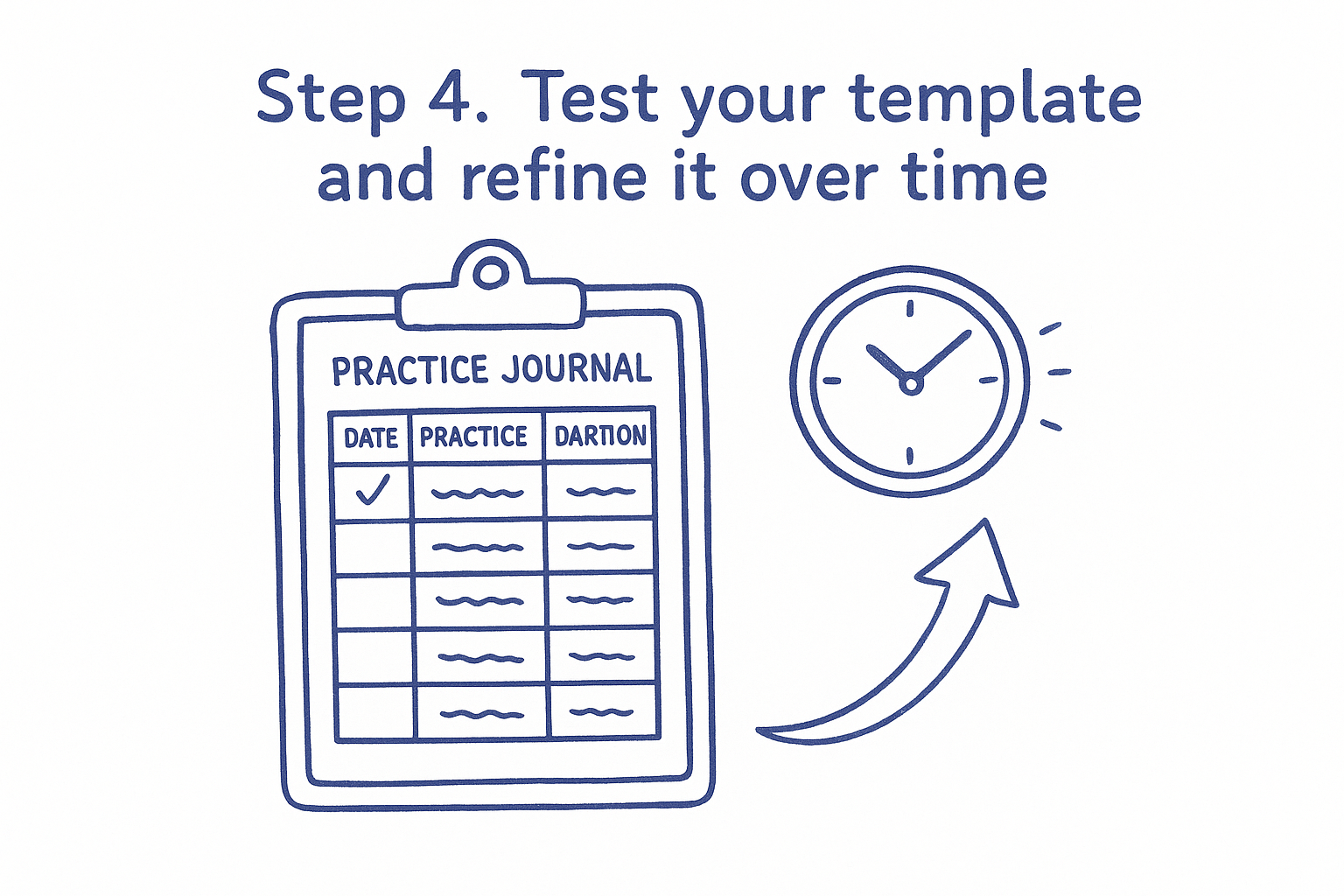
Run a seven-day trial before you commit
Give the template a full week without changing anything mid-stream. Switching fields on day two means you can't tell if the format failed or if you just didn't give it a fair shot. At the end of the week, ask yourself three questions:
- Did I fill this in every day, or did I skip it when practice felt rushed?
- Did any field consistently sit blank because it didn't apply to what I was working on?
- When I flipped back through the week, could I actually tell what needed more attention?
If a field sits blank three days running, cut it. A template earns its space by getting used, not by looking thorough.
Adjust based on what you skipped, not what you added
Here's the mistake most people make when refining a template: they add fields instead of removing them. If you found yourself skipping the tempo column because half your practice was sight-reading, drop it or make it optional rather than bolting on a sixth field to cover the gap. Fewer fields used consistently beat more fields used sporadically every time.
Revisit the format every few weeks, not every day
Once the template survives that first week, leave it alone for at least two or three more weeks before making further changes. Constant tweaking is its own form of procrastination, it feels productive but it's really just avoiding the practice itself. Set a recurring check-in, maybe the first Sunday of the month, to look back and ask if the fields still match how you're actually practicing. If your repertoire has gotten more complex or your available time has shrunk, that's when small adjustments make sense, not every time a single session feels awkward to log.
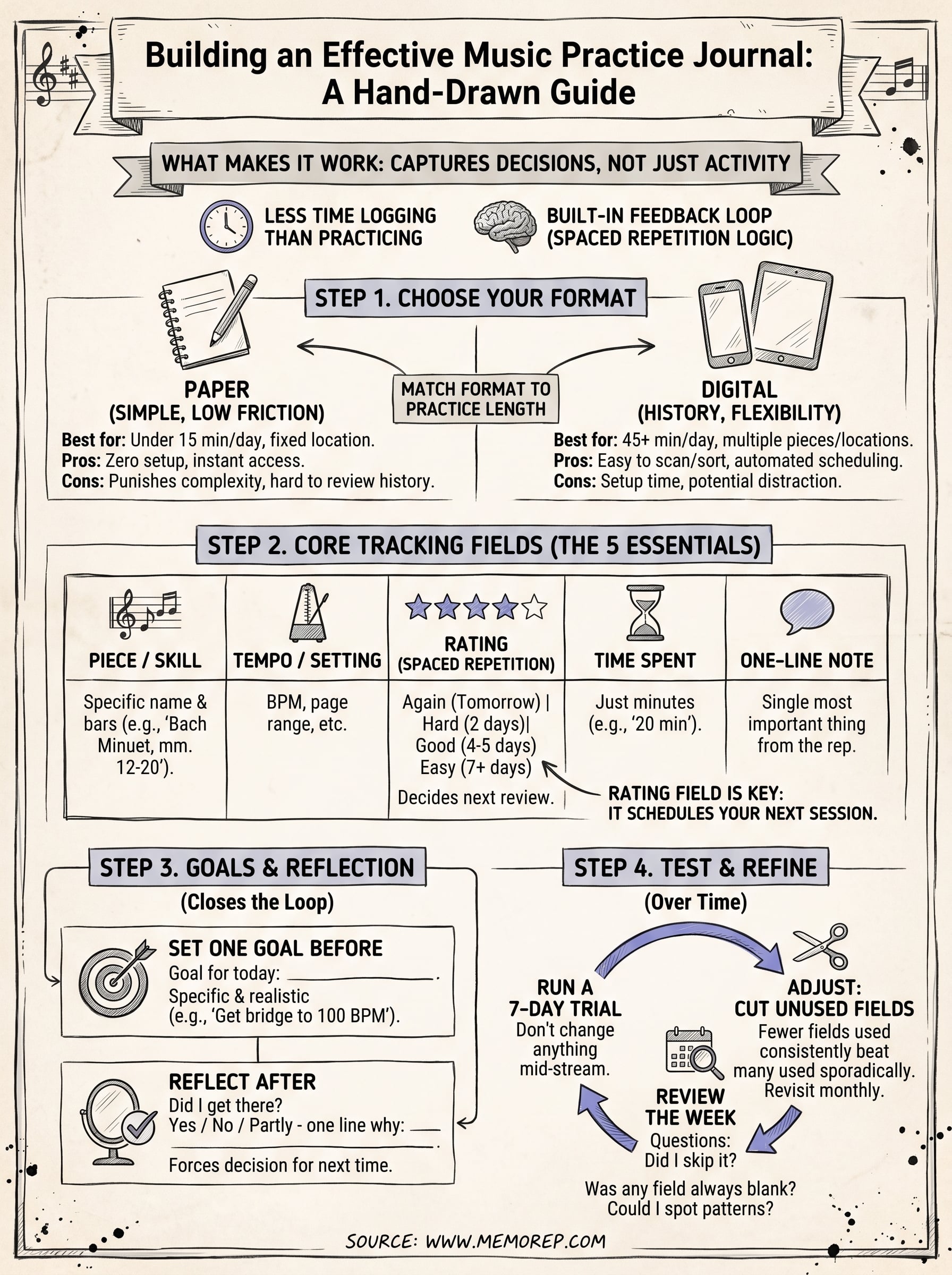
Turning your template into a lasting practice habit
A good music practice journal template earns its place by staying simple: five tracking fields, one goal line, one reflection line, tested against a real week before you trust it. Skip the elaborate versions with six columns and a mood tracker. They look thorough on day one and sit empty by day ten. Build something you can fill in half asleep, and it'll still be running months from now.
Eventually, paper and spreadsheets hit a ceiling. Once you're juggling a dozen pieces and passages, remembering which rating means what and manually calculating your next review date turns into its own chore, exactly the decision fatigue this whole exercise was meant to eliminate. That's the gap tools built on the same spaced repetition logic are designed to close. If you want to see how that scheduling actually works before you build your tenth spreadsheet version, check out the science behind memoRep.