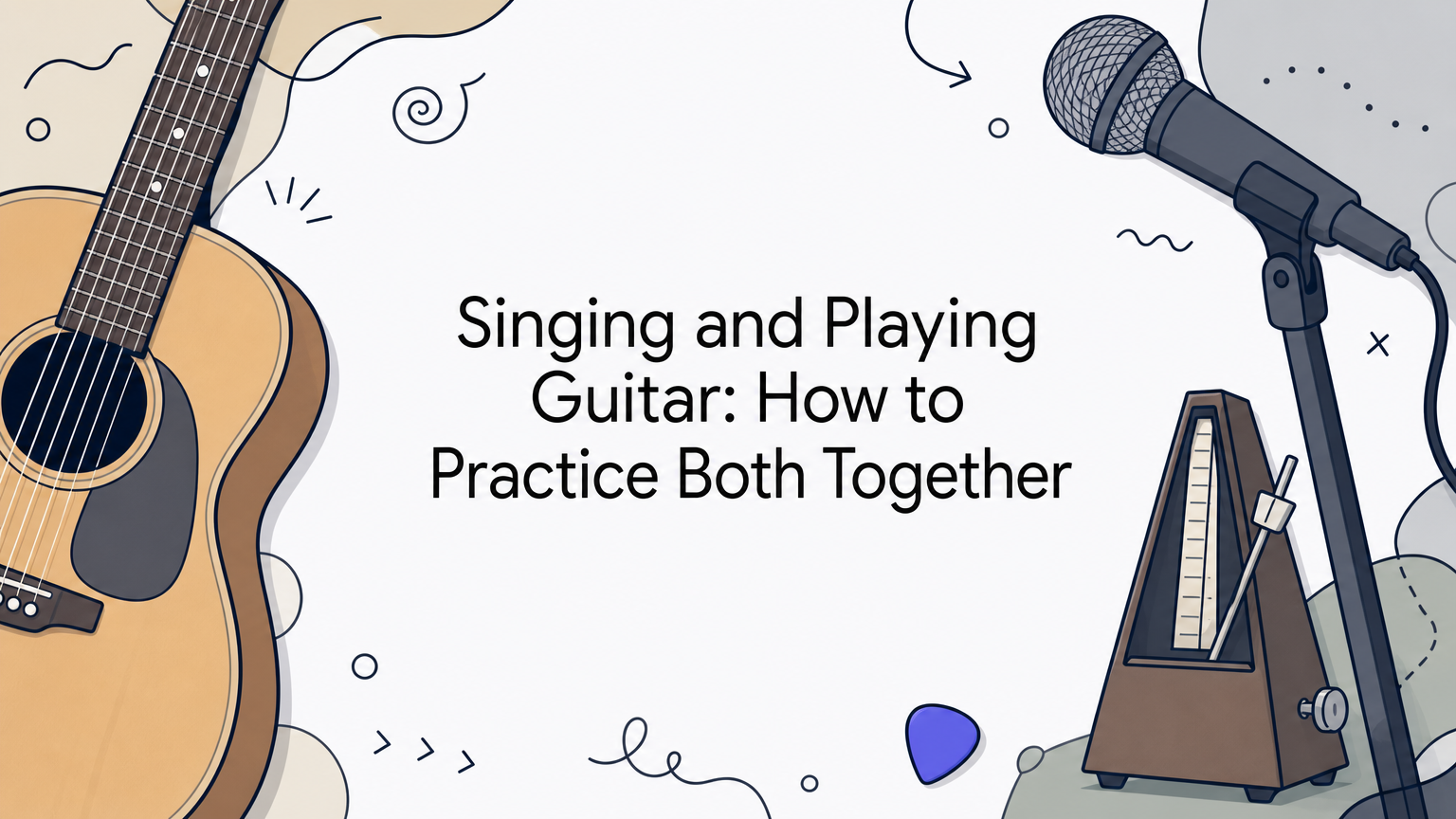
Singing and Playing Guitar: How to Practice Both Together
You can strum a song cleanly and you can sing it cleanly. Put them together and one of them falls apart. Your hands drift off the rhythm when the melody starts, or your voice goes flat the moment a chord change arrives. This is normal, and it has a cause. Each skill runs on its own timing, and your brain needs repetition to make one of them automatic. If you are wondering how to practice singing and playing guitar without the frustration, the answer is to build the pieces separately and then layer them in small, repeatable steps.
The short version: make the guitar part automatic first, then add the voice in short sections, and revisit each stage on a schedule instead of running the whole song until it breaks. Random full run-throughs mostly rehearse your mistakes.
This guide explains why the coordination is so hard, how to structure your sessions, and how to sequence your practice from one stage to the next. We also look at how to decide what to revisit and when. That is the problem we built MemoRep to solve with spaced repetition, so you always know what to practice next.
Why singing and playing guitar feels so hard
Before you fix the problem, it helps to see what is actually going wrong. Singing over guitar asks your brain to run two separate jobs at once, and for most learners neither job is automatic yet.
Two skills, two timing systems
Your hands follow a steady pulse, while your voice follows phrasing that rarely lines up with it. A lyric can start between beats or land across a chord change. So the voice and the strumming hand pull against each other, and the weaker part gives way first. Most learners hit the same three problems:
- Strumming speeds up or stalls when the first word arrives
- Chord changes come late because attention jumps to the lyrics
- Pitch slips when the hands get busy
Attention is the real bottleneck
Skills you have not automated demand conscious attention, and you only have so much of it. When the guitar part still needs thought, nothing is left for singing. That is the core of how to practice singing while playing guitar: the guitar part has to run on autopilot before the voice can join.
A skill you still have to think about leaves no attention for anything else.
Repetition builds that autopilot, but spacing matters. An hour on one song feels productive, yet short, repeated sessions across several days build lasting automaticity better than one long block.
Step 1. Practice each part on its own first
Begin by not doing both. Split the song into two separate practice items, one for the guitar part and one for the vocal line. Isolating each part shows you which one is holding you back, and it is the foundation of how to practice singing with guitar without constant breakdowns.
Test the guitar part
Play one section until it passes a simple test: you can talk while strumming without losing the beat. If you can't, the part is not automatic yet, so keep it in rotation.
If you can't talk through the guitar part, you can't sing through it.
Learn the vocal line alone
Sing the melody and lyrics along with the original recording, no guitar. Your goal is to know the line by heart. Work on one verse or chorus at a time, so every rep stays short.
Step 2. Combine them in small, simple layers
Now comes the part most learners rush. Here is how to practice singing and playing guitar together without cognitive overload: add one layer at a time, and keep each layer short enough to finish cleanly.
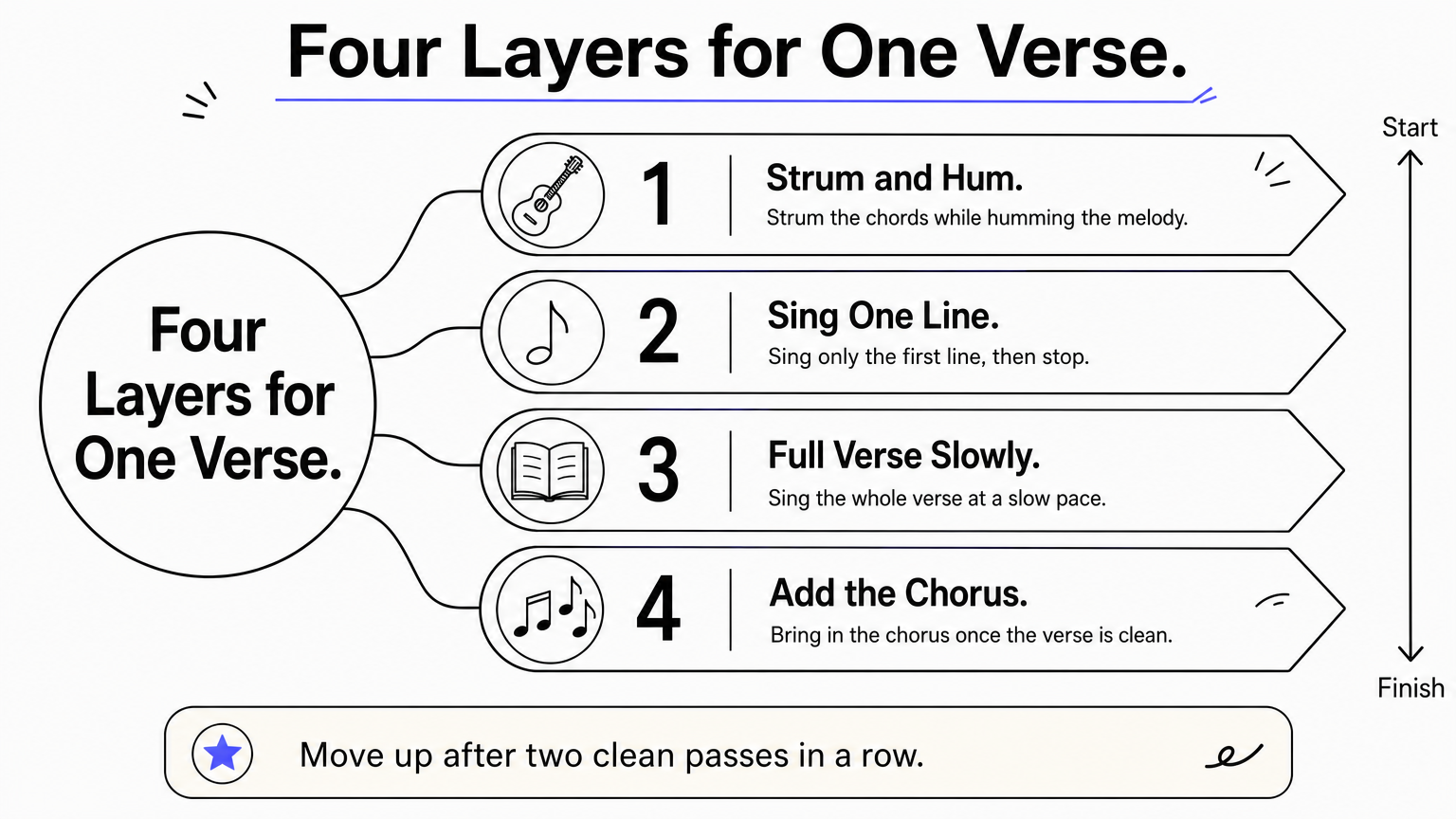
Stack the layers
Work through these four layers on a single verse before you touch the rest of the song, and repeat each layer until it feels easy:
- Strum the chords while humming the melody.
- Sing only the first line, then stop.
- Sing the full verse at a slow pace.
- Add the chorus.
Advance only when it's clean
Move up a layer after two clean passes in a row. If something breaks, drop back one step instead of pushing through.
Drop back a layer before you rehearse a mistake.
Slow, clean reps teach your brain the pairing. Fast, messy reps teach it the errors, and they are harder to unlearn later.
Step 3. Add a metronome and build up tempo
A metronome gives your hand and your voice one shared reference, which makes it central to how to practice singing and playing guitar together. Without a click, you drift, and you rarely notice until the song falls apart.
Start slower than feels necessary
Set the click to about 60% of the original tempo. If the song runs at 100 BPM, start near 60. At that speed, every clean pass is real evidence that the pairing works, not luck.
Raise the tempo in small steps
Raise the speed only when the current one is earned. Use this rule and write down your last clean BPM so tomorrow's session starts in the right place:
- Two clean passes in a row: add 5 BPM
- One mistake: stay at the same tempo
- Two mistakes: drop 5 BPM
Earn every tempo increase with two clean passes.
Step 4. Schedule short sessions and track what fades
Knowing how to practice singing and playing guitar means little if the work happens once. Short sessions of 15 to 20 minutes, spread across the week, beat one long block because skills fade between sessions.
Rate every pass honestly
After each run, rate it Again, Hard, Good, or Easy. Rate the guitar part, the vocal line, and each combined layer separately, because they fade at different speeds. Your rating decides when you see that item again:
- Again: review tomorrow
- Hard: review in one or two days
- Good or Easy: wait longer before the next review
Review what is about to fade, not what you already know.
Let the schedule decide
Doing this by hand gets messy once you have several songs. MemoRep schedules each item from your ratings, so you open the app and see what to practice instead of guessing. That removes the decision fatigue and keeps every song from going rusty.
Easy songs to start with
What makes a song easy
Pick songs that make how to practice singing and playing guitar manageable: three or four chords, a slow to medium tempo, and a melody in a comfortable range. Skip fast, wordy songs for now.
The best first song is one your hands can already play without thinking.
Four songs to try
Each of these has few chords and a steady pace, so the guitar part automates quickly.
| Song | Chords | Approx. tempo |
|---|---|---|
| Three Little Birds | 3 | 74 BPM |
| Knockin' on Heaven's Door | 4 | 70 BPM |
| Stand By Me | 4 | 118 BPM |
| Horse with No Name | 2 | 120 BPM |
Treat each song as two items, guitar and voice, exactly as in Step 1. Start at 60% of the tempo above, and move on only after two clean passes feel easy.
Putting it all together
Learning how to practice singing and playing guitar comes down to one idea: don't ask your brain to do both jobs until each one is solid. Split the song, make the guitar part automatic, layer the voice in slowly, and let a metronome make you earn every tempo increase. Keep sessions short, and rate each pass honestly so you know what is about to fade.
Start this week with one easy song from the table. Treat the guitar and the vocal line as separate items, and come back to them on a schedule instead of on a hunch. If you would rather not track all of that by hand, try MemoRep and claim your free-for-life subscription while it lasts, and let it tell you what to practice next.