How to Practice Deliberately: A Step-by-Step Guide
You practice for an hour, feel good about it, and a week later the same passage falls apart again. That's not a talent problem. It's a practice problem. Learning how to practice deliberately means replacing vague repetition with a structured method that targets exactly what's weak and revisits it before it fades.
Deliberate practice isn't just "trying harder." It's a specific loop: isolate a skill, work it at the edge of your current ability, rate your performance honestly, and let that feedback decide what you touch next. Most learners skip the last two steps, which is why progress stalls even after months of effort. This guide breaks that loop into concrete, repeatable steps you can apply today, whether you're drilling scales, refining a golf swing, or rehearsing a technical skill.
Below, you'll get a step-by-step framework for turning any skill into small, practice-ready segments, a system for judging when you've actually improved versus when you're just going through motions, and a way to schedule revisits so nothing you've worked hard on quietly slips away. We built MemoRep around this exact problem, so the steps here reflect what actually works in daily practice, not just theory.
What deliberate practice actually requires
Anders Ericsson, the psychologist whose research popularized the term, was blunt about this: most practice isn't deliberate at all. It's repetition. You play the piece again, you hit another bucket of golf balls, you run the same drill, and you call it practice because time passed and effort was spent. Deliberate practice is narrower and less comfortable. It requires a defined target, immediate feedback, and enough difficulty that you're forced to concentrate instead of coast. Strip any of those three out and you're back to rehearsal, not improvement.
Deliberate practice isn't about how long you practice. It's about whether every rep gives you information you can act on.
A defined target beats a vague goal
"Get better at guitar" isn't a target, it's a wish. A target is something you can point at and say whether you hit it or not: clean string transitions in a specific chord change at 90 BPM without buzzing. This matters because your brain can't correct what it can't measure. If the goal is fuzzy, your attention during practice stays fuzzy too, and you end up running the passage on autopilot instead of watching for the exact failure point.
Feedback has to arrive fast
The second requirement is a feedback loop that closes quickly, ideally within the same session. If you don't find out you played the wrong fingering until a teacher points it out three weeks later, you've already reinforced the mistake dozens of times. Fast feedback can come from a metronome, a mirror, a recording you play back immediately, or your own honest self-rating right after the attempt. The source matters less than the speed. Athletes call this the difference between practicing and just doing reps; musicians call it the difference between rehearsing and drilling.
Difficulty has to sit at the edge of comfort
The third piece is calibration. Practice that's too easy builds nothing new because your brain isn't working hard enough to form new connections. Practice that's too hard produces frustration and sloppy technique because you're overwhelmed. The zone you want sits right at the edge, hard enough that you fail sometimes, easy enough that you can diagnose why. This is the same territory covered by flow research from psychologists like Mihaly Csikszentmihalyi, where peak engagement happens when challenge and skill are closely matched.
The three requirements side by side
| Requirement | What it looks like | What happens without it |
|---|---|---|
| Defined target | A specific, measurable outcome for the session | Practice becomes unfocused repetition |
| Fast feedback | Immediate rating or correction after each attempt | Mistakes get reinforced instead of fixed |
| Right difficulty | Task sits just past your current comfort zone | You plateau (too easy) or burn out (too hard) |
Why most practice sessions fail this test
Most home practice fails at least one of these three conditions, usually all of them at once. You sit down, play through a piece start to finish, notice a few rough spots, and move on without ever isolating them or rating whether they actually improved. There's no target beyond "play the whole thing," no feedback beyond a vague feeling, and no calibration because you're mixing easy and hard passages together. None of this is a discipline problem. It's a structural one, and it's fixable with a system rather than more willpower.
Once you understand these three requirements, the rest of this guide is really just a method for enforcing them consistently: naming a skill precisely enough to target it, breaking it down small enough to get fast feedback, and scheduling revisits so the difficulty stays calibrated over time instead of drifting toward whatever feels comfortable that day.
Step 1. Pick one skill and name it precisely
Every deliberate practice session starts with a name, not a vague category. "Practice piano" or "work on my backswing" gives your brain nothing to aim at. Naming the skill precisely means writing down the exact behavior you're trying to change, in language specific enough that another person could watch you and tell whether you did it. This single step filters out most of the wasted practice time people log every week.
Why vague labels sabotage the session
When the target is broad, your attention spreads across everything at once: tone, timing, posture, memory, all competing for focus during the same rep. You end up noticing a little of everything and fixing none of it. A precise name forces a decision about what you're actually training right now, and that decision is what makes the rest of the session productive.
If you can't describe the skill in one sentence a stranger would understand, you haven't picked a skill yet, you've picked a category.
A simple naming formula
Use this structure to turn a fuzzy goal into a workable target:
[Action] + [specific context] + [measurable condition]

Examples:
- Shift from G to C chord without buzzing, at 80 BPM
- Land a 7-iron approach within 10 feet, from 120 yards
- Solder a clean joint on 22-gauge wire in under 15 seconds
- Recall the opening 8 measures from memory, no sheet music
Notice each example names an action, pins it to a specific situation, and attaches a condition you can check against. That last part matters most, because it's what lets you rate the attempt honestly later instead of guessing.
Test your skill name before you start
Before your first rep, run the name through three quick checks:
- Can you point to it? Someone watching should be able to tell when you succeed and when you fail.
- Is it small? If it takes more than a sentence to describe, it's probably two skills stacked together.
- Does it match today's weak point? Pick the thing that actually broke last session, not the thing you enjoy practicing.
If your draft name fails any of these, narrow it further. "Improve my solo" becomes "play the four-bar turnaround cleanly at 100 BPM." That version is small enough to isolate, easy to rate, and specific enough that you'll know within minutes whether the session is working. This is also the level of detail MemoRep asks for when you create a practice card, because a card built on a vague name produces vague feedback for weeks afterward.
Step 2. Break the skill into micro-skills
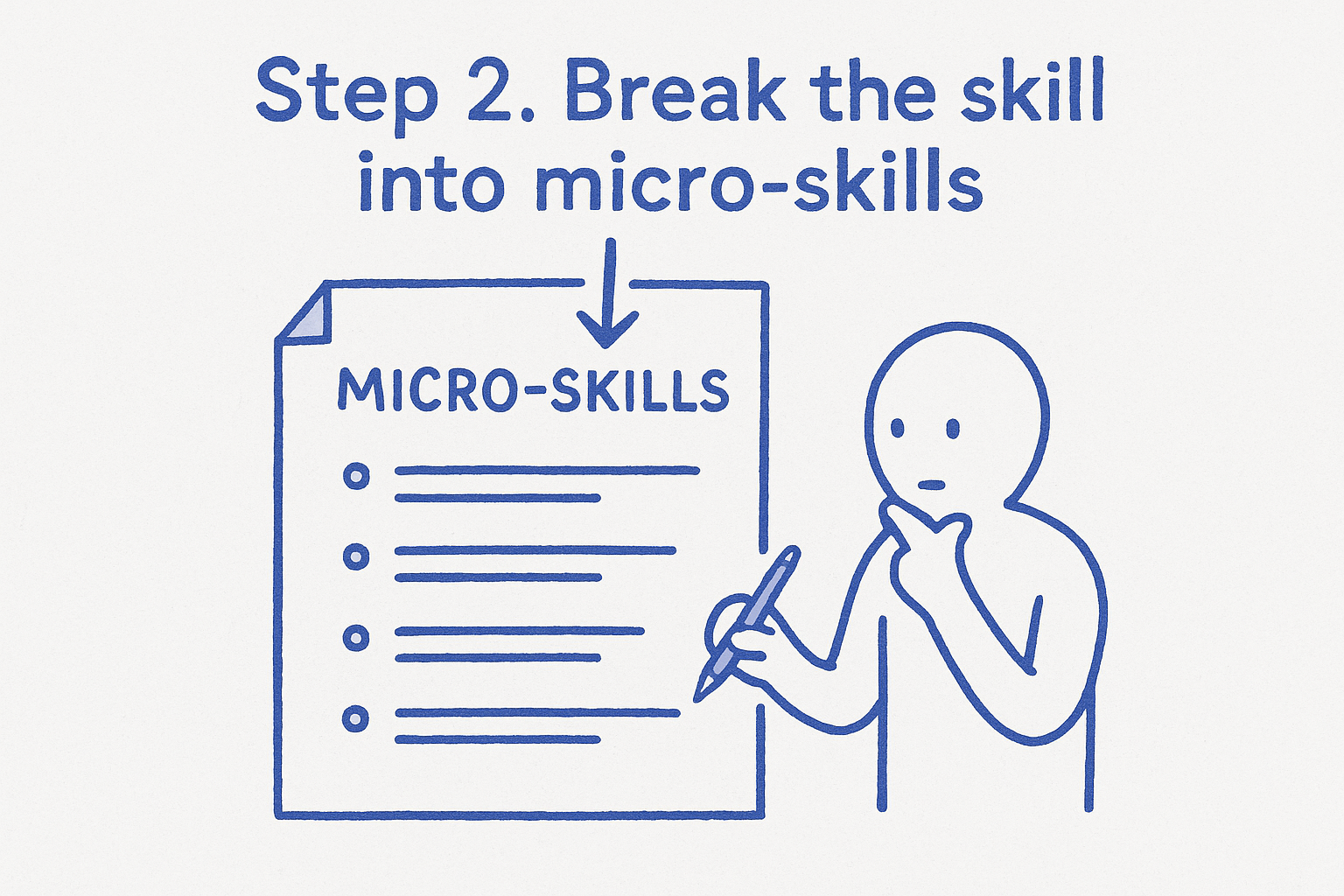
Once you've named a skill precisely, the next move is to check whether it's actually one skill or several stacked together. Most named skills are still bundles. "Play the four-bar turnaround cleanly at 100 BPM" involves fingering accuracy, timing, tone, and transitions between chords, all at once. Breaking a skill into micro-skills means splitting that bundle into pieces small enough that each one can be practiced, rated, and fixed on its own.
Why bundled skills stall progress
When you drill a bundled skill, a failure could come from any of its parts, and you often can't tell which. You play the turnaround, it sounds rough, and you're left guessing whether the problem was your left hand, your timing, or your attention drifting on the third chord. Splitting the bundle removes the guessing. Isolate the chord transition alone, get it clean, then isolate the timing alone, then combine them. Each piece gets its own fast feedback loop instead of sharing one muddy one.
A skill you can't isolate is a skill you can't actually fix, you can only hope it improves.
A simple splitting method
To break a skill down, ask what has to go right, in sequence, for the whole thing to work. Write each requirement as its own line. For the turnaround example:
Skill: Play the four-bar turnaround cleanly at 100 BPM

Micro-skills:
1. Fret the G-to-C chord change without buzzing
2. Keep strumming pattern steady at 100 BPM
3. Transition from chord 3 to chord 4 without a pause
4. Maintain even volume across all four bars
The same logic applies outside music. A golf swing splits into grip, takeaway, and follow-through. A soldering technique splits into wire prep, heat application, and joint inspection. Each micro-skill should pass the same test from Step 1: point to it, keep it small, tie it to today's weak point.
Rank the micro-skills before you practice
Not all micro-skills deserve equal time. Rank them by which one is currently failing the most, and start there.
| Micro-skill | Currently failing? | Practice priority |
|---|---|---|
| Chord change without buzzing | Yes, frequently | High |
| Steady strumming at tempo | Occasionally | Medium |
| Smooth transition between chords 3-4 | Rarely | Low |
| Even volume across bars | No | Skip this session |
This ranking is exactly what MemoRep's card system is built around: each micro-skill becomes its own card, so the scheduling algorithm can push the failing ones back into rotation sooner than the ones you've already stabilized.
Step 3. Set a specific, measurable goal for each session
A micro-skill tells you what to work on. A session goal tells you what counts as success today. Without that second layer, you'll drill the right thing for twenty minutes and still walk away unsure whether anything improved. Setting a measurable goal turns a practice block from open-ended noodling into a test you can pass or fail, and that's what makes the feedback in Step 6 actually mean something.
Turn the micro-skill into today's target
Take the micro-skill you ranked highest in Step 2 and attach a number to it. "Work on the chord change" becomes "hit the G-to-C change cleanly 8 times out of 10 at 80 BPM." A golfer working on takeaway might set "keep the clubface square through 10 consecutive swings." The number matters less than the fact that there is one. It gives you a stopping point and a clear answer to the question every session should end with: did I hit it or not?
A session without a number is a session you can't grade, and a session you can't grade doesn't teach you anything.
Build the goal with three parts
Use this simple template before you start the timer:
[Micro-skill] + [success threshold] + [conditions]

Examples:
- Chord change: 8/10 clean transitions at 80 BPM
- Takeaway: 10 consecutive swings with square clubface
- Solder joint: 5/5 joints under 15 seconds, no cold joints
Write it down before you touch the instrument, club, or tool. Writing the goal first stops you from quietly redefining success mid-session once you realize the original target was harder than expected.
Keep the goal tight enough to finish
A good session goal should be reachable in one sitting, usually 10 to 20 minutes of focused reps on that single micro-skill. If you're not close to the threshold after 15 minutes, the goal was set too high for today, not too high in general. Lower the tempo, shrink the count, or narrow the condition, then try again. This is also where MemoRep's rating system earns its keep: log the attempt as Again, Hard, Good, or Easy against the exact goal you wrote down, and the scheduler uses that outcome to decide whether this micro-skill comes back tomorrow or next week.
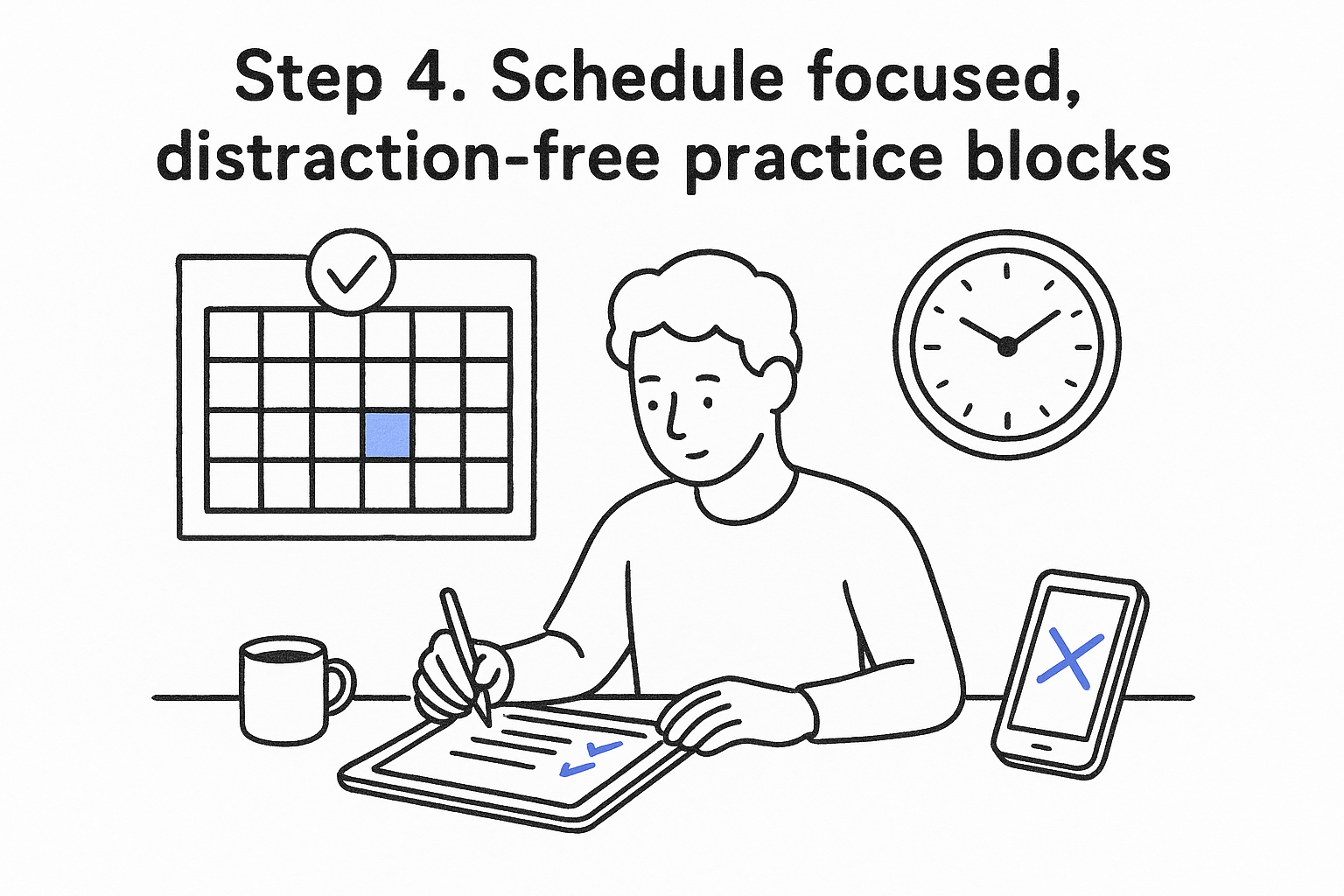
Step 4. Schedule focused, distraction-free practice blocks
A precise goal only pays off if you protect the time you're using to chase it. Ten minutes of scattered attention spread across a two-hour session produces worse results than fifteen minutes of full focus. Scheduling a distraction-free block means picking a fixed window, removing the things that will pull you out of it, and treating that window as non-negotiable, the same way you'd treat a meeting you can't skip.
Why interruptions cost more than they seem to
Every time your attention breaks, you lose more than the seconds you were away. You lose the thread of what you were noticing about the mistake, and you have to rebuild that awareness from scratch on the next rep. A phone buzz mid-swing or a notification mid-passage doesn't just interrupt the rep, it resets the feedback loop from Step 6 back to zero. Research on attention switching backs this up: even brief interruptions measurably slow task recovery, which is one reason the American Psychological Association has written about the real cost of multitasking.
A distracted rep isn't a wasted rep, it's a rep that teaches you the wrong lesson.
Build the block before you build the habit
Don't rely on willpower to find focus once you sit down. Set the conditions up in advance so focus is the default, not something you have to fight for.
- Pick a fixed time, ideally the same slot each day, so it becomes automatic rather than negotiated fresh every morning.
- Silence your phone, not just on vibrate, actually out of reach or in another room.
- Close the loop before you start, meaning you already know your session goal from Step 3 so you're not deciding mid-block.
- Set a visible timer, 15 to 25 minutes works for most micro-skills, long enough to get real reps, short enough to stay sharp.
- Tell people you're unavailable, whether that's a closed door, headphones, or a quick heads-up to whoever shares your space.
Match the block length to the skill, not the clock
A short technical drill like a chord change needs less time than a full run-through of a piece, and cramming both into one long block usually means the second half gets your tired attention instead of your sharp attention. If you're stacking multiple micro-skills in one sitting, split them into separate mini-blocks with a short break between, rather than blending them into one long, unfocused session. MemoRep's reminder system is built around this idea: it nudges you toward one focused card at a time instead of dumping your whole practice list on you at once, so each block stays sized to what you can actually give full attention to.
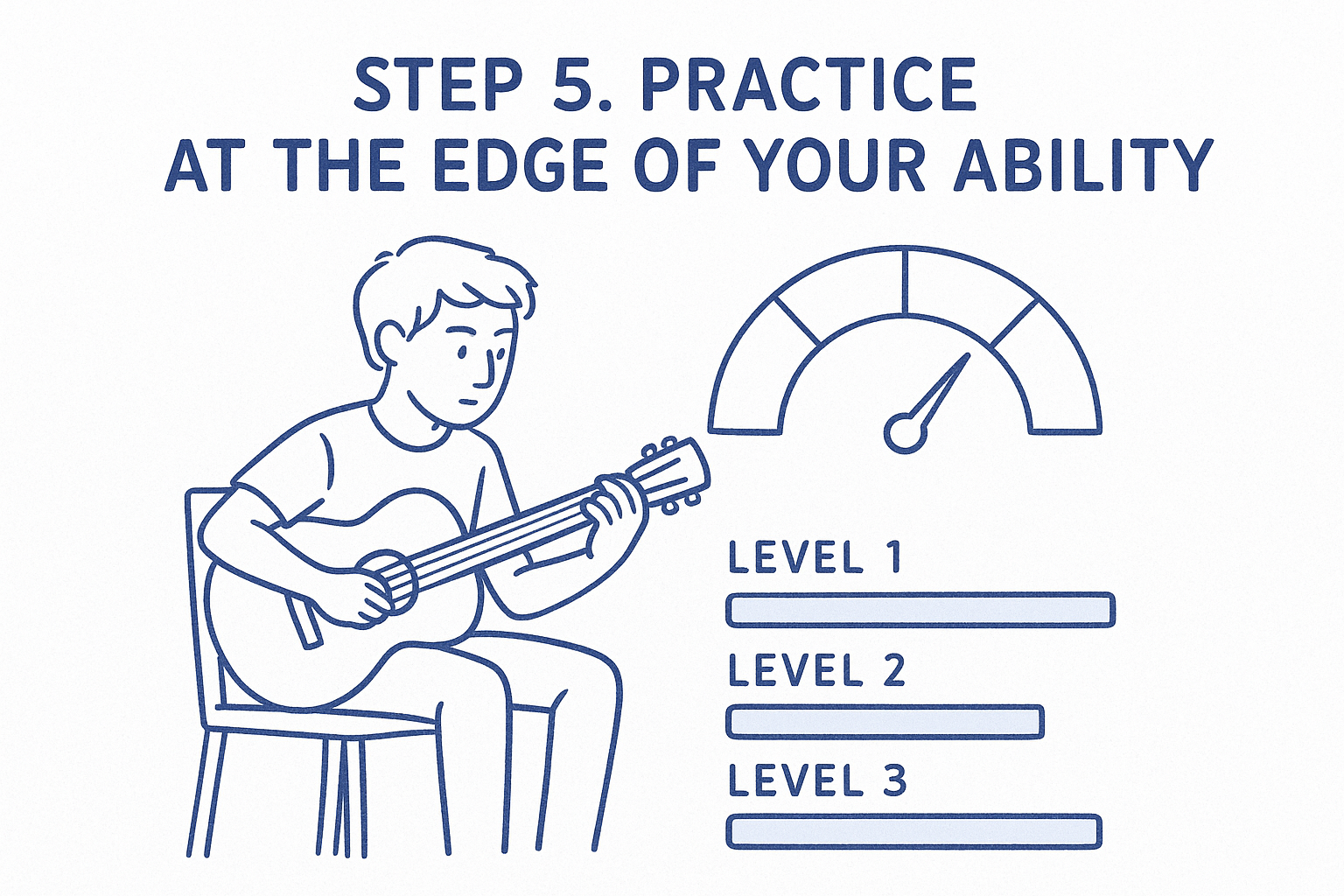
Step 5. Practice at the edge of your ability
Once your block is protected and your goal is written down, the next question is whether the task itself is calibrated correctly. Practicing at the edge of your ability means picking a difficulty where you succeed most of the time but fail often enough to learn something from the failure. Too easy, and you're just confirming what you already know. Too hard, and every rep turns into damage control instead of information.
Find your current edge with a quick probe
Before committing to a tempo, distance, or repetition count, run a short probe: try the micro-skill at three difficulty levels and note where it starts to break down. If you're working the G-to-C chord change, try it at 70, 90, and 110 BPM for a few reps each. The tempo where you succeed about 70 to 85 percent of the time is your edge for today. That failure rate isn't a flaw in your technique, it's the signal that tells you the difficulty is set correctly.
If you're not failing sometimes, you're not at the edge, you're just repeating what you can already do.
Use a simple difficulty ladder
A ladder gives you a repeatable way to find and adjust the edge without guessing each time:
Level 1: Comfortable, near 100% success (warm-up only)
Level 2: Edge zone, 70-85% success (main practice target)
Level 3: Overload, under 50% success (occasional stress test)
Spend most of your session at Level 2. Use Level 1 briefly to warm up and Level 3 sparingly, maybe once every few sessions, to test how far you've actually come.
Adjust one variable at a time
When a session feels too easy or too hard, resist changing everything at once. Move a single dial: tempo, distance, repetition count, or complexity, and observe the effect before touching another. This keeps your feedback clean, because you'll know exactly which change caused the shift in performance.
| Variable | Easy direction | Edge direction |
|---|---|---|
| Tempo | Slower | Faster, closer to target speed |
| Repetitions | Fewer, more rest | More consecutive attempts |
| Complexity | Isolated micro-skill | Combine two micro-skills |
| Distance/precision | Wider tolerance | Tighter tolerance |
This is exactly the calibration MemoRep's rating buttons are designed to capture. Marking a card Easy repeatedly tells the scheduler to push the difficulty or the interval further out, while Again or Hard keeps it close so you stay working right at the edge instead of drifting back into comfortable repetition.
Step 6. Build a fast feedback loop
A session goal and a calibrated difficulty only help if you know, rep by rep, whether you hit the mark. Building a fast feedback loop means closing the gap between an attempt and knowing how it went, ideally within seconds, not at the end of the week when a teacher or a coach finally weighs in. Without this loop, you can run twenty reps at the perfect difficulty and still walk away not knowing which ones worked.
Rate every attempt, not just the session
Most people judge practice in hindsight, deciding after the fact whether "that felt pretty good." That's too coarse to be useful. Instead, rate each individual attempt right after you make it, using a scale simple enough that you can apply it without breaking focus. A four-point scale works well because it maps directly onto what you'll do next with that micro-skill:
Again: Missed the goal, needs immediate repetition
Hard: Hit the goal, but shakily or with hesitation
Good: Hit the goal cleanly, as expected
Easy: Hit the goal with room to spare, ready to raise difficulty
Feedback you get next week doesn't fix the rep you just did, it only prevents the next twenty from repeating the same mistake.
Choose a feedback source that matches the skill
Self-rating works, but pairing it with an external check makes the loop tighter and harder to fool yourself on. Pick whichever source gives you the clearest signal for the specific micro-skill you're drilling:
- A metronome or tempo app for anything timing-related, since drift is easy to miss by ear alone.
- A phone recording, played back immediately for tone, form, or technique you can't observe while performing it.
- A mirror or video for physical positioning, like a golf takeaway or an instrument's hand posture.
- A measurable outcome, like a shot landing within a marked distance or a joint holding under a quick tug test.
- Your own honest rating, applied consistently, when none of the above fits the skill.
Log the rating the moment you make it
Don't wait until the block ends to record how each attempt went. Rate it, log it, move to the next rep. This is precisely the mechanic behind MemoRep's card system: every practice card carries the Again/Hard/Good/Easy buttons, so the rating you give in the moment feeds directly into when that card resurfaces. A fast, honest loop here is what makes Step 7's tracking meaningful instead of guesswork after the fact.
Step 7. Track results and log what changed
Rating each rep tells you how one attempt went. Tracking results over time tells you whether the whole approach is working. Without a log, you're relying on memory to compare today's session to one from three weeks ago, and memory flatters you. You'll swear you've improved because the last few reps felt good, even if the actual success rate has barely moved. A written record removes that bias and gives you something concrete to look back at when you're deciding what to adjust next.
What to log after every session
Keep the log simple enough that you'll actually fill it out. Five fields cover almost everything you need:
Date:
Micro-skill:
Goal (from Step 3):
Result (hit / missed, with numbers):
What changed (tempo, distance, complexity, rest, etc.):
That last field matters most and gets skipped most often. If you raised the tempo, shortened the rest between reps, or combined two micro-skills for the first time, write it down. Logging what changed is what turns a string of session notes into an actual experiment, because it lets you connect a specific adjustment to a specific result instead of guessing why last week went better or worse.
A log without a reason for the change is just a diary, not a training record.
Look for patterns, not single sessions
One bad session doesn't mean much. A pattern across five sessions does. Every week or two, scan the log for the same micro-skill and ask whether the success numbers are trending up, flat, or down at the same difficulty level. A flat trend at a stable difficulty usually means the difficulty needs to move, either up because you've plateaued comfortably, or down because you've been stuck failing the same way for too long.
Let the log do the deciding, not your mood
On a rough day, it's tempting to decide a skill needs more work than the numbers actually show, and on a good day, it's tempting to declare it solved too early. The log settles that argument. This is the exact role MemoRep's history view plays for each practice card: it holds the rating trail across sessions, so when you're deciding whether a micro-skill is ready to space out further or needs to come back sooner, you're reading a record instead of trusting a feeling that might just be today's energy talking.
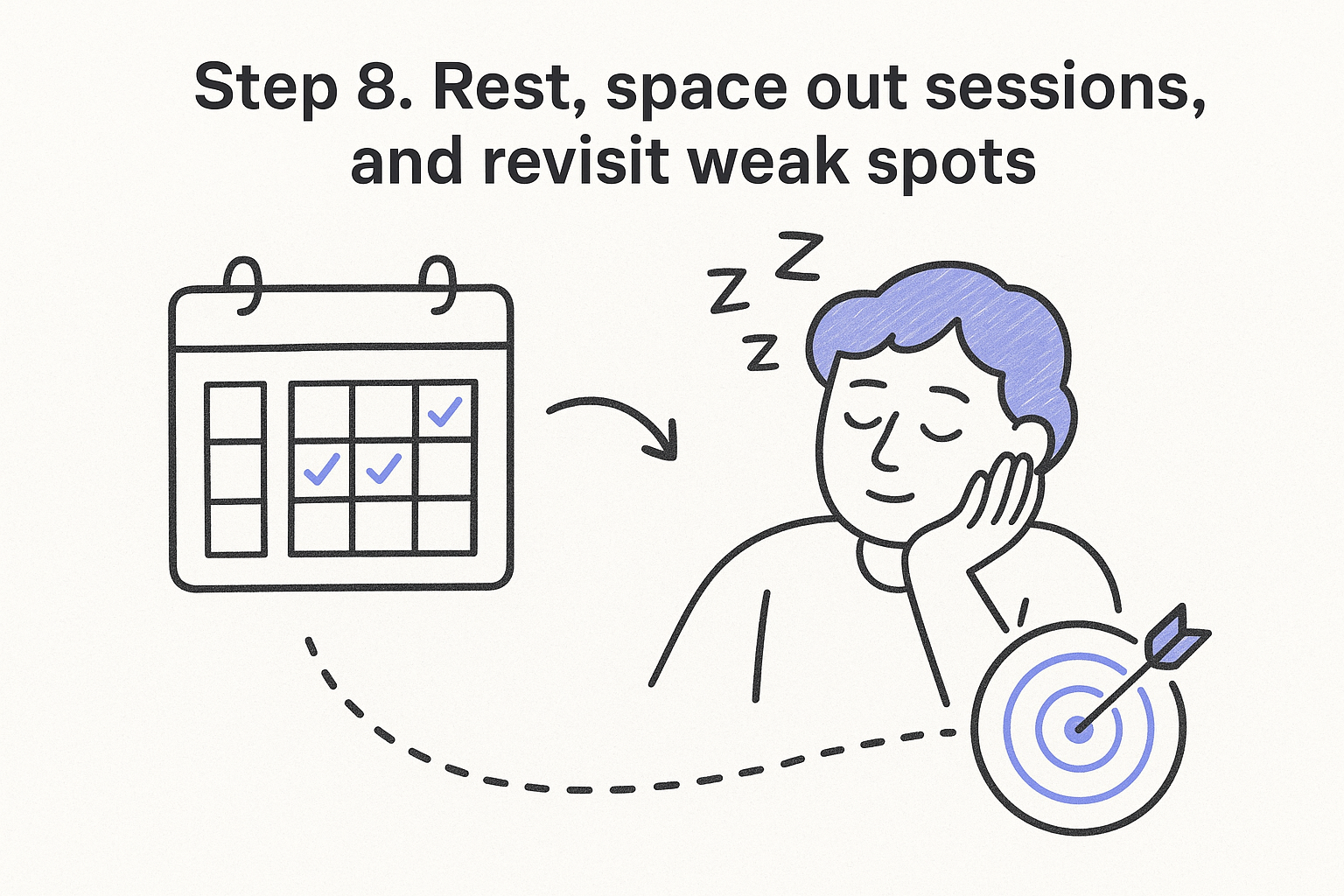
Step 8. Rest, space out sessions, and revisit weak spots
Most learners treat rest as time off from progress, something that happens between the real work. That's backwards. Spacing out revisits is part of the practice method itself, not a break from it. The Ebbinghaus forgetting curve shows that new skills fade fastest right after you learn them, then fade more slowly each time you successfully retrieve them again. Skip the revisit and you're not preserving a skill, you're just delaying the moment you find out it's gone.
Why forgetting is part of the plan
Forgetting a little bit before you revisit a micro-skill is actually useful, because retrieving something that's started to slip forces your brain to work harder than reviewing something still fresh. That extra effort is what strengthens the memory. Practicing the same clean chord change five days in a row with no gap teaches you almost nothing new after day two, since you're rehearsing something you haven't had a chance to forget yet.
If you never let a skill get a little rusty before you revisit it, you're not building durability, you're just repeating what's already easy.
Space out revisits instead of grinding daily
A simple spacing pattern works better than daily drilling for most micro-skills once you've hit your session goal. Try something like this as a starting point, then adjust based on how a skill actually holds up:
First revisit: 1 day after the goal was hit
Second revisit: 3 days after that
Third revisit: 7 days after that
Fourth revisit: 14 days after that
If you hit the goal cleanly at a revisit, push the next interval further out. If you miss it, pull the interval back in and treat it like a fresh weak spot. This is the exact logic behind MemoRep's scheduler, which reads your Again/Hard/Good/Easy ratings from Step 6 and adjusts each card's next revisit date automatically, so you're not stuck guessing whether three days or three weeks is the right gap.
Rest is not a break from progress
Rest between sessions matters just as much as the spacing between revisits. Sleep and downtime consolidate what you practiced that day, which is why cramming five sessions into one long evening rarely beats spreading them across a week. Give a skill room to fade slightly, catch it before it disappears, and you'll find the revisit takes less time than the original session did.
Step 9. Adjust the plan and raise the difficulty
Eight steps in, you've got a working loop: a named skill, broken into micro-skills, each with a measurable goal, a protected block, calibrated difficulty, fast feedback, a log, and a spacing schedule. Adjusting the plan is what keeps that loop from going stale. A schedule that never changes eventually stops teaching you anything, because the difficulty that felt like an edge in week one becomes comfortable by week four. Knowing how to practice deliberately over months, not just sessions, means treating the whole plan as something you revise on a fixed cadence, not something you set once and leave alone.
Read the log before you touch anything
Go back to the log from Step 7 every one to two weeks and look for one specific signal: a micro-skill that's been hitting Good or Easy for three sessions in a row at the same difficulty. That's your cue to move, not a coincidence to ignore.
A skill that stops surprising you has stopped teaching you, and that's exactly when it's time to raise the difficulty.
Raise one variable, then re-test
When you spot that pattern, go back to the difficulty ladder from Step 5 and nudge a single variable, the same way you did when you first calibrated the skill:
If Good/Easy for 3+ sessions:
- Raise tempo by 5-10%, or
- Tighten the success threshold (8/10 becomes 9/10), or
- Combine two stabilized micro-skills into one, or
- Shorten the rest between reps

Then re-run the Step 5 probe to find the new edge.
Change only one of these at a time. Combine a tempo jump with a tighter threshold and you'll have no idea which change caused the next dip in performance.
Retire, merge, or promote micro-skills
Not every micro-skill needs its own card forever. Once a micro-skill has been stable at a high difficulty for several revisits, decide what happens to it next:
- Retire it into a longer spacing interval, checking in monthly instead of weekly.
- Merge it with a related micro-skill now that both hold up under pressure.
- Promote it into a new, harder version that becomes its own fresh skill to name and track.
This is the review MemoRep's dashboard is built to support: it surfaces which cards have been coasting at Easy so you know exactly where to raise the bar, instead of scrolling through a practice list guessing which skills still deserve your attention.
Turning practice into progress
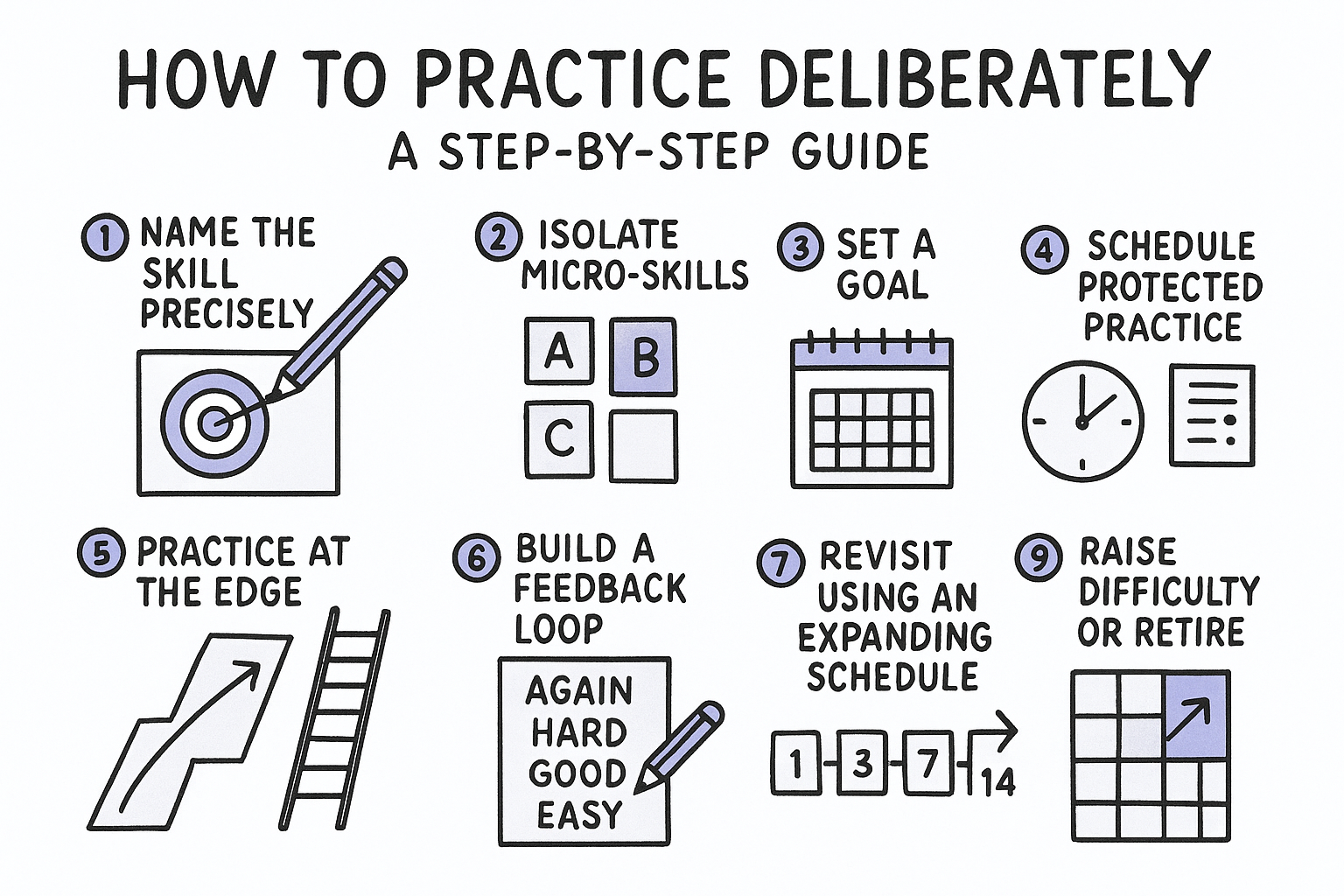
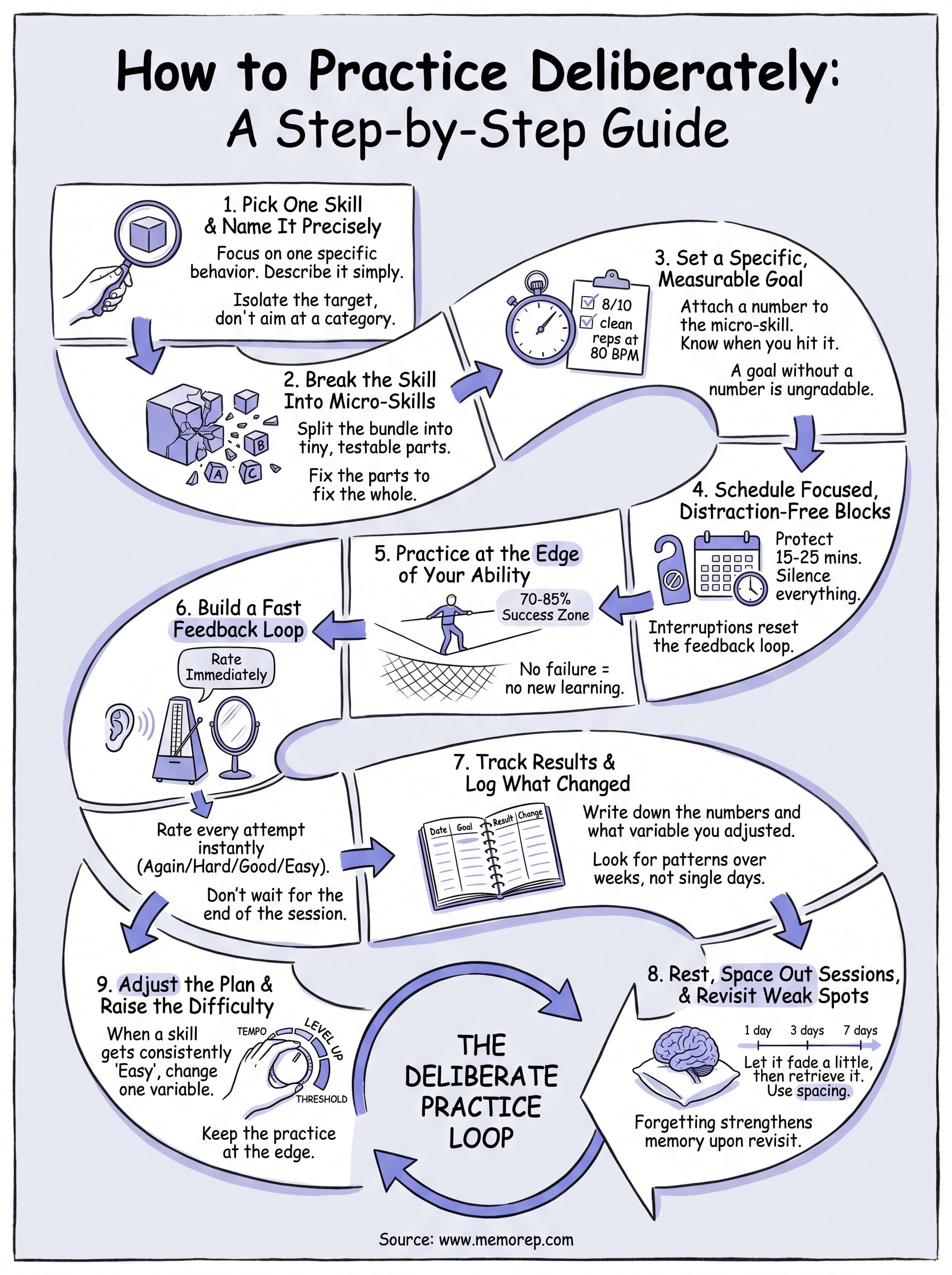
Nine steps, one loop: name the skill, break it down, set a number, protect the block, sit at the edge, rate fast, log it, space the revisits, then raise the bar. None of this requires more hours. It requires fewer wasted ones, spent on the wrong skill at the wrong difficulty with no record of what happened last time.
The hardest part isn't understanding the method, it's running it consistently across weeks without a spreadsheet turning into a chore. That's the exact gap MemoRep was built to close: cards for each micro-skill, Again/Hard/Good/Easy ratings that drive the scheduler, and revisit dates that show up automatically instead of living in your memory.
If you want to see the algorithm behind that scheduling before you commit, check out the science behind MemoRep. If you'd rather just start applying these nine steps today, claim a free-for-life spot in the beta while it's still open.