How to Practice Guitar When Traveling: Your 4-Step Plan
The best way to approach how to practice guitar when traveling is to set a small goal for the trip, bring a compact setup or go without an instrument, and put short sessions on a schedule. Ten to fifteen minutes a day on a few pieces you already know is enough to keep a week or two away from turning into a restart.
The problem is that travel breaks routine. At home, practice runs on habit: the guitar sits on its stand and the time slot is fixed. On a trip you have thin hotel walls, luggage limits, and a packed itinerary. Skip everything and you spend the first week back relearning what you had. Many players either drag a full-size guitar through airports or give up, and neither works well.
This guide covers four steps: set a goal, choose your setup, plan guitar-free practice, and schedule the sessions. It deals only with logistics and planning. What to play and how to play it stays with your teacher. MemoRep, a spaced repetition practice app, appears as one example of how to schedule it all.
Why a trip does not have to stall your progress
A trip only stalls your progress if you leave practice to chance. Skills fade when you stop revisiting them, and a short, planned touch every day or two slows that fade far more than one long session after you get home.
What a break actually costs
Memory research going back to Hermann Ebbinghaus shows that what you learn fades unless you return to it. For guitar, a week or two of nothing is usually enough to feel rusty on your newest material. Your oldest, most solid pieces survive best. The newest ones fade first, so those are the ones worth protecting.
What to sort out before you leave
You need three things before packing:
- A list of what you are working on now. Songs, exercises, and pieces in progress.
- Your trip dates and rough daily schedule. Look for gaps such as mornings, flights, and evenings.
- A quick word with your teacher. If you have one, ask what they want you to do while away.
A trip costs you progress only when practice has no plan, not when it has less time.
Step 1. Set a realistic goal for the trip
Your goal for the trip should be to maintain, not to make big gains. Choosing "keep my current pieces alive" over "learn a new song" removes the pressure and makes the plan easy to follow.
Match the goal to the trip
Trip length and type decide how much effort makes sense. These are starting points, not rules:
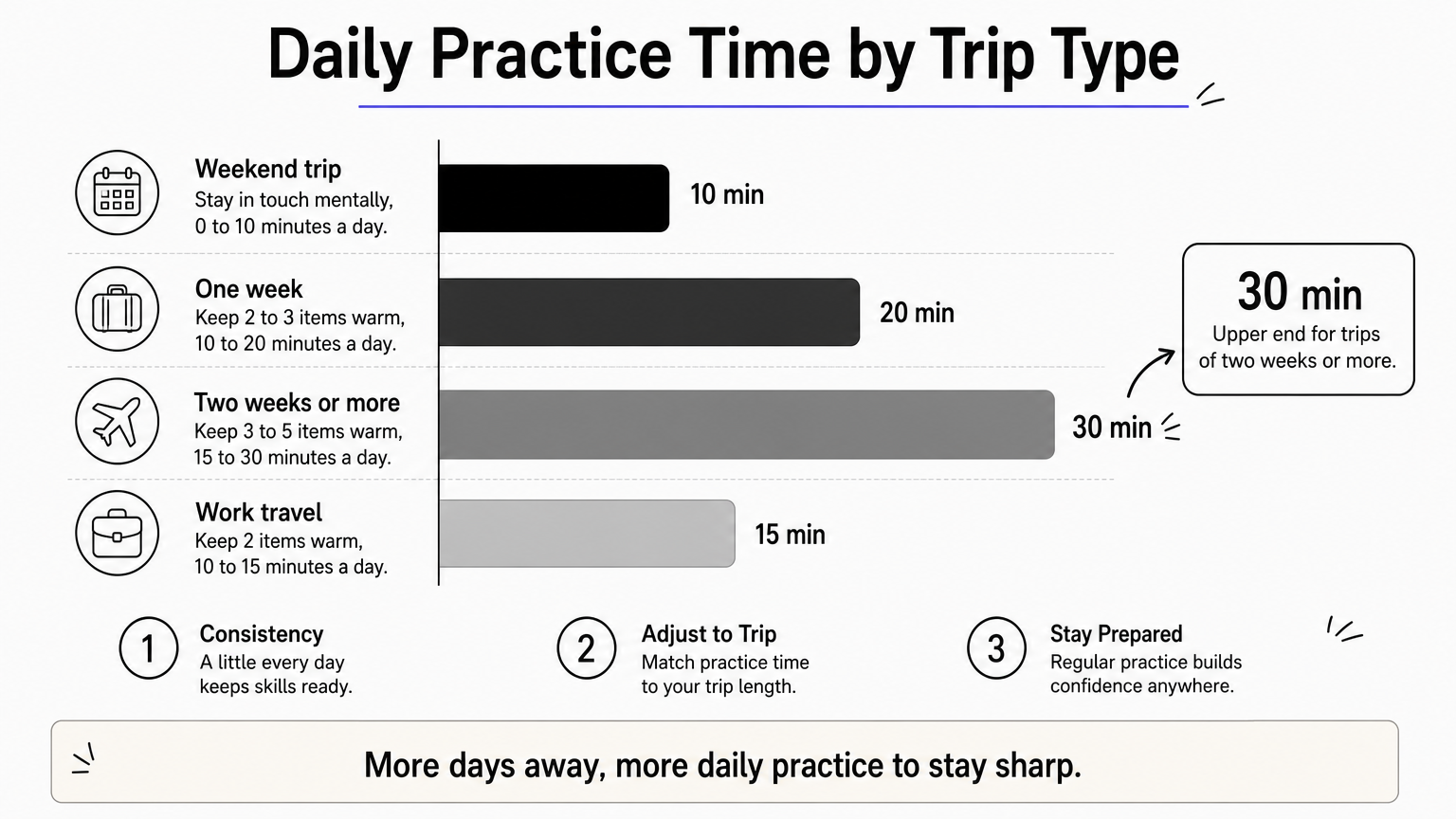
| Trip type | Guitar along? | Goal | Daily time |
|---|---|---|---|
| Weekend (2 to 3 days) | Usually no | Stay in touch mentally | 0 to 10 min |
| One week | Optional | Keep 2 to 3 items warm | 10 to 20 min |
| Two weeks or more | Recommended | Keep 3 to 5 items warm | 15 to 30 min |
| Work travel | Only if you have quiet hours | Keep 2 items warm | 10 to 15 min |
Pick three to five items
Choose the items you would hate to lose, starting with whatever you learned most recently. A short list stops you from deciding what to play every time you sit down. Decision fatigue kills more trip practice than lack of time does.
Here is a worked example. You leave for 14 days and pick 3 items. With a guitar, you play 15 minutes on 10 of the days, which is 150 minutes, about 2.5 hours. On the other 4 days you do a 5-minute mental review, 20 minutes in total. That plan fits a vacation, and it is much better than nothing.
Pick three to five items and ignore everything else until you are home.
Step 2. Decide whether to bring a guitar
Bring a guitar if the trip lasts more than a week and you will have quiet time to use it. Otherwise leave it at home and use Step 3. A full-size guitar is rarely the right travel companion.
Compare your travel options
| Option | Best for | Trade-off |
|---|---|---|
| Compact travel acoustic | One instrument, no extra gear | Smaller body, different feel and volume |
| Ultra-portable or foldable-neck guitar | Backpacking, tight luggage | Feels unlike your main guitar |
| Travel electric plus headphone amp | Hotels and shared rooms | Needs power or batteries and a few cables |
| Your regular guitar | Short trips by car | Hard to protect on planes |
Get it on the plane
Carry it on, never check it. Under a 2012 federal law, U.S. airlines must let you bring a small instrument into the cabin if it fits in the overhead bin or under the seat. Space is not guaranteed, so board early and check your airline's size rules before you pack. Use a padded case or a sturdy gig bag.
Pack a quiet-practice kit
Keep the kit small enough to live in your carry-on:
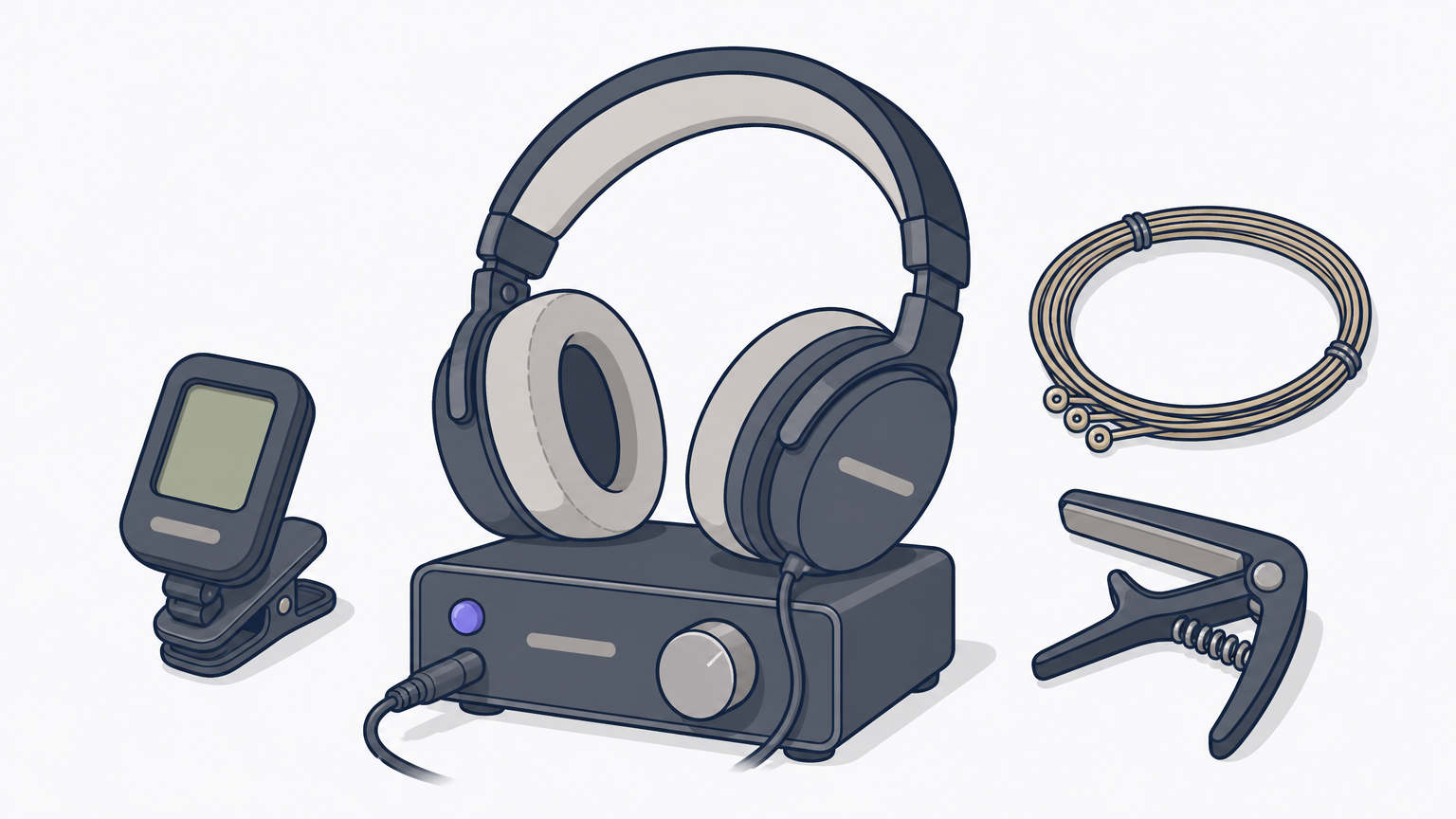
- A clip-on tuner
- A spare set of strings
- A capo, if you use one
- A headphone amp or audio interface with headphones, for electric or amplified setups
- Any cables and adapters the amp needs
The best travel guitar is the one you can carry on and play without annoying your neighbors.
Step 3. Plan your guitar-free practice
Without a guitar, you can still keep your repertoire alive in your head. This is the plan for short trips, for flights, and for days when the guitar stays in its case.
What counts without the instrument
Treat it as memory work on your repertoire, not playing. You can:
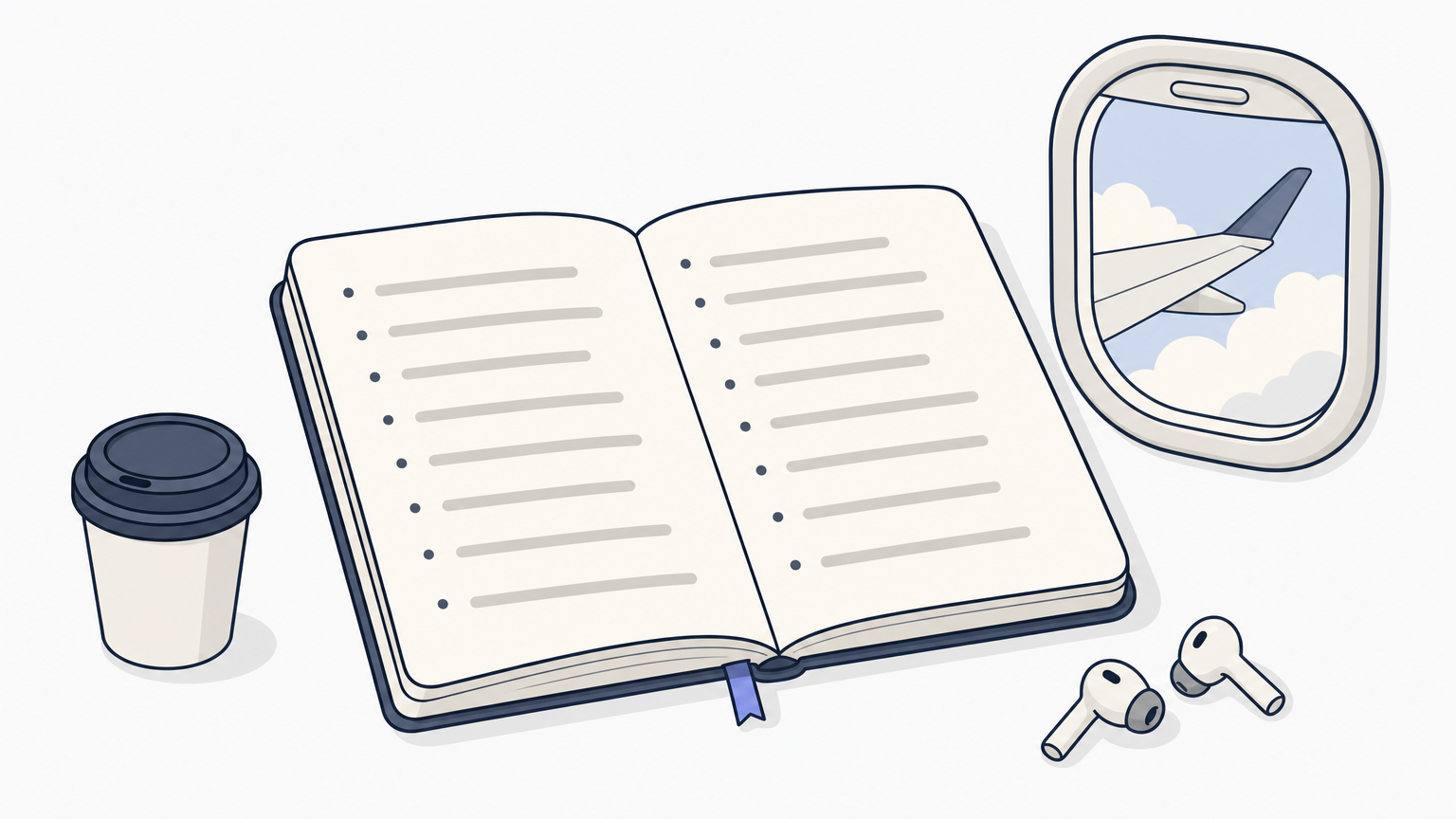
- Write out the order of your set list or piece sections from memory.
- Listen to recordings of your current pieces and follow the structure.
- Run through lyrics, song forms, or the sequence of sections in your head.
Do this in the time gaps you found earlier: waiting at the gate, riding in a car, or winding down at night. Five minutes is enough.
Let your teacher set the content
Anything involving technique, theory, or how to play something belongs with your teacher. Ask for a travel assignment before you leave. A teacher knows your level and can tell you what is useful away from the guitar. A generic tip list cannot do that, and neither can this article.
Away from the guitar, protect your memory of the music and leave the technique to your teacher.
Step 4. Schedule sessions and review when you return
Put every session into your day, then track how each item felt so you know what slipped. Trip practice fails when it is optional, so give it a time and a trigger.
Anchor each session to your day
Link practice to something that already happens, such as right after breakfast or before you shower for dinner. A fixed anchor beats a vague plan to play when you have time. Keep sessions short and stop on time. A quick, finished session makes tomorrow's easier to start.
Track it with spaced repetition
Spaced repetition means revisiting something just as it begins to fade. In MemoRep, you create practice cards for your three to five items inside a project, and the app tells you what to practice next and when. It also sends daily practice notifications, which helps when the trip has erased your usual rhythm.
Rate each session and read the results at home
After each pass, rate it with Again, Hard, Good, or Easy. The schedule adjusts to your rating. When you get home, cards you rated Again or Hard show which items slipped, so you start with those instead of guessing. A paper notebook with a simple one-to-four rating also works, but you do the scheduling yourself.
Rate every session honestly, because those ratings tell you where to start when you get home.
Keep the habit, skip the guilt
Practicing guitar on vacation comes down to three decisions: how much to aim for, whether the guitar comes along, and when each session happens. A small goal, a compact kit or a guitar-free plan, and short scheduled sessions keep your repertoire intact without taking over the trip.
If you want the scheduling handled for you, try MemoRep and get free access during the limited beta. Set up your trip cards before you leave and let the app decide what comes next.