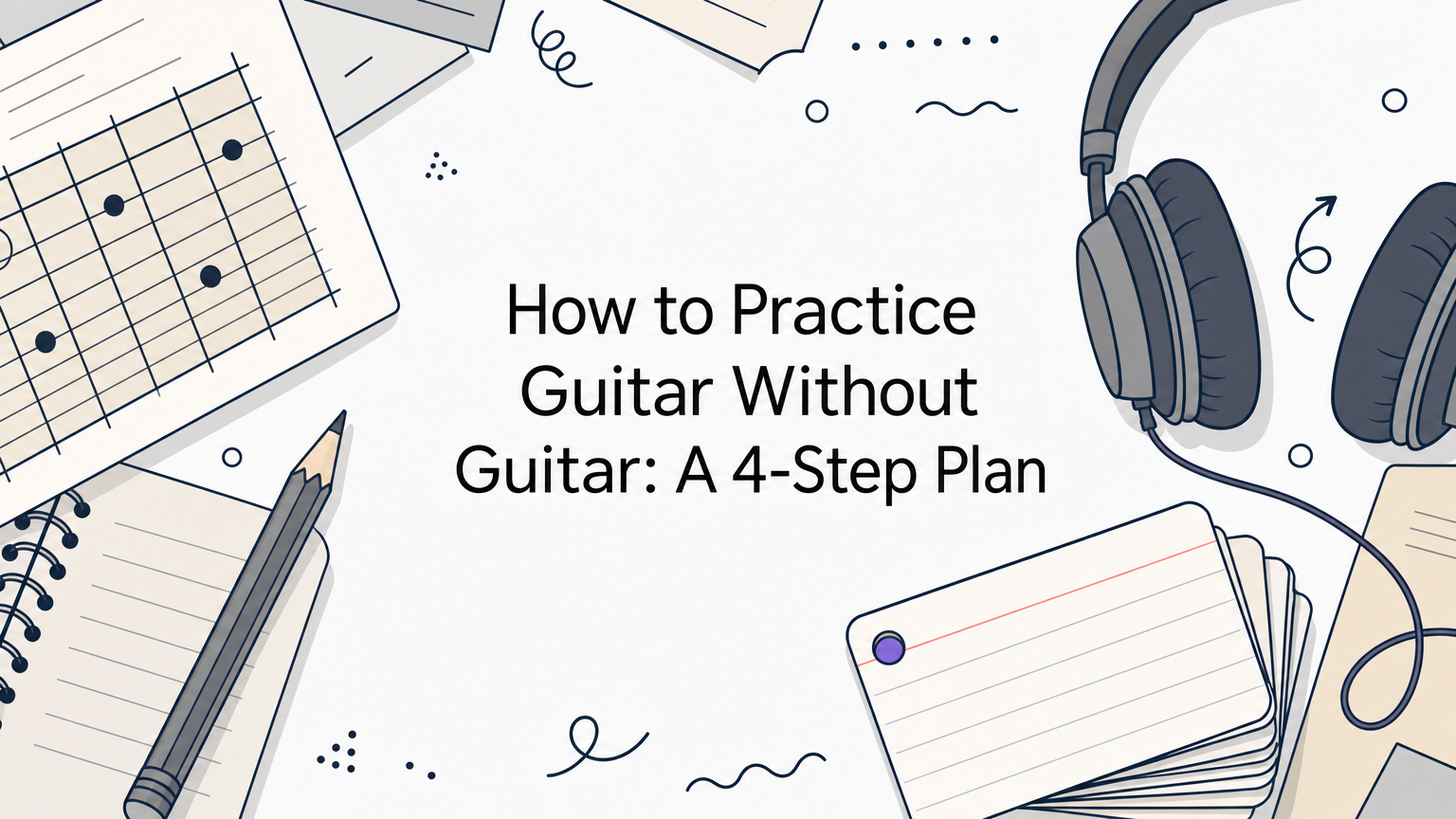
How to Practice Guitar Without Guitar: A 4-Step Plan
The best answer to how to practice guitar without guitar is to stop treating the instrument as the only place practice happens. Take the material you are already working on and rehearse it away from the guitar. Run pieces in your head, write the fretboard out from memory, listen to your repertoire with a specific task, and schedule each of those sessions so nothing fades.
You probably know the problem. A trip, an injury, a broken string with the shop closed, or a few months in a dorm room takes the guitar out of your hands. Practice stops, and the skills you built start to slip. Because you cannot play, you also lose track of what you were supposed to work on, so you do nothing at all. Forgetting is fastest in the first days after you stop.
This guide gives you four steps to fill that gap. You will sort what can be rehearsed without an instrument, practice it mentally, use paper and listening, and put it all on a schedule. MemoRep is a spaced repetition platform for musicians, so organizing and timing practice is our territory. What to play and how to play it belongs to your teacher, so you will find no theory or technique lessons here.
Why practicing without a guitar works
Practicing without a guitar works because a large part of playing lives in memory, not in your fingers. You hold the pieces, the layout of the fretboard, and the sound of your repertoire in your head. You can exercise all three anywhere.
What you can and cannot maintain
Mental work keeps memory, recognition, and listening active. It does not replace the feel of the instrument under your hands. After several weeks away, expect your hands to need a few days to settle back in. The goal is to return with nothing forgotten, not to gain ground on the instrument.
Off-guitar practice protects what you already know. It does not replace time on the instrument.
Why timing matters more than length
Forgetting follows a curve. Hermann Ebbinghaus described it in the 1880s. Memory drops fastest soon after you learn something, then the loss slows down. Each review resets the curve and flattens it. Short sessions at spaced intervals beat one long session, which is why the last step of this plan is scheduling.
Who decides what to rehearse
Your teacher decides what you work on and how. This guide only covers how to keep that material alive while you are away. If you have no teacher, use whatever you were practicing before the guitar disappeared. Do not start new technical projects without an instrument and without guidance.
Step 1. List what you can rehearse without a guitar
Start by writing down everything you were practicing, then sort each item by whether it can be done without the instrument. Most items can, in some form. This sorting is the foundation of any plan for how to practice guitar without guitar.
Sort your current material
Open your practice notes, your teacher's assignments, or your song list. Write each item on its own line. Then assign it to one of the four categories below.
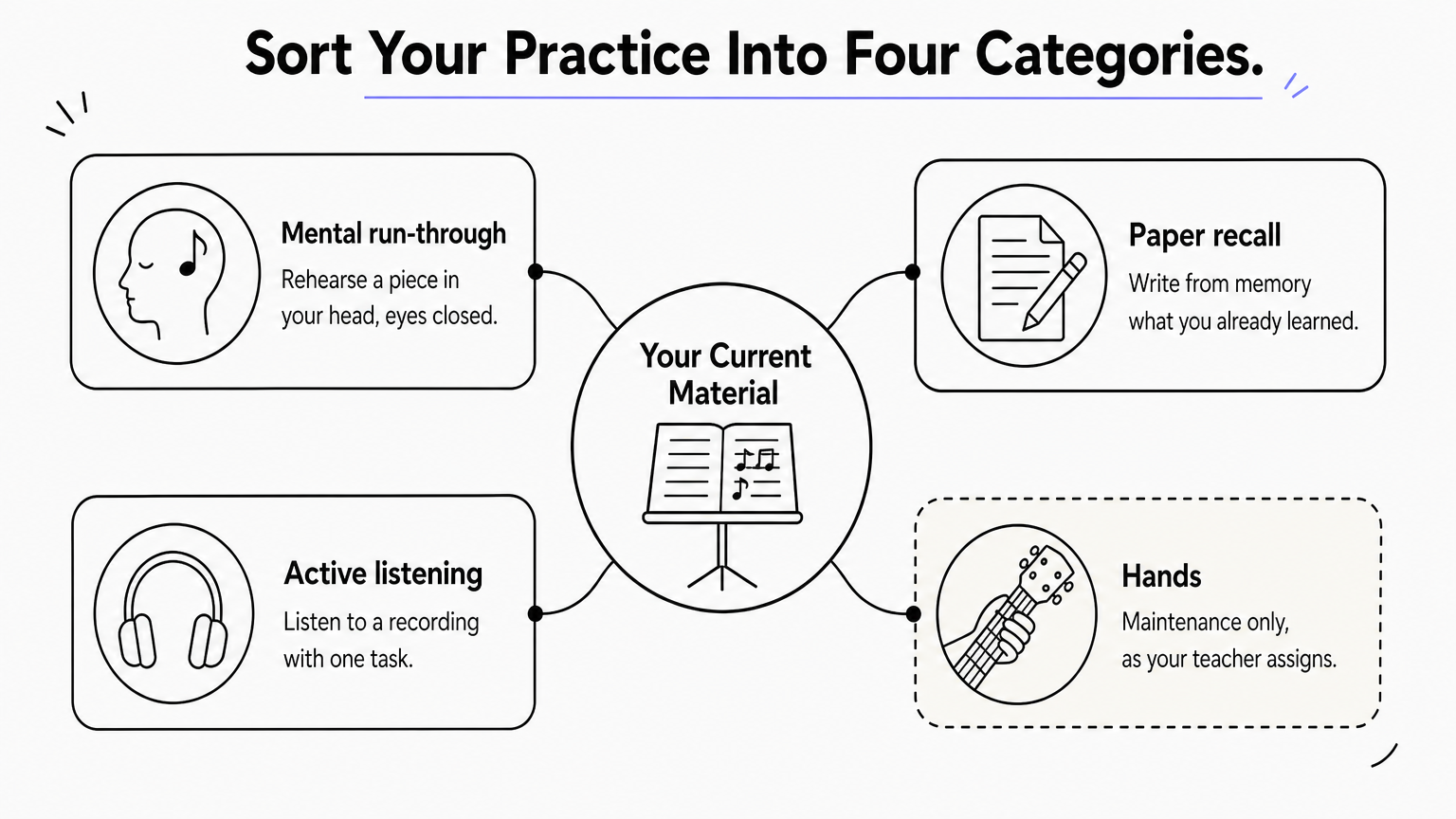
| Category | What you do | Example from your own list |
|---|---|---|
| Mental run-through | Rehearse a piece in your head | The piece you are polishing |
| Paper recall | Write from memory what you already learned | Notes on the fretboard, a chord chart |
| Active listening | Listen to a recording with a task | Your repertoire, one part at a time |
| Hands | Maintenance only, per your teacher | Whatever your teacher already assigned |
Drop what cannot travel
Some items need a real guitar. Anything that depends on feel, sound, or physical coordination goes on hold. Do not force these into off-guitar sessions. A short list of items you can actually do beats a long list you will ignore.
A short list you will actually do beats a long list you will skip.
Step 2. Rehearse your pieces in your head
Mental rehearsal means imagining a piece from start to finish, in detail, without playing it. Athletes use the same idea. Research on mental practice in music and sport suggests it can support performance, though it works best alongside real playing, not instead of it.
Start with the score in front of you
Pick one short section of a piece you already know. Read it slowly with the page open and imagine playing it, hearing each note in your head as you go. When you lose the thread, look back at the page and continue. Keep sessions short, five minutes is plenty.
Move to eyes closed
Once the section feels clear, close the book and run it from memory. Imagine the sound, the pulse, and your hands moving. Then check against the page. Every place where you stumbled tells you what to review again tomorrow.
Wherever you stumble in your head is where you will stumble on the guitar.
Grow the section gradually
Add one phrase at a time. If a phrase will not come, shrink the section instead of pushing through. Mental practice should feel easy enough to repeat daily, because repetition is what makes it count.
Step 3. Use paper, your ears, and gadgets
Paper work and listening cover the two things you can train best without an instrument: recall and recognition. Both are central to how to practice without a guitar over a long stretch.
Write the fretboard from memory
Draw six horizontal lines on a sheet of paper and fill in what you already know. Notes, chord shapes, or a pattern your teacher gave you all work. Write only from memory, then check against your teacher's material. Mistakes show you what to review, and paper costs nothing.
Listen with a job to do
Pick a song from your repertoire and follow one thing only. It might be the bass line, the rhythm, or the moment the vocal leaves space. Listen again and follow something else. One task per listen turns background music into practice. Choose music you are working on, or music your teacher recommended.
Apps, trainers, and hand gadgets
Ear training apps and fretboard quiz apps fit into short gaps in your day. Portable neck trainers and grip gadgets exist too, but I will not prescribe exercises for them. How you condition your hands is a question for your teacher. If you feel pain or numbness, stop and talk to a doctor.
Use gadgets only with your teacher's approval, and stop if anything hurts.
Step 4. Schedule every session with spaced repetition
Scheduling is what turns a pile of good ideas into a routine. Without it, you will drift back to doing nothing. Spaced repetition tells you what to review and when, so you never have to decide.
Turn each task into a card
Write each off-guitar task as a specific, checkable item. Vague items like "think about guitar" never get done. Here are examples you can copy and adapt:
Piece: [title], bars 1-8, run through in my head, eyes closed
Paper: fretboard notes I learned last week, write from memory
Listening: [song], follow the bass line only
Rate each session honestly
After each session, rate it. In MemoRep you choose Again, Hard, Good, or Easy. An honest "Again" brings the item back soon. An honest "Easy" pushes it further out. Honest ratings keep the schedule accurate, and the schedule only helps if it matches reality.
Let the intervals plan your days
MemoRep uses the Ebbinghaus forgetting curve and the SuperMemo SM-2 algorithm to schedule each item just before it fades. Your daily list shows only what is due. You can see how MemoRep works before you try it.
Practice is not what you remember to do. It is what a schedule asks of you.
Keep your playing alive until you are back
You do not need a guitar to keep your playing alive. You need a list of what can be rehearsed, a method for mental practice, paper and listening tasks, and a schedule that brings each item back at the right time. Leave technique and theory to your teacher, and keep your own sessions short and regular.
When the guitar returns, you will start from what you kept, not from scratch. To put these four steps on autopilot, try MemoRep and get a free-for-life subscription for a limited time.