How to Memorize Vocal Music: 5 Methods for Solo and Choir
The fastest way to learn how to memorize vocal music is to stop rereading the score and start testing yourself on short passages, then revisit each passage just before you would forget it. The five methods below all follow that idea. Spaced repetition suits singers with a long repertoire. Chunking suits anyone facing a long piece. Self-testing suits choir members who must hold a part alone. Ear-based learning suits singers who read slowly. Mental rehearsal suits anyone who cannot sing out loud right now.
Most singers know the problem. You feel secure at Tuesday's rehearsal and blank on Saturday. Memorizing choral music adds a twist: your part sits among other parts, and the singers beside you can carry you without your noticing. The song feels known until you stand alone, and then it is not. This article gives you five methods you can combine, each with concrete steps and the kind of singer it suits best.
MemoRep is a spaced repetition practice app, so scheduling comes first on the list. One boundary applies throughout: this article covers memory only. How to produce tone, pitch, or breath, and how to read the music, belongs with your voice teacher or choir director. Nothing here replaces their guidance.
1. Spaced repetition with MemoRep
Spaced repetition means you review each passage at growing intervals, right as it starts to fade. It is the most reliable answer to losing a song between rehearsals, and MemoRep automates the scheduling for you.
How to do it
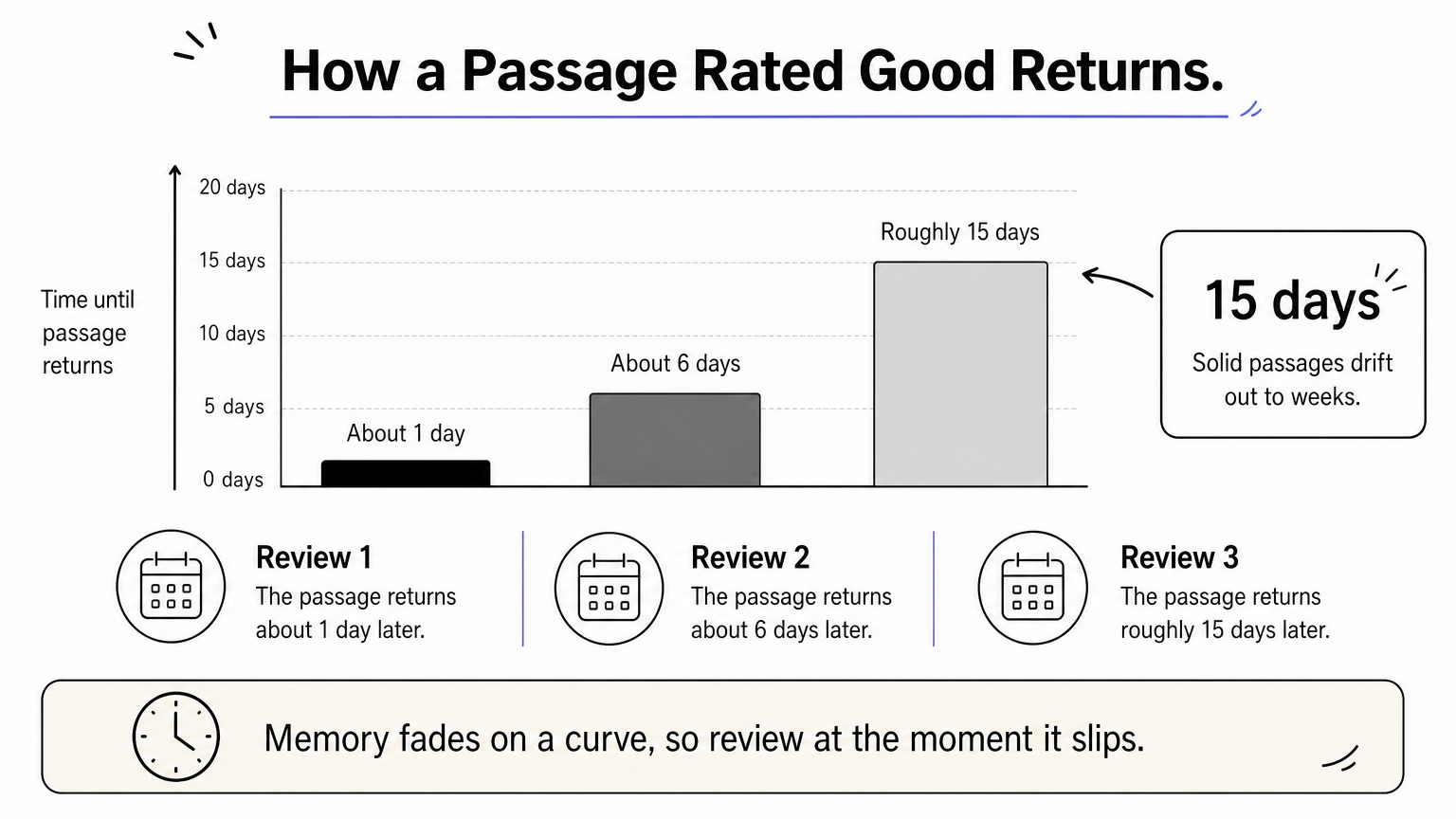
Split your piece into passages and create one practice card per passage inside a project for that piece. When a card comes up, run the passage from memory, then rate it Again, Hard, Good, or Easy. MemoRep builds on the Ebbinghaus forgetting curve and the SM-2 algorithm, adjusts each card to your ratings, and sends a daily practice notification. These are practice cards for something you do, not text flash cards. In an SM-2 style schedule, a passage you rate Good typically returns like this:
- Review 1: about 1 day later
- Review 2: about 6 days later
- Review 3: roughly 15 days later
A three-minute song split into six passages makes six cards. Passages you keep rating Again come back almost daily, while solid ones drift out to weeks.
Who it suits
This method fits singers with several pieces in progress, or choir members learning a concert program over a month or more. MemoRep is free during its limited beta, which is open to the first 200 users. The catch is time: spacing needs days to work, so for a piece due tomorrow, lean on methods 2 and 3.
Memory fades on a curve, so review each passage at the moment it starts to slip.
2. Chunk the piece into short passages
Chunking means learning a few lines at a time instead of running the whole piece from the top. It works because you hold only a small amount in mind, and it fixes the common pattern where the opening is rock solid and the ending is shaky.
How to do it
Pick break points from the words and phrases themselves, such as line ends, verses, or a choir entrance. Then work through these steps:
- Learn one chunk until you get it twice in a row from memory with no slip.
- Add the next chunk and run both together.
- Start some sessions at the last chunk so the ending gets as much time as the beginning.
- Where verses repeat with small word changes, write down only the differences and review that list.
Who it suits
Chunking helps anyone with a long or wordy piece. In choir, chunk your own part only and start each chunk at one of your entrances. The weak spot is the seam between chunks, so rehearse the joins on purpose.
Small chunks beat full run-throughs because you spend your effort where you actually forget.
3. Test yourself with the score closed
Active recall means you try to produce the passage from memory before you look at the music. Reading along feels like knowing, but struggling to retrieve a line strengthens memory far more than rereading it.
How to do it
Close the score and sing or speak the passage. Then open it and put a pencil dot above every spot where you hesitated or got it wrong. Follow this loop:
- Test the dotted spots first in your next session.
- Once per session, run the whole piece cold, with no warm-up pass through the music.
- Erase a dot only after the spot comes out right on two different days.
For choral music, test your part alone, away from the piano and your neighbors. If you only ever sing it surrounded by others, you will not know what you really hold.
Who it suits
This is the best fit for choir members with a performance date and for anyone memorizing for an audition. It feels worse than rereading, and that discomfort is the signal that it is working. Use it after chunking, since there is little to test until each passage is in your head.
If you can only sing it with the page open, you do not know it yet.
4. Learn by ear and speak the words
Listening to your part and speaking the words in rhythm builds memory through your ears and mouth instead of your eyes alone. Many choirs share part tracks. If yours does not, ask your director before recording your section.

How to do it
Play your part track on a walk or commute with no score in hand. Then split the job in two:
- Speak the words in rhythm, without pitch, so the text stands on its own.
- Hum the line on closed lips, then add the words.
- Record yourself from memory and compare it with the part track to find gaps.
For Latin or another foreign language, speak the syllables slowly before putting them back together.
Who it suits
Ear-based learning suits slow music readers and singers who retain sound better than print. The risk is learning a mistake by ear. Check your recording against the score and your director's version regularly, so a wrong note does not harden into habit.
Your ears and mouth store the piece differently from your eyes, so use all three.
5. Rehearse mentally and attach cues
Mental rehearsal means running the piece silently in your head, picturing the page or the words, and tagging hard spots with cues. It adds repetitions when you cannot sing aloud, and cues give your memory a handle at the places you lose it.
How to do it
Run the piece in your head during a walk or while waiting in line. Wherever your mind goes blank, note the spot and check it later. Then add a cue to each trouble spot, such as:
- A vivid image for the first word of the line
- A small hand gesture you use only in practice
- The last word of the previous line as a trigger
Run your trouble spots once more before bed and test them in the morning. Sleep helps the brain consolidate what you practiced.
Who it suits
This one is for busy singers and anyone in shared housing or on the road, with no chance to sing out loud. A silent run only shows you where you blank. It does not prove you can perform, so follow it with a closed-score test from method 3.
A blank in your head is information: it tells you exactly which line to practice next.
Where to start
No single trick memorizes a piece. The reliable approach is to chunk it, test each chunk with the score closed, and then space your reviews so that nothing fades before the performance. Ear learning and mental rehearsal fill in the gaps when you have a commute but no piano.
Pick one piece you need to memorize and split it into passages today. If you want the scheduling handled for you, try MemoRep while the limited beta is open and let it tell you what to review and when. Your voice teacher or choir director remains the one to guide how you sing it.