How to Practice Pentatonic Scales on Guitar with a Schedule
The most reliable way to learn how to practice pentatonic scales on guitar is to stop treating the scale as one big thing. Split it into small practice cards, such as one position in one key. Rate how each pass felt, then let a spaced repetition schedule bring each card back just before you would forget it. That replaces the usual routine of running your favorite box until it sounds good and ignoring everything else.
The problem is rarely the first week. Pentatonic patterns are friendly, so you learn a position fast, feel good, and move on. Two weeks later the position you skipped feels foreign, the keys you rarely touch have faded, and you spend half your session deciding what to play. A scale you can't recall on the spot won't show up in your solos.
This guide walks through four steps for organizing that practice: building cards, rating them honestly, trusting the schedule, and connecting the cards to real playing. It does not teach fingerings, theory, or technique. That is your teacher's job, and a good teacher decides what you work on next. This guide covers the other half, deciding when to come back to it, which is the half MemoRep automates.
Why pentatonic practice needs a schedule
Pentatonic practice needs a schedule because the scale is not one skill. It is a collection of small skills, such as positions, keys, and ways of using them, and memory drops the small things you stop revisiting.
Why the scale is easy to learn and easy to lose
The scale has few notes, so it feels easy, and in the first session it is. The difficulty is volume. Over a few months you collect several positions, multiple keys, and a growing pile of phrases. Each one fades on its own timeline, following what researchers call the Ebbinghaus forgetting curve: new material drops fast without review, and each well-timed review slows the drop.
Without a system, you rehearse what already feels good. The favorite position gets a hundred passes while the others get none, and skills become rusty from inconsistent revisiting. Here is how the usual habits compare with a schedule:
| Common habit | What goes wrong | What a schedule does |
|---|---|---|
| Playing your favorite position every day | Other positions fade | Surfaces the card that is closest to fading |
| Deciding what to practice on the spot | Time lost to decisions | Hands you a list of what is due |
| Reviewing everything equally | Easy material steals time | Spaces easy cards far apart |
| Practicing only when you feel inspired | Gaps of weeks open up | Sends a daily reminder |
A pentatonic scale is many small skills, and each one needs its own review date.
What you need before you start
You need three things. First, a source of instruction: a teacher, a method book, or a course. That source decides what the scale should sound and feel like. Second, a list of what you are currently working on, even if it has only three items. Third, a place to track it. MemoRep organizes cards inside projects, so you can keep one project for pentatonic work and another for songs.
If you have no source of instruction yet, get one before building cards. A schedule makes you good at the thing you are practicing, so you want that thing to be correct.
Step 1. Turn the scale into practice cards
A practice card is one small, ratable unit of work. For pentatonic practice, make each card one position in one key, so you can say clearly afterward whether you got it or not.
Decide what counts as one card
If a card is too big, such as "the whole scale in every key," you can never rate it honestly. Part of it will be solid and part shaky, and the rating will mean nothing. If a card is too small, you drown in cards. A good test is whether you could finish a card in a few minutes and know how it went.

Take your teacher's material and cut it along its natural seams. Here is an example set for someone working on a minor pentatonic scale:
| Card name | Where the content comes from | What "Good" means |
|---|---|---|
| A minor pentatonic, position 1 | Your teacher's lesson | Clean pass, no stops |
| A minor pentatonic, position 2 | Your teacher's lesson | Clean pass, no stops |
| Position 1 to 2 connection | Your method book | Moves between them without hesitating |
| E minor pentatonic, position 1 | Your teacher's lesson | Clean pass, no stops |
Name cards so you can rate them in seconds
Use a consistent pattern: what, where, which key. Put the instruction source in the card notes, such as "lesson 4" or "page 12," so you never wonder what the card meant. Add the tempo where a pass felt Good so you have something to compare against later.
One card, one clear outcome: if you can't say whether it went well, the card is too big.
Step 2. Rate each pass honestly
After each card, rate it Again, Hard, Good, or Easy. The rating is the only information the scheduler gets about your skill, so honest ratings produce a good schedule and flattering ratings produce a useless one.
What each rating means for a pentatonic card
Rate against what you were asked to do, not against how it felt in your head. Use these definitions:
| Rating | Use it when | Effect on the schedule |
|---|---|---|
| Again | You couldn't get through it, or had to stop and rebuild | The card comes back soon |
| Hard | You got through it, but with errors or hesitation | The card returns sooner than usual |
| Good | You played it cleanly at the pace you were asked | The gap before the next review grows |
| Easy | It required no thought at all | The gap grows a lot |
MemoRep adjusts each card to how you experience it, so a card that is Hard for you in one key and Easy in another will end up on separate rhythms.
Rating mistakes that wreck the schedule
The most common mistake is rating Good because you almost got it. Almost is Hard. The second is rating Easy for a card you like playing. Enjoyment is not recall. The third is rating after a warm-up of five repetitions. Rate the first clean attempt, because that is what a cold start in front of a band will look like.
If you rate harshly for a week and feel bad about it, that is fine. A card marked Again today is a card you will not lose next month.
Rate the first attempt, not the fifth, because the first attempt is the skill you will actually have on stage.
Step 3. Let the schedule choose what's next
Once your cards exist and you are rating them, stop deciding what to practice. The scheduler uses the SuperMemo SM-2 algorithm, built on the forgetting curve, to space each card further out every time you recall it well.
How the intervals grow
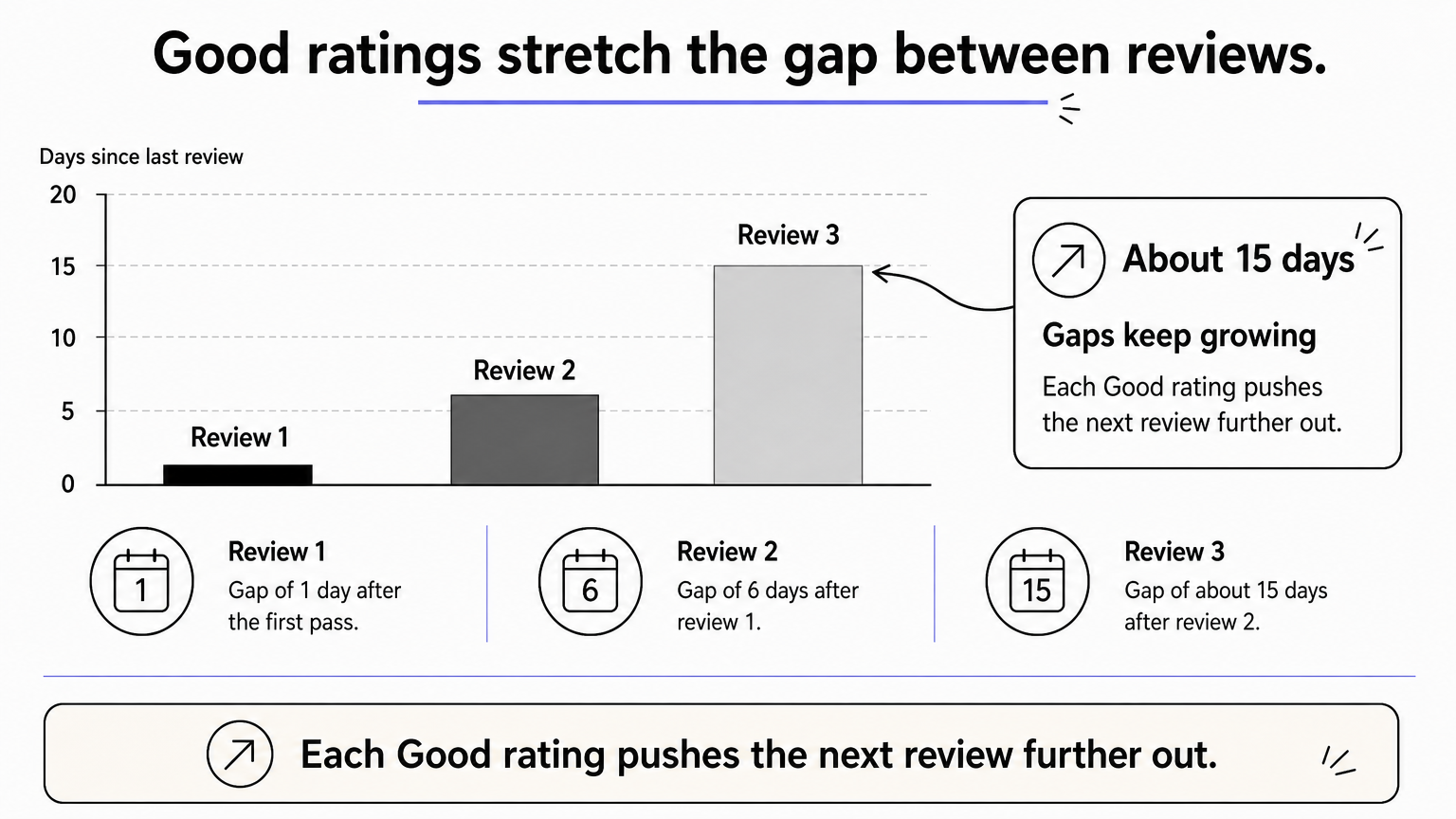
In a classic SM-2 pattern, a card that keeps getting Good comes back after 1 day, then about 6 days later, then roughly 15 days after that. The next table shows that growth for a single card, as an illustration of the principle and not a promise of exact dates in your account:
| Review | Rated | Days since last review | Day count from first pass |
|---|---|---|---|
| First pass | Good | 0 | Day 0 |
| Review 1 | Good | 1 | Day 1 |
| Review 2 | Good | 6 | Day 7 |
| Review 3 | Good | about 15 | About day 22 |
If you rate a card Again at any point, the gap collapses and the card returns soon. That is the system working. You see the weak card often and the solid card rarely.
Work only what is due
Open your daily practice list and work the cards that are due, in the order shown. Suppose you have a 20-minute session and 5 cards are due. Budget about 4 minutes per card, rate each one, and stop. If only 2 are due, you have time left over for whatever your teacher assigned outside the system.
Daily practice notifications from MemoRep help you show up at the same time each day. Short and regular beats long and rare, because the schedule can only space what you actually review.
Trust the list: the card that is due is the card closest to fading.
Step 4. Connect your cards to real playing
Pentatonic practice only pays off when the patterns show up in playing, so add cards that use the scale in context, not just cards that repeat it in isolation. Your teacher or method book supplies the material. You supply the structure.
Add application cards
Ask your teacher for a few short phrases, a backing-track exercise, or a section of a song where the scale is used. Turn each into a card. For example:

- "Phrase from lesson 6, A minor"
- "Backing track from lesson 7, first two choruses"
- "Solo section, song title, bars 9 to 16"
Rate these like any other card. If a phrase is Good in one key and Again in another, you learn exactly where your pentatonic fluency has holes, and the schedule brings the weak one back until it holds.
Add cards slowly and watch your progress
Adding twenty cards in one evening creates a review pile you will resent. Add two or three new cards at a time, and add more only when your daily due list stays manageable. That protects you from decision fatigue, which is how many routines die.
Every few weeks, check your progress view. You are looking for a simple pattern: cards that began as Again or Hard now landing on Good with longer gaps. If a card stays stuck on Hard, take it to your teacher and ask what to change. The schedule can tell you that something is not working. It can't tell you how to fix it.
Progress looks like cards moving from Hard to Good while the gaps between reviews get longer.
Your first week
Start small: pick one key, build four cards from your teacher's material, rate them tomorrow, and let the list tell you what comes next. The goal is not to practice more. It is to stop wasting time deciding, and to stop losing patterns you already worked for.
When you are ready to try the system, try MemoRep and get a free-for-life subscription for a limited time. Build your first pentatonic project, rate honestly, and let the schedule do the remembering.