Guitar Scales Practice Routine: Build One in 4 Steps
A good guitar scales practice routine is a short daily session built from a list of small, separate scale items. Each item comes back for review just before you would forget it. You write the list once, turn every item into a practice card, work through whatever is due today, and rate how each one went. The rating decides when the item returns. That is the whole system, and it works at any level.
Most players don't fail at scales for lack of effort. They fail because the practice has no structure. You play the patterns you know best, skip the ones that feel clumsy, and a week later the keys you ignored have faded. Deciding what to practice eats the first ten minutes, and on some days that decision alone is enough to make you put the guitar down.
This guide shows you how to organize your practice around your scales in four steps. It does not tell you how to play a scale, which fingering to use, or which scales to learn. Your teacher or course covers that. At MemoRep we build spaced repetition schedules for musicians, so the steps below use the same logic. You can run them in a notebook or in the app.
Why scale practice needs a system
A scales routine works when it decides for you what to practice today and when each item returns. Without that, you fall back on habit, and habit favors what you already do well.
Why unscheduled practice fades
Skills fade when you stop revisiting them. This is the pattern behind the Ebbinghaus forgetting curve, and it applies to finger memory as much as to facts. You have felt it: a scale that was solid two weeks ago feels rusty after you spent the time on a new song.
Random practice has the opposite problem. You review items that were already fine and miss the ones about to slip. Reviewing at the right moment is more efficient than reviewing everything every day, and it is what a schedule does for you.
What this routine covers and what it leaves out
This routine covers organization: how you list your scales, how you split them into cards, how long each session runs, and how you decide when an item returns. It does not cover technique or theory. Those instructions come from your teacher, because only a teacher can see how you play and tell you what to change.
A routine decides when you practice each scale. Your teacher decides how.
Step 1. Break your scales into separate items
Start by turning your scale material into a list of small items, where one item is one scale in one position in one key. Small items are easy to schedule, easy to rate, and quick to finish.
Count what you actually have
The number surprises most players. Suppose your teacher has assigned four scales, each in five positions, and you want all 12 keys. That is 4 × 5 × 12 = 240 items. You cannot touch all of them every day, and you shouldn't try. This is why a plain checklist fails and a schedule works.

| Scales | Positions | Keys | Total items |
|---|---|---|---|
| 4 | 5 | 1 | 20 |
| 4 | 5 | 3 | 60 |
| 4 | 5 | 12 | 240 |
Choose a starting batch
Pick one key and list every scale and position in it. In the example above, that is 20 items. Leave the other keys for later. A small batch lets you see the routine work within the first week, and you add new keys as the first batch settles. If you are a beginner with only one or two scales, your list may hold just five or ten items. That is fine.
Step 2. Turn each item into a practice card
A practice card is a short written record of one item, with your teacher's instruction on it and a finish line you set yourself. The card is what the schedule moves around, so it has to be clear enough that you can start without thinking.
What goes on a card
Keep every card in the same format. This template works in a notebook, a spreadsheet, or a note on your phone:

Item: A minor pentatonic, position 3
Source: Lesson 4 with my teacher
Instruction: (copy your teacher's wording here)
Done when: (your own finish line for this item)
Last time: (one line on what felt off)
The instruction line is the important one. Copy it from your teacher's words or your course, and don't invent your own. If you don't have an instruction yet, ask for it at your next lesson. The finish line is whatever you decide counts as a successful pass, so you can rate honestly later.
Name cards so you can find them
Use one naming pattern, such as scale, position, key. A consistent name tells you in one second what the card is. It also lets you sort the list and spot gaps, like a key where you have cards for three positions but not the other two.
A card without a clear instruction and a finish line is only a reminder, and a reminder can't be rated.
Step 3. Build a daily session around due cards
Your daily session should be short, fixed in length, and filled from the cards that are due. A fixed length means you never have to decide how much to do. The schedule tells you which cards, and the clock tells you when to stop.
A 20-minute session layout
Here is a layout for one session. Adjust the minutes to your day, but keep the order.
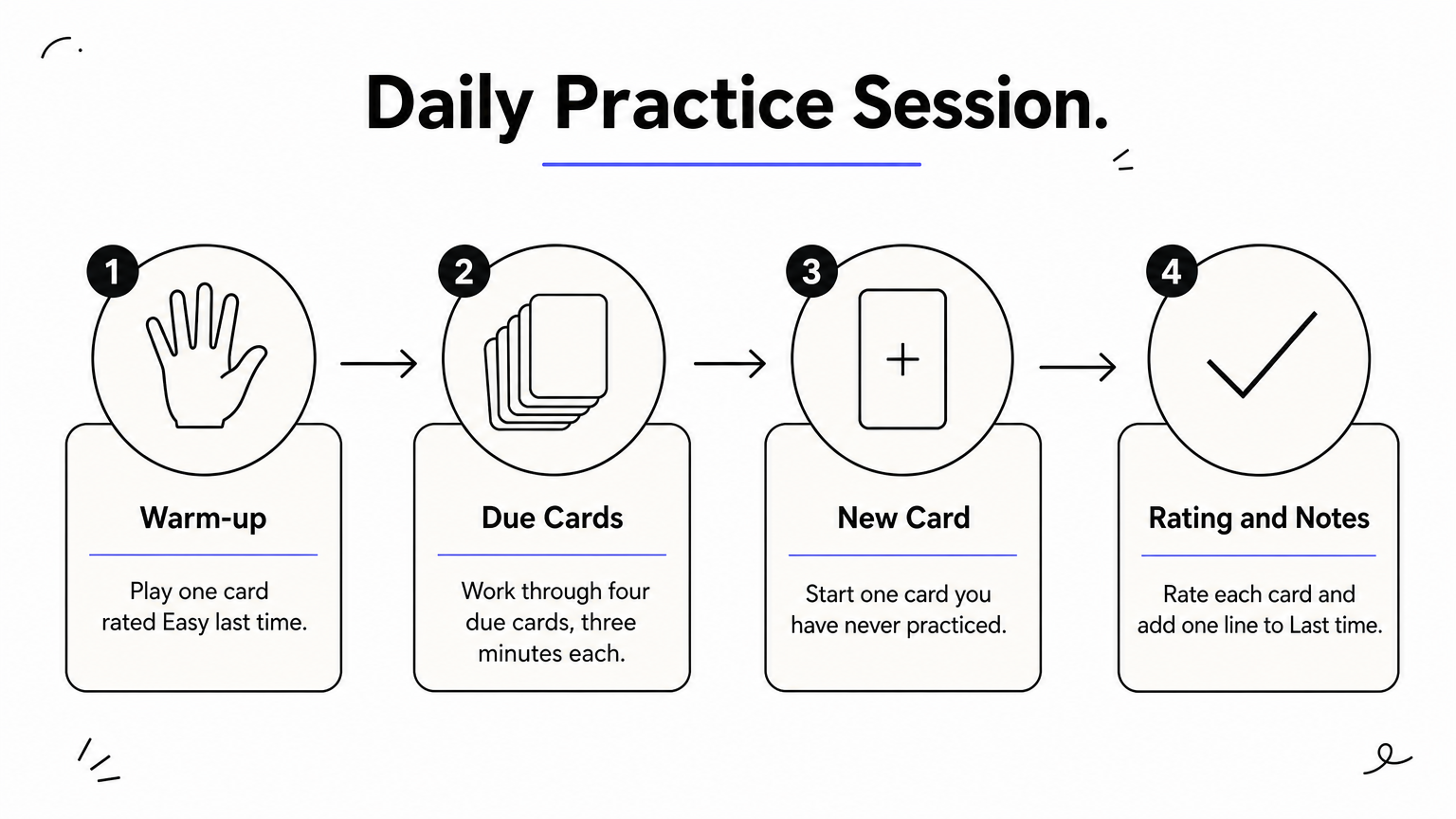
| Block | Minutes | What goes in it |
|---|---|---|
| Warm-up | 3 | One card you rated Easy last time |
| Due cards | 12 | Four due cards, 3 minutes each |
| New card | 3 | One card you haven't practiced before |
| Rating and notes | 2 | Rate each card, add a line to "Last time" |
| Total | 20 |
With one new card per day, the 20 starting cards from Step 1 are all in rotation within about three weeks. Then you can add the next key. Opening with a card you know gets your hands moving without a fight, and ending with notes keeps the schedule honest.
What to do on short days
Some days you have 8 minutes. Don't skip the day. Do the due cards only, starting with the one you rated Hard or Again most recently, and skip the new card. A short session that keeps the streak alive beats a skipped one. Daily reminders help here. MemoRep sends daily practice notifications, and a phone alarm does the same job in a notebook system.
Fix the length of the session and let the due cards fill it.
Step 4. Rate each card and let the schedule adjust
After every pass, rate the card with one of four answers: Again, Hard, Good, or Easy. The rating tells the schedule how soon the card should return, which is how the routine stays matched to what you actually need.
Rate honestly against your finish line
Compare what happened with the finish line on the card, not with how you felt. Use the ratings like this:
| Rating | When to use it | What happens next |
|---|---|---|
| Again | You missed the finish line | The card returns soon |
| Hard | You reached it with effort | The card returns after a shorter gap |
| Good | You reached it as expected | The gap grows at the normal rate |
| Easy | You reached it with room to spare | The gap grows more |
Spaced repetition systems built on the SuperMemo SM-2 algorithm work this way: intervals grow when a card goes well and shrink when it doesn't. Don't rate Good out of politeness. Honest ratings make the schedule useful, and inflated ones push a weak card away before it is ready.
Check your progress once a week
Once a week, look at the whole list. Count how many cards you rated Easy twice in a row, how many keep coming back as Again, and which keys have no cards yet. The Again cards are what to bring to your next lesson, so your teacher can see exactly where you are stuck. When most cards in a batch are steady, add the next key. Progress tracking in MemoRep shows this picture automatically, but a tally in a notebook is enough.
The ratings are only useful if they are true, because the schedule believes them.
Start with ten cards this week
A scales routine comes down to four moves: split your material into small items, write each one as a card with a clear instruction and finish line, run a fixed daily session from the due cards, and rate honestly so the schedule adapts. Technique stays with your teacher. The routine takes care of the rest.
You don't need all 240 cards to begin. Write ten this week, run the 20-minute session for seven days, and look at your ratings. If you would rather have the scheduling handled for you, you can try MemoRep during the free beta and let it tell you what to practice each day.