How to Practice Scales on Bass Guitar Without Getting Bored
To learn how to practice scales on bass guitar in a way that lasts, turn each scale into a small practice card with a clear target, rate how it went, and let a spaced schedule bring it back just before you would forget it. Short daily sessions that rotate through a few cards beat one long run through every scale you know. The routine does the deciding, so you only have to play.
Most bassists run into the same two problems. You play the same scale the same way every day until it feels like a chore, or you drop it for a week and it feels brand new again. Both come from having no system. You open your bass, wonder which key to work on, and pick whatever feels comfortable. The scales you avoid get avoided even more.
This guide covers the practice system: how to split scales into cards, how to set pass rules, how to schedule reviews, and how to add variety. It does not teach fingering, theory, or technique. Your teacher or method book owns those decisions. MemoRep, a spaced repetition practice app, is the example tool for scheduling, but a notebook works if you check it every day.
Why scale practice stalls and what you need first
Scale practice stalls for two reasons: forgetting and boredom. Both are planning problems, not discipline problems, so the fix is a structure that decides what you play today and gives you a reason to play it differently tomorrow.
The two problems a routine has to solve
Forgetting happens when you work on a scale for a few days and then leave it alone. The pattern fades, and you spend the next session rebuilding it. Boredom happens at the other extreme, when you repeat the same pass in the same key at the same speed with no sign of progress.
A good routine fixes both at once. It revisits each scale at spaced intervals, so you rarely relearn from scratch. It also splits the work into pieces with different targets, so each session feels different and you can see movement.
A scale routine fails when you have to decide what to play, not when you lack discipline.
What to have ready before you start
You need very little equipment, but you do need these five things before step 1:
- A source for the scales you are learning, such as your teacher's assignment, a method book, or a tab or PDF you trust
- A metronome or metronome app
- Your bass, tuned and within reach
- A tracking tool, either a practice app or a notebook
- 15 to 20 minutes a day
This guide will not tell you how to finger a pattern or which scales to learn first. If you are a beginner, ask your teacher or follow a method book for that part. Everything below works on top of whatever they give you.
Step 1. Split scales into small practice cards
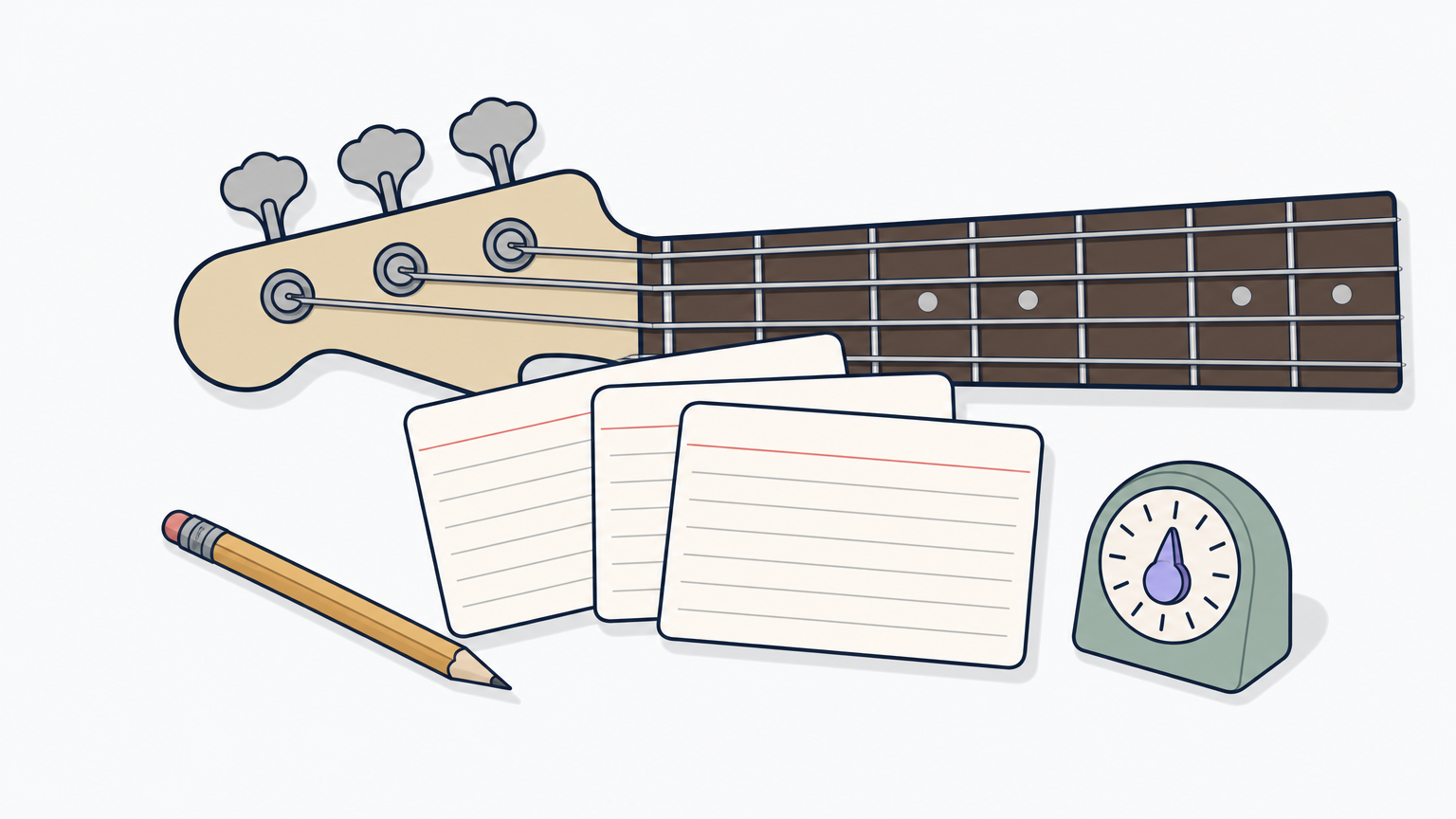
Start by breaking each scale into cards, where each card is one specific task you can finish in about five minutes. A card named "scales" is too vague to rate. A card named "C major, position 1, up and down, 60 bpm" is easy to start, finish, and judge.
Make each card one clear task
Name every card with the same four parts: key, scale, neck position, and tempo target. A consistent name means you never wonder what a card wants from you. It also makes the neck area explicit, so your fretboard coverage grows one card at a time instead of staying stuck in the first few frets.
C major, position 1, up and down, 60 bpm
C major, position 2, up and down, 60 bpm
A minor, position 1, up and down, 60 bpm
Use the positions your teacher or book gives you, and write them in the card title in the same words you would use to find them again. If your source is a tab or PDF, add the page or file name to the card notes so you can find it in seconds.
Start small if you are a beginner
If you are new to bass, resist the urge to build thirty cards on day one. Begin with one scale in one position, and make two or three cards from it. That is enough for a full week of sessions, and it keeps the routine easy to run.
Add a new card only when an existing one starts feeling comfortable. A small deck you review every day builds more than a huge deck you open twice. The number of cards should grow because you earned it, not because you planned it.
One scale in one position, split into two or three cards, is a complete routine for a beginner.
Step 2. Give every card a pass rule
A pass rule is a sentence that defines what "done" means for a card, so rating it takes seconds and stays honest. Without one, you will rate by mood, and mood changes daily.
Write the target on the card
Keep the rule short and measurable. Good examples: "two clean passes in a row at 60 bpm," or "one pass with no stops and no looking at the sheet." Decide what "clean" means with your teacher once, then reuse that definition on every card.
Include the metronome setting in the rule. A tempo number removes the argument about whether a pass felt fast enough. It also gives you something to raise later when the card becomes easy.
Log where you start
Before the first review, record a baseline for each card. Note the tempo at which you currently meet the rule, and the tempo you want to reach. This takes a minute per card and gives you proof of progress weeks later.
| Card | Baseline | Target |
|---|---|---|
| C major, position 1 | 60 bpm | 80 bpm |
| C major, position 2 | 50 bpm | 70 bpm |
| A minor, position 1 | 50 bpm | 70 bpm |
These numbers are only an example. Your own baseline comes from your first honest session, and your teacher can help you pick a realistic target. Raise the target on a card only after you rate it Easy a few times.
A pass rule turns "that felt okay" into a yes or no you can rate in seconds.
Step 3. Schedule reviews with spaced repetition
Spaced repetition brings each card back just as you are about to forget it, which is when a review does the most work. This is why a scheduled routine beats playing everything every day, and why it keeps the total time per session small.
Let the forgetting curve set the order
The idea goes back to Hermann Ebbinghaus, who measured how quickly memory fades without review. Each successful review pushes the next one further out. MemoRep builds on that with the SuperMemo SM-2 algorithm, schedules each practice card for when a skill is ready for another pass, and sends a daily notification so you know what is due.
You no longer choose which scale to play. You open the app, see today's cards, and play them. That removes the decision fatigue that kills most routines before the scales do.
Rate each card honestly
After each card, rate it. The rating is the signal that tells the schedule how to space the next review.
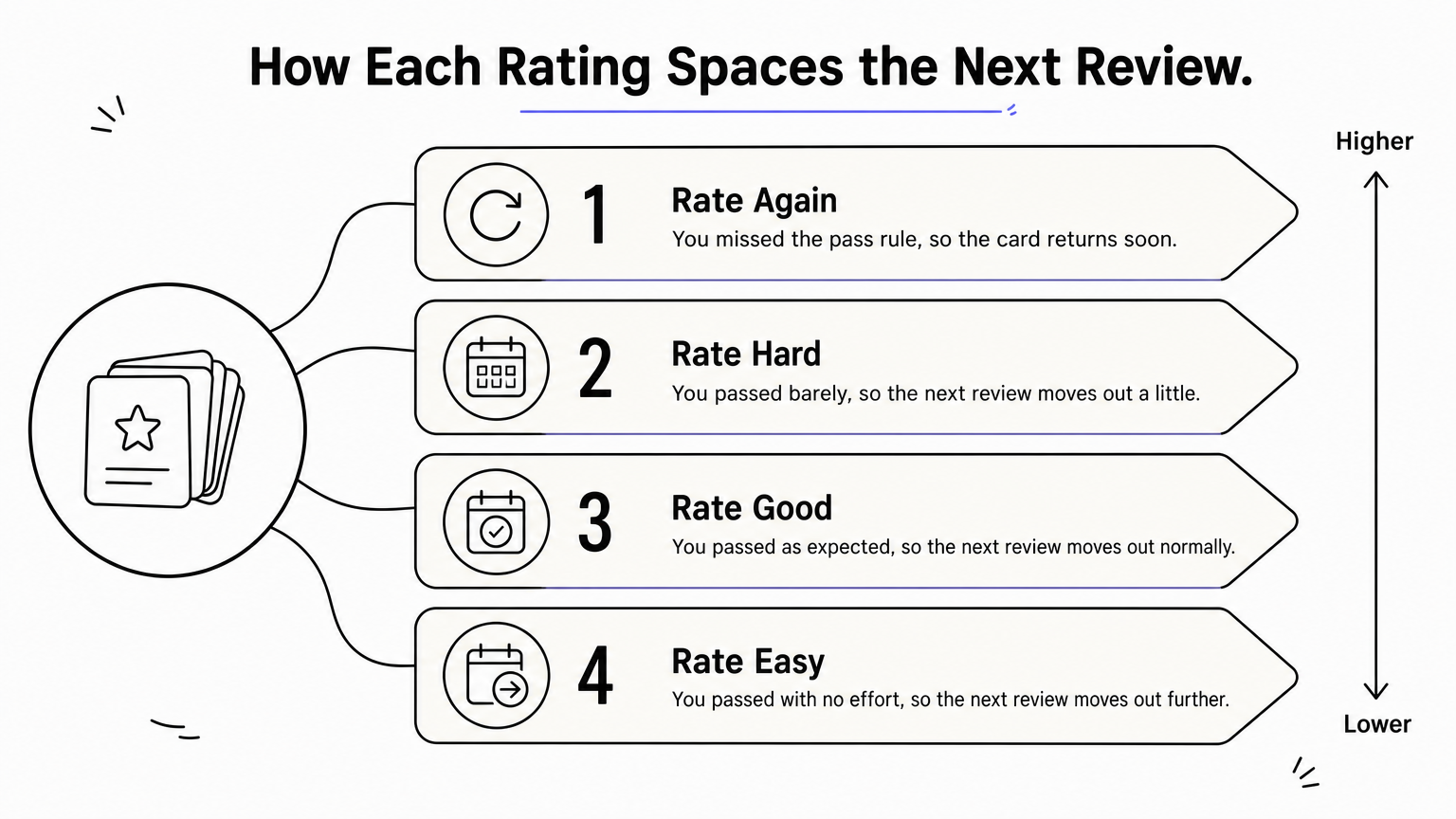
| Rating | Use it when | What the schedule does |
|---|---|---|
| Again | You missed the pass rule | Brings the card back soon |
| Hard | You passed, but barely | Moves the next review out a little |
| Good | You passed as expected | Moves the next review out normally |
| Easy | You passed with no effort | Moves the next review out further |
Here is a worked example. Say your deck holds twelve cards, but only four are due today. At five minutes each, your session is 20 minutes. Tomorrow a different mix is due, and the card you rated Again comes back sooner than the rest. Twelve cards never means twelve tasks in one day.
Rate the card you actually played today, not the one you hope to play next week.
Step 4. Add variety and tie scales to songs
Variety keeps the routine fresh without breaking the schedule, because each variation becomes its own card with its own rating. Instead of changing how you play one card until it feels different, you add a new card and let the schedule handle it.
Make each variation its own card
Ask your teacher for variations that suit your level. Common categories include different note groupings, playing along with a backing track, working in a new key, or running the same scale in another neck position. Each one gets a card with a clear name and a pass rule.
C major, position 1, with backing track, 70 bpm
G major, position 1, up and down, 60 bpm
This is how you practice scales on bass guitar without getting bored. The notes stay familiar while the task changes, and every new card has its own tempo target to beat. You never need to invent a new exercise on the spot.
Link scales to a bass line you care about
A scale feels pointless until you hear it in a song. Add a card for a section of a bass line that uses the scale you are working on, and give it a pass rule like "play the verse with no stops at 80 bpm." That connects practice to music.
Keep these song cards in the same deck as your scale cards. Then a session might run two scale cards and one song card, which ends the 20 minutes on actual music. Once a week, glance at your baselines and targets, raise a tempo on any card you keep rating Easy, and retire cards you no longer need.
Every variation and every song passage is a new card, so the schedule does the varying for you.
Keep the routine simple and let it run
Practicing scales on bass is a planning problem before it is a playing problem. Split each scale into small cards, give every card a pass rule, rate each review honestly, and let a spaced schedule decide what comes next. Add variation cards and song cards when the basics feel solid, and you will always know what to play and why.
You can run this system in a notebook, but an app removes the daily bookkeeping. If you want the scheduling handled for you, try MemoRep free while the beta is open. Build your first three scale cards today and play whatever comes due tomorrow.