How to Practice Scales on Guitar and Actually Remember Them
Here is the short version of how to practice scales guitar players actually retain: break each scale into a small practice item, log the metronome tempo where it felt clean, rate the session, and let a spaced schedule decide when that item comes back. Your teacher or method book decides which scales and fingerings to play. Your job is to organize the practice around them so nothing fades.
Most players who struggle with scales do not lack effort. They run into three problems. They play the same favorite pattern every day and ignore the rest. They practice a new scale hard for a week, then drop it and find it gone a month later. Or they spend the first ten minutes of every session deciding what to work on. Each of these is a scheduling problem, not a talent problem.
This guide shows how to practice scales on guitar as a system you can run in four steps: define your practice items, record a tempo baseline, space your reviews, and keep the routine fresh. MemoRep is built around this approach to practice management, so some examples refer to it. We never tell you what to play or how to play it. We help you decide what to practice next and when.
Why scales fade without a schedule
Scales fade because you stop revisiting them at the right moments. A scale you practiced intensely last month will feel rusty today if nothing brought it back in between. That is a memory problem, and memory problems respond to scheduling.
Scales are a retention problem
Hermann Ebbinghaus described the forgetting curve in the 1880s. Memory of something you learned drops quickly at first, then levels off. A review just before the drop resets the curve and flattens it, so the next gap can be longer. Psychologists call this the spacing effect.
For guitarists, this explains the "I knew this last spring" feeling. Playing a scale ten times in one sitting builds short-term familiarity. Returning to it on day 1, day 6, and day 15 builds the kind of recall that survives a busy month.
A scale you practice once in a marathon fades faster than a scale you touch briefly at the right intervals.
What this guide covers and what it leaves to your teacher
This guide covers organization only. It does not teach fingerings, picking, posture, or theory, because those depend on your hands, your level, and your goals. A teacher can watch you play and correct what you cannot hear yourself. If you do not have one, a reputable method book or course can supply the content.
What you bring to the system is a list of items to practice. Everything after that, the tempo log, the ratings, the intervals, is bookkeeping that tells you what to open the guitar and work on today.
Step 1. Break scales into practice cards
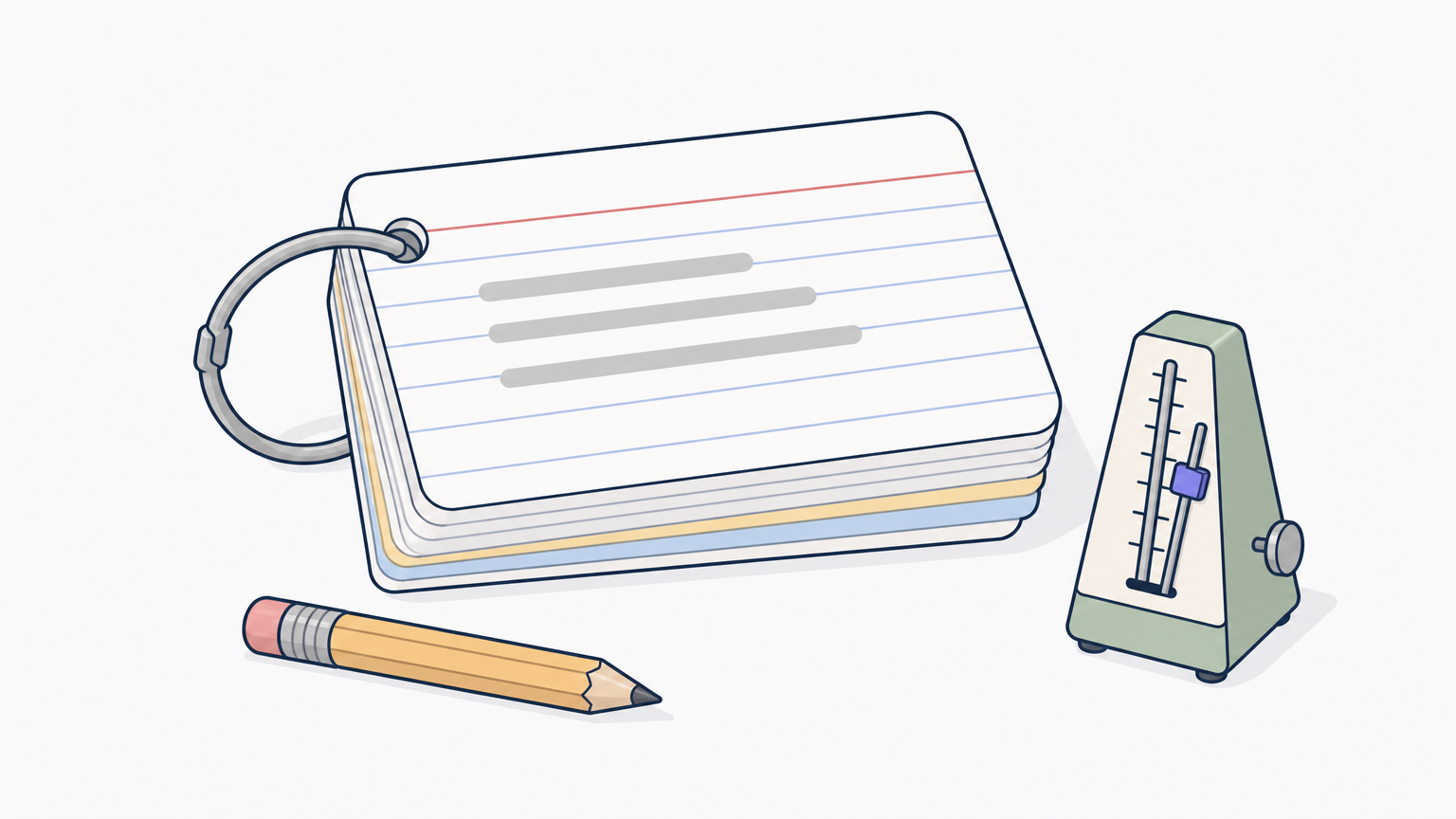
The first step in how to practice scales on guitar is to stop treating "scales" as one task. Split your scales into small, separately trackable items, one per card, so each can be scheduled on its own.
Define one item per card
A good card is specific enough that you know when it is done. "Practice major scale" is too broad. "G major, the position my teacher assigned, ascending and descending" is a card. Different positions, keys, and variations your teacher gives you should each get their own card, because you will remember some better than others.
This matters most for memorizing fretboard patterns. If you only track the scale as a whole, your strong position hides your weak one. Separate cards expose the weak ones and bring them back more often.
A card template you can copy
Use the same fields every time. Fill the brackets from your teacher's instructions.
Card: [Scale name and key]
Area: [Position or region of the neck, as assigned]
Task: [Exactly what your teacher asked you to play]
Target tempo: [Metronome number you are working toward]
Last clean tempo: [Number from your last session]
Notes: [Anything your teacher flagged]
Keep the "Task" field copied from your teacher's words, not your own interpretation. That keeps your cards aligned with the instruction you paid for.
Step 2. Set a tempo baseline and rate each session
Record the metronome number at which you played the card cleanly, then rate how the session felt. A tempo log turns "I think I'm improving" into a number, and a rating tells the schedule how soon to bring the card back.
Log the metronome number
Practicing with a metronome is the most common advice for scales, and for good reason: it gives you an objective reading. At the end of each session, write down the highest setting where you played the card as your teacher defined "clean." Do not log the tempo you attempted. Log the tempo you achieved.
After a few weeks you will see which cards climb and which stall. A card stuck at the same number for three sessions is worth showing your teacher, because it may need different instruction rather than more repetition.
Rate honestly with four buttons
A simple rating keeps the system fast. Use four options, the same ones MemoRep uses.
| Rating | What it means | What happens next |
|---|---|---|
| Again | You could not play it cleanly | Card returns very soon |
| Hard | You got through it, with effort | Short interval |
| Good | You played it as expected | Normal interval |
| Easy | It felt effortless | Long interval |
Rate the scale, not your mood. If you hit your target tempo but it felt shaky, that is Hard. Honest ratings are what make the schedule work.
The rating is the only feedback the schedule gets, so an inflated rating schedules your practice wrong.
Step 3. Let spaced intervals set the schedule
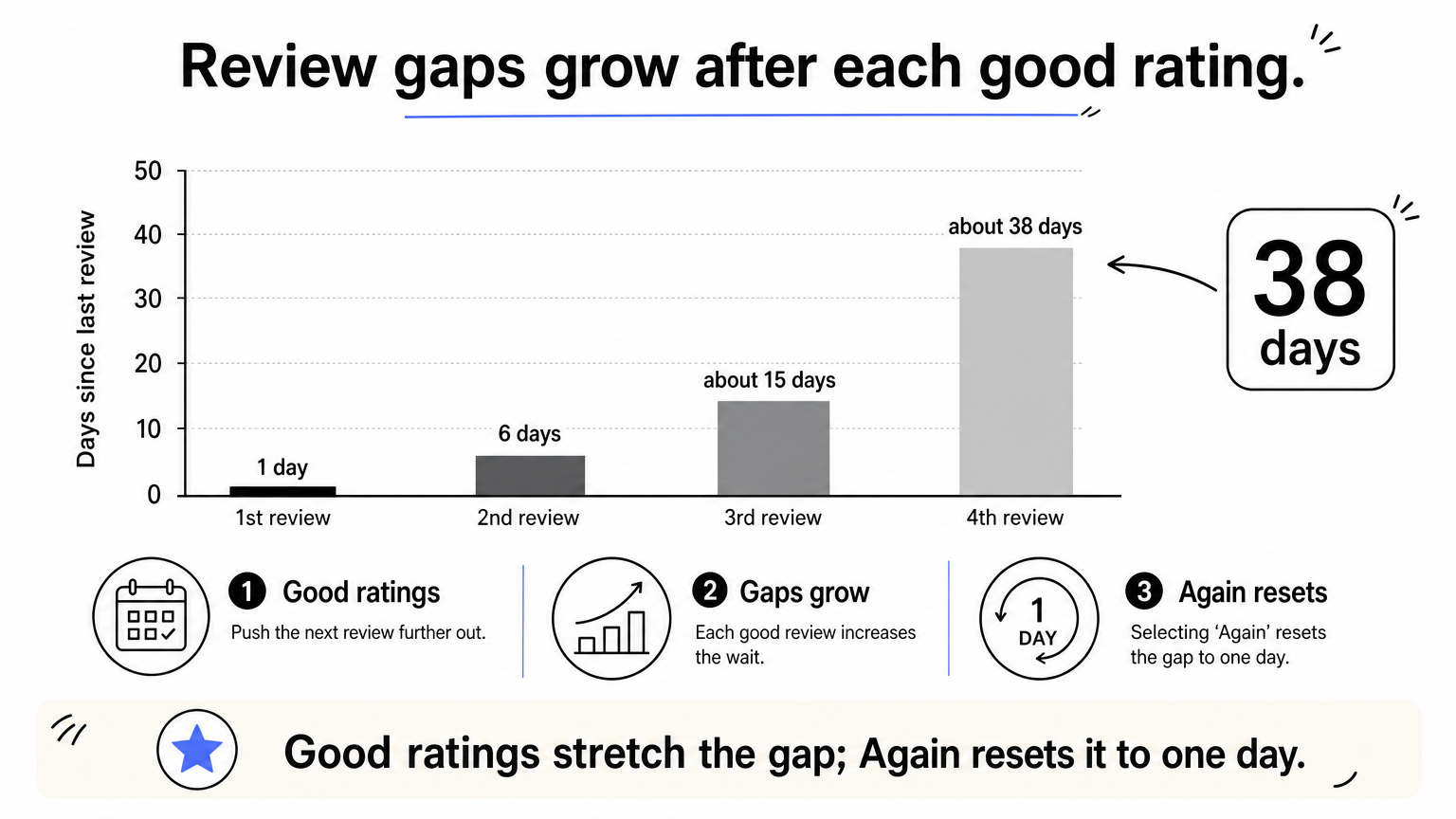
Each time you rate a card, the gap before its next review should change. Good ratings lengthen the gap, and poor ratings shorten it. This is how you practice scales on guitar without re-drilling what you already know.
How the intervals grow
The SuperMemo SM-2 algorithm, which MemoRep builds on, uses a simple pattern in its original form. The first review comes after 1 day, the second after 6 days, and each later gap is the previous gap multiplied by an ease factor that starts at 2.5. A failed review resets the card to the short gaps.
| Review | Gap before it | Total days since learning |
|---|---|---|
| 1st | 1 day | 1 |
| 2nd | 6 days | 7 |
| 3rd | about 15 days | about 22 |
| 4th | about 38 days | about 60 |
Within two months, a card you keep rating Good appears four times. You are practicing it for a few minutes on those days, not for an hour every day. The saved time goes to the cards that need it. You can read how this works inside the app on the MemoRep science page.
Build a session from due cards
Each day, you open the cards that are due and practice only those. If five cards are due, your session is five cards. If twelve are due and you only have twenty minutes, do the ones rated Again or Hard first and let the rest slide a day.
This removes the decision fatigue of choosing what to practice. A scheduling tool does the picking, and you spend your attention playing.
When the schedule picks what to practice, your session time goes to practice instead of deciding.
Step 4. Keep scale practice from getting boring
Scales feel boring when every day looks the same. A spaced schedule fixes much of that automatically, because no scale appears every day, and the cards that do appear change from session to session.
Let due dates create variety
A fixed routine of the same scale in the same order repeats until it feels like a chore. With cards, Monday might bring two scales and a position that has been waiting two weeks, while Tuesday brings one scale and nothing else. The variety comes from the intervals, not from willpower.
You can also place scale cards next to repertoire cards in the same project. A short scale item before a song you are learning keeps scales connected to music you care about.
Ask your teacher for variety, then card it
Boredom is also a signal that you may be ready for a new task. Ask your teacher for new variations, applications, or exercises on scales you already know. Each new item becomes a new card with its own tempo and rating.
Here are practical ways to keep the routine interesting without changing technique on your own:
- Cap scale practice at a fixed number of minutes so it never crowds out playing.
- Check your progress charts weekly. Seeing tempo numbers rise is motivating.
- Retire cards your teacher says you have finished with.
- Add one new card at a time, so the schedule never overwhelms you.
A scale routine stays interesting when the schedule changes each day and you can see your own progress.
Start your scale schedule
Knowing how to practice scales on guitar comes down to structure. Split scales into specific cards, log the tempo you actually reached, rate each session honestly, and let spaced intervals decide what returns and when. Your teacher supplies the content. The system makes sure none of it fades.
Start small. Pick three scale items from your current lessons, write them as cards, and run the system for two weeks. You will quickly see which items need attention and which can wait.
If you would rather not manage intervals by hand, try MemoRep and get a free-for-life subscription while the limited beta lasts. It schedules your practice cards, tracks your ratings, and tells you what to work on next.