7 Ways to Practice Fingerstyle Guitar Without Wasting Time
The best way to approach how to practice fingerstyle guitar is to stop treating practice as one long session and build it from small, repeatable pieces: a few right-hand drills, short daily blocks, and a schedule that brings each drill back before you forget it. Spaced cards suit players who juggle many drills and songs. A five-minute daily block suits beginners with little time. Section-by-section learning suits anyone chasing a specific piece. A tempo ladder and a recording habit suit players who want proof of progress.
The usual problem is not a lack of exercises. Search for fingerstyle drills and you will find dozens of rolls, patterns and warm-ups. Most beginners pick a handful, play them until they feel bored, and then jump to something new. Two weeks later the first drills have gone rusty, and you cannot tell what to work on next.
This article covers the structure around your practice, not the playing technique itself. How your fingers should move is a question for your teacher or a trusted lesson source. What follows is seven ways to organize that material so each drill gets the right amount of attention at the right time.
1. Spaced repetition practice cards
Spaced repetition practice means turning each drill or song section into a card and revisiting it just before the skill fades. It is the most hands-off way to decide what to play each day, and it is what MemoRep is built for.
How it works
You play a card, then rate it Again, Hard, Good or Easy. The rating tells the scheduler how the drill felt, and it brings the card back when you are due another pass. The idea comes from the Ebbinghaus forgetting curve, and MemoRep applies the SuperMemo SM-2 algorithm to practice cards instead of flash-cards. You never track intervals yourself. You open the app, see today's cards, and play them.
Rate honestly, because the schedule is only as good as the feedback you give it.
How to set it up
MemoRep schedules and tracks your practice. It does not teach you what to play, so you bring the drills from your teacher, a book or a lesson series. Then:
- Create a project called "Fingerstyle."
- Add one card per drill, such as a roll exercise or a bass-and-melody pattern.
- Add one card per section of any song you are learning.
- Name cards specifically, with the chord and target tempo, so you know what you are doing.
- Turn on daily practice notifications.
Keep each card small enough to finish in a few minutes. A card that says "fingerpicking" is too vague to rate.
Who it suits
This approach fits players with more than four or five items in rotation. It also fits anyone who loses time every session deciding what to practice, or who finds old drills have gone rusty. If you only have one drill and one song, a plain timer does the job.
2. A five-minute daily right-hand block
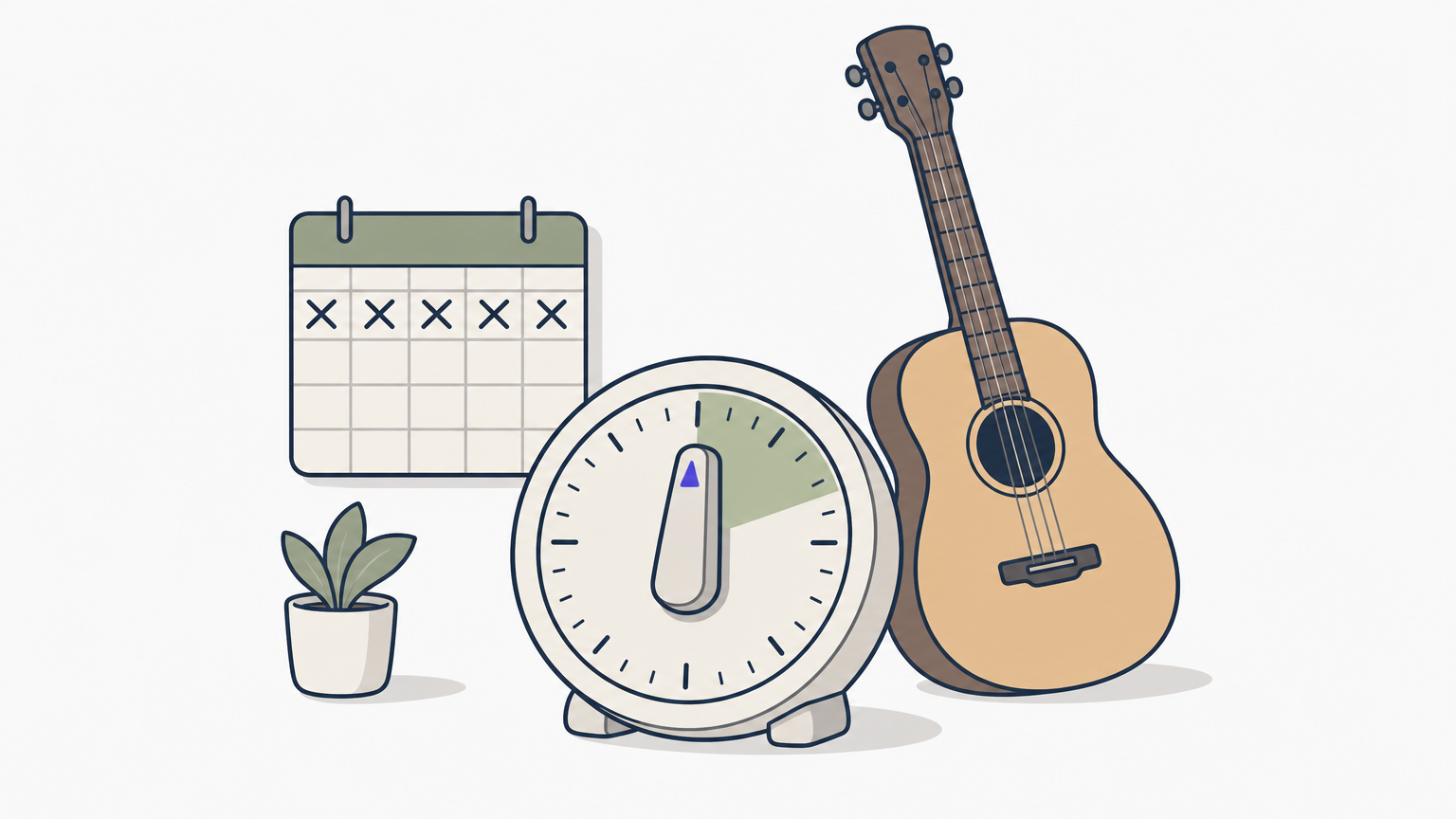
A five-minute daily block means picking one right-hand drill and playing only that drill for five minutes, every day. It works because it is easy to start, so you actually do it.
How it works
Short daily contact keeps the drill fresh and gives you many small repetitions across a week. Five minutes also lowers the barrier. You do not need to warm up for half an hour or clear your evening. Most players who say they "can't find time to practice" can find five minutes.
The block is not meant to be your entire session. Think of it as a floor. On days when you have more time, you can add other items from this list on top. On days when you have none, you still did the block.
How to set it up
Keep the rules simple:
- Choose one drill before you pick up the guitar.
- Set a timer for five minutes.
- Stop when the timer ends, even if you feel good.
- Mark the day on a calendar or in your practice app.
Stopping on time matters more than it sounds. It keeps the habit light, and it leaves you wanting to come back tomorrow.
Who it suits
This is the best first step for complete beginners and for returning players with an unpredictable schedule. It also helps anyone who has tried and abandoned an ambitious practice plan. If you already practice 45 minutes daily without trouble, you can skip this and use it only as a minimum on busy days.
3. One variable at a time
Changing one variable at a time means each session alters only the pattern, or only the chord, or only the tempo, never all three at once. It helps you see exactly what is causing trouble.
How it works
When a drill falls apart, it is hard to know why. Maybe the pattern is new, the chord change is awkward, or the tempo is too fast. If you changed all three, you cannot tell. Holding two steady and moving one gives you a clear signal. When the drill breaks, you know where to look.
How to set it up
Plan a short run of sessions where each one changes a single thing. A simple example looks like this:
| Session | Pattern | Chord | Tempo |
|---|---|---|---|
| 1 | New | Familiar | Slow |
| 2 | Same | New | Same slow tempo |
| 3 | Same | Same as session 2 | One step faster |
Write each plan on its card or in a notebook before you start. Your teacher can tell you which patterns and chords to use. You only need to decide what stays fixed.
Who it suits
This suits players who feel stuck or frustrated when a new drill "just doesn't work." It also suits students who change patterns, chords and speed all at once and then feel lost. If you already diagnose problems quickly, you can use it only for new material.
4. A tempo ladder with a metronome
A tempo ladder is a written list of speeds for one drill, climbed one rung at a time. It turns "get faster" into a visible set of steps.

How it works
Pick a starting tempo where the drill feels clean and a target tempo you want to reach. One lesson source suggests playing its forward-roll exercises smoothly at 100 BPM before moving on, which makes a reasonable example target. Between them, set small steps. From 60 to 100 BPM in steps of 5 gives you nine rungs, which is eight moves up. You only climb after the drill feels solid at the current rung.
A ladder replaces the vague goal of playing faster with a number you can check off.
How to set it up
Write the ladder on the drill's card. Then follow a simple rule, for example: move up only after rating the drill Good twice in a row at the current tempo. If a rung rates Hard, stay there or drop one step. Dropping back is not failure. It is the system working.
Log the date you reach each rung. After a month you will have real evidence of how fast you progress, which is more motivating than guessing.
Who it suits
It suits players who already own a metronome or app and want measurable progress. It also helps if you tend to rush, because the ladder discourages jumping ahead. Players working on slow, expressive pieces can use it only for their technical drills.
5. Learn songs in short sections
Learning a song in sections means splitting it into short phrases, practicing each one separately, and joining them later. It is the most natural way to practice a piece instead of a drill.
How it works
A full piece contains easy and hard parts. If you always play from the top, you spend most of your time on the parts you already know and almost none on the one passage that keeps breaking. Treating each phrase as its own item lets the hard parts get the repetitions they need.
Most players find that two to four bars is a workable size, though your teacher may suggest something different for your piece. If a section still feels too big, make it smaller.
How to set it up
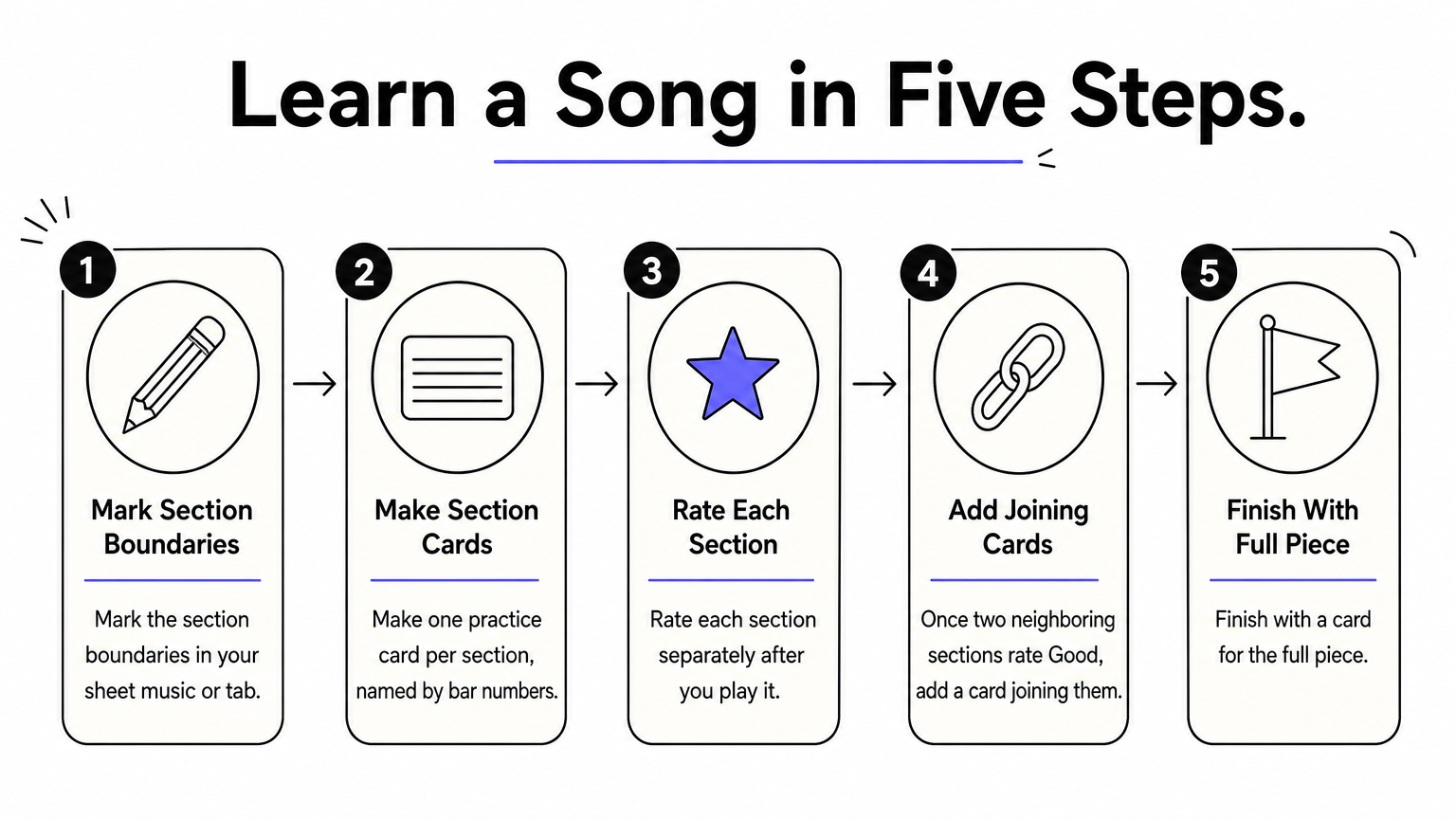
Follow this order:
- Mark the section boundaries in your sheet music or tab.
- Make one practice card per section, named by bar numbers.
- Rate each section separately after you play it.
- Once two neighboring sections both rate Good, add a card that joins them.
- Finish with a card for the full piece.
The joining cards matter. Many players learn sections well and then stumble at the seams.
Who it suits
This is ideal for anyone learning a specific piece, from a simple song to a classical study. It is less useful for pure technique drills, which are already short. If you play only by ear and never use notation, name sections by their lyrics or position in the song.
6. Rotate drill categories across the week
Rotating categories means giving each type of drill its own day instead of squeezing everything into every session. It keeps practice varied and makes sure nothing gets ignored.
How it works
Fingerstyle includes several families of material, such as forward rolls, Travis-style patterns, arpeggio patterns and percussive effects. If you practice whichever feels most fun, the others fade. A weekly rotation gives each family regular attention with no daily guesswork. Confirm with your teacher which categories fit your level, and drop any that do not.
How to set it up
Here is a sample week of 15-minute sessions, six days at 15 minutes for 90 minutes total:
| Day | Focus | Minutes |
|---|---|---|
| Monday | Forward rolls | 15 |
| Tuesday | Travis-style patterns | 15 |
| Wednesday | Arpeggio patterns | 15 |
| Thursday | Review your weakest card | 15 |
| Friday | One section of your current piece | 15 |
| Saturday | Free play-through of songs you enjoy | 15 |
Sunday is a rest day. Swap categories to match your own material. If you use a scheduling app, the rotation can happen automatically, since cards come due on different days.
Spreading categories across the week beats cramming them all into one long session.
Who it suits
This suits players with three or more types of material to maintain, and those who notice that one area is always neglected. If you are a beginner with a single drill, start with the five-minute block instead and add rotation later.
7. Record and rate every session
Recording yourself means capturing 30 to 60 seconds of each drill on your phone, listening back, and rating the result. It gives you the outside view that you cannot get while playing.
How it works
While you play, you focus on your hands. When you listen back, you hear the result. Many players are surprised by what they find: drifting tempo, a restart, a note that did not sound. Recording also builds a dated archive, so you can compare this month with the month before. It does not replace a teacher, who can tell you what to change. It only shows you what happened.
How to set it up
Keep the process light:
- Record one take, not five.
- Ask three questions: Did I stay in time? Did I stop and restart? Did I reach my target tempo?
- Give the take a rating: Again, Hard, Good or Easy.
- Save it in a folder named by date.
Share a recording with your teacher whenever you can. Their feedback tells you what to practice, and your log tells you how you did.
Who it suits
It helps self-taught players who have no one to listen to them. It also helps students between lessons who want to bring something concrete to the next one. If recording makes you tense, start by recording only once a week.
Start with one routine
Good fingerstyle practice rests on small units, regular timing and honest feedback. Spaced cards decide what you play and when. The five-minute block keeps you consistent. One-variable changes, a tempo ladder and section-by-section learning make each session more focused. Weekly rotation covers every type of material, and recordings show you whether it is working.
You do not need all seven. Pick the one that solves your biggest problem today, run it for two weeks, and add a second only when the first feels easy. If you want the scheduling handled for you, set up your first fingerstyle practice cards in MemoRep and let it tell you what to play each day.