Active Recall vs Passive Recall: Differences and Examples
You sit down to study, reread your notes, and everything feels familiar. Then you try to use the material and it is gone. That gap is the core of active recall vs passive recall, and it explains why some hours of study stick and others vanish by the weekend.
Here is the short answer. Passive recall means taking information in again: rereading, highlighting, or watching a lecture a second time. Active recall means pulling information out of memory without looking, like answering a question or reproducing something from scratch. Research on the testing effect, including work by Roediger and Karpicke, shows that active retrieval produces stronger long-term retention than restudying, even though it feels harder.
Below, you will find clear definitions, side-by-side examples of each method, and what the evidence says about when each one is worth your time. We also cover how timing changes results, which is why we built MemoRep around spaced retrieval for practical skills like music, where recalling and performing matter more than recognizing.
Why the difference between active and passive recall matters
Both methods feel like studying, so the gap between them is easy to miss. It shows up later, when you need the material and your memory either responds or does not. Understanding active vs passive recall helps you spend your hours where they actually pay off.
Why passive review feels productive
Rereading is easy because the answer sits right on the page. That ease creates the illusion of knowing, where recognizing something gets mistaken for being able to produce it. It is why you can feel completely ready and still blank on the test.
Active recall removes that illusion. When you try to answer first, you discover what you really know before the stakes are real.
Recognizing an answer is not the same as being able to produce it.
What each method does to memory
Retrieval does more than check your memory, it changes it. Every successful pull from memory strengthens the path to that information, while passive review adds exposure without the effort of retrieving.
| Passive recall | Active recall | |
|---|---|---|
| Effort | Low | High |
| How it feels | Smooth and familiar | Difficult and effortful |
| Reveals gaps | Rarely | Immediately |
| Long-term retention | Weaker | Stronger |
The effortful feeling is not a sign that something is wrong. It is the signal that the memory is being built.
How to move from passive review to active recall
You do not have to throw out your notes. You only have to change the order. The shift is small: try first, then check, every time.
Turn review into a self-test
Close the material and ask what it said. This turns review into a test you run on yourself, and the gaps show up at once.
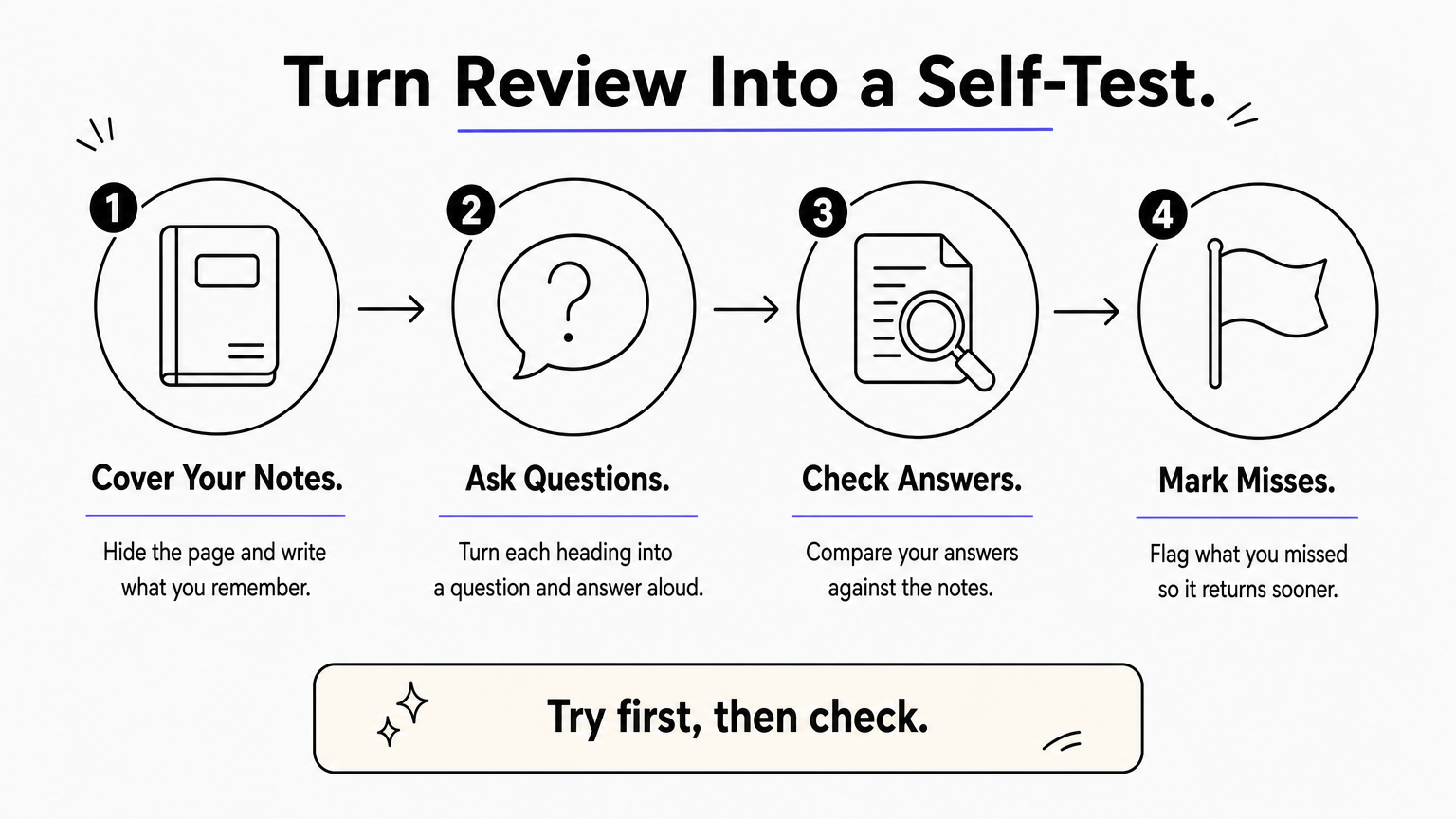
- Cover your notes and write down everything you remember.
- Turn each heading into a question and answer it aloud.
- Check your answers against the notes, then mark what you missed.
Always attempt the answer before you look at it.
Make retrieval repeat
One attempt is not enough. Return to the same material after a day, then a few days, then a week. Each visit should start with retrieval, not rereading.
Anything you missed should come back sooner, while what you nailed can wait longer. That is how spaced repetition works, and it keeps your effort focused on weak spots instead of on what already feels easy.
Examples of active recall and passive recall side by side
Seeing active recall vs passive recall in the same situations makes the difference concrete. Each pair below covers identical material, but only one half makes you retrieve it yourself.
Everyday study examples
| Task | Passive recall | Active recall |
|---|---|---|
| Textbook chapter | Rereading and highlighting | Closing the book and writing a summary from memory |
| Vocabulary | Reading the word list again | Covering the translations and producing each one |
| Lecture | Rewatching the video | Pausing to predict the next point |
| Exam prep | Skimming old answers | Taking a practice test with no notes |
The active column is harder in the moment. That is the point, because the struggle is what exposes your gaps.
Examples from practical skills
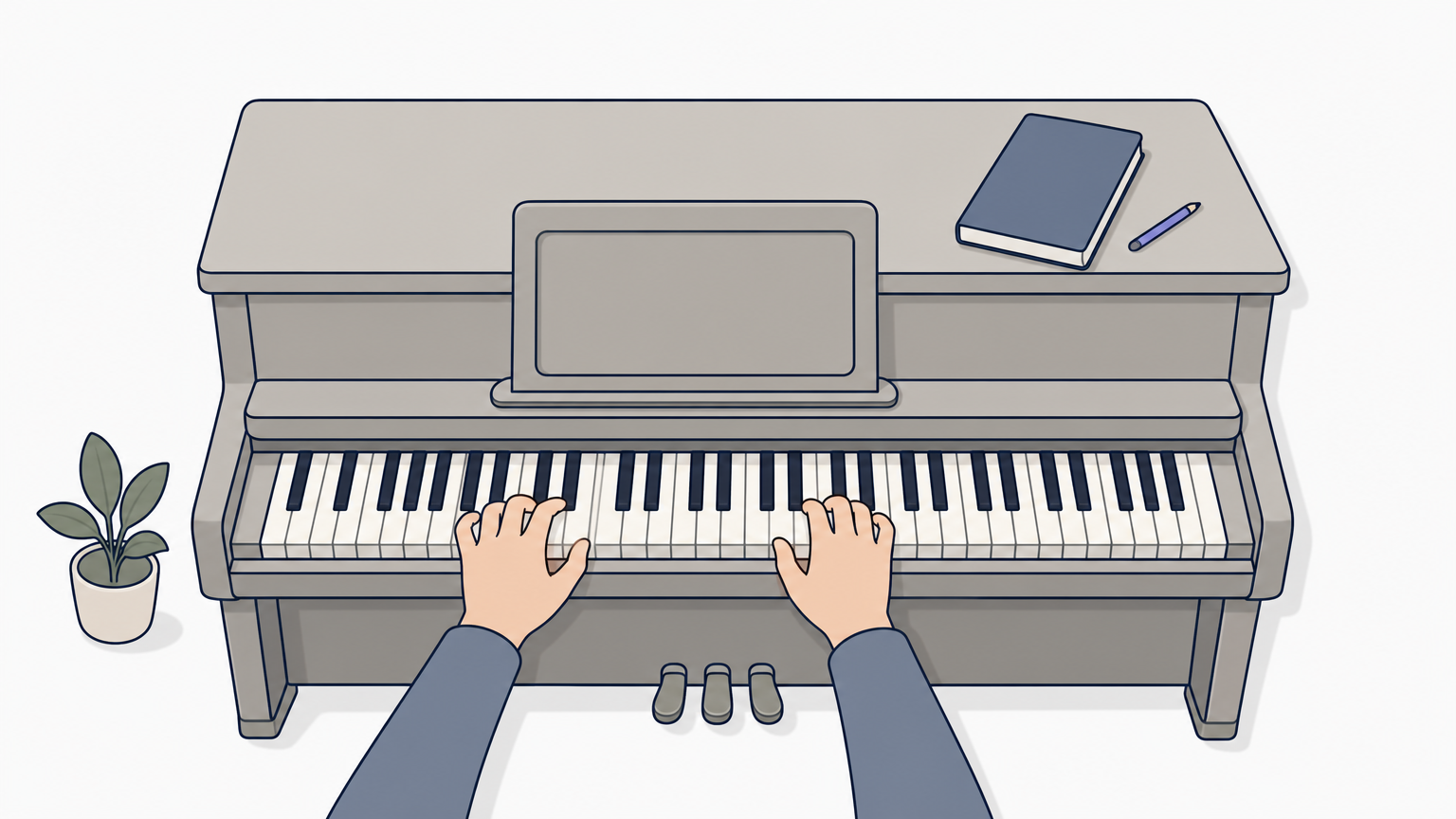
Now take a pianist with a piece learned last month. Passive review means listening to a recording or reading through the score. Active recall means playing it from memory with no score, then noting where you stalled. The same split applies to a drill, a chord progression, or a certification procedure: doing it cold beats looking it over.
If you can only succeed with the answer in view, you have not recalled it yet.
What the research says about long-term retention
The testing effect in action
In a 2006 study, Roediger and Karpicke had students read short passages, then either restudy them or take recall tests. After five minutes, restudying looked better. After one week, the result flipped: tested students remembered about 56 to 61 percent, while rereaders kept only 40 percent.
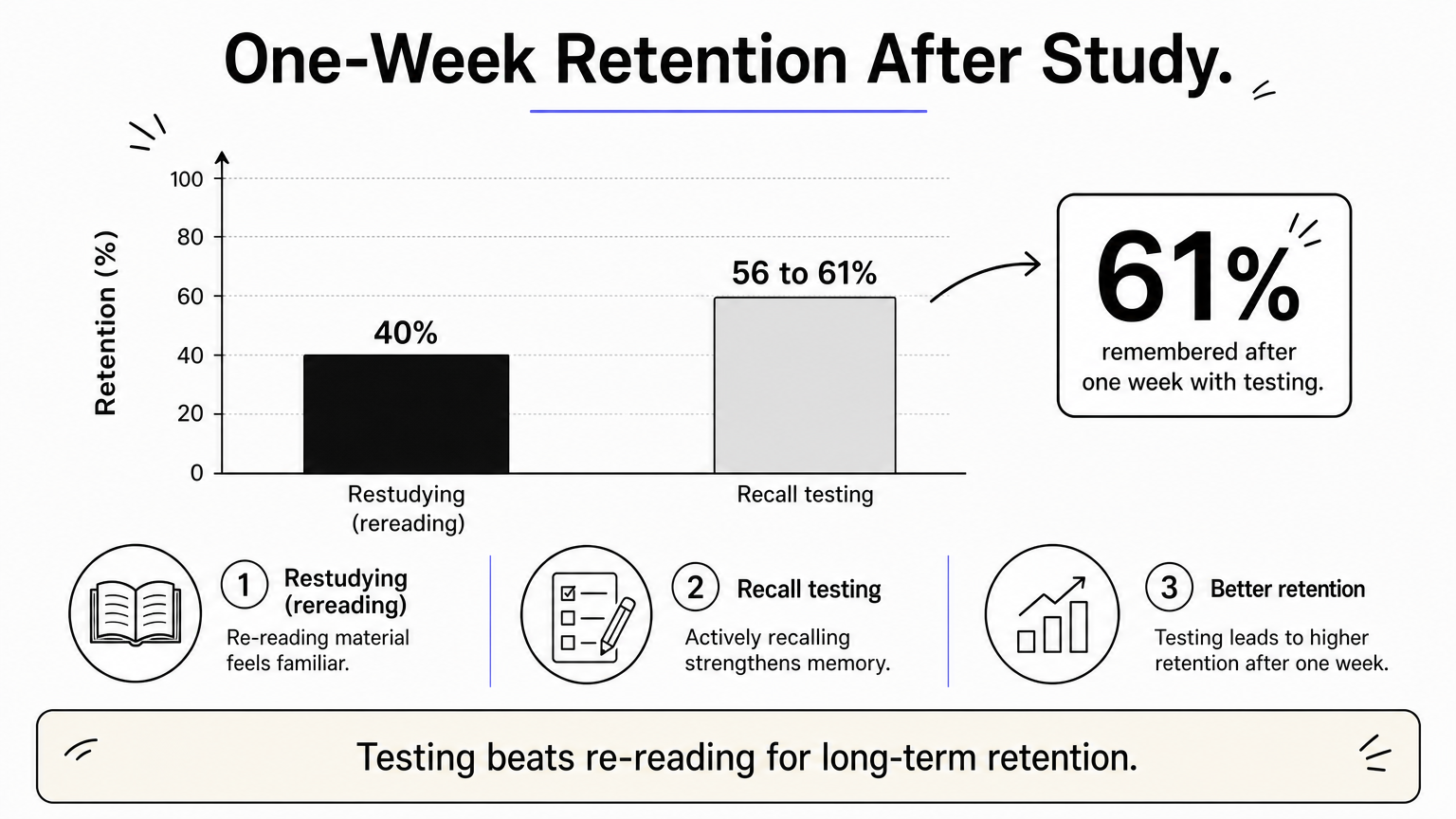
Rereading helps you tonight, but retrieval helps you next month.
How it compares with other study methods
A 2013 review by Dunlosky and colleagues rated ten common techniques. Practice testing and distributed practice earned the highest utility scores. Highlighting and rereading ranked near the bottom, which fits the wider pattern in active recall vs passive recall research.
Later work by Karpicke and Blunt in 2011 found that retrieval practice beat concept mapping on a delayed test. Mapping feels active, yet retrieval itself is what drove the gain, and spacing the attempts makes the benefit last longer.
Active recall for practical skills and practice routines
Retrieval applies to skills too
Most studies use facts, but the logic carries over to anything you perform. In active vs passive recall terms, watching a demonstration or scanning your materials is passive. Performing without a cue is active.
A skill you can only perform with a cue in view is not yet yours.
Your stall point is useful data. Mark it, and that item should come back sooner than the ones you nailed.
Let a schedule decide
Skills fade at different speeds, so a fixed weekly rotation wastes time on solid items while others slip. Spaced repetition brings each one back as it starts to fade.
After every attempt, you rate it Again, Hard, Good, or Easy. That honest rating sets the next date, which removes decision fatigue about what to practice. MemoRep automates this with practice cards grouped into projects.
Choosing how you review
The choice between active recall vs passive recall comes down to one question: are you pulling the material out, or just looking at it? Passive review is fine for a first pass. But retrieval is what builds lasting memory, and the research from Roediger, Karpicke, and Dunlosky all points the same way.
Pair that with spacing and you get the full benefit. Try first, check second, and let the items you missed come back sooner than the ones you nailed. For music and other practical skills, that means performing from memory instead of rereading the score.
If you would rather not track those intervals by hand, see how MemoRep works and get a free for life subscription for a limited time. It schedules each practice card for you, so you spend your time practicing instead of deciding what to practice next.