How to Build a Bass Guitar Practice Schedule That Works
You pick up your bass, noodle for twenty minutes, run through a scale you already know, and put it down again. No plan, no progress. If that sounds familiar, you don't need more practice time, you need a real bass guitar practice schedule that tells you what to work on and when. Most players never get one, so they relearn the same licks over and over while actual weak spots quietly get worse.
A good schedule does three things: it balances warm-ups, technique, and repertoire so nothing gets neglected, it fits the time you actually have (20 minutes or 90), and it revisits material right before you'd forget it, not weeks after. That last part is where most homemade routines fall apart. Players practice whatever feels fun that day instead of what's fading from memory.
This guide walks through building a schedule from scratch: how to structure a session, how much time to give each skill category, and how to sequence practice across a week so old material stays sharp while new material moves forward. We'll also cover spaced repetition principles you can apply even with a simple notebook, though tools like MemoRep automate the scheduling for you once you've got the framework down.
Why a practice schedule matters for bass players
Bass is a physical skill wrapped around a musical one. You're training muscle memory in your fretting hand, timing in your picking or plucking hand, and ear recognition for intervals and grooves, all at once. Without a structured practice routine, these three tracks develop unevenly. You might nail a walking bassline but still fumble basic string skipping, because you practiced the fun part and skipped the boring part. A schedule forces balance by design instead of by mood.
The forgetting curve is working against you
Hermann Ebbinghaus proved over a century ago that memory decays fast without review, and the same curve applies to physical skills like scales, fingerings, and songs. Practice a lick once, feel great about it, then don't touch it for three weeks, and you'll relearn most of it from scratch. That's not a discipline problem, it's biology. The National Institutes of Health has published research showing spaced review strengthens retention far more than cramming or random repetition. A practice schedule that revisits material at the right interval, not too early, not too late, is what keeps skills sharp instead of fading.
Skills you don't schedule for review are skills you're quietly forgetting.
Random practice wastes your limited time
Every bass player has a finite amount of practice time each week, whether that's four hours or fourteen. Spend it randomly and you get random results: strong on whatever you happened to enjoy, weak everywhere else. A weekly bass practice routine assigns time deliberately, so technique, repertoire, and ear training all get their share instead of competing for whatever's left after you've jammed on your favorite riff. This is the difference between players who plateau for years and players who visibly improve month over month.
What unstructured practice actually costs you
Here's a quick comparison of what typically happens with no plan versus a scheduled approach over a few months:
| Without a schedule | With a practice schedule |
|---|---|
| Same 2-3 licks repeated weekly | Rotating focus across technique, theory, songs |
| Weak spots avoided because they're frustrating | Weak spots deliberately targeted |
| Progress feels invisible or stalled | Progress tracked session to session |
| Sessions end when motivation runs out | Sessions have a defined start and end |
| Old repertoire quietly forgotten | Repertoire resurfaces before it fades |
Decision fatigue is a real practice killer
Many bass players quit a session early not because they're tired of playing, but because they're tired of deciding what to play. Standing there wondering "should I work on slap technique or run through that song again?" burns mental energy before a single note gets played. A weekly practice routine removes that decision entirely. You open your notebook, your app, or your practice log, and it already tells you today's focus. This is the same principle MemoRep applies to skill practice generally: remove the guesswork so the only decision left is picking up the instrument.
Getting this right matters more for bass than people expect, because bass technique compounds. Sloppy right-hand muting habits from month one show up as buzzy, unclear tone in month six. A schedule catches these issues early by forcing regular, honest review of fundamentals alongside the fun stuff. The next section breaks down exactly how to set goals that your schedule can actually be built around.
Step 1. Define your practice goals
Before you touch a metronome or open a method book, get specific about what you're actually trying to achieve. A bass practice schedule built without clear goals just becomes a random rotation of exercises, which defeats the whole purpose. Goals give your schedule direction: they tell you which skill categories deserve more minutes this month and which ones can coast on maintenance.
Separate long-term goals from weekly targets
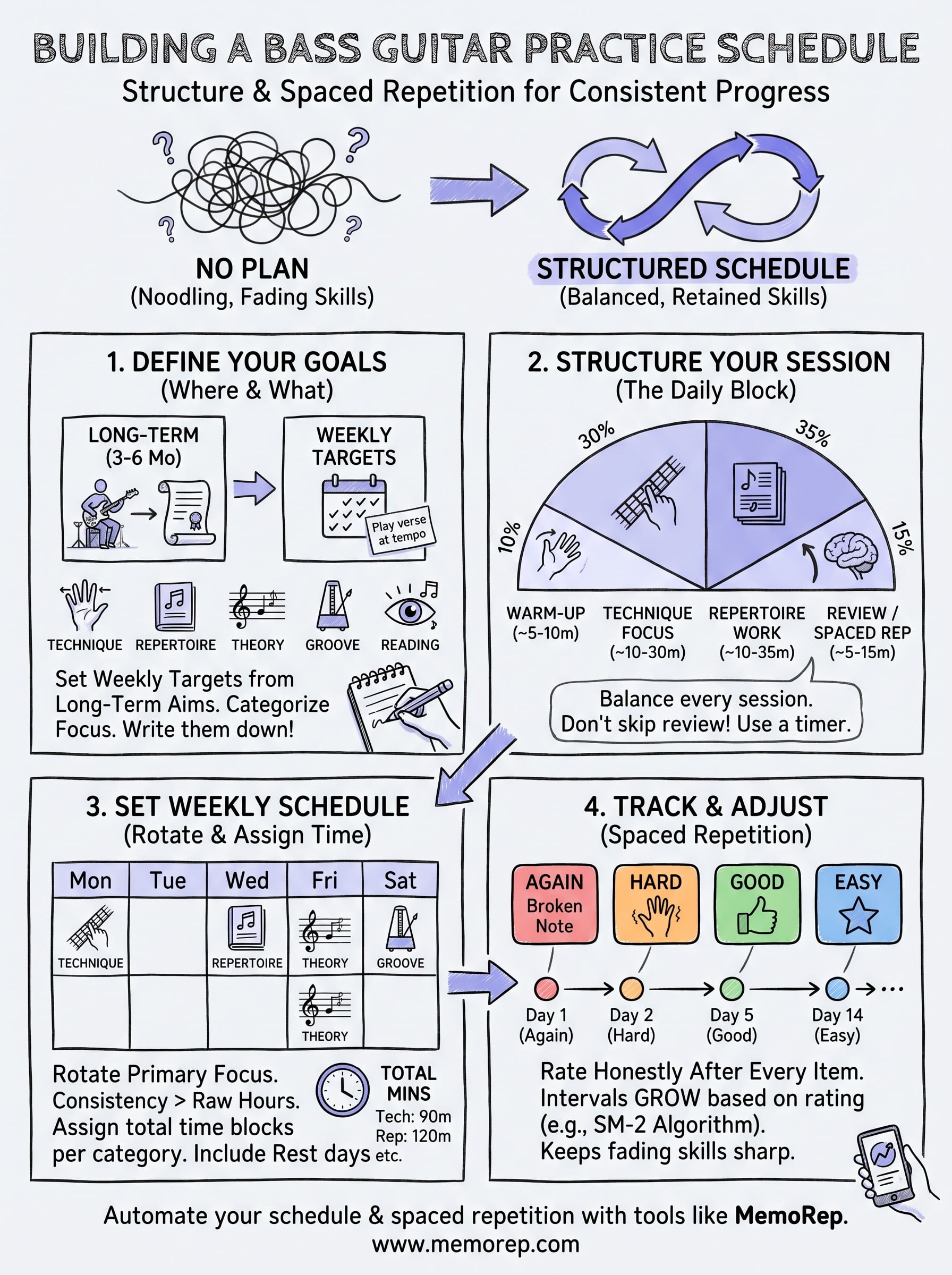
Start by writing down where you want to be in three to six months. Maybe that's playing five songs cleanly at a jam, nailing a specific slap technique, or reading basic notation without freezing up. Then break that into weekly targets small enough to act on immediately. "Get better at bass" isn't a goal, it's a wish. "Play the verse of this song at full tempo by Friday" is a goal your daily practice routine can be built around.
A goal you can't schedule this week isn't a goal yet, it's a wish.
Match goals to skill categories
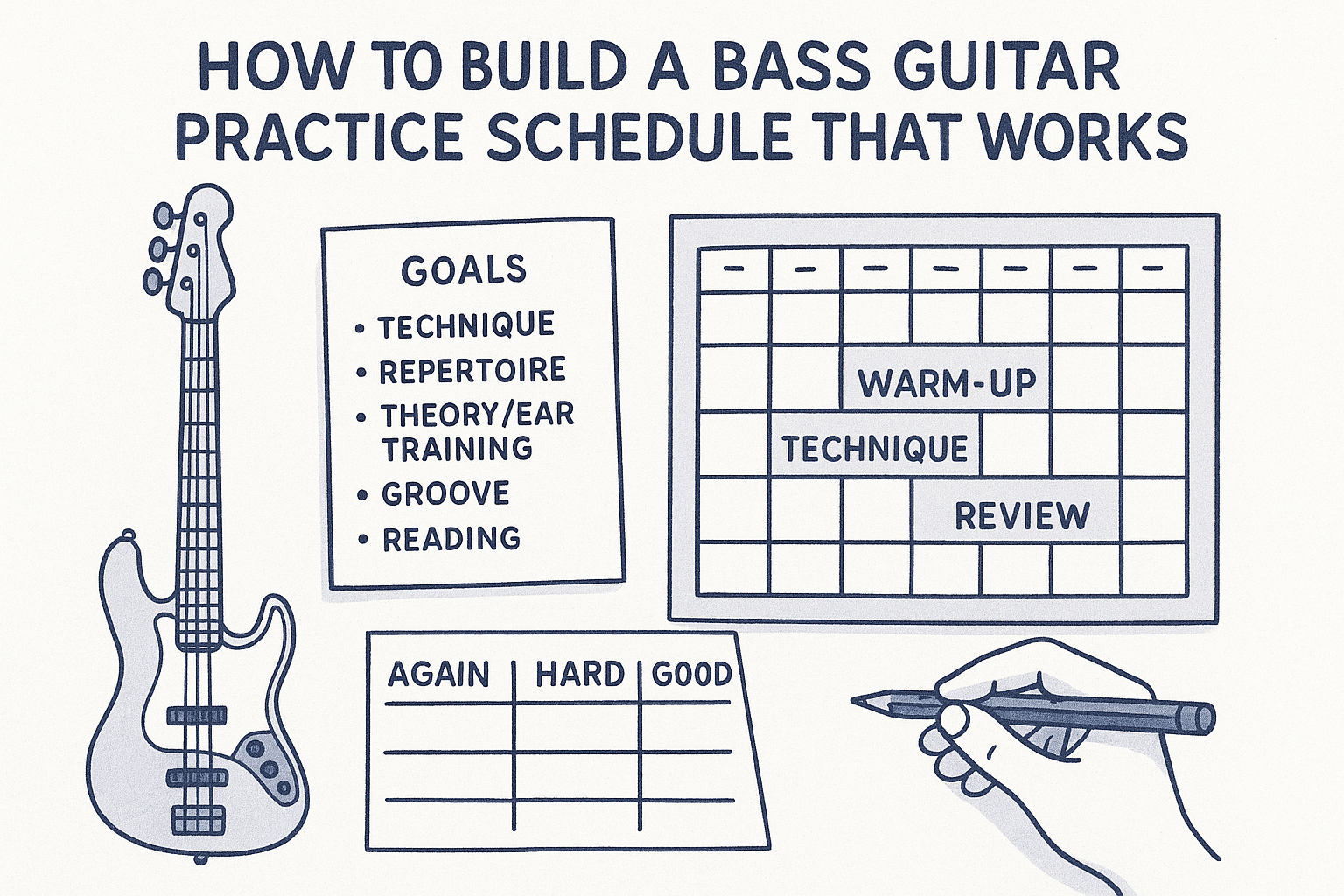
Most bass goals fall into a handful of buckets, and your schedule needs at least a little time in each one, even during weeks when you're laser-focused on a specific song or audition.
- Technique: fretting hand accuracy, right-hand plucking or picking consistency, muting, shifting
- Repertoire: songs, basslines, or covers you're learning or maintaining
- Theory and ear training: intervals, scales, chord tones, transcribing by ear
- Groove and timing: playing with a metronome or drum track, locking in with a rhythm section
- Reading: standard notation or tab, if that's relevant to your goals
Ignoring any one of these for too long is exactly how gaps form. A player who only chases repertoire ends up with great songs and shaky fundamentals underneath them.
Write goals down where you'll actually see them
Goals that live only in your head get forgotten by Wednesday. Keep a running list, whether that's a notebook page, a note on your phone, or a project inside a practice app, and review it before each session. Specific, written goals are also what make Step 4's progress tracking meaningful, because you need something concrete to measure against. Once your goals are clear, the next step is turning them into an actual session structure you can follow without thinking.
Step 2. Structure your practice session
A bass practice session needs internal structure just as much as your week does. Without it, you end up spending forty minutes warming up and five minutes on the thing you actually needed to fix. Breaking each session into fixed blocks, even loose ones, keeps every skill category from Step 1 getting real attention instead of whatever's left over when your hands get tired.
Break sessions into four blocks
Every effective session, regardless of length, follows roughly the same shape: warm-up, technique, repertoire, and review. The warm-up loosens your hands and resets timing, technique work targets a specific weak spot, repertoire applies that technique to real music, and review closes the loop by revisiting something older that's due for reinforcement. Skipping the review block is the most common mistake, because it feels like the least urgent part in the moment.
The block you're tempted to skip is usually the one keeping old skills from fading.
Sample session structure by length
Here's how a structured practice session breaks down at three common time budgets:
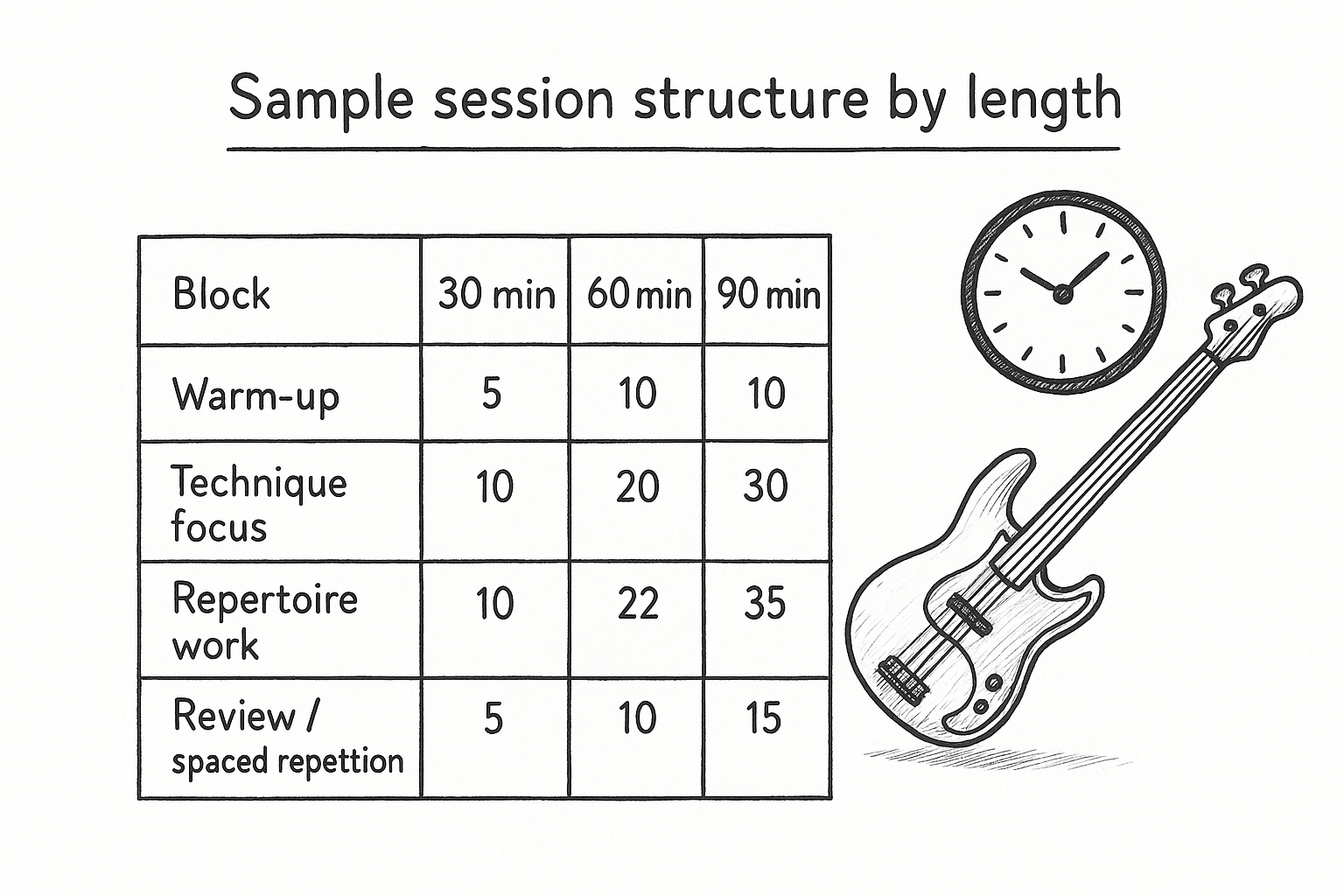
| Block | 30 min session | 60 min session | 90 min session |
|---|---|---|---|
| Warm-up | 5 min | 8 min | 10 min |
| Technique focus | 10 min | 20 min | 30 min |
| Repertoire work | 10 min | 22 min | 35 min |
| Review / spaced repetition | 5 min | 10 min | 15 min |
These ratios aren't rigid law, but they keep any single block from swallowing the whole session, which is exactly what happens when you sit down without a plan.
Keep transitions short and deliberate
Transitions between blocks are where sessions quietly fall apart. You finish a technique drill, get distracted noodling on a riff you like, and suddenly your review block never happens. Set a timer for each block, even a phone alarm, so you move on without negotiating with yourself. This is a small habit, but it's the difference between a session that covers everything and one that drifts into whatever felt good at the moment.
Whether you're working with 30 minutes before work or 90 on a weekend, the block structure stays the same, only the minutes per block change. Once a single session is built this way, the next step is deciding how these sessions repeat and rotate across your week, so technique, repertoire, and review each get consistent coverage over time.
Step 3. Set your weekly schedule and time blocks
Once you know how a single session is structured, the next question is how sessions repeat across seven days. A weekly bass practice routine isn't about practicing every single day for the same length of time. It's about deciding, in advance, which days cover which skill categories, so technique, repertoire, and review each get consistent coverage instead of whatever you feel like on a given evening.
Pick a realistic number of practice days
Four to five sessions a week beats seven inconsistent ones. Consistency matters more than raw hours, because spaced review only works if sessions actually happen on schedule. If you can only manage three days some weeks, build your rotation around three and treat extra days as bonus practice, not the baseline you'll inevitably miss.
A realistic four-day schedule you'll actually follow beats an ambitious seven-day one you won't.
Rotate focus across the week instead of repeating the same session
Don't run an identical session every day. Rotate which skill category gets the deepest focus while keeping warm-up and review constant. Here's a sample weekly practice schedule for someone practicing four days:
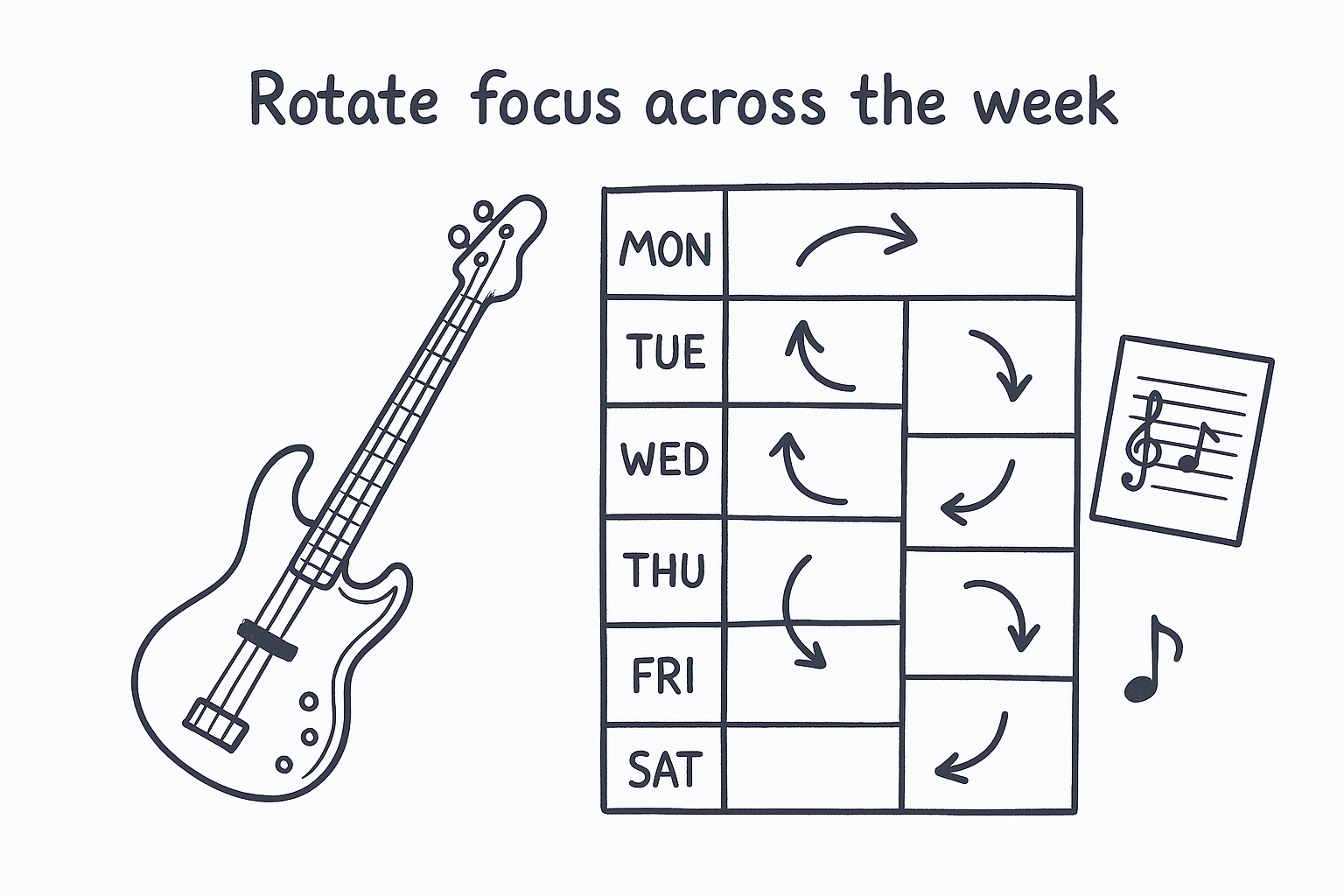
| Day | Primary focus | Secondary focus |
|---|---|---|
| Monday | Technique drills | Review due cards |
| Wednesday | Repertoire / songs | Groove and timing |
| Friday | Theory and ear training | Review due cards |
| Saturday | Repertoire / songs | Technique drills |
Every session still opens with a short warm-up and closes with review, but the middle block shifts, so no single skill dominates the whole week.
Assign time blocks, not just days
Within each week, decide roughly how many total minutes go to each category, not just which day touches it. If you have five hours a week, something like 90 minutes technique, 120 minutes repertoire, 60 minutes theory and groove, and 30 minutes pure review keeps the balance from Step 1 intact. Write these numbers down alongside your goals so you can check, at the end of the week, whether you actually hit them.
Finally, treat one day as genuinely light or off. Rest days aren't wasted time, they let the physical and mental gains from your other sessions settle in. A weekly schedule that accounts for rest is one you'll sustain for months, not abandon after two frustrated weeks. With days and time blocks set, the last piece is making sure old material actually resurfaces before it fades, which is where spaced repetition comes in.
Step 4. Track progress and adjust with spaced repetition
Without tracking, you can't tell if your schedule is actually working, you're just guessing. Every session should end with a quick log: what you practiced, how it went, and when it needs to come back around. This is where a spaced repetition schedule turns your weekly plan from a static routine into something that adapts to your actual playing, not the calendar you wrote it on months ago.
Rate every skill honestly
Grading yourself after each drill or song is what makes spaced repetition work. Use a simple four-point scale, borrowed from proven spaced repetition systems, right after each item you practice:
- Again: fell apart, needs review tomorrow
- Hard: got through it but shaky, needs review in a couple days
- Good: solid, push the next review out a week or so
- Easy: nailed it, push the review further out
Honesty here matters more than optimism. Rating a shaky bassline as "Good" just because you're tired of working on it defeats the entire system.
Rate honestly or the schedule can't protect you from forgetting.
Let intervals grow instead of guessing
Once you've rated something, the review interval should expand automatically based on that rating, not stay fixed at "once a week" forever. A scale you rated Easy three times in a row doesn't need weekly review anymore, it needs monthly checks. A song you keep rating Hard needs to come back in days, not weeks. This is the core of the SuperMemo SM-2 algorithm: intervals grow when performance is strong and shrink when it's weak, so your limited practice time goes toward what's actually fading, not what already feels solid.
Build the habit even without software
A notebook with dated columns works fine to start. Write the skill, the date, and the rating, then flip back each session to see what's due. It's tedious by hand, which is exactly why apps built around spaced repetition exist, they calculate the next review date for you and surface only what's due today. Either way, the discipline of logging every single session, not just the good ones, is what separates a schedule that adapts from one that quietly drifts back into guesswork after a few weeks.
Making your practice routine stick
A bass guitar practice schedule only works if you keep running it past the first excited week. Goals give direction, session blocks keep every practice covering warm-up through review, weekly time blocks spread that coverage across days, and honest rating keeps old material from quietly fading. Skip any one piece and the whole thing drifts back into random noodling within a month.
Manual tracking works, but it's tedious, and tedious systems get abandoned right when you need them most. If you'd rather spend that time playing than maintaining spreadsheets, see how MemoRep's scheduling actually works and let the algorithm handle the intervals for you.
Beta access is still open to the first 200 users, with premium free for life. If a schedule that adapts to your real performance sounds better than one you're forcing yourself to follow, sign up for free access and build your first practice project today.