Best Book on Deliberate Practice: Start with Peak (+ 6 Next Reads)
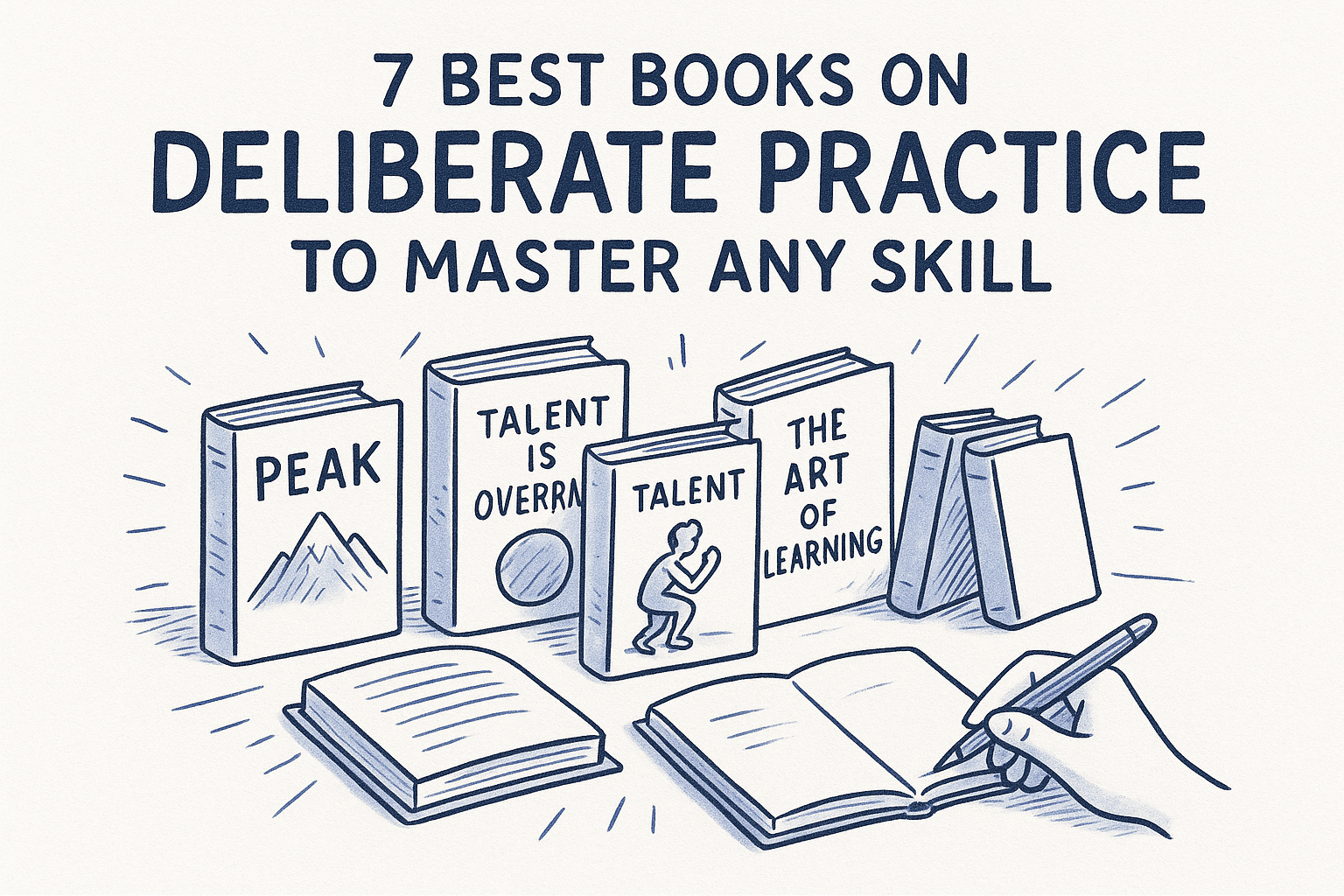
If you want one book on deliberate practice, start with Peak by Anders Ericsson and Robert Pool. It is the clearest first stop for the research behind expert performance and for understanding why focused work on weaknesses matters more than a raw hour count.
The other six books here are follow-up reads, not interchangeable alternatives. Choose Practice Perfect for drills and coaching, Make It Stick for retention, Deep Work for concentration, or the remaining titles for talent, pressure, and learning psychology.
This page is a recommended reading path for someone choosing a first or next book. If you want a broader eight-title comparison organized by learning goal and style, use our deliberate practice books comparison. Once you have the theory, MemoRep can help turn the ideas into a scheduled practice routine.
1. Peak: secrets from the new science of expertise
Written by psychologist Anders Ericsson, the researcher whose work on expert performance inspired the "10,000 hours" idea (and who spent much of the book correcting how that idea got misused), Peak is the closest thing to a primary source in this list. Ericsson spent decades studying chess grandmasters, violinists, and surgeons to figure out what actually separates elite performers from everyone else who just logged hours.
What the book covers
Ericsson lays out his concept of deliberate practice as something distinct from mindless repetition. He argues that real improvement requires a clear goal, immediate feedback, and constant adjustment at the edge of your current ability, what he calls working in your "stretch zone." The book also debunks the myth of innate talent, using case studies like the London taxi drivers who physically grow larger hippocampi from memorizing the city's streets. If you've ever wondered why some musicians plateau after years of practice while others keep climbing, this book explains the mechanism.
Real skill growth comes from working at the edge of your ability with a coach or clear feedback loop, not from clocking hours on autopilot.
Who it's for
This is the right starting point if you want the research foundation before you touch technique books or apps. It suits musicians, athletes, and anyone learning a physical or technical skill who wants to understand why structured practice beats casual repetition. It's less useful if you already know the theory and want a quick action plan instead.
Key practice tip you can apply
Ericsson's core recommendation translates directly into daily practice:
- Break your skill into narrow, specific sub-skills instead of practicing "the whole thing"
- Set a target just beyond your current comfort level for each session
- Get feedback immediately, whether from a teacher, a recording, or a metronome
- Repeat with small adjustments until the sub-skill sticks, then move to the next one
That cycle of narrow focus and fast feedback is exactly what spaced repetition systems like MemoRep are built to schedule, so you're not guessing which sub-skill needs another pass this week.
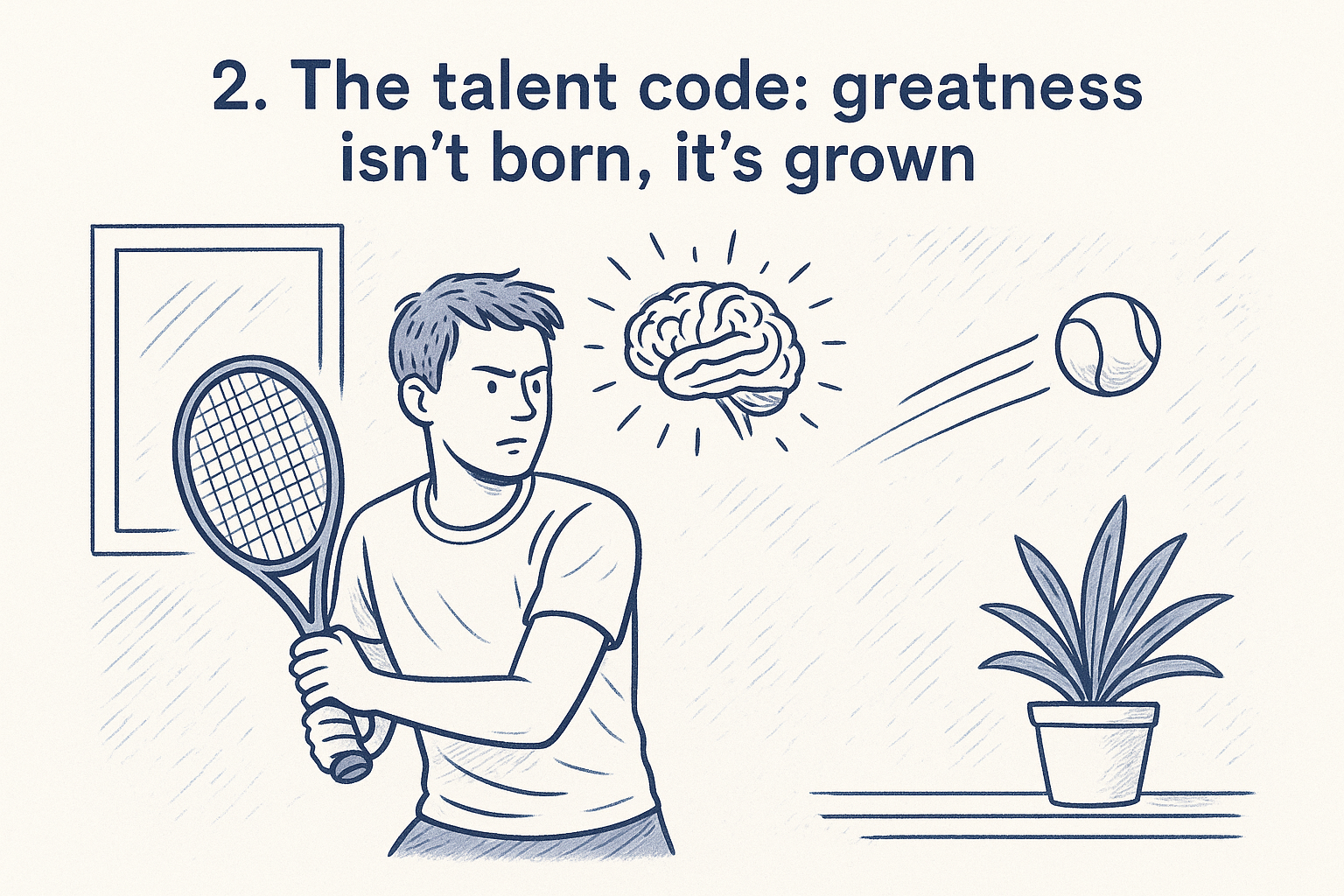
2. The talent code: greatness isn't born, it's grown
Daniel Coyle spent years visiting what he calls "talent hotbeds", places like a rundown Moscow tennis club and a Brazilian soccer academy, that produce a disproportionate number of world-class performers. His question was simple: what are these places doing differently? The answer he found centers on myelin, the insulating layer that wraps around nerve fibers and makes neural signals fire faster and more accurately every time you repeat a movement correctly.
What the book covers
Coyle explains deep practice as slow, error-focused repetition where you deliberately work at the edge of your ability and fix mistakes in real time. He pairs this with two other ingredients: ignition, the spark of motivation that gets someone started, and master coaching, the kind of terse, targeted feedback that keeps reps honest. The book leans on neuroscience but reads more like a series of case studies than a textbook.
Skill isn't a gift, it's insulation you build one correct repetition at a time.
Who it's for
This one suits readers who respond to stories over statistics, and anyone curious about the biology behind why slow, focused reps beat fast, sloppy ones.
Key practice tip you can apply
Coyle's central technique is straightforward:
- Slow the movement or passage down until you can execute it without error
- Isolate the exact spot where mistakes happen
- Repeat that narrow chunk deliberately before speeding back up
3. Talent is overrated: what separates top performers
Geoff Colvin, a longtime editor at Fortune, wrote this book partly as a rebuttal to the idea that CEOs and athletes are simply born gifted. He digs into the same research base as Ericsson but aims it squarely at business and everyday performers, arguing that innate talent explains far less than we assume and that deliberate, structured effort explains far more.
What the book covers
Colvin builds his case around deliberate practice as a specific activity, not just "working hard." He stresses that it has to be designed to improve performance, repeatable, and mentally demanding enough that you can't sustain it for more than a few hours a day. He also tackles the myth that early exposure guarantees mastery, showing that structured effort beats a head start almost every time.
Hard work only counts if it's designed to stretch a specific weakness, otherwise you're just staying busy.
Who it's for
Readers who want the argument against talent laid out plainly, especially anyone in a competitive field who's been told they lack a natural gift, will get the most from this one.
Key practice tip you can apply
Colvin's advice for structuring a session:
- Define one weakness to target before you start
- Push past your comfort zone for short, intense stretches
- Stop before fatigue erodes your focus, then reflect on what happened
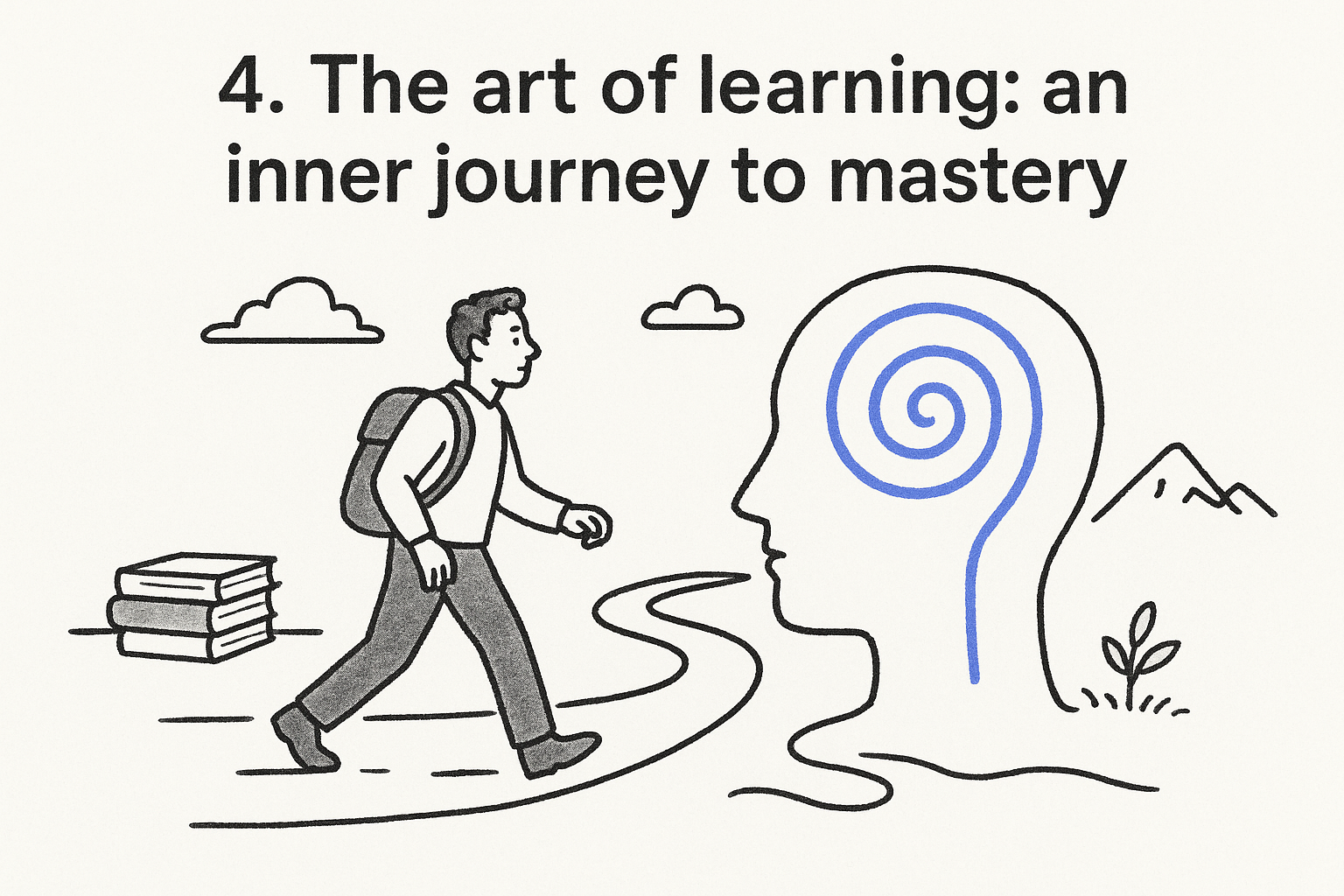
4. The art of learning: an inner journey to mastery
Josh Waitzkin became a chess prodigy as a kid, the subject of Searching for Bobby Fischer, then walked away from chess to become a world champion in Tai Chi Push Hands. The Art of Learning is his attempt to explain how the same learning principles carried him across two completely unrelated disciplines. It's part memoir, part manual, and it reads faster than most books on this list.
What the book covers
Waitzkin focuses on the psychology of performance under pressure, especially how to recover after a mistake instead of spiraling. He introduces the idea of investment in loss, deliberately entering situations where you'll get beaten so you learn faster than you would by staying safe. He also breaks down technique into what he calls making smaller circles, refining a skill until the tiniest version of it is flawless.
Growth happens fastest when you're willing to lose on purpose so you can find the gap in your skill.
Who it's for
This book suits performers who choke under pressure or freeze after a mistake, and anyone who's switched disciplines and wondered if their old skills still count.
Key practice tip you can apply
Waitzkin's approach for tightening a skill:
- Pick one small element of a larger skill and isolate it completely
- Practice that tiny piece until it's automatic under pressure
- Gradually widen the circle back out without losing that precision
5. Practice perfect: 42 rules for getting better
Doug Lemov built his career studying teachers who consistently got better results than their peers, then turned that research into a coaching manual with Erica Woolway and Katie Yezzi. Practice Perfect takes the theory from books like Ericsson's and translates it into 42 concrete rules you can apply the next time you sit down to rehearse, coach, or drill anything.
What the book covers
Lemov argues that most people practice the wrong things because they practice whatever feels comfortable, not whatever actually moves the needle. The book pushes you to rehearse the moment, meaning you isolate the exact five seconds of a performance that usually goes wrong and drill just that, instead of running the whole piece end to end. It also covers how to build practice environments that reward small wins early, so momentum doesn't die before a skill takes hold.
Practice the five seconds that go wrong, not the whole performance that already goes right.
Who it's for
This book suits coaches, teachers, and self-directed learners who want a rulebook rather than a research summary. It's a strong fit if you already believe in deliberate practice but keep structuring sessions poorly.
Key practice tip you can apply
Lemov's rule of practicing the twenty percent that causes eighty percent of your mistakes translates into a simple routine:
- Record or review a recent session and flag the exact failure point
- Drill that isolated segment repeatedly before reattaching it to the full piece
- Track whether the failure point improves before moving to the next weak spot
6. Make it stick: the science of successful learning
Cognitive scientists Peter Brown, Henry Roediger, and Mark McDaniel wrote this book to translate decades of learning research into advice anyone can use, whether you're a musician, a student, or a surgeon. Their central finding cuts against how most people practice: the techniques that feel productive, like rereading notes or repeating a passage smoothly, are usually the least effective ways to build lasting skill.
What the book covers
The authors build their case around retrieval practice, the act of pulling information or a skill out of memory rather than passively reviewing it, because that struggle is what cements learning. They also cover spaced repetition and interleaving, showing that mixing skills together and spreading sessions apart beats blocked, massed practice even though it feels harder in the moment. Their term for this discomfort is "desirable difficulty," the idea that practice which feels slower and more frustrating is often the practice that actually sticks.
If a practice session feels easy and smooth, it's probably not building much long-term skill.
Who it's for
Anyone who suspects their study or rehearsal habits are optimized for feeling good rather than for actual retention will get real value here, especially learners juggling multiple pieces or techniques at once.
Key practice tip you can apply
Build sessions around retrieval instead of review:
- Test yourself on a skill or passage before looking at notes or a recording
- Mix two or three different skills in one session instead of drilling one repeatedly
- Space repeat attempts days apart rather than cramming them back to back
7. Deep work: rules for focused success
Computer scientist Cal Newport wrote this book after noticing that the people producing the best work in any field, from novelists to programmers, share one trait: they protect long, uninterrupted blocks of concentration while everyone else fragments their attention across email and notifications. Deep Work isn't about music or sports specifically, but its argument underpins every practice session you'll ever schedule.
What the book covers
Newport defines deep work as focused, distraction-free effort on a cognitively demanding task, the kind that pushes your abilities to their limit. He contrasts it with shallow work, the busywork that feels productive but builds no real skill. The book lays out routines for training your focus like a muscle, arguing that your capacity for sustained attention shrinks every time you let a session get interrupted by your phone or a stray thought.
Skill only grows during the minutes you're fully absorbed, not during the minutes you're merely present.
Who it's for
This book suits anyone whose practice keeps getting hijacked by notifications, background noise, or a wandering mind, and it's especially useful if you've already read the other books here but still can't protect the focused time deliberate practice requires.
Key practice tip you can apply
Newport's approach for building focus into a routine:
- Block a fixed, uninterrupted window for practice and treat it like a meeting you can't skip
- Remove your phone from the room, not just the volume
- Start with shorter deep sessions and extend the length as your focus stamina builds
Putting these lessons into practice
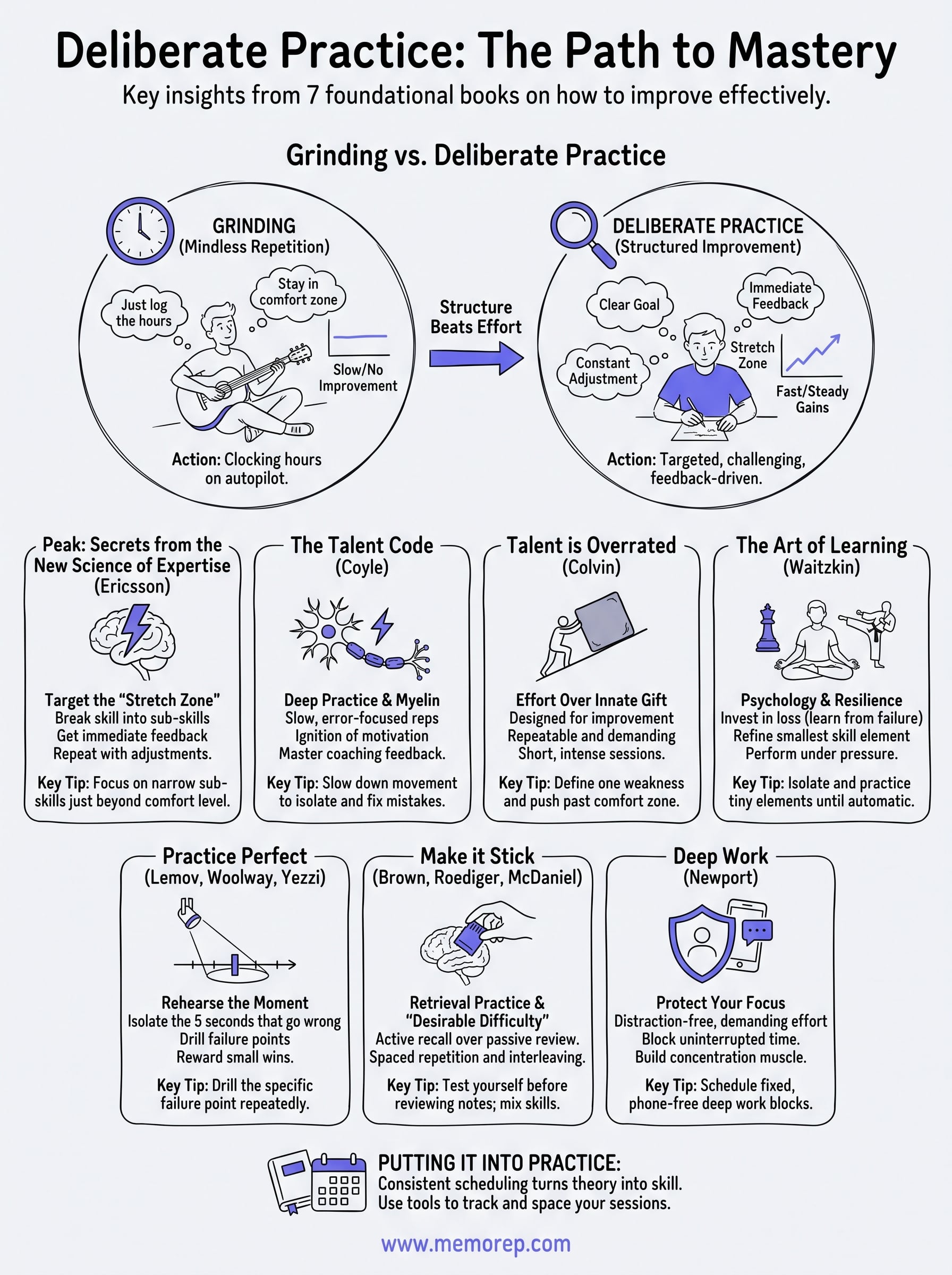
Every book on deliberate practice on this list circles back to the same point: structure beats effort. Ericsson gives you the science, Coyle and Colvin explain the mechanics, Waitzkin and Lemov show you how to drill the exact weak spot, and Brown, Roediger, and McDaniel plus Newport cover how to make focus and retention actually stick. None of that matters, though, if you close the book and go back to practicing whatever feels comfortable that day.
Reading builds the framework, but consistent scheduling is what turns it into skill. You still need something to track which sub-skill is fading, when to revisit it, and how your feedback ratings shift over time, without you manually juggling spreadsheets or sticky notes. That's the exact gap MemoRep fills, using the same spaced repetition principles these authors write about. See how MemoRep's scheduling works and turn what you just read into your next practice session.