8 Deliberate Practice Books Compared by Goal and Learning Style
The best deliberate practice books do different jobs. Some explain the research behind expert performance, some turn that research into coaching rules, and others help with mindset, focus, or consistency. This comparison helps you choose by the problem you need to solve rather than treating every title as a substitute for the others.
Use Peak for the primary framework, Practice Perfect for drill design, Mindset or Grit for long-term behavior, and The Practicing Mind for staying present. The eight reviews below compare each title’s main contribution, ideal reader, and practical takeaway.
If you are looking for a single first recommendation and a shorter reading sequence, start with our best book on deliberate practice guide. Stay here when you want a wider comparison across research, coaching, sports, psychology, and performance.
1. Peak: secrets from the new science of expertise
What it's about
Anders Ericsson spent decades studying chess grandmasters, violinists, and memory champions before writing Peak with journalist Robert Pool in 2016. The book distills his research into a single argument: raw talent explains far less than we assume, and structured practice explains far more. Ericsson was the psychologist whose original studies got flattened into the popular "10,000 hours" rule, and much of this book exists to correct that oversimplification. He walks through case studies, from the London cabbies who memorize the city's streets to Benjamin Franklin's writing drills, showing how each field has its own version of structured skill-building.
Key insight on deliberate practice
Central to the book is the idea that deliberate practice requires a clear goal, immediate feedback, and constant adjustment at the edge of your current ability. Ericsson calls this working in your "stretch zone," not so easy that you coast and not so hard that you can't process what went wrong. He also introduces the concept of mental representations, the detailed mental models experts build that let them spot errors and patterns beginners miss entirely.
Deliberate practice isn't about doing more, it's about doing the right thing at the edge of your ability, every single time.
Ericsson insists that practice without feedback is just repetition, and repetition alone rarely produces improvement. This distinction matters more than any other idea in the deliberate practice literature, and it's the reason apps built around spaced feedback loops exist at all.
Who should read it
Start here if you want the primary source behind nearly every other book on this list. Musicians, athletes, and anyone learning a hands-on skill will find direct, practical guidance rather than abstract motivation. It's a denser read than some of the others, but it rewards the effort with a framework you can apply the same day you finish a chapter. If you only read one book from this article, make it this one, since it shapes how you'll interpret everything else you read afterward.
2. The talent code
What it's about
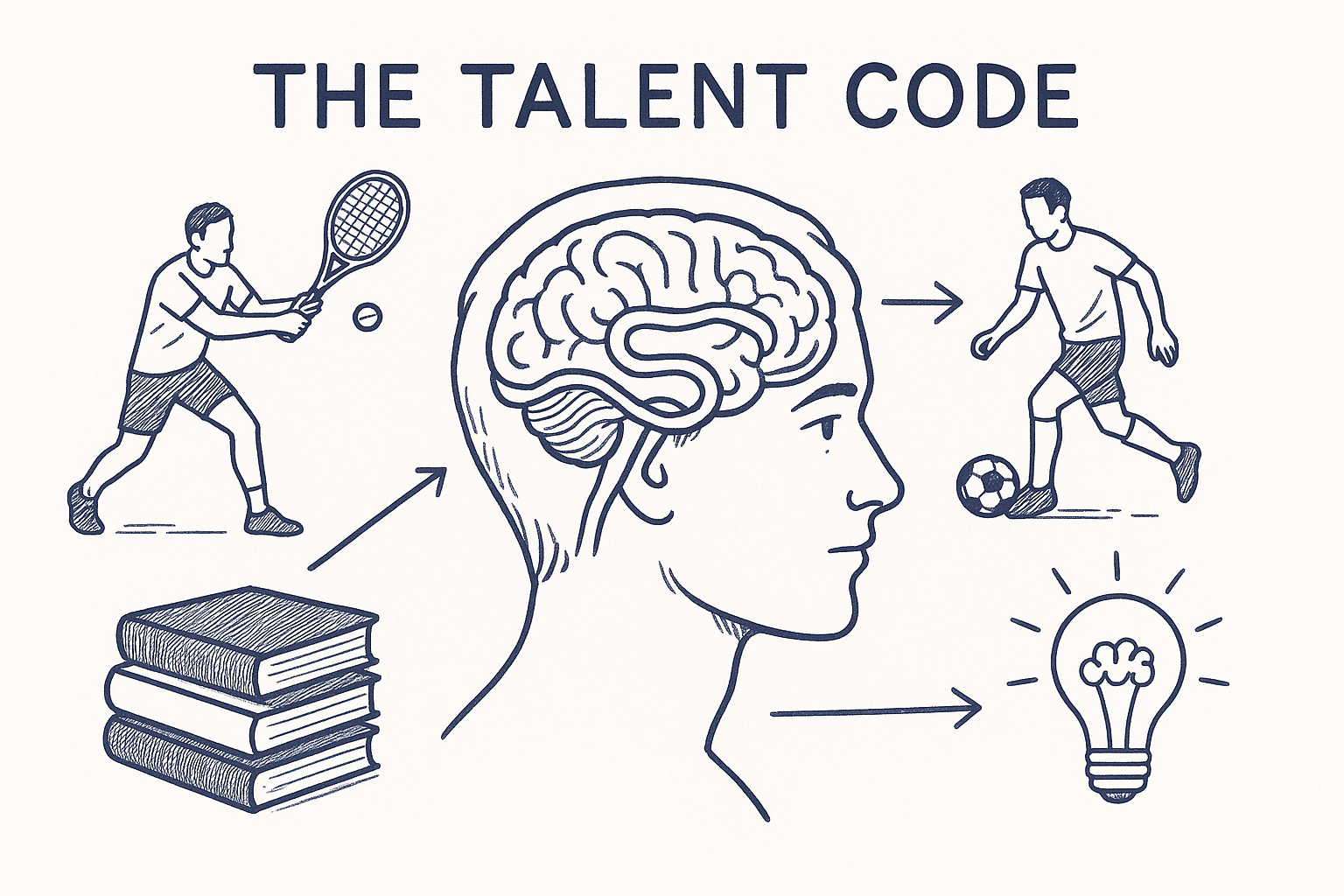
Daniel Coyle traveled to talent hotbeds around the world, from a Moscow tennis club to a Brazilian soccer academy, to figure out why certain small pockets of the globe produce disproportionate numbers of elite performers. The Talent Code argues the answer isn't genetics or luck but a biological process called myelination, where repeated, targeted practice wraps nerve fibers in insulation that makes skill circuits fire faster and more reliably. Coyle blends neuroscience with on-the-ground reporting, making the science feel concrete rather than academic.
Key insight on deliberate practice
Coyle's core contribution is naming the mechanism behind what Ericsson describes more abstractly. He calls it deep practice: slowing down, breaking a skill into chunks, and deliberately making mistakes so your brain can correct them and build stronger myelin sheaths around the right circuits.
Skill grows from firing the right circuit over and over, mistakes included, until the wiring gets faster.
He also highlights the role of ignition, the emotional spark that gets someone to commit to years of unglamorous repetition in the first place.
Who should read it
Reach for this one if you like your practice science paired with vivid storytelling instead of dry data tables. It suits musicians and coaches who want to understand why chunking a difficult passage into small pieces works at a biological level. Parents and teachers building practice routines for younger learners will also find Coyle's chapters on ignition genuinely useful for keeping motivation alive.
3. Talent is overrated
What it's about
Geoff Colvin wrote Talent Is Overrated around the same research base as Ericsson, but he aims it squarely at business readers and career-driven skill builders. Colvin dismantles the idea that top performers in music, chess, or corporate leadership got there through innate gifts, pointing instead to years of deliberately structured effort most people never bother to put in. He pulls examples from Tiger Woods and Mozart to show that even the most celebrated "naturals" had fathers, teachers, or mentors pushing them through rigorous, targeted training from an early age.
Key insight on deliberate practice
Colvin's sharpest contribution is his checklist for what actually counts as deliberate practice, as opposed to just showing up and going through the motions. He argues real practice is designed specifically to improve performance, can be repeated a lot, offers continuous feedback, is mentally demanding, and frankly isn't much fun.
If your practice feels comfortable, you're probably not improving anymore.
That last point separates this book from motivational fluff. Colvin is blunt that genuine improvement requires discomfort, and he gives you a concrete way to audit whether your current routine qualifies as deliberate practice or just familiar repetition.
Who should read it
Grab this one if you want a no-nonsense checklist you can hold your own practice sessions against. It suits professionals and skill learners who respond better to blunt frameworks than to storytelling, and it pairs well with Peak if you want the business-world application of the same research. Anyone questioning whether their daily routine still challenges them will get real value from Colvin's diagnostic approach.
4. Mindset: the new psychology of success
What it's about
Carol Dweck, a Stanford psychologist, spent her career studying why some students recover from setbacks while others quit at the first sign of difficulty. Mindset, published in 2006, distills that research into two categories: a fixed mindset, where you believe ability is set at birth, and a growth mindset, where you believe ability develops through effort and strategy. Dweck draws on decades of classroom experiments and interviews with athletes, CEOs, and musicians to show how these two beliefs shape whether someone sticks with hard practice or avoids it.
Key insight on deliberate practice
Every reading list of deliberate practice books eventually circles back to Dweck, because mindset determines whether you even attempt the hard, uncomfortable work Colvin and Ericsson describe. Someone with a fixed mindset treats a wrong note or a missed shot as proof of limited talent. Someone with a growth mindset treats it as information about what to fix next.
Your beliefs about ability decide whether you practice through failure or quit at the first wrong note.
Who should read it
Pick this up if you notice yourself avoiding practice sessions where you might fail in front of others. It suits learners who've stalled not from lack of technique but from a fear of looking incompetent while improving. Teachers and parents will also find Dweck's language useful for reframing feedback sessions with students.
5. Bounce: the myth of talent and the power of practice
What it's about
Matthew Syed, a former British table tennis champion turned journalist, wrote Bounce from the rare position of having lived elite performance from the inside. He opens with his own path to the top of British table tennis, tracing it back to a childhood accident of geography: his street had one of the only late-night table tennis clubs in the country, and his school had a teacher obsessed with the sport. Syed uses his own story alongside research on chess masters and tennis prodigies to argue that opportunity plus deliberate practice books-style structured training explains elite performance far better than any myth of natural gifts.
Key insight on deliberate practice
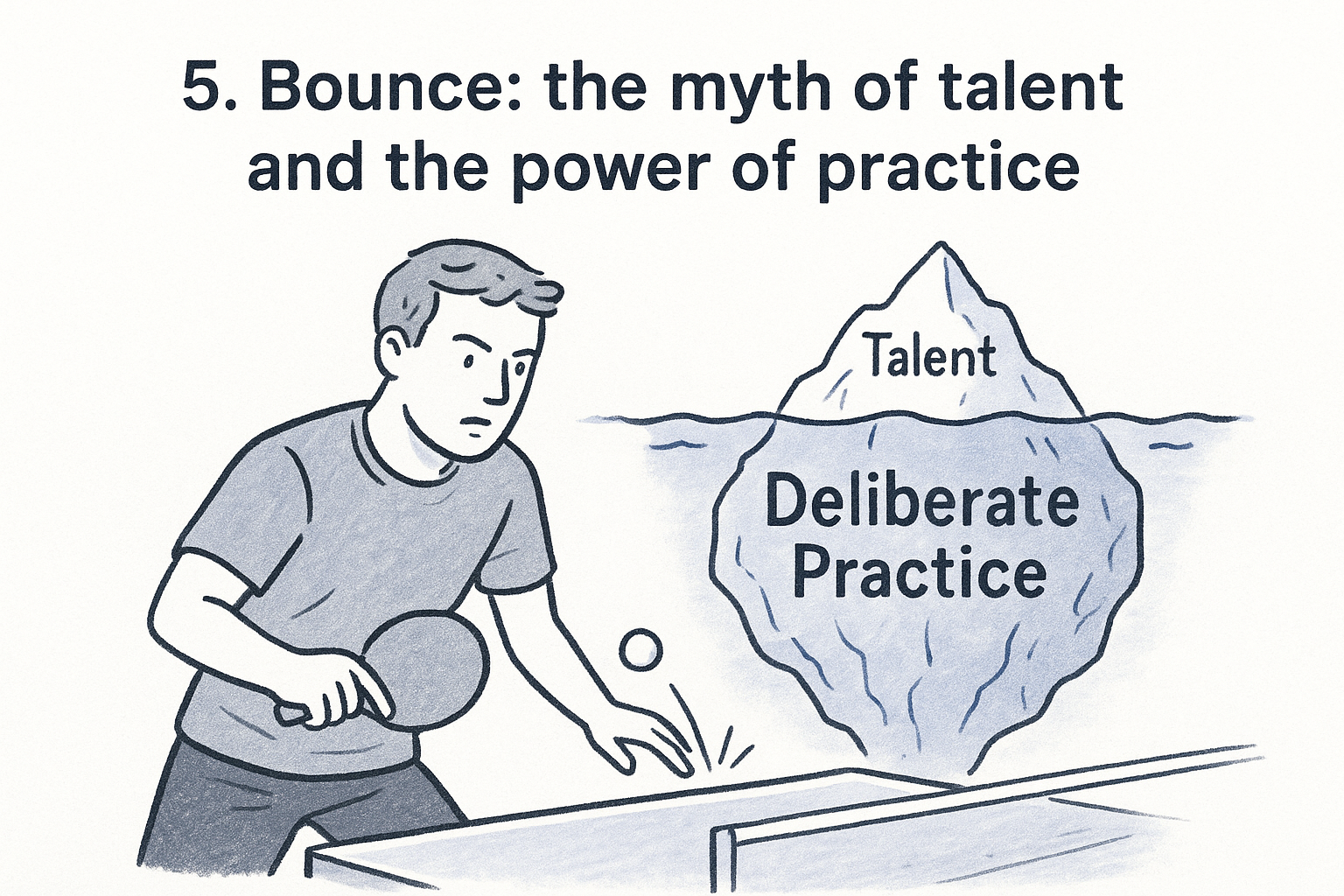
Syed's sharpest idea is what he calls the "iceberg illusion." Spectators see the flawless performance and assume it reflects innate talent, while the thousands of invisible practice hours underneath stay hidden. He also digs into purposeful practice, arguing that champions actively seek out drills that expose their weaknesses rather than polishing what already works.
What looks like natural talent is usually just the practice nobody saw.
Syed backs this with sports psychology research showing that top performers spend disproportionate time on the specific shots or passages that expose their current limits, not the ones that already feel comfortable.
Who should read it
Choose this book if you respond to a personal, first-person account rather than pure research summary. It suits athletes, musicians, and competitive learners who want proof that access and structured opportunity matter as much as any inborn gift. Syed's chapters on choking under pressure also make this a strong pick for anyone whose practice gains vanish during performances or auditions.
6. The practicing mind
What it's about
Thomas Sterner spent years as a professional piano tuner and technician before writing The Practicing Mind, a slim book that treats practice as a mental discipline rather than a technical checklist. Sterner draws heavily on Zen philosophy and his own experience with golf and music, arguing that most people sabotage their progress by fixating on outcomes instead of the process happening right in front of them. Unlike the research-driven books earlier on this list, this one reads more like a meditation guide aimed squarely at skill practitioners who already know the theory but struggle to stay present during a session.
Key insight on deliberate practice
Sterner's central claim is that impatience, not lack of ability, wrecks most practice sessions. He introduces the idea of staying in "the process," meaning you judge a session by whether you stayed focused on the task itself rather than whether you hit some external milestone.
Impatience with your own progress does more damage to your practice than any wrong note ever will.
He also warns against what he calls the "DOC" mechanism, a spiraling loop of dissatisfaction, disappointment, and comparison that pulls attention away from the actual work.
Who should read it
Reach for this book if you already have solid technique but find yourself frustrated, distracted, or quick to quit sessions early. It suits musicians and athletes who've read the science-heavy titles above and now need help applying that knowledge with patience instead of anxiety. Anyone whose practice routine feels more stressful than productive will find Sterner's short chapters genuinely calming.
7. Outliers
What it's about
Malcolm Gladwell popularized the "10,000 hours" idea that this very article opened by debunking, and reading Outliers in context shows why the shorthand caught on even though it oversimplifies Ericsson's research. Gladwell profiles Bill Gates, The Beatles, and Canadian hockey players born in the right months of the year to argue that success depends heavily on accumulated practice time plus circumstantial advantages most people never notice. The book reads fast, mixing anecdote with statistics in the style that made Gladwell a household name.
Key insight on deliberate practice
Gladwell's real contribution isn't the hours figure itself but his insistence that opportunity access shapes who gets to log those hours at all. The Beatles played eight-hour sets in Hamburg clubs before fame, racking up stage experience most bands never get. Gates had access to a computer terminal in 1968, when almost no teenager did.
Nobody clocks thousands of hours of practice by talent alone, someone has to hand them the opportunity first.
This reframes deliberate practice as something that requires structural access, not just personal discipline, a point the earlier science-heavy books tend to underplay.
Who should read it
Pick up Outliers if you want context for why the hours-based myth spread so widely, and why it's incomplete without the quality standards Ericsson and Colvin describe. It suits readers who enjoy narrative nonfiction over dense research summaries, and anyone curious about how circumstance and access shape who gets to put in serious practice time. Treat it as a companion to Peak rather than a replacement, since Gladwell borrows Ericsson's research directly and simplifies it for a general audience.
8. Grit: the power of passion and perseverance
What it's about
Angela Duckworth, a psychologist who left a management consulting career to study why some people stick with hard goals while others abandon them, wrote Grit after years of research with West Point cadets, spelling bee competitors, and Chicago teachers. She defines grit as a combination of sustained passion and sustained perseverance toward a single long-term goal, arguing this trait predicts success better than IQ or raw talent across nearly every field she studied. Duckworth builds her case from her own research lab rather than borrowing Ericsson's data, which makes this one of the more original entries among deliberate practice books on this list.
Key insight on deliberate practice
Duckworth connects grit directly to daily practice habits, showing that gritty people don't necessarily practice harder in any single session, they practice more consistently across years without quitting when progress stalls. She introduces the idea of a "lower level goal" hierarchy, where small daily practice tasks feed into a larger purpose that keeps you motivated when the work gets tedious.
Talent gets you started, but only sustained interest and effort over years gets you good.
Her research shows that grit scores predicted retention better than any measure of skill at the outset.
Who should read it
Turn to this book if you've struggled to maintain a practice routine beyond the first few motivated weeks. It suits anyone whose skill goals stretch years into the future, from conservatory musicians to competitive athletes rebuilding technique after injury. Duckworth's frameworks pair naturally with Dweck's mindset research if you're building a long-term practice habit from scratch.
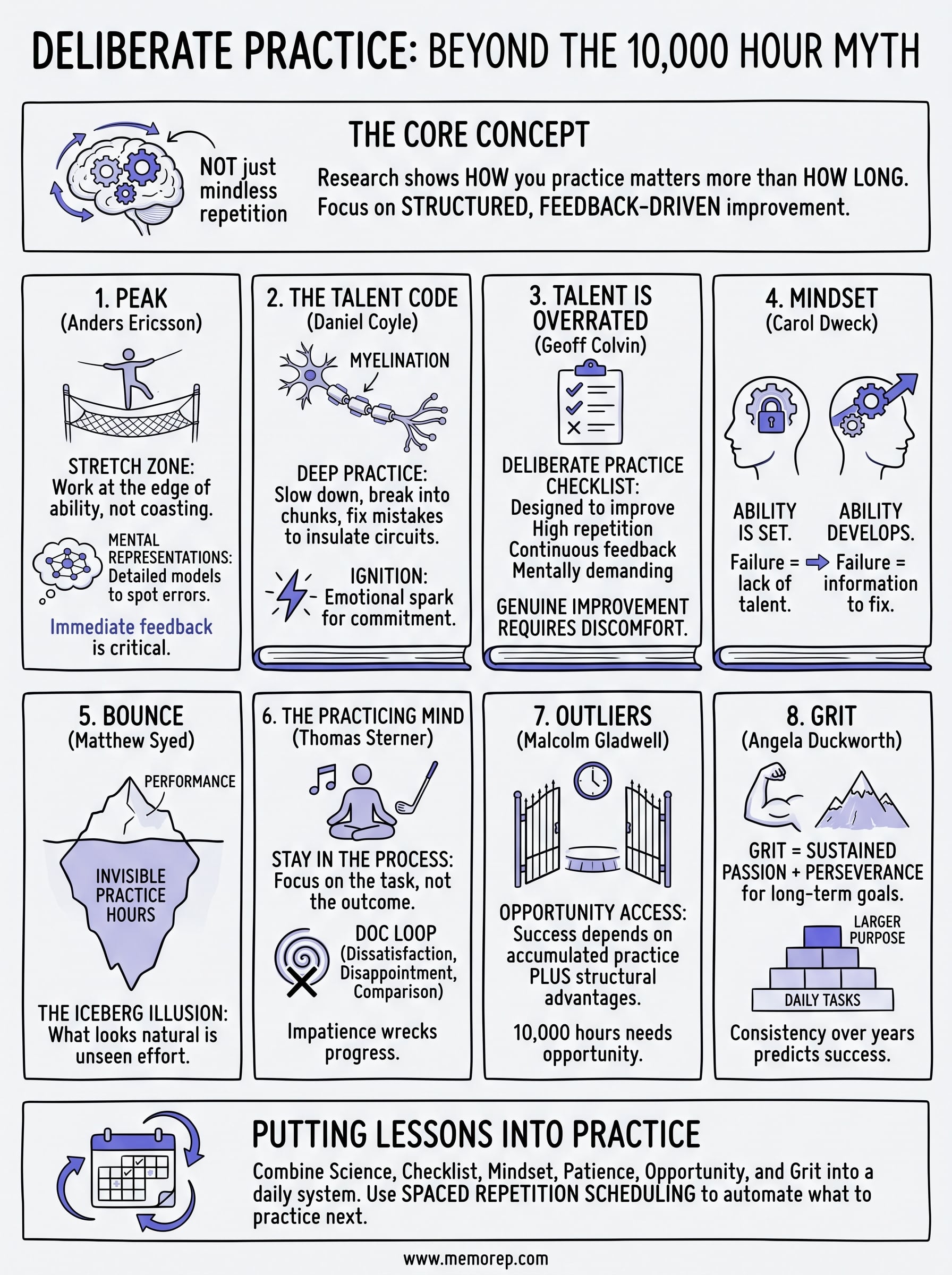
Putting these lessons into practice
Every book on this list points to the same conclusion: skill grows from structured, feedback-driven repetition, not from raw hours or natural gifts. Ericsson gives you the science, Colvin gives you the checklist, Dweck and Duckworth give you the mindset to stick with it, and Sterner reminds you to stay present while you do the work. Knowing this research changes nothing on its own, though. You still need a system that tells you what to revisit and when, or you'll fall back into the same random practice these authors warn against.
That's exactly the gap spaced repetition scheduling fills for practical skills like an instrument, a sport, or any hands-on craft. If you want to see how these deliberate practice principles translate into an actual daily routine, see how memoRep applies the science to schedule your next session automatically, so you spend your time practicing instead of deciding what to practice.