
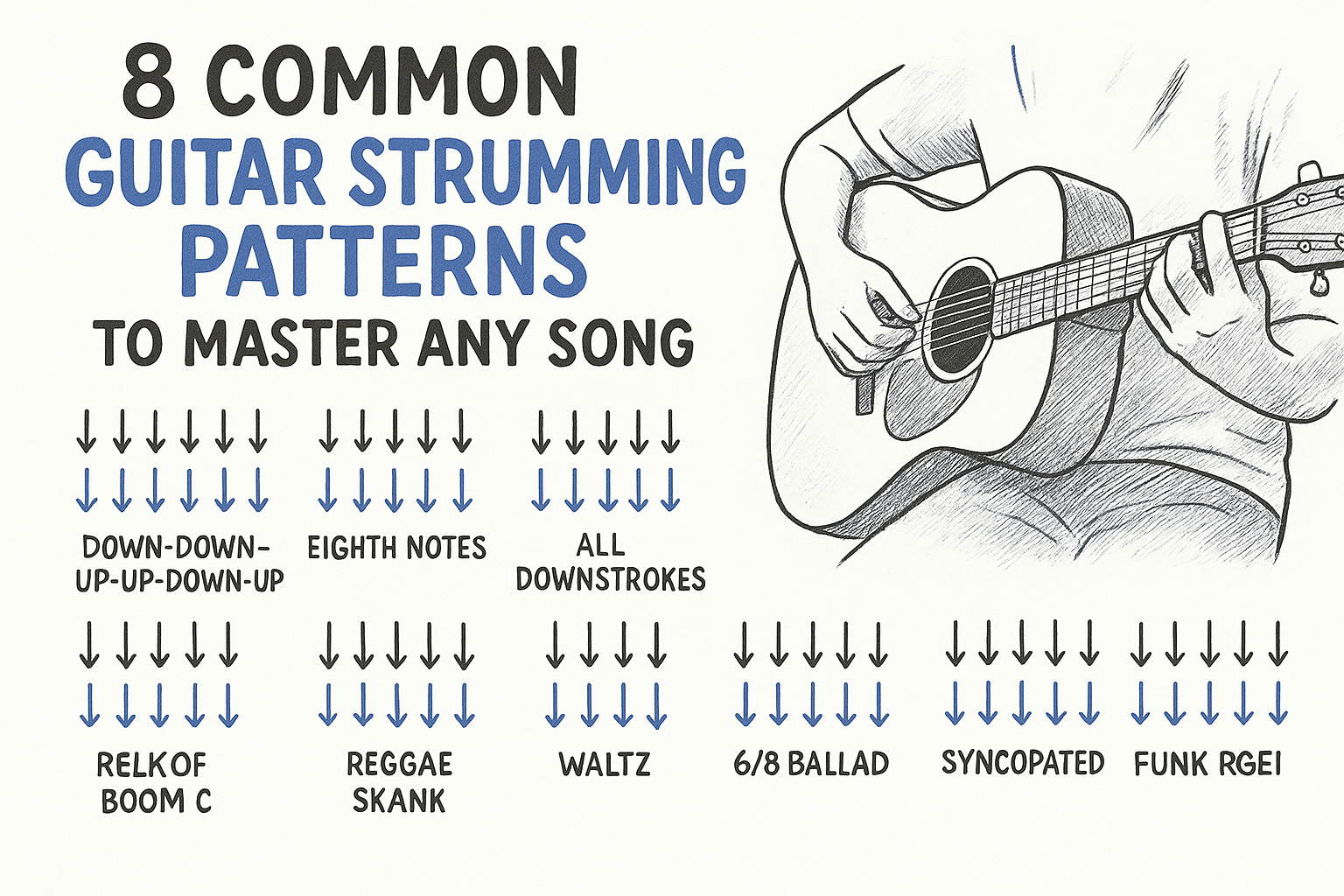
8 Common Guitar Strumming Patterns to Master Any Song
If you can switch chords cleanly but your rhythm guitar still sounds flat, the problem probably isn't your fretting hand. It's your strumming vocabulary. Learning common guitar strumming patterns gives you a toolkit you can apply to almost any song, from campfire folk to pop radio hits, instead of guessing at rhythm every time you pick up your guitar.
This article breaks down eight patterns that show up constantly in real songs, with the down and up strokes written out so you can count them and play along immediately. You'll get practical examples for each one, plus notes on which genres and tempos they fit best, so you're not just memorizing arrows on a page.
Knowing the pattern is only half the job, though. The real skill comes from repeating each one enough that your strumming hand stops thinking and starts feeling the groove. That's where a lot of guitarists stall out: they learn a pattern once, move on, and lose it a month later, which is exactly how memory fades over time. Spaced practice for guitarists, revisiting these patterns right before you'd forget them, is what actually locks them into muscle memory for good.
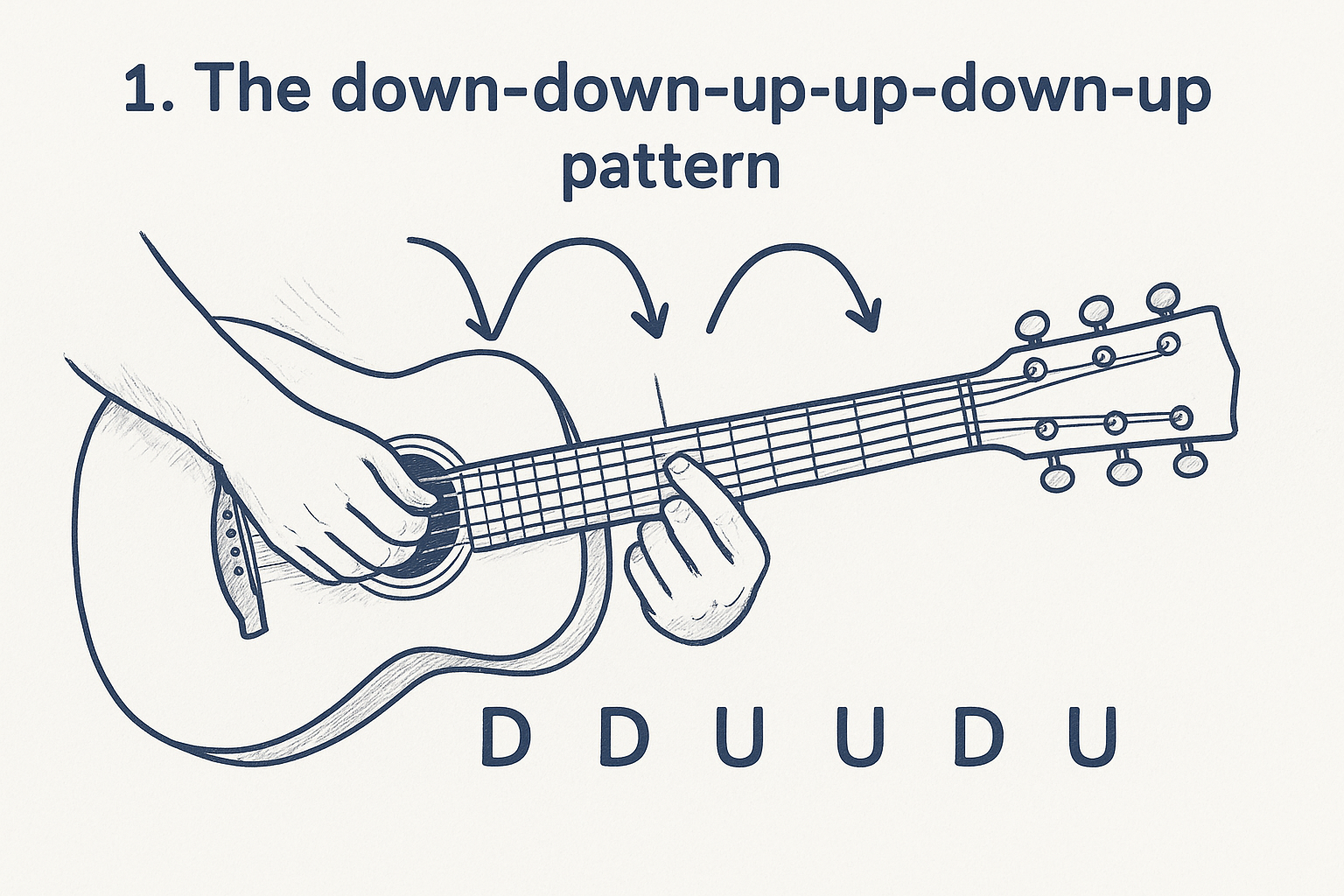
1. The down-down-up-up-down-up pattern
This six-stroke pattern is probably the most widely taught of all guitar strumming patterns, and for good reason. It fits an enormous range of songs at moderate tempos, gives your strumming hand constant motion to lock onto, and sounds full without requiring any fancy technique. Most guitar teachers hand this one out in the first few lessons because it builds the muscle memory every other pattern depends on.
How to play it
Count it out over one measure of 4/4 time like this: D D U U D U, spoken as "down, down, up, up, down, up" while you keep your strumming arm moving in a continuous pendulum, even on the beats you don't strike a string. That constant motion is the real secret here.
Keep your arm swinging on every beat, even the ones you skip, and the rhythm stays locked in on its own.
Here's how the strokes line up against the beat count:
Beat:   1  &  2  &  3  &  4  &
Stroke: D     D  U  U     D  U
Notice the gap after beat 1 and before beat 3. Those silent upstrokes are what make the pattern feel syncopated instead of mechanical.
Songs that use it
You'll hear this exact rhythm, or a close variation, in acoustic staples like "Wonderwall" by Oasis and "I'm Yours" by Jason Mraz. It also works underneath countless pop and country songs where the chords change every measure, because the pattern gives the ear enough rhythmic information to feel the groove without overwhelming the melody.
Practice tips
Start slower than feels necessary, somewhere around 70 beats per minute, and resist the urge to speed up until your arm motion feels automatic. A metronome app or a simple drum loop helps more than counting out loud once you've got the shape down.
- Mute the strings with your fretting hand and just practice the arm motion first
- Isolate the gap, playing only D D _ U _ U until the silence feels natural
- Add chord changes last, once the pattern itself is boring to think about
Revisiting this drill every few days beats cramming, which is one of the study techniques that don't work, and it's the kind of spaced practice that keeps the pattern from fading.
2. The steady eighth-note down-up pattern
Sometimes the simplest option is the right one. This pattern strips away the gaps and syncopation of the first entry and just alternates down and up on every eighth note. It's one of the most basic strumming patterns you'll learn, and it's the fastest way to build a rock-solid internal sense of eighth-note timing before you tackle anything trickier.
How to play it
Play a downstroke on every number and an upstroke on every "and," filling all eight subdivisions of the measure without a single rest:
Beat:   1  &  2  &  3  &  4  &
Stroke: D  U  D  U  D  U  D  U
Think of it as the engine underneath every other pattern on this list. Once this feels automatic, you're really just removing strokes from it to create variations.
Master the constant down-up motion here, and every fancier pattern becomes an exercise in leaving notes out.
Songs that use it
Punk and pop-punk tracks lean on this pattern heavily because it drives energy without needing complex chord work, think early Green Day or Blink-182 style rhythm parts. Slower ballads use it too, just with lighter pick attack and softer dynamics.
Practice tips
Set a metronome around 80 BPM and don't stop strumming, even through chord changes. Missing a beat here usually means your arm paused instead of continuing its swing. Practice muted first, then add volume gradually as your consistency improves.
3. The all-downstrokes pattern
Sometimes you need power, not finesse. This pattern strips out every upstroke and hits four solid downstrokes per measure, giving you the punchy, driving feel that acoustic strumming can't touch. Among common strumming patterns, this is the one guitarists reach for when a song needs weight behind every chord change rather than rhythmic complexity.
How to play it
Strike a firm downstroke on each beat and let the chord ring slightly between hits instead of muting it right away:
Beat:   1  2  3  4
Stroke: D  D  D  D
The trick isn't the motion, it's the attack. Dig into the strings with more force than you would for a mixed pattern, since there's no upstroke to fill out the sound in between.
Four downstrokes, played with real force, can sound bigger than a pattern twice as busy.
Songs that use it
You'll hear this in punk anthems, hard rock rhythm parts, and plenty of Johnny Cash-style boom tracks where the guitar needs to sound relentless. It also shows up in slower power ballads during choruses, where a band wants the rhythm section to hit harder without adding notes.
Practice tips
Exaggerate your pick attack at first, almost aggressively, then dial it back once you find a tone you like. Try alternating between this pattern and the eighth-note pattern from entry two on the same song, so you feel the contrast between driving and flowing rhythms firsthand.
4. The folk boom-chick pattern with a rest
Country and folk players rely on this pattern when a song needs space to breathe. Instead of filling every beat, you strum once, skip a beat entirely, then fill in the back half with quicker strokes. Among easy strumming patterns for beginners, this one teaches you something the busier patterns can't: silence is part of the rhythm too.
How to play it
Hit a single downstroke on beat 1, let beat 2 pass without striking a string, then play down-up-down-up through beats 3 and 4:
Beat:   1  2  3  &  4  &
Stroke: D  _  D  U  D  U
That rest on beat 2 is the whole personality of the pattern. Skip it and you've just got a busier eighth-note strum with none of the bounce.
A single well-placed rest can do more for a rhythm's character than an extra strum ever could.
Songs that use it
Johnny Cash's train-beat rhythm parts and plenty of John Denver-style folk tunes build entire songs around variations of this shape. Bluegrass rhythm guitar borrows it constantly too, since the gap on beat 2 leaves room for a bass note or a mandolin chop to fill in.
Practice tips
Count out loud while you play, saying "one, (rest), three-and, four-and," until the gap stops feeling like a mistake. Then loop it against a metronome at 90 BPM before adding chord changes, so the rest becomes muscle memory rather than something you have to think about mid-song.
5. The reggae skank pattern
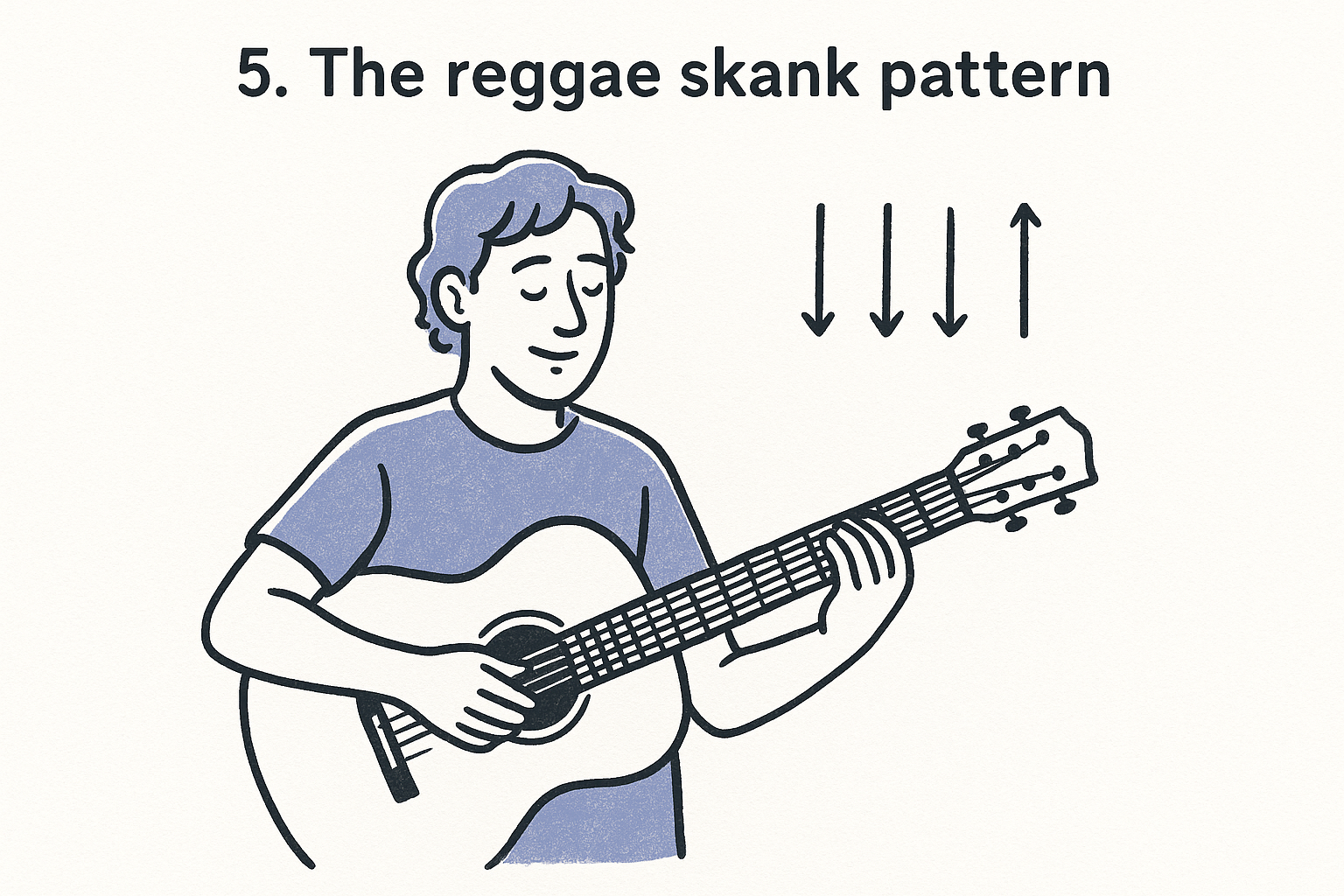
Reggae flips the usual emphasis on its head. Instead of accenting the downbeat, you mute the strings on beats 1 and 3 and let the chord ring out sharply on the upbeats. This off-beat strumming pattern trains your hand to think in terms of silence and accent rather than constant motion, which makes it one of the more useful guitar strumming patterns for developing rhythmic independence.
How to play it
Rest your palm lightly on the strings for beats 1 and 3, then snap a crisp upstroke on the "and" of each beat, letting the chord ring for just a moment before muting again:
Beat:   1  &  2  &  3  &  4  &
Stroke: _  U  _  U  _  U  _  U
A reggae groove lives entirely in what you leave out, not what you play.
Keep the chord short and choppy. The gap between hits is what gives the pattern its bounce.
Songs that use it
Bob Marley's catalog is the obvious classroom here, especially tracks like "Stir It Up" and "Is This Love." You'll also hear this skank rhythm borrowed into ska-punk and even some pop songs that want a laid-back, off-kilter feel.
Practice tips
Start by clapping just the upbeats along with a slow song, around 70 BPM, before you pick up the guitar. Once the timing feels natural in your body, add the muted strums, then the chord.
6. The waltz pattern in 3/4 time
Every pattern so far lives in 4/4 time, but plenty of songs count in three. The waltz pattern trades the usual four-beat feel for a bass-strum-strum motion that rocks instead of drives, making it one of the more distinctive guitar strumming patterns on this list simply because the meter itself feels different under your hand.
How to play it
Play a downstroke on beat 1, hitting mostly the low strings like a bass note, then two lighter downstrokes on beats 2 and 3:
Beat:   1  2  3
Stroke: D  D  D
Weight matters more than motion here. Accent beat 1 heavily and let 2 and 3 sit back, almost like a piano player's left hand doing bass-chord-chord.
In 3/4 time, the strum that matters most is the one you hit hardest, not the one you add.
Songs that use it
You'll find this rhythm in "Kumbaya," Norah Jones' "Come Away With Me," and countless country waltzes built around a rocking, three-beat sway. It's also common in slower singer-songwriter ballads that want a lullaby feel instead of a driving pulse.
Practice tips
Count "one-two-three, one-two-three" out loud before you touch a chord, since most guitarists default to counting in four out of habit. Practice at 100 BPM per beat, and exaggerate the bass note on beat 1 until the rocking feel becomes automatic rather than something you have to force.
7. The 6/8 ballad pattern
Six-eight time feels like two big beats each split into three, and this pattern is built to breathe inside that pulse. It's the rhythm behind slow-dance ballads and rock power ballads alike, giving guitarists a flowing strumming pattern that never sounds rushed even at higher tempos. Among guitar strumming patterns for ballads, this one rewards patience over speed.
How to play it
Count six subdivisions per measure, down on 1, up on 3, down on 4, up on 6, leaving 2 and 5 unstruck to create the rolling feel:
Beat:   1  2  3  4  5  6
Stroke: D  _  U  D  _  U
The 6/8 groove rolls forward on its own once you stop trying to strum every beat.
Let your arm keep swinging through the silent counts, just like the six-stroke pattern earlier. The motion never stops, only the contact with the strings does.
Songs that use it
You'll hear this shape in "House of the Rising Sun," plenty of Adele ballads, and classic rock slow songs like "Nothing Else Matters" by Metallica. It's the default choice whenever a songwriter wants emotional weight without a driving beat.
Practice tips
Count "1-2-3-4-5-6" aloud before adding the guitar, since the compound meter trips up guitarists used to counting in four. Practice at 60 BPM, then let the pattern's natural swing carry the tempo up gradually.
8. The syncopated 16th-note pattern
Funk and R&B guitarists push rhythm further than any pattern so far by splitting the beat into 16th notes and accenting the gaps between them. This syncopated strumming pattern demands more coordination than the others on this list, but it's the one that makes a rhythm part sound funky instead of just busy. Among advanced guitar strumming patterns, this is usually the last one players tackle, since it requires the eighth-note feel from entry two to already be automatic.
How to play it
Keep your arm moving in constant 16th notes, down-up-down-up four times per beat, but only let the pick actually strike the strings on the accented notes, ghosting the rest:
Beat:   1  e  &  a  2  e  &  a
Stroke: D  u  D  u  U  d  U  d
Lowercase letters mark ghost strokes, where your hand moves but barely touches the strings. That constant motion with selective contact is what creates the syncopated snap.
The groove lives in the strokes you fake, not just the ones you actually hit.
Songs that use it
You'll hear variations of this pattern in funk-influenced pop like John Mayer's rhythm parts, plus plenty of Motown and disco-era guitar tracks where the rhythm guitar functions almost like a percussion instrument.
Practice tips
Drill the constant 16th-note motion with muted strings first, at 60 BPM, before worrying about which notes to accent. Add accents one at a time rather than all at once, loop short two-beat chunks until the ghost strokes feel effortless, and give this pattern its own slot in a weekly guitar practice plan.
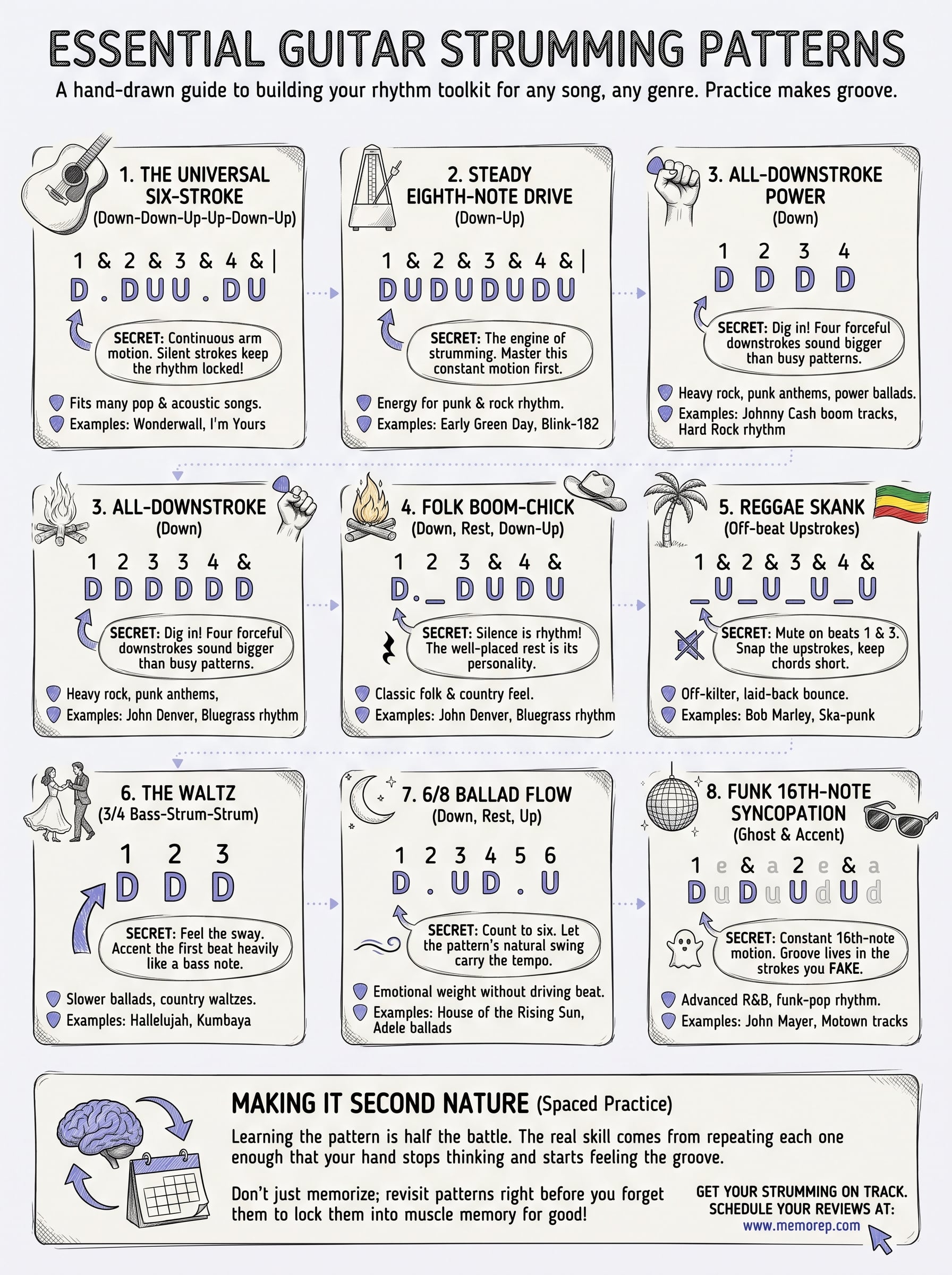
Making these patterns second nature
Eight patterns, one shared truth: reading the arrows on a page won't put them in your hands. Common guitar strumming patterns become useful only after you've drilled each one past the point of thinking about it, and that takes more than a single practice session. You need to hit the down-down-up-up-down-up pattern today, the reggae skank in three days, the waltz next week, right as each one starts slipping from memory.
That's the part most guitarists skip, and it's why patterns learned in January are gone by March. Tracking eight rhythms, plus every chord shape and lick you're also working on, gets messy fast without a system telling you what to revisit and when.
That's exactly the gap MemoRep fills. Instead of guessing, see how MemoRep schedules your reviews and lock these strumming patterns into permanent muscle memory before beta access closes.