Deliberate Practice vs Regular Practice: What's the Difference?
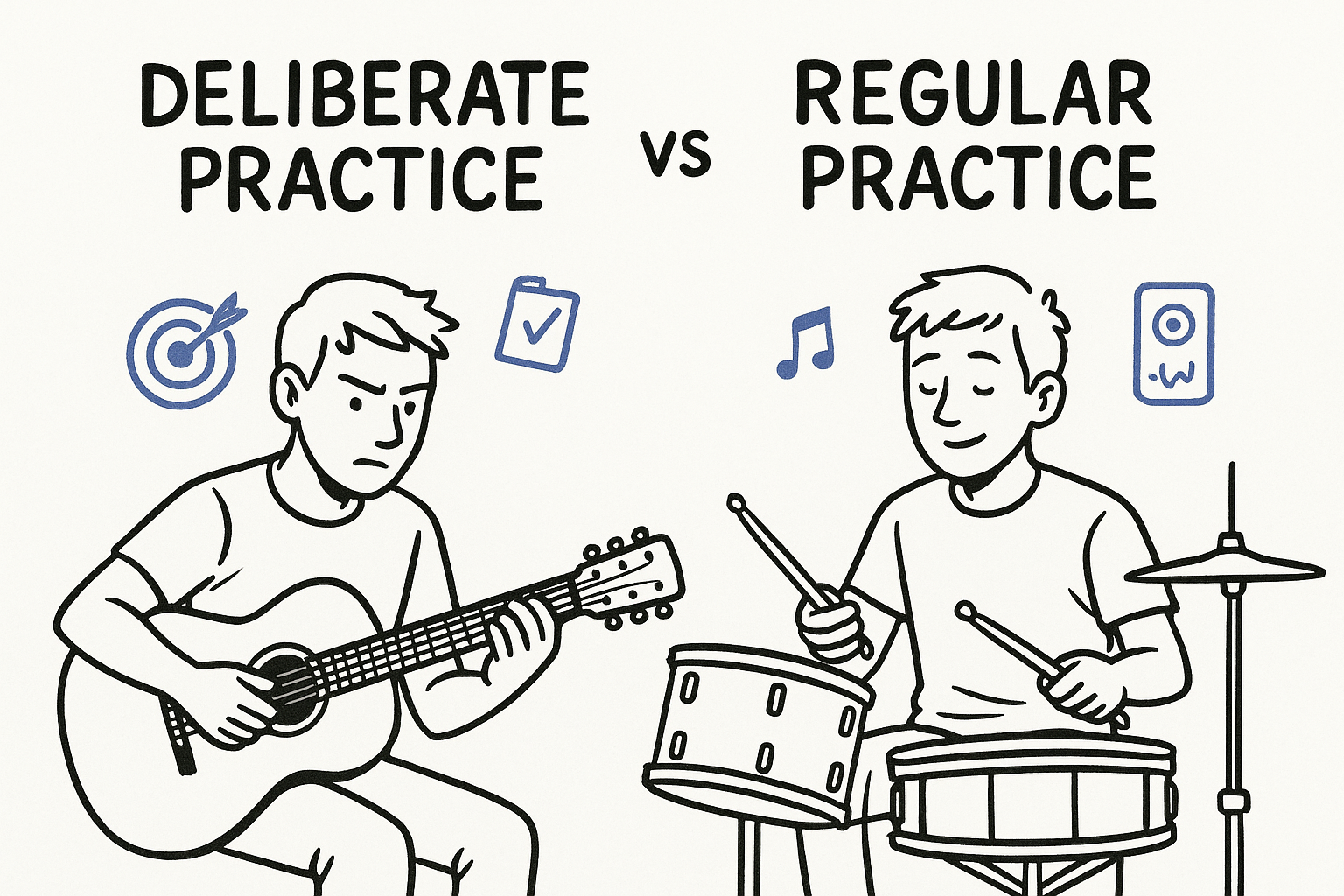
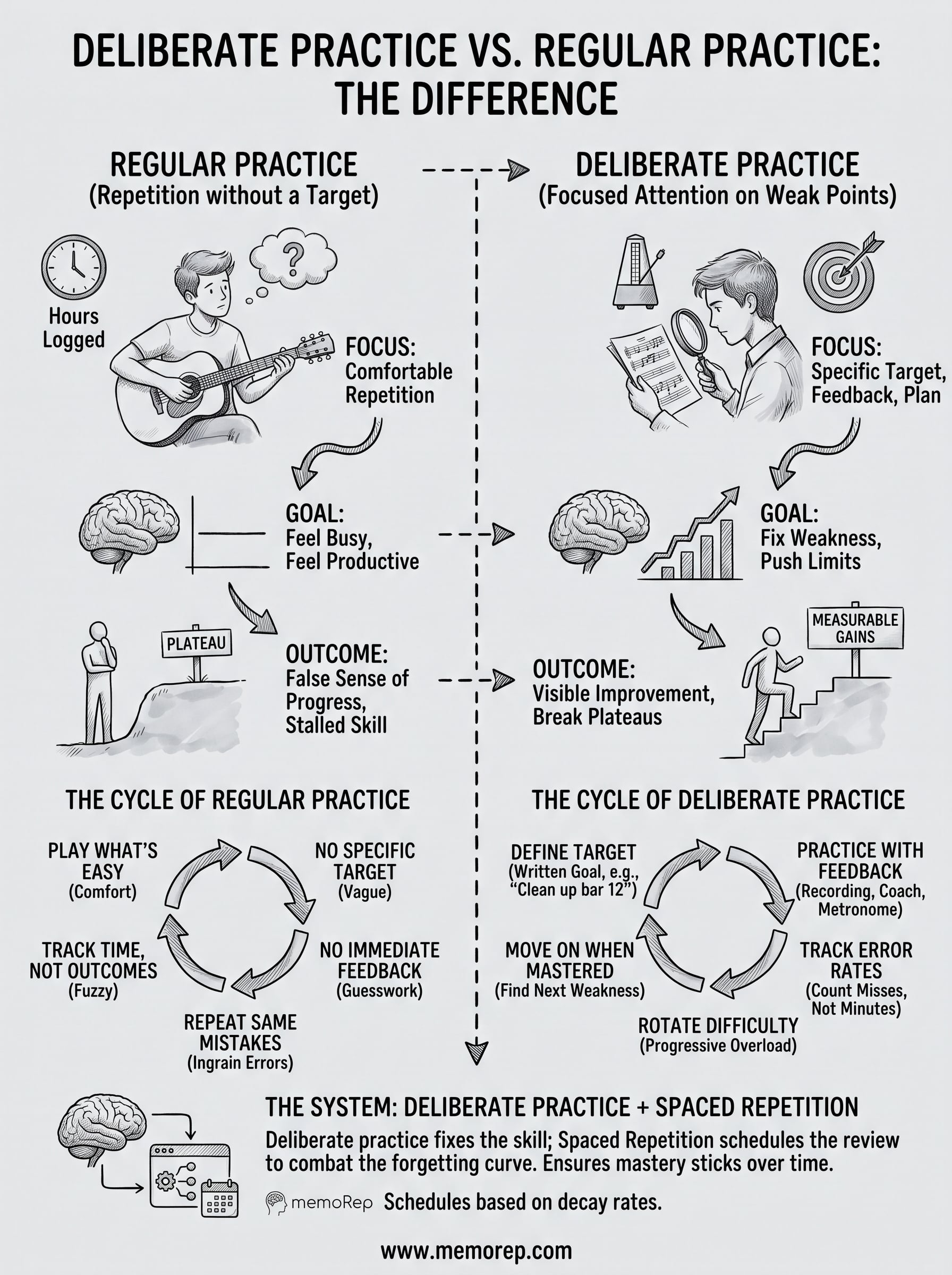
You've probably logged hundreds of hours on your instrument or craft without seeing the progress those hours should have earned you. That's the gap between deliberate practice vs regular practice, and it explains why some people improve fast while others plateau for years doing what feels like the same work. Regular practice is repetition. Deliberate practice is repetition with a target, immediate feedback, and a plan to fix a specific weakness.
If you're here to understand exactly what separates the two, this article breaks it down in plain terms. You'll see concrete examples of each approach in action, from a guitarist mindlessly running scales to one isolating a single problematic chord change and tracking error rate. The core answer: deliberate practice works because it forces focused attention on weak points instead of comfortable repetition of what you already know.
We'll walk through the defining traits researchers use to separate the two, why one produces measurable skill gains and the other often just burns time, and how to spot which one you're actually doing during your next session. You'll also get practical ways to turn your loose, unstructured routine into something closer to structured, feedback-driven practice, the kind that actually moves the needle.
Why deliberate practice matters more than regular practice
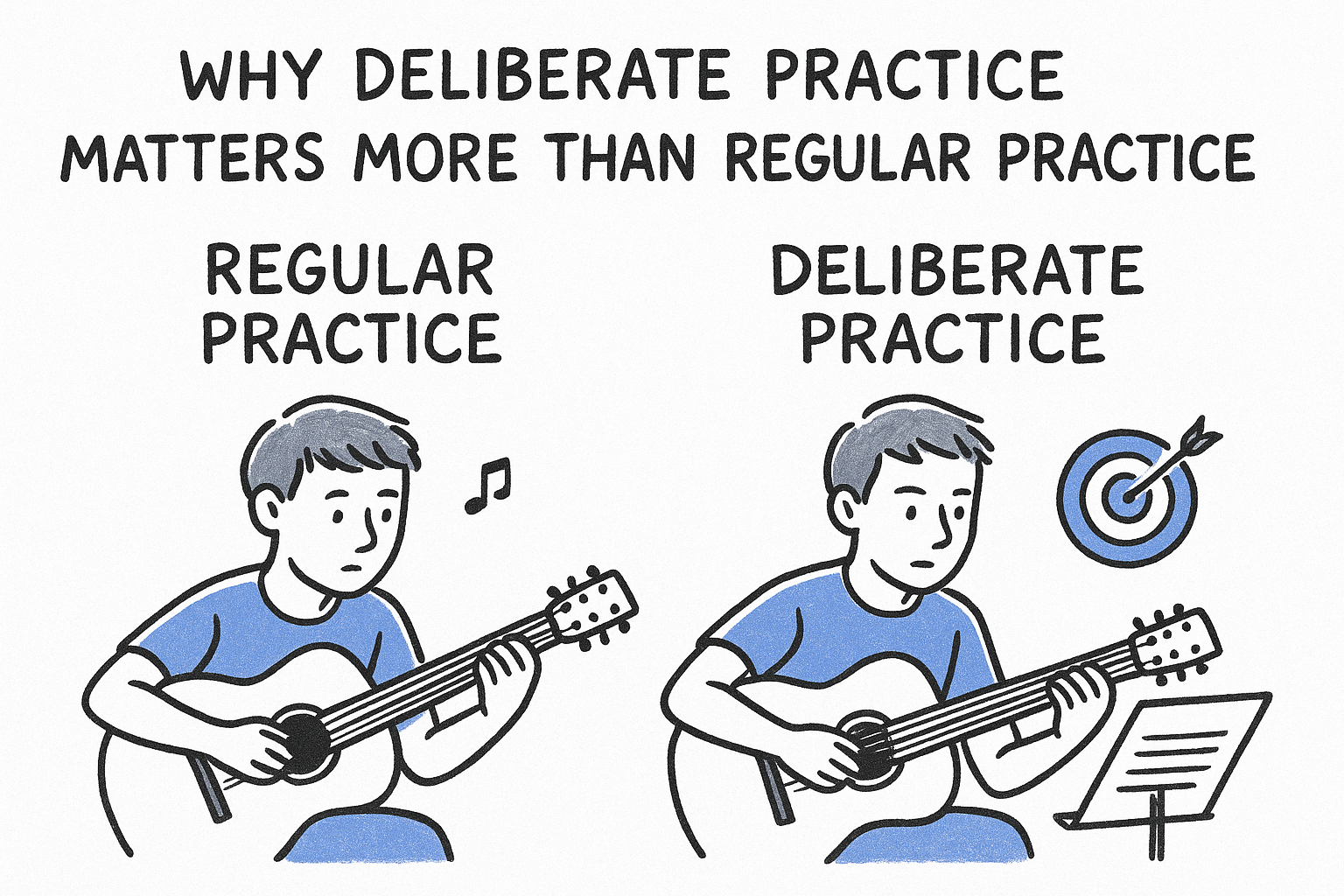
Psychologist K. Anders Ericsson spent decades studying what actually separates experts from hobbyists, and his research is the foundation for nearly every serious conversation about skill acquisition today. His famous study of violin students at a Berlin music academy, published through work later summarized by the American Psychological Association, found that the top performers didn't just practice more hours than everyone else. They practiced differently. The elite group spent their time on targeted, effortful tasks designed to push past their current limits, while the average group logged similar hours doing familiar, comfortable repetition. Same clock time, wildly different outcomes.
The research behind the gap
That finding matters because it kills the myth that hours alone predict mastery. Total practice time is a weak predictor of improvement once you control for how those hours were spent. A drummer who practices for 45 minutes a day with a metronome, a specific tempo goal, and a log of missed hits will outpace a drummer who jams for two hours without any structure. The second drummer isn't lazy. He's just spending his time on passive repetition that reinforces existing habits instead of correcting them.
Hours logged don't predict skill gained. What you do inside those hours does.
What regular practice actually does to your skill
Regular practice tends to lock you into a comfortable groove. You play the passage you already know, run the drill you've already mastered, or rehearse the routine that feels good because it doesn't expose your weak spots. This creates a false sense of progress. You feel busy, you feel productive, and you walk away tired, which your brain interprets as effort well spent. But skill plateau happens precisely because your brain stops adapting once a task becomes automatic. Neuroscience research on motor learning, including work referenced by the National Institutes of Health, consistently shows that improvement requires novel challenge, not repetition of what's already automatic.
Think about a pianist who practices the same piece for months without changing anything about how they approach it. They get faster at the parts they already play well and never touch the two measures that keep tripping them up. That's regular practice in its purest form: comfortable repetition dressed up as diligence.
The compounding effect over months, not days
The real cost of regular practice shows up over time, not in a single session. A single unstructured practice session and a single deliberate one might look similar in the short term. The gap widens dramatically once you stack weeks and months on top of each other, because deliberate practice compounds while regular practice flatlines.
| Time invested | Regular practice outcome | Deliberate practice outcome |
|---|---|---|
| 2 weeks | Slight comfort with familiar material | Measurable drop in error rate on target skill |
| 1 month | Feels productive, little measurable change | Visible improvement in the specific weak point |
| 3 months | Plateau, same mistakes recur | New skill becomes automatic, next weak point identified |
| 6 months | Frustration, motivation drops | Compounding gains across multiple skills |
This table isn't hypothetical fluff. It reflects the pattern practitioners report again and again: unstructured repetition produces a flat curve, while targeted, feedback-driven work produces a stair-step curve where each plateau gets broken through deliberately.
Why this distinction matters more for practical skills
Musicians, athletes, and craftspeople face a specific problem that language learners and test-takers don't: practical skills require motor memory, not just recall. You can't cram a chord change the night before a performance the way you might cram vocabulary before an exam. Motor patterns get built slowly, through repeated correct execution under increasing difficulty, and they get undone quickly through neglect or through repeated incorrect execution.
This is exactly why the deliberate practice vs regular practice distinction carries higher stakes for a guitarist, drummer, or dancer than it does for someone memorizing flashcards. A skill practiced incorrectly a hundred times doesn't just fail to improve, it actively ingrains the error. Fixing an ingrained bad habit takes far longer than building the correct pattern from scratch would have. Every session of regular practice on a flawed technique is a small step backward disguised as a step forward.
The decision fatigue problem
There's a second reason deliberate practice wins out, and it has nothing to do with the mechanics of skill building. It has to do with decision fatigue. Musicians juggling ten pieces, an athlete managing multiple drills, or a language-adjacent skill practitioner tracking dozens of exercises all face the same daily question: what do I work on today? Regular practice usually answers that question by default, you play whatever feels good or whatever you remember to open. Deliberate practice answers it with a plan, whether that plan comes from a coach, a written schedule, or an algorithm that tracks which skills are decaying fastest.
Removing that daily decision doesn't just save time. It removes a source of mental friction that causes many practitioners to skip sessions altogether. When you know exactly what to practice and why, you show up more consistently, and consistency is the other half of the equation that even the most efficient deliberate technique can't replace. The two most important lessons from this section are simple: focus without structure eventually stalls, and structure without focus never gets a chance to prove itself. You need both, and the rest of this article shows you how to build them into a routine you can actually sustain.
How to turn regular practice into deliberate practice
Converting a loose routine into deliberate practice doesn't require a coach, a lab, or hours of extra time. It requires a specific target for every session and a way to measure whether you hit it. Musicians who make this switch usually describe the same feeling: practice suddenly feels harder, less pleasant, and far more productive. That discomfort is the signal you're doing it right, because comfort is exactly what regular practice optimizes for.
Define the target before you touch your instrument
Before you play a single note, name the one thing you're fixing today. Not "get better at the piece," but "clean up the string crossing in bar 12" or "hit the downbeat within 20 milliseconds of the click." A vague goal produces vague practice, and vague practice is just regular practice wearing a disguise. Written goals beat mental ones because they force specificity you can't fudge later when you're tired and want to call the session a win.
A practice session without a written target is just a warm-up that never ends.
Build a feedback loop into every session
Once you have a target, you need a way to know immediately whether you're closing in on it. Recording yourself, using a metronome with a visual offbeat indicator, or working with a teacher all serve the same purpose: they replace guesswork with data. Without immediate feedback, you can repeat the same error fifty times and feel like you're working hard. Musicians who train alone often skip this step because it's uncomfortable to hear their own mistakes played back, but that discomfort is where the actual learning happens.
Here's a simple checklist to run before starting any session:
- Name the specific weak point you're targeting today
- Choose a measurable indicator (error count, tempo hit, timing accuracy)
- Set up a feedback method (recording, metronome, mirror, teacher)
- Decide on a stopping rule tied to the metric, not the clock
- Log the result immediately after, while it's fresh
Track error rates, not just time
Stop measuring practice in minutes and start measuring it in outcomes. Error tracking turns a fuzzy sense of "that felt better" into an actual number you can compare across sessions. If you missed the chord change eight times out of twenty attempts on Monday and five times out of twenty on Wednesday, you have proof of improvement. If you only tracked minutes spent, you'd have no idea whether Wednesday's session did anything at all. This single habit change, swapping the clock for a counter, is often the fastest way to convert regular practice into deliberate practice without changing anything else about your routine.
Rotate difficulty like a rep scheme
Once a target skill stops producing errors, it stops producing growth too. Progressive difficulty keeps the challenge just above your current level, which is where real adaptation happens according to motor learning research summarized by the National Institutes of Health. Increase the tempo by five beats per minute, add a second hand to the drill, or introduce a distraction while you play. Weightlifters call this progressive overload, and the same logic applies to a guitar fretboard or a dance routine.
Rotating difficulty also solves a problem regular practice never addresses: what to do once you've technically mastered something. Regular practice keeps rehearsing the mastered version forever, burning time on diminishing returns. Deliberate practice moves on the moment the metric shows mastery, then finds the next weak point and repeats the same four-step loop. That loop, target, feedback, tracking, rotation, is the entire mechanism. Everything else in this article is just examples of it working in different skills.
Deliberate practice vs regular practice in real skills
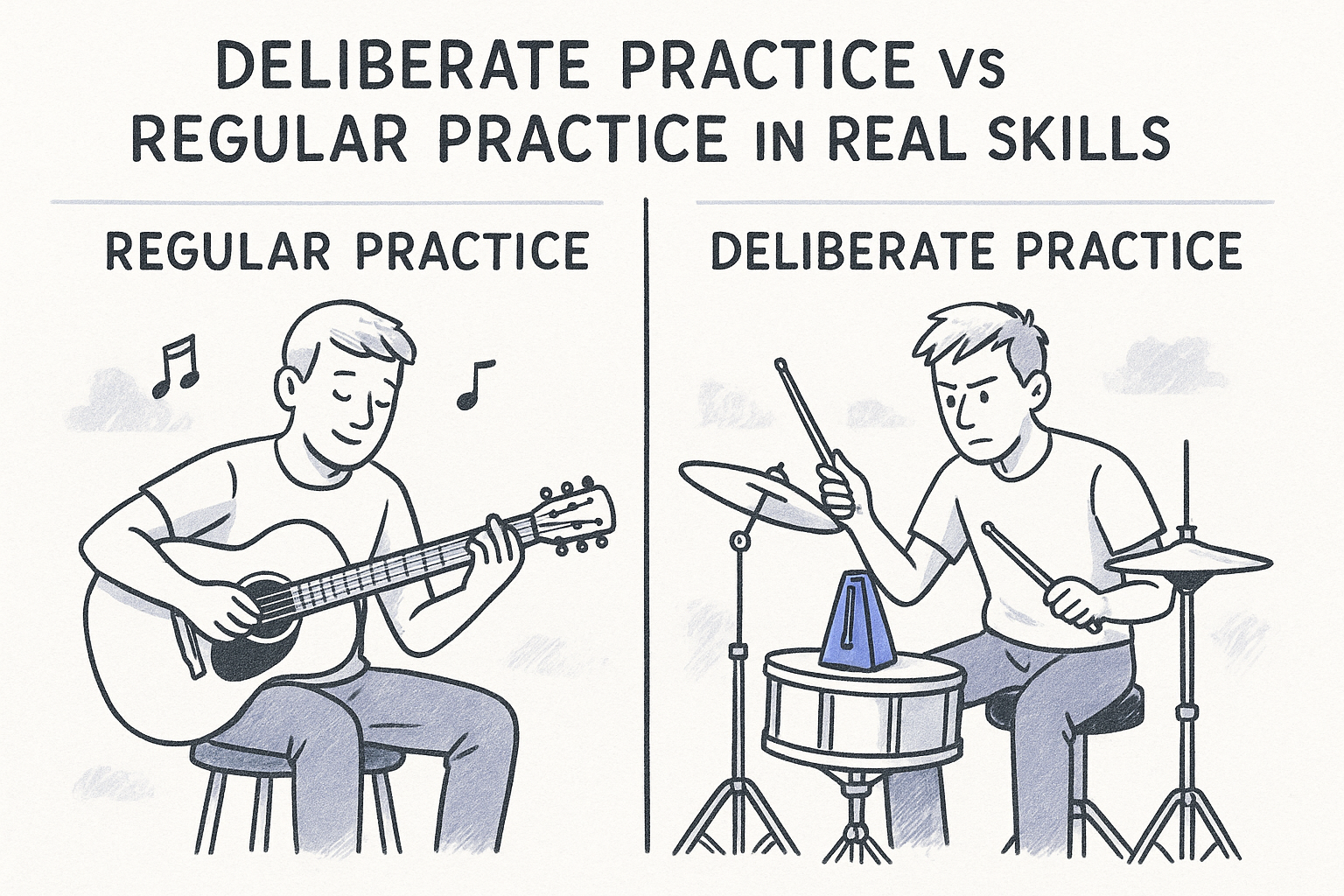
Abstract definitions only go so far. Watching how deliberate practice vs regular practice plays out inside three different skills, guitar, drumming, and dance, makes the distinction impossible to miss. Each example below shows the same pattern: one version treats practice as a container of time, the other treats it as a series of targeted problems to solve.
Guitar: scales versus a single chord change
Guitarists love running scales because scales feel productive without demanding much thought. Fingers move, sound comes out, and the session feels full. But running a scale you've already mastered for the tenth week in a row is passive maintenance, not growth. A deliberate approach looks completely different: isolate the one chord change that trips you up, slow it down to half tempo, play it twenty times in a row, and count how many of those twenty come out clean. Next session, you compare the number. That single habit, counting clean reps instead of just playing through, turns an unfocused warm-up into a measurable drill.
Drumming: free jamming versus metronome-locked drills
Drummers face a similar trap. Jamming along to a favorite track for thirty minutes feels like practice, and it's genuinely fun, but it rarely fixes timing problems because you never isolate the beat you're rushing or dragging. Metronome-locked drills solve this by giving you a fixed reference point and a specific error to chase down. Set the click at 80 BPM, play a single fill, and note whether you land ahead of, behind, or on the beat. Move up five BPM only once you're consistently on time. This is the same progressive-difficulty logic from the previous section, applied to a completely different instrument.
The instrument changes, the discipline doesn't: name the flaw, measure it, fix it, move on.
Dance and physical technique: repetition versus corrected reps
Dance and martial arts make the contrast even starker because the body forgets nothing, including bad habits. Running through a choreography sequence from start to finish repeatedly, without a mirror or a coach pointing out a collapsed knee or a late turn, just grooves the error deeper into muscle memory. A dancer working deliberately isolates the eight-count that's off, watches it in a mirror or on video, and repeats only that section until the correction sticks before rejoining it to the full sequence. The difference isn't effort, both dancers sweat the same amount, it's where the effort gets pointed.
A side-by-side comparison across skills
Seeing these examples laid out together makes the pattern obvious, and it's the same pattern regardless of the skill involved.
| Skill | Regular practice approach | Deliberate practice approach |
|---|---|---|
| Guitar | Run full scales repeatedly | Isolate one chord change, count clean reps |
| Drumming | Jam freely to a track | Metronome drill on a single fill, track timing accuracy |
| Dance | Run full choreography end to end | Isolate one eight-count, correct with mirror or video |
| Public speaking | Rehearse the whole speech | Isolate the weak transition, record and review it alone |
Notice that in every row, the deliberate version shrinks the unit of practice. That shrinking is the actual mechanism. Smaller, measured units of practice let you apply immediate feedback and track progress in a way that a full run-through never allows. Whole-skill repetition feels more complete, but it hides your weak points inside a wash of things you already do well, which is exactly why it produces slower gains no matter how many hours you log.
Signs your practice is regular practice in disguise
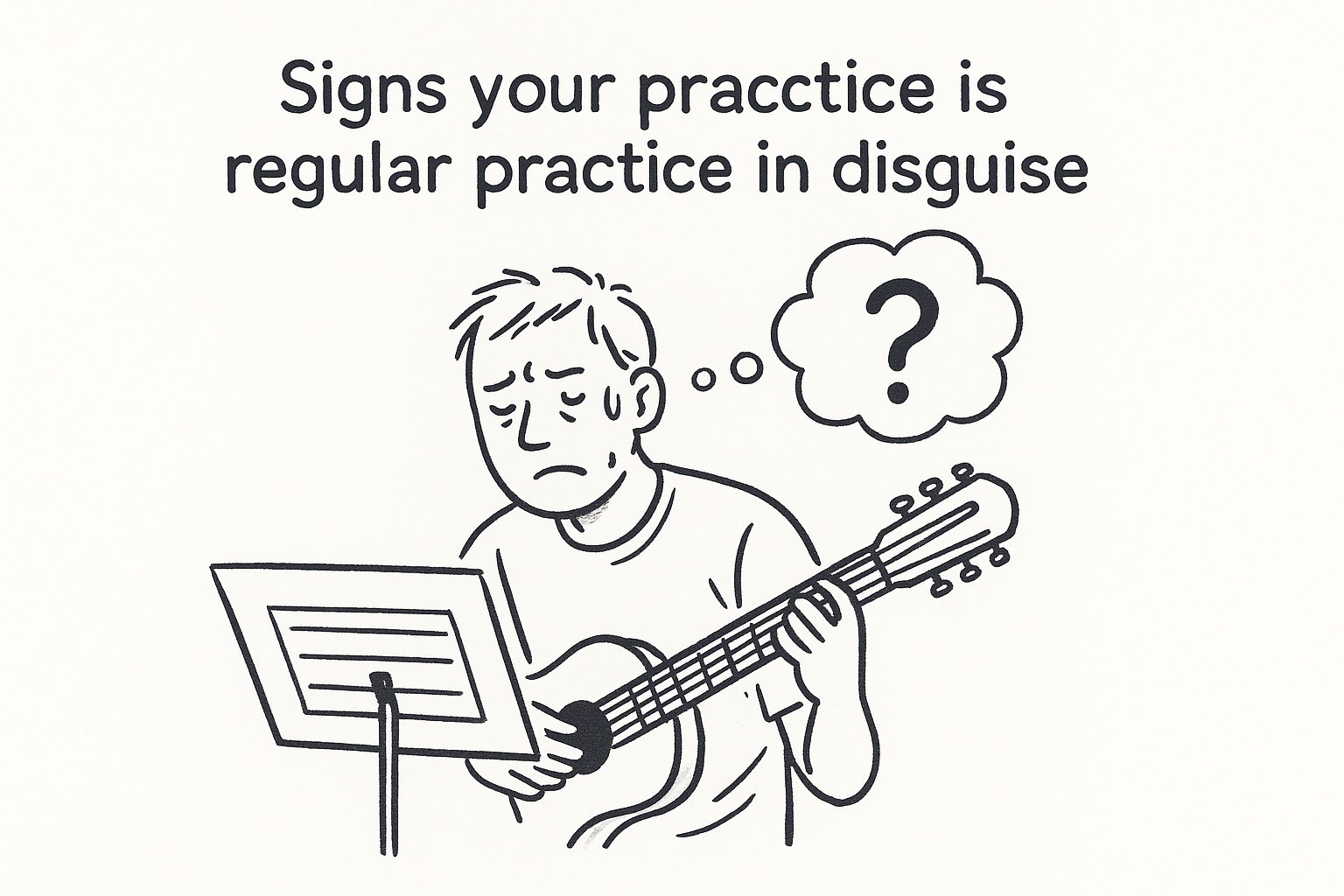
Many musicians think they're practicing deliberately because they're focused, tired, and sweating by the end of a session. Effort alone doesn't prove anything, though. Regular practice can feel just as intense as deliberate practice, which is exactly why it's so easy to mistake one for the other. The signs below are the tells that give it away once you know what to look for.
You feel tired but can't say what improved
Walking away from a session exhausted feels like proof you worked hard, but exhaustion measures effort, not progress. Ask yourself a simple question right after you finish: what specifically got better today? If the honest answer is "I'm not sure" or "I just played through everything," you were logging time, not fixing a weakness. Vague fatigue is a classic symptom of regular practice wearing the costume of hard work.
If you can't name what improved, nothing measurable did.
You keep returning to the parts you already play well
Comfort pulls hard, and most practitioners drift toward the passages, drills, or routines they've already mastered without noticing they're doing it. It feels good to nail something cleanly, so you play it again, and again, while the actual weak spot sits untouched two pages later. This pattern shows up constantly in self-directed sessions where nobody is watching to redirect your attention. If you tracked exactly how many minutes you spent on material you can already perform versus material that's genuinely hard for you, most people would be shocked at the ratio.
You avoid the parts that expose your mistakes
Deliberate practice requires walking straight into your weakest moment and repeating it until it's fixed. Regular practice does the opposite, it skips past the hard transition or plays it just fast enough to blur the mistake. Avoidance behavior like this is easy to spot once you're looking for it: notice whether you slow down and isolate the tricky measure, or speed through it hoping momentum covers the flaw. Skipping the uncomfortable four seconds of a piece, night after night, is how a fixable problem becomes a permanent habit.
You can't quote a number from your last session
Deliberate practice always produces a data point: an error count, a tempo reached, a percentage of clean reps. Regular practice usually produces nothing more specific than a feeling. If someone asked you right now what your error rate was on yesterday's hardest passage, could you answer with a number? Most people practicing without structure can't, and that gap is the clearest single diagnostic marker available.
Run through this checklist honestly after your next few sessions. If you answer yes to two or more, you're likely running regular practice under a deliberate-sounding label:
- You finished the session without writing down a specific target beforehand
- You spent more time on material you already play well than on your weak point
- You can't state a number (errors, tempo, accuracy) from the session
- You avoided or rushed through the hardest four to eight seconds of the piece
- You felt tired afterward but couldn't name what specifically improved
- You practiced the same length of time as always, regardless of what you were working on
The self-audit habit that fixes this fast
Spotting these signs matters less than acting on them. Building a two-minute post-session audit into your routine, just answering "what did I target, and did it improve?" out loud or on paper, closes most of the gap immediately. It won't fix decades of unfocused habits overnight, but it forces the kind of honesty that regular practice quietly avoids, and honesty is the first ingredient deliberate practice actually requires.
Why feedback and coaching set deliberate practice apart
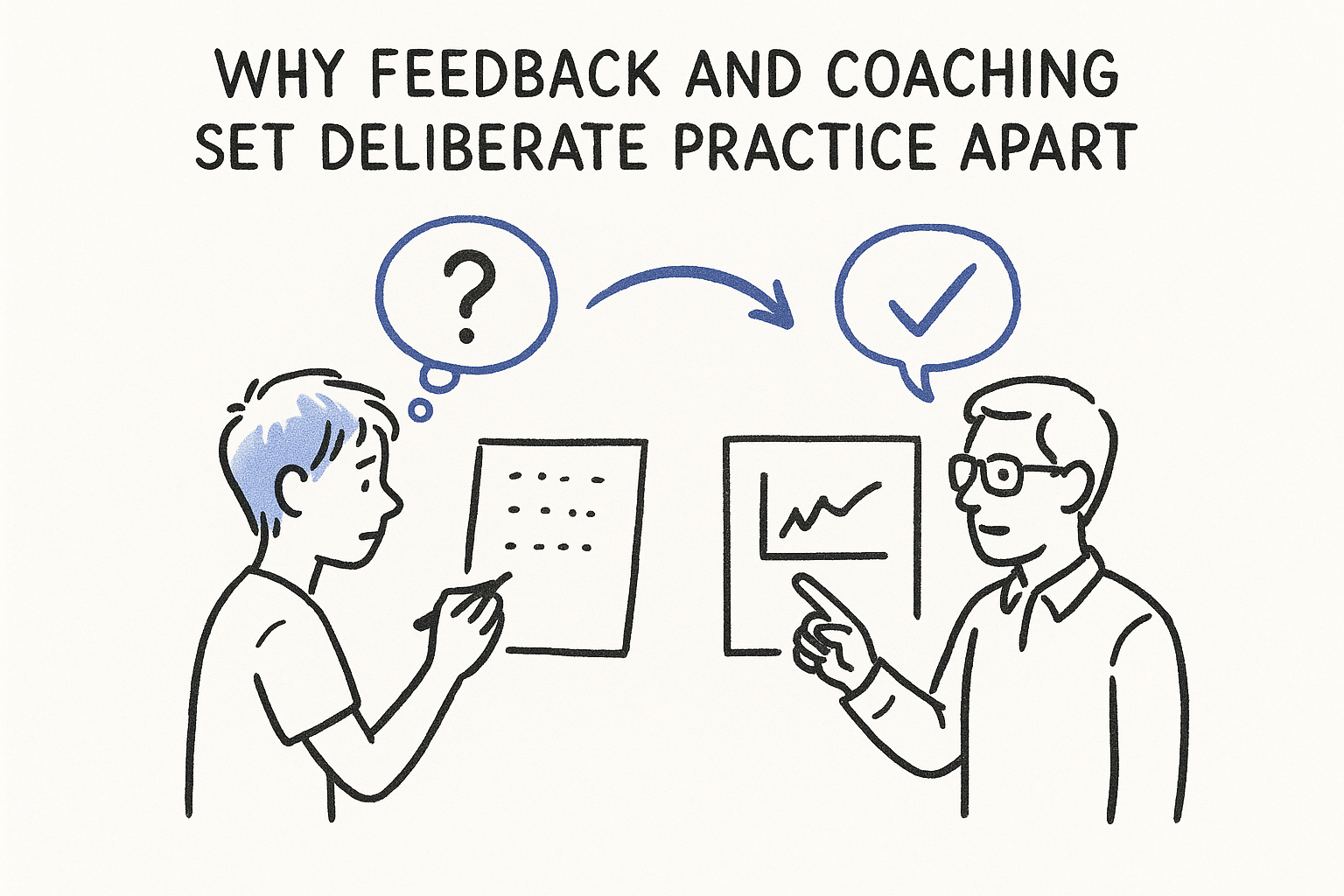
Every example so far has pointed at the same missing ingredient in regular practice: nobody is telling you when you're wrong. Ericsson's research on expert performance keeps circling back to this point, and organizations like the American Psychological Association have summarized it clearly: external feedback is what separates practice that improves you from practice that just occupies time. You can be as focused and motivated as possible, but if you can't tell whether your last rep was better or worse than the one before it, you're navigating blind.
What a coach actually does that you can't do alone
Good coaches aren't valuable because they know more theory than you, they're valuable because they catch errors you're physically incapable of noticing in real time. A guitar teacher hears a rushed downbeat half a second before you do. A dance instructor sees a collapsed knee that feels perfectly normal from inside your own body. This is the core function of outside observation: it closes the gap between what you think happened and what actually happened. That gap is invisible to you by definition, which is exactly why self-assessment alone, no matter how honest, hits a ceiling.
You can't correct what you can't perceive, and a coach exists to perceive what you can't.
Building feedback loops when you can't afford a coach
Most musicians and skill learners don't have weekly access to a teacher, and that's fine, because coaching is one method of feedback, not the only one. Substitute feedback tools can replace a human set of eyes for most of what deliberate practice requires:
- Record video or audio of every practice attempt on your target skill
- Play the recording back immediately, not days later when memory has smoothed over the mistake
- Compare against a reference recording (a professional performance, a metronome track, a tutorial)
- Use a mirror for anything involving posture, form, or movement
- Bring recordings to an occasional lesson so a real coach can spot-check your self-diagnosis
The pattern across all five is the same: something outside your own perception has to catch the error, because your brain is too invested in the performance to judge it objectively while it's happening.
Why immediate feedback beats delayed feedback
Timing matters as much as accuracy. Feedback that arrives a week later, like a teacher's comment at your next lesson, still helps, but it forces you to remember and reconstruct an error instead of feeling it fresh. Immediate correction lets your nervous system link the mistake and the fix while the motor pattern is still active, which is when actual relearning happens. This is why practitioners who record themselves and review the footage within minutes improve faster than practitioners who wait for a weekly lesson to find out what went wrong, even when the weekly lesson is with a highly skilled teacher.
Feedback quality beats feedback quantity
More feedback isn't automatically better feedback. A teacher who says "that was good, try it again" gives you almost nothing to act on, while one who says "you rushed beat three by about a sixteenth note" gives you a target you can actually fix. The same applies to self-review: watching your own video and thinking "that felt off" is weaker than watching it with a specific question in mind, like "did my wrist stay level through the whole phrase?" Specific feedback turns a vague impression into an actionable next rep, and that specificity is what makes coached practice so much more efficient than solo guessing, session for session.
The practical takeaway is straightforward: if you have access to a coach, use every session to get specific, targeted corrections rather than general encouragement. If you don't, build your own feedback loop with recordings, mirrors, and reference material, and treat that loop as non-negotiable, not optional. Either way, the goal is the same one that's run through this entire article: replace guesswork about your performance with actual information about it, every single session.
Using spaced repetition to structure deliberate practice
Everything covered so far explains how to make a single session deliberate: a target, a feedback loop, a tracked metric, and a rotation once mastery shows up. Spaced repetition answers the question that comes right after that loop finishes: what do you revisit, and when? Without a system, most practitioners either drop a mastered skill entirely or keep rehearsing it out of habit long after it stopped needing attention. Spaced repetition schedules the return trip automatically, based on how quickly a specific skill tends to fade.
The forgetting curve problem deliberate practice must solve
Hermann Ebbinghaus documented over a century ago that memory and skill retention decay in a predictable curve, sharp at first, then flattening out, and each successful review resets and flattens that curve further. This pattern holds for motor skills as well as recall, which is why a chord change you nailed last month can feel shaky today even though you never consciously forgot it. The forgetting curve is the hidden reason regular practice feels inconsistent: you're not managing decay on purpose, so it manages you instead. Deliberate practice without a review schedule still leaves this gap open, because naming a target and tracking an error rate says nothing about when to check back in on a skill you already fixed.
Fixing a weak point once means nothing if you never schedule the moment it starts fading again.
How spaced repetition schedules the rotation step
Algorithms built on this research, most notably the SuperMemo SM-2 method, calculate the ideal review interval for each individual skill based on how well you performed last time. A skill you rated "Easy" gets pushed weeks out. One you rated "Again" comes back tomorrow. This is exactly the rotation step from the deliberate practice loop, just automated and personalized instead of guessed at manually. Research on motor learning summarized by the National Institutes of Health supports the same underlying principle: spacing practice at increasing intervals produces stronger, more durable skill retention than cramming the same material every day or abandoning it after one good session.
Turning ratings into practice decisions
A simple four-option rating system, Again, Hard, Good, Easy, turns the fuzzy question "do I still need to work on this?" into a concrete input the schedule can act on. Rating-based scheduling removes the daily decision fatigue covered earlier in this article, because you're no longer guessing which of fifteen skills needs attention today. Compare the two approaches directly:
| Approach | How review timing gets decided | Risk |
|---|---|---|
| Manual memory | You try to remember what needs revisiting | Skills quietly decay unnoticed |
| Fixed calendar | Every skill reviewed on the same schedule | Wastes time on mastered skills, neglects fragile ones |
| Spaced repetition algorithm | Interval adjusts per skill based on your last rating | Matches review timing to actual decay rate |
Why this closes the loop for practical skills
Practical skills, unlike flashcard facts, involve dozens of individual techniques running on different decay timelines at once. A practice management system built on spaced repetition tracks each one separately: the chord change you fixed last week, the tempo drill from last month, the eight-count you corrected yesterday. Applying spaced repetition here doesn't replace anything from earlier in this article, it schedules when the target, feedback, and tracking steps happen again for a skill you already worked on, so nothing you've fixed quietly slips back into being a weak point.
Practicing with purpose from here on
The real answer to deliberate practice vs regular practice isn't complicated: one gives your brain a specific problem to solve, the other gives it something to do. Hours don't build skill on their own. A target, a feedback loop, a tracked number, and a schedule for revisiting what you've already fixed are what actually move you forward. You now have the framework Ericsson's research points to and the practical steps to apply it session by session.
What's usually missing isn't motivation, it's the system to run all this without burning out on manual tracking. That's exactly the gap spaced repetition software closes, deciding what to revisit and when so you spend your energy on the practicing itself. If you want to see the algorithm behind that decision, check out how memoRep works, then put it to work on your own routine.