Guitar Scale Practice Routine PDF: 5 Types to Look For
A good guitar scale practice routine PDF has a clear scope, a fixed number of items, and a source you trust, ideally your teacher. Five types cover almost every free sheet. Open-position scale sheets suit beginners. Movable pattern sheets suit intermediate players. Pentatonic position sheets suit soloists. Interval and arpeggio routines suit advanced players. Graded daily-scale books suit classical players.
Free sheets are easy to find, but a guitar practice routine PDF is a list, not a plan. It does not tell you what to play on Tuesday or which key is starting to fade. Most players end up repeating page one every day or skipping pages they dislike. Both habits leave gaps that show up weeks later.
This article does not host a download, and it does not teach technique or theory. Which scales to learn and how to play them is your teacher's call. What we cover is what each PDF type contains, who it suits, and how to schedule it so every page gets revisited at the right time. That scheduling job is what MemoRep does, so we treat each sheet as raw material for practice cards.
1. Open-position scale sheets
What the sheet covers
These are the simplest free PDFs. They collect one-octave scales that use open strings, usually major first, then natural and harmonic minor. Tab usually sits beside standard notation.
- One octave per key
- Major first, minor variants after
- Short enough for one pass per session
Who it suits and how to schedule it
Beginners and returning players get the most from this type. A short sheet means a short list of cards, so you can review everything in one sitting without feeling buried. Ask your teacher which scales on the sheet to start with, because the best scale to practice depends on your repertoire and level.
For scheduling, make one card per key, the same way you would memorize music scales in separate cards. Rate each card honestly after you play it. A card you rate Again comes back soon, and a card you rate Easy waits longer.
A short sheet works best when every key gets its own card and its own review date.
2. Movable pattern sheets
What the sheet covers
Movable sheets show scale shapes that slide up and down the neck. Typical versions give seven three-notes-per-string shapes for the major scale, or the five CAGED-derived shapes carried through all twelve keys. They are denser than open-position sheets and often run many pages.
- Seven or five shapes per scale
- Repeated across several or all keys
- Tab, notation, or both
Who it suits and how to schedule it
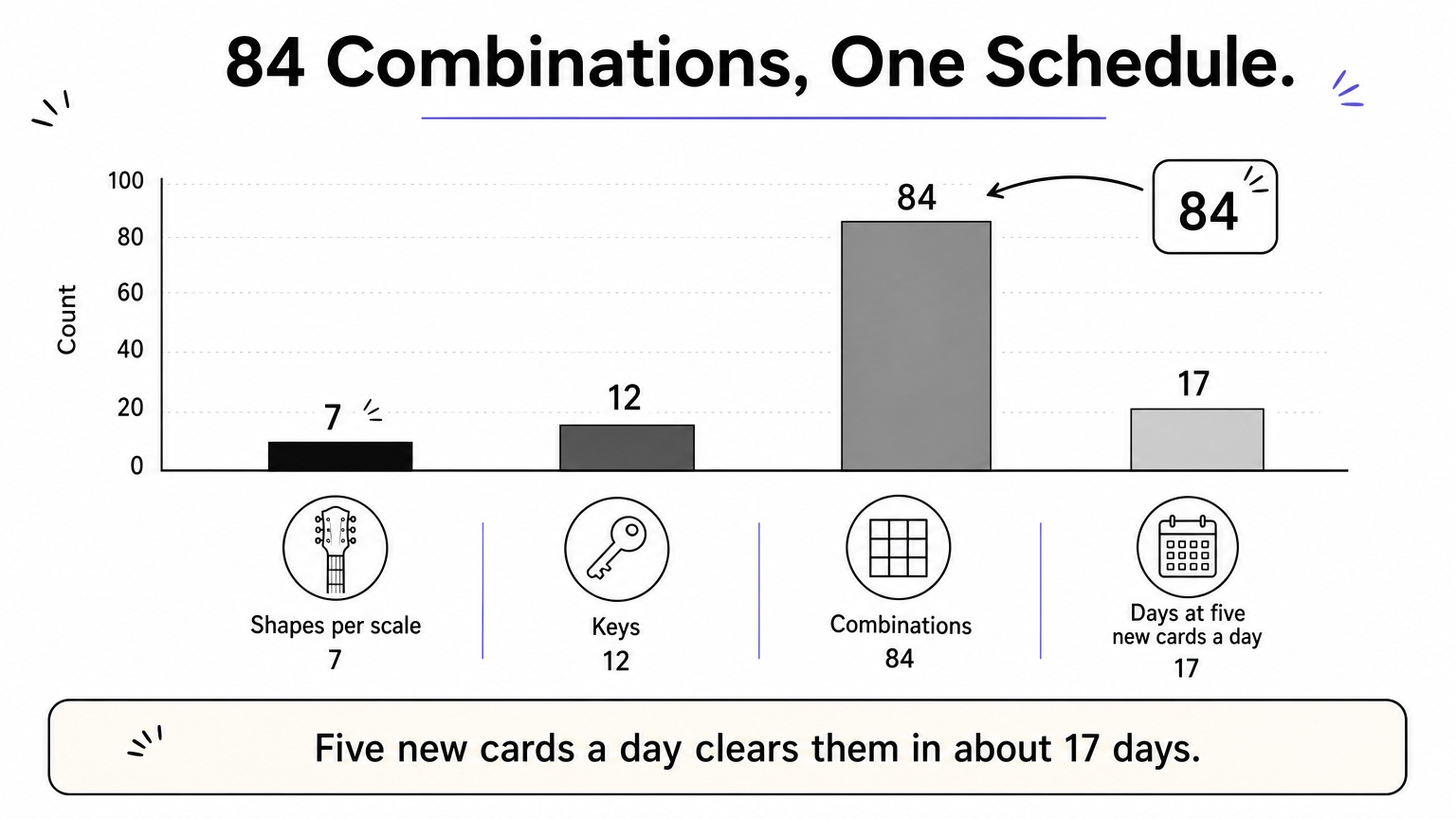
Intermediate players who already know their open-position scales are the audience. The challenge here is volume. Seven shapes across twelve keys is 84 combinations. Adding five new cards a day, you would need about 17 days just to introduce them all.
That is where a plain printout fails. You cannot repeat 84 items daily. Group the cards by shape, introduce a few at a time, and let a scheduler built on spaced repetition for guitar surface the ones about to go rusty instead of scanning the whole PDF each morning.
Eighty-four combinations need a schedule, not a daily read-through.
3. Pentatonic position sheets
What the sheet covers
Pentatonic PDFs usually show the five positions of the minor pentatonic scale in one key, often A minor. Some add a second page in another key with a rhythmic pattern, such as triplets, applied across the same five positions.
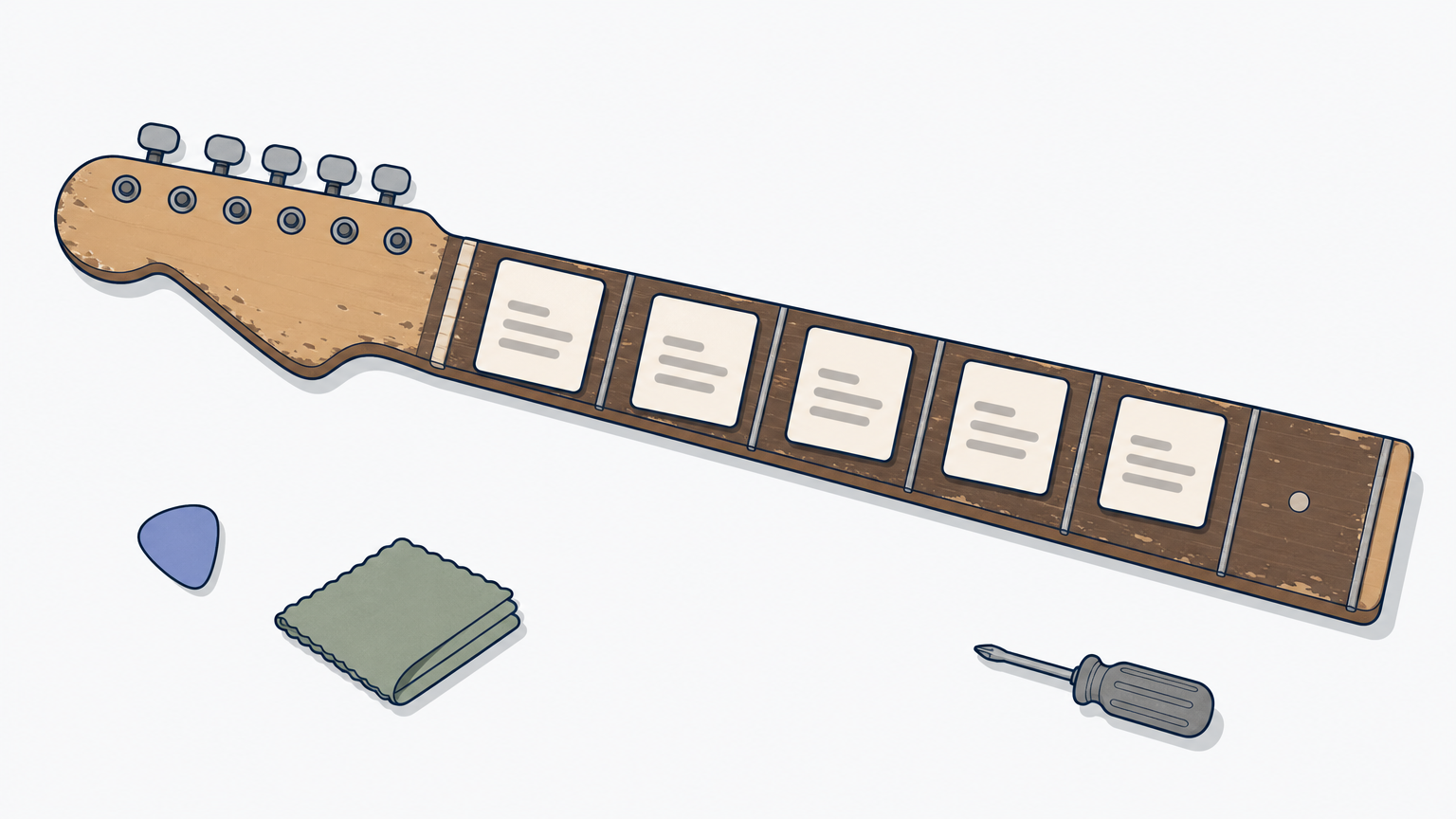
- Five positions per key
- Tab with notation or box diagrams
- Sometimes a rhythmic variation page
Who it suits and how to schedule it
Players who want to solo in rock, blues, or similar styles tend to pick this type, since the sheet is compact and tied to the music they want to play. Confirm with your teacher that it fits your current goals.
Each position is its own item, so make five cards per key. Positions rarely feel equally comfortable, and separate ratings capture that. A position you rate Hard returns quickly, while one you rate Good moves out to a longer interval. Your effort goes where the gaps actually are.
Five positions are five separate skills, so rate and schedule them separately.
4. Interval, triad, and sequence routines
What the sheet covers
These routines go beyond scale shapes. They present the same scale as diatonic intervals, triads, seventh-chord arpeggios, and note sequences. Teachers often hand them out as a single daily routine that you work through in one sitting.
- Intervals such as thirds
- Triad and seventh-chord arpeggios
- Sequences and melodic patterns
- Usually one key at a time, repeated for others
Who it suits and how to schedule it
Intermediate and advanced players who improvise or want a daily workout use this type. Players often skip the interval pages because they feel awkward. A written routine does nothing about that.
Turn each exercise into a card and tag it with its key. Instead of working all exercises in every key daily, you see the ones due today. The routine stays varied, and nothing gets silently dropped because it is unpleasant.
A routine you can skip without noticing is not a routine, so give every exercise a due date.
5. Graded daily-scale books
What the sheet covers
Some free PDFs are small books that grade scales into levels, from beginner to advanced. Classical guitar versions are common, and some use five levels. Each level adds keys, ranges, or more demanding material than the one before.
- Several levels in one document
- Beginner through advanced content
- Often paired with an explanatory lesson
Who it suits and how to schedule it
Classical players, students preparing for exams, and anyone who wants a visible progression should choose this type. Check with your teacher before starting at a higher level, because the book's labels are not a placement test.
Create cards by level section. Keep the current level's cards active, and add the next level once your recent ratings are mostly Good or Easy. That way the PDF sets the order of material, and the schedule sets the timing of each review.
A graded book gives you the order, and the schedule gives you the timing.
Make the PDF into a schedule
The five types differ in size and difficulty, but they share one weakness. A printout cannot tell you what to practice today. Pick the sheet your teacher approves, break it into cards, and let spaced repetition decide when each one returns.
If you want that handled for you, try MemoRep during the limited free beta. It is open to the first 200 users, with free premium access. It turns scales, exercises, and routines into practice cards, schedules them from your Again, Hard, Good, or Easy ratings, and sends a daily reminder.