How to Build a Classical Guitar Practice Routine in 4 Steps
The best classical guitar practice routine is a fixed daily session split into time blocks (warm-up, technique, repertoire, reading, cool-down), filled with the items your teacher assigned, and rotated by when each item is due instead of repeated all at once. You build it in four steps: set your time blocks, turn your material into small practice cards, schedule the cards by due date, and rate every session so the plan adjusts. You can keep the result on one page and print it yourself.
Most players know the problem. You sit down, spend ten minutes deciding what to play, drift back to the piece you like best, and realize two weeks later that another piece has gone rusty. A routine copied from the internet does not fix this. It was written for someone else's pieces, someone else's level, and someone else's week.
This guide shows how to structure the time and schedule the material. It does not tell you which exercises to play or how to play them. That belongs to your teacher, and we leave it there on purpose. At MemoRep we build spaced repetition tools for practice, so the scheduling side is what we know well. Everything below works with pen and paper, and we show where an app saves effort.
Why a fixed routine needs more than a PDF
A printed routine fails for one reason: it stays the same while your repertoire changes. What lasts is a simple structure and a schedule that updates itself as you improve. A static sheet gives you the first and never the second.
What a routine should and should not contain
A routine is a container for your practice. It answers three questions: when you play, for how long, and what you work on in each part of the session. The content of that last answer comes from your teacher or your current assignment list.
A downloadable 30-day plan makes the opposite choice. It prescribes the content and ignores your situation. If your teacher gave you a different piece, a different exercise, or a different focus this month, the plan and your lessons start pulling in two directions. Let your teacher own the content and let your routine own the structure.
A routine decides when and how long you practice. Your teacher decides what you practice.
What to have ready before step 1
Gather four things before you start:
- Your current list of pieces and exercises, as your teacher assigned them
- A fixed daily time slot written in your calendar
- A timer that is not your phone's social media screen
- A place to log sessions, whether a notebook, a notes app, or MemoRep
Good intentions fade without a written slot. A blocked-out time, such as 7:00 to 8:00 a.m., turns practice from a daily decision into a habit. The rest of this guide assumes you have these four things.
Step 1. Split your daily time into blocks
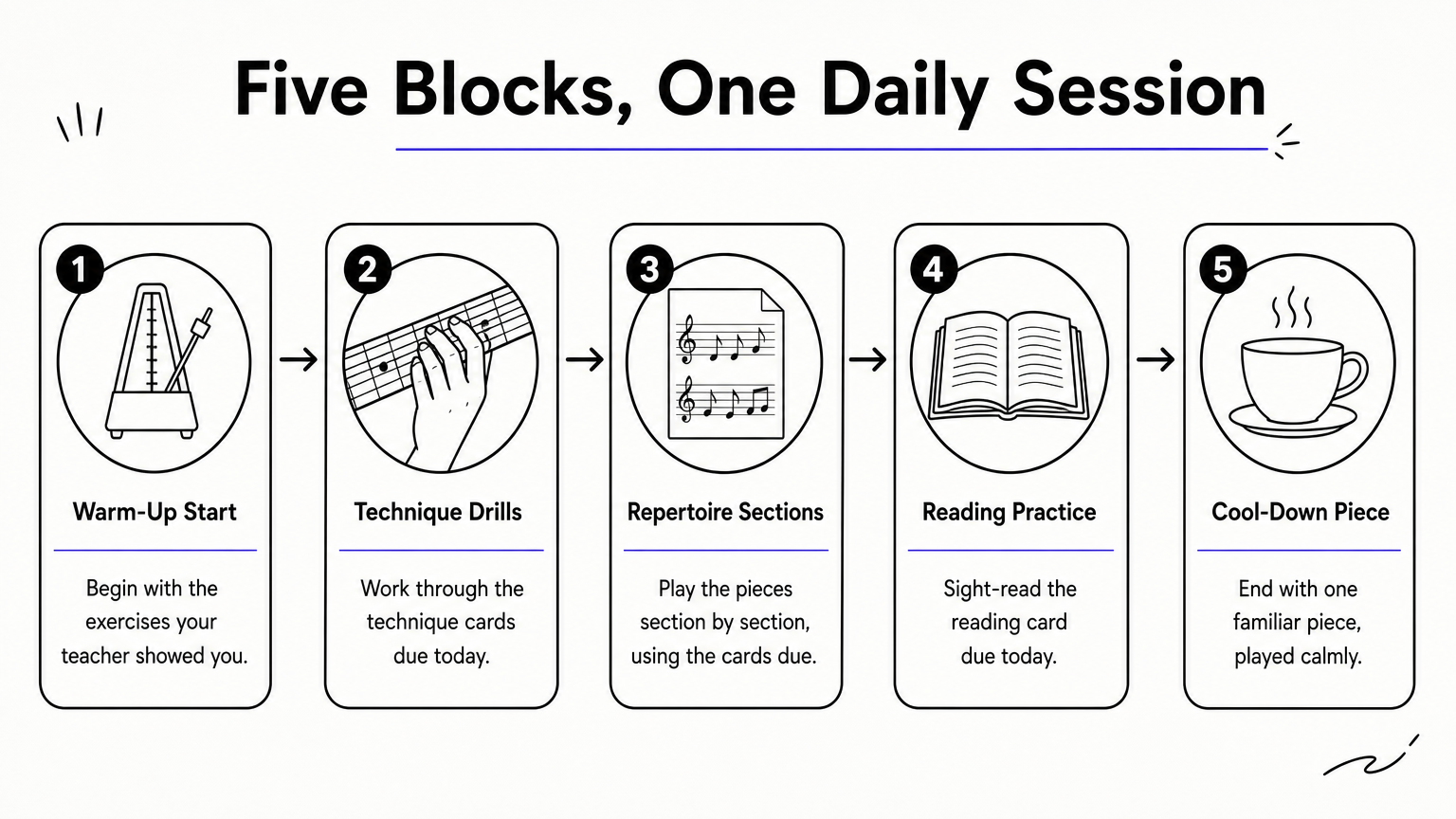
Set a daily session length you can repeat on most days, then divide it into five blocks: warm-up, technique, repertoire, reading, and cool-down. Consistency beats duration, so choose the length you will actually keep.
Pick a session length you can repeat
Thirty focused minutes every day will outperform a three-hour session once a week. If you have more time, you can run one longer session or two shorter ones. The usual reason to split is to keep your attention sharp. If something hurts, stop and ask your teacher.
On the question of whether two hours a day is good: yes, if you can keep your attention on the work for that long. The famous 10,000 hours figure comes from research on elite performers that was popularized in a bestseller. It describes a lifetime of work, not a daily quota, so ignore it when you plan your week.
Divide the session into five blocks
A common teacher guideline is to give up to one third of a session to warm-up and technique, with the rest going to pieces. The table below keeps you under that limit at four session lengths.
| Session | Warm-up | Technique | Repertoire | Reading | Cool-down |
|---|---|---|---|---|---|
| 30 min | 5 | 5 | 12 | 5 | 3 |
| 60 min | 5 | 10 | 30 | 10 | 5 |
| 90 min | 10 | 15 | 45 | 12 | 8 |
| 120 min | 10 | 20 | 60 | 20 | 10 |
Check the sums for the 60-minute row: 5 + 10 + 30 + 10 + 5 = 60, and warm-up plus technique is 15 minutes, a quarter of the session. If you split your day into two sessions, give each its own short warm-up.
Copy this sheet into a document or notes app and print it yourself if you like paper:
Classical guitar practice routine: 60 minutes
Warm-up (5 min): as your teacher showed you
Technique (10 min): cards due today: ____ , ____
Repertoire (30 min): cards due today: ____ , ____ , ____
Reading (10 min): card due today: ____
Cool-down (5 min): one familiar piece
Notes for tomorrow: ____
Fix the block lengths once, then change only the items that fill them.
Step 2. Turn your material into practice cards
Break every piece, exercise, and reading task into small, separate items, and write each one as a practice card with a clear target. Small items can be scheduled and rated on their own, while a whole piece cannot.

Break pieces and exercises into small items
"Practice the Tárrega piece" is not an item. It is a pile of items, and some will be fine while others fade. Split each piece into sections of eight to sixteen bars, or into the sections your teacher marks. Give each exercise from your teacher its own card.
A typical player with three pieces, split into three sections each, ends up with nine repertoire cards. Add four technique cards from your teacher and one reading card, and you have 14 active items. That number matters later.
Keep the active list to roughly 10 to 15 cards. More than that and you return to the old problem of too many choices. Park finished or shelved pieces outside the list and bring them back when your teacher says so.
Write every card the same way
A card needs a name, a goal, a block, and a place to record the result. Use the same format every time, so a glance tells you what to do.
Card: [piece] - bars [x to y]
Goal: [one sentence from your teacher or lesson notes]
Block: Repertoire
Time on task: 8 min
Last rating: Again / Hard / Good / Easy
Next due: [date]
The goal line is the one to guard. Write it in your teacher's words from your last lesson, such as "clean for the lesson on Thursday." If you cannot fill it in, bring the card to your next lesson and ask.
A card with no clear goal is a wish, not a practice item.
Step 3. Rotate cards by when they are due
Do not practice every card every day. Practice the cards that are due today, and push the rest into the future. Spacing practice this way works with how memory fades, so you revisit a skill just before it slips.

Why rotation beats daily repetition
Hermann Ebbinghaus showed in the 1880s that memory decays quickly at first and then more slowly, and that a well-timed review resets the decline. Spaced repetition algorithms such as SuperMemo SM-2 turn that observation into a schedule.
Here is what it changes in the 14-card example. In a 60-minute session you have 10 minutes of technique, 30 of repertoire, and 10 of reading, so 50 minutes of card time. If you touch all 14 cards daily, each gets about 3.6 minutes. That is too short to improve anything.
With rotation, perhaps six cards are due on a given day: two technique cards at 5 minutes each, three repertoire cards at 10 minutes each, and one reading card at 10. That adds up to 50 minutes, and every card gets real working time.
What one card's schedule looks like
The original SM-2 algorithm starts with a one-day gap, then a six-day gap, then multiplies each gap by an ease factor that starts at 2.5. The table shows one card that keeps getting rated Good, then fails once.
| Day | Rating | Next gap |
|---|---|---|
| 1 | Good | 1 day, due day 2 |
| 2 | Good | 6 days, due day 8 |
| 8 | Good | 15 days (6 × 2.5), due day 23 |
| 23 | Again | Back to 1 day, due day 24 |
These are illustrative numbers. Real practice items often need shorter gaps than flashcards, which is why the schedule has to adapt to how each card feels. MemoRep does this for you: it schedules each card when the skill is ready for another pass, adjusts to your ratings, and sends a daily notification. On paper, you would recalculate dates for 14 cards every evening, which is the main reason people abandon manual systems.
Practice a card when it is due, not when you happen to remember it.
Step 4. Rate each session and review weekly
After each card, give it an honest rating: Again, Hard, Good, or Easy. Then spend ten minutes once a week reviewing the ratings and preparing for your next lesson. Honest ratings are what make the schedule accurate.
Rate each card honestly
Rate how the card felt, not how you wish it had felt. Inflated ratings push a card too far into the future, and you meet it again after it has faded.
| Rating | When to use it | Effect on the schedule |
|---|---|---|
| Again | You could not get through it | Returns tomorrow |
| Hard | You got through it, but with effort | Short gap |
| Good | You got through it as expected | Normal gap |
| Easy | It felt comfortable | Long gap |
Rate right after you finish the card, while the memory is fresh. Two seconds is enough. If you are tempted to round up, round down.
Hold a ten-minute weekly review
Pick one day a week and go through the same short list:
- Count how many cards you rated Again or Hard this week.
- Mark any card that got Again three times and bring it to your teacher, since a repeated failure usually needs instruction, not more repetition.
- Retire cards that are finished and add cards for new material.
- Check that your active list is still between 10 and 15 cards.
- Play one piece start to finish for a listener or a recording, and note what you heard.
Take the marked cards and your notes to your next lesson. Your teacher gets a clear picture of what holds and what does not, and your lesson time goes to instruction instead of guessing.
Your ratings show what is slipping. Your teacher tells you how to fix it.
Start with one week of cards
A good classical guitar practice routine comes down to four moves: fixed time blocks, small practice cards with teacher-given goals, rotation by due date, and honest ratings with a short weekly review. The structure stays the same while the cards change with your repertoire, which is why it outlasts any printed plan.
Start small. Write your active cards this week, block out one daily slot, and run the routine for seven days before you change anything. If you would rather skip the date math, try MemoRep and get free for life access during the limited beta. It schedules the cards, adjusts to your ratings, and tells you each day what is due.