Spaced Practice Learning Strategy: Why It Beats Cramming
The spaced practice learning strategy is simple. Spaced practice is an approach to learning that involves splitting your study or practice into several short sessions spread over days and weeks, instead of one long block. The total time stays the same, but you remember far more of it later. It is the opposite of cramming, and more than a century of research supports it.
This article covers why spacing beats cramming, how to build a schedule you can follow, and which intervals to start with. You will also see what a worked schedule looks like for a four-week exam, how teachers can build spacing into a course, and how spacing applies to practical skills where there is no textbook to review.
At MemoRep, we build a practice app around this idea for musicians and practical-skill learners. That is why we focus here on the scheduling side of spaced practice: when to come back to something, not how to learn it. How to learn it is a question for your teacher.
Why spaced practice works better than cramming
Spaced practice works better because it gives you a second look at material just as you start to forget it, and it asks for less total effort than a last-minute marathon. Cramming can get you through tomorrow's quiz. It rarely gives you knowledge that is still there in six months.
The forgetting curve and the spacing effect
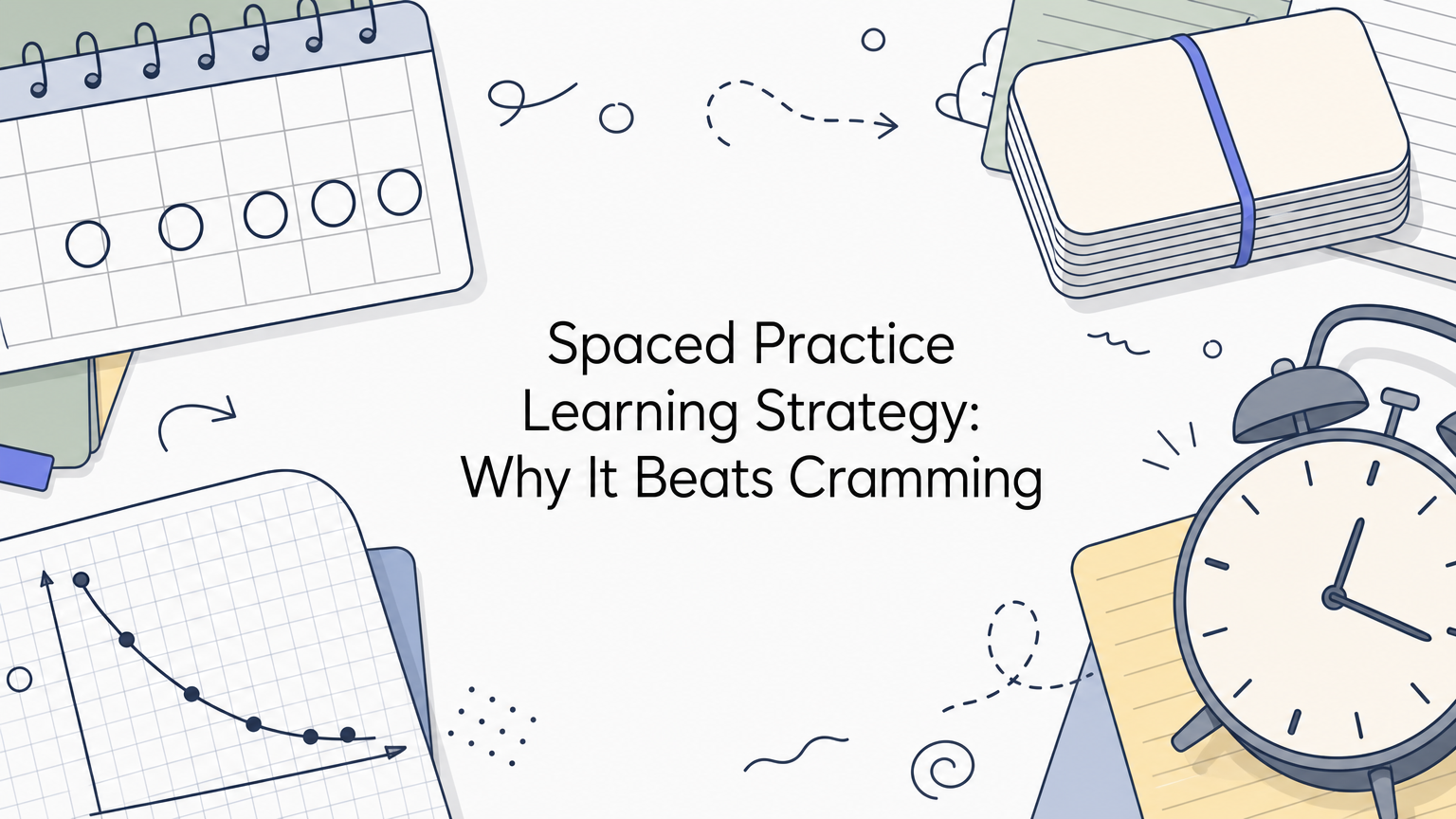
In the late 1890s, the psychologist Hermann Ebbinghaus measured how fast memories fade. His forgetting curve drops steeply right after learning, and a large share is gone within a day. Each time you revisit the material, the memory recovers and then fades more slowly than before. This is the core of the spacing effect, which has been shown in over 200 studies across a century of research, including a major 2006 review by Cepeda and colleagues in Psychological Bulletin.
Researchers point to a few reasons it works. Memories need time to consolidate, and rest or sleep after learning helps. Coming back after a gap also forces you to rebuild the memory instead of just recognizing it, which strengthens the path to it. And because the context has changed since your last session, you build more ways to reach the same information.
Spacing works because forgetting a little and then recovering is what makes a memory stable.
Where cramming falls short
Cramming has three problems. It costs more time for the same result, because massed repetition in one sitting is largely wasted. What you gain fades within days, so you relearn it before the next course or test. And it usually eats into sleep, which is itself part of how learning sticks.
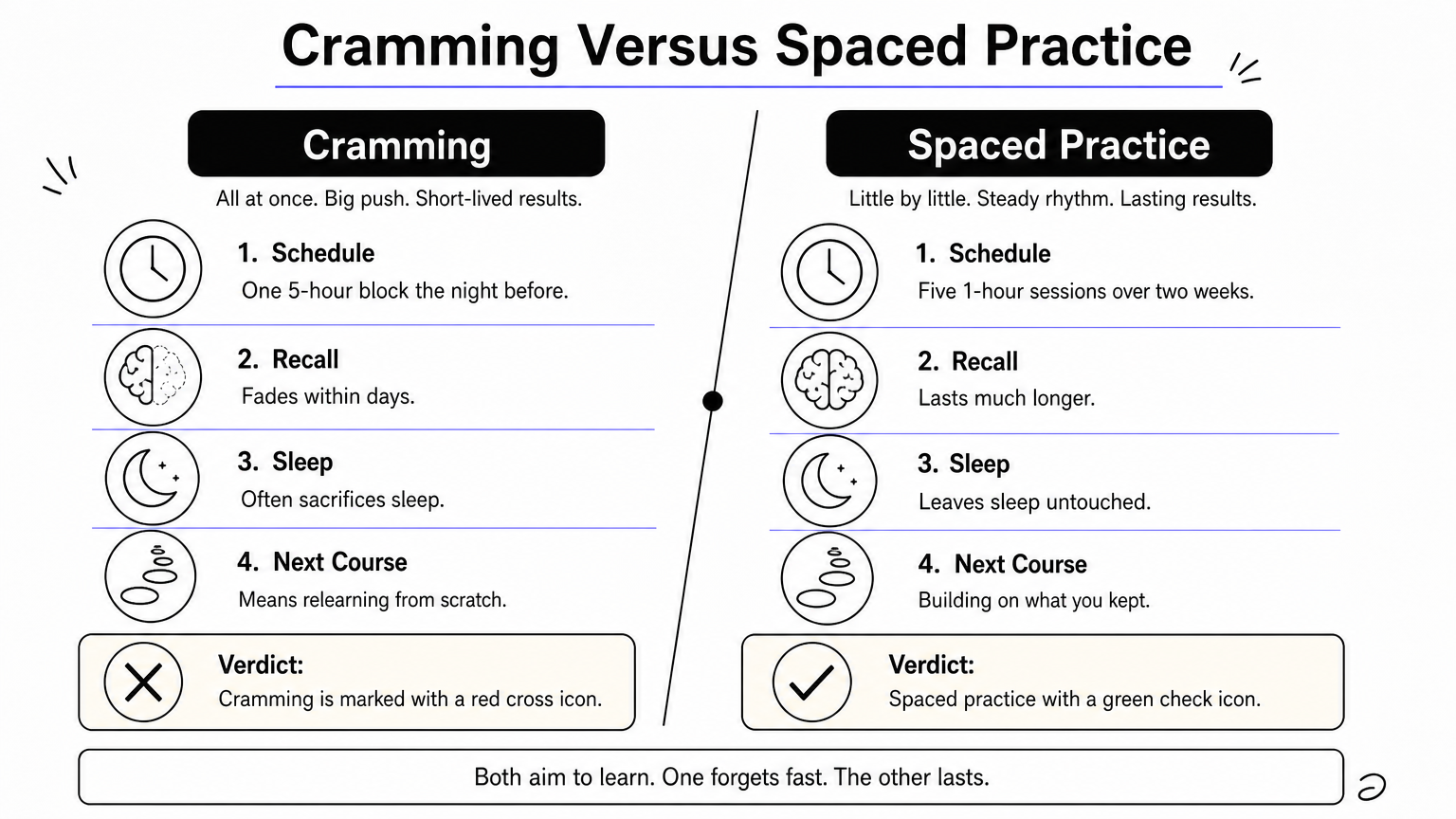
Here is the same five hours of work done two ways:
| Cramming | Spaced practice | |
|---|---|---|
| Schedule | One 5-hour block the night before | Five 1-hour sessions over two weeks |
| Recall after the exam | Fades within days | Lasts much longer |
| Sleep | Often sacrificed | Untouched |
| Next course or test | You relearn from scratch | You build on what you kept |
How to use the spaced practice learning strategy
To use spaced practice, start early, split the material into short sessions on fixed days, and mix old material in with new. You do not need more hours. You need the same hours in a different shape.
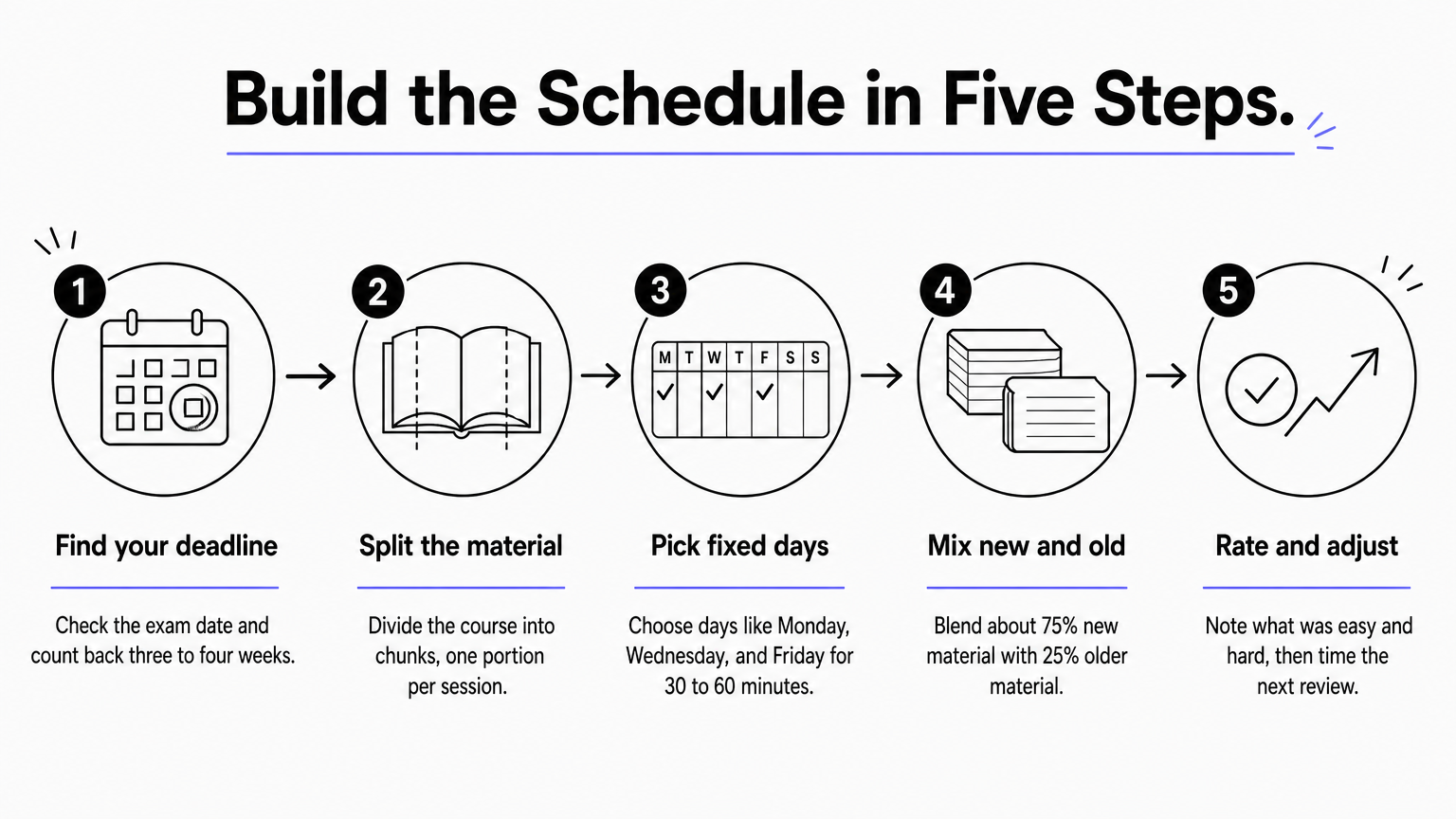
Build the schedule in five steps
- Find your deadline. Check your syllabus or calendar for the exam, performance, or review date, and count back at least three to four weeks.
- Split the material into chunks. Each session should cover a portion of the course, not all of it.
- Pick fixed days. Something like Monday, Wednesday, and Friday works better than "whenever I have time." Sessions of 30 to 60 minutes are enough.
- Mix new and old. A split such as 75% new material and 25% older material keeps early topics from fading while you move on.
- Rate and adjust. End each session by noting what came easily and what did not. Bring the hard items back sooner and the easy ones later.
During the session, try to recall the material before checking your notes. Rereading feels productive, but it does little to rebuild a fading memory.
A schedule you actually follow beats a perfect one you abandon in week two.
Mistakes that undo the benefit
Most spacing plans fail in a few predictable ways:
- Reviewing too soon. Going over class notes right after class means nothing has faded yet, so there is little to rebuild.
- Skipping sessions. A gap that grows by accident is not a spacing plan.
- Treating forgetting as failure. Struggling to recall something after a few days is the point. A little forgetting is what makes the next review count.
- Cramming anyway. You can still study right before the exam. Just do not make it the only time you study.
Spaced practice schedules and examples
A good default is to review new material after 1 day, 3 days, 7 days, 14 days, and about 30 days. The gaps grow because each successful review makes the memory last longer.
A starting interval ladder
Count days from the first time you learned the material:
| Review | Days after first learning | Gap since last review |
|---|---|---|
| 1 | 1 | 1 day |
| 2 | 3 | 2 days |
| 3 | 7 | 4 days |
| 4 | 14 | 7 days |
| 5 | 30 | 16 days |
You may see shorthand such as the 1-3-5-7 rule, which means reviewing on days 1, 3, 5, and 7. It is a rule of thumb, not a research result, and it suits a one-week horizon. Other number patterns are variations on the same idea. For a longer horizon, stretch the gaps.
Adjusting the gaps
The best moment to review is when the material has faded noticeably but not completely. Research suggests at least one day between repetitions for long-term retention, and longer gaps produce longer-lasting memory. If you recall something easily, wait longer. If you draw a blank, shorten the gap next time.
Worked example: a four-week exam
Say you have five hours of study time before an exam in four weeks. Instead of one five-hour block, run ten 30-minute sessions: two in week one, three in week two, two in week three, and three in week four. Each session covers one chunk of the course plus a quick return to an earlier chunk. Total time is the same five hours, but every topic gets seen several times with gaps in between.
Five hours spread over four weeks will usually beat the same five hours on the last night.
Spaced practice in the classroom
In the classroom, spaced practice means planning review into the course calendar so students do not have to invent it themselves. The teacher controls the schedule, so spacing becomes a routine instead of a study tip.
Build review into every lesson
You can add spacing without redesigning a course. Common ways include:
- Opening reviews that revisit content from last week and last month, not only yesterday.
- Low-stakes quizzes that bring older material back for practice, not for a grade.
- Scaffolded assignments with intermediate due dates for drafts, so work is spread out.
- Interleaved problem sets that mix problem types instead of repeating one type in a block. Mixing the order creates natural gaps and forces students to choose a strategy each time.
Explain why you are doing it. Students who understand that effortful review is the goal are less likely to read the difficulty as a sign they are failing.
Separate first learning from practice
When a concept is first introduced, repeating it several times within the same lesson helps. Spacing belongs to the practice phase, after the idea is in place. Revisit it after days and weeks at first, then after months. Expect early reviews to feel slow and vague, because retrieving older material is harder than repeating something from ten minutes ago. That difficulty is what builds durable memory.
Teach new ideas with repetition, then practice them with gaps.
Spaced practice for musicians and practical skills
Spaced practice applies to practical skills just as it does to facts: every song, drill, or exercise you stop revisiting fades. The challenge is tracking dozens of items at once and deciding what to return to today.
Why skills need a schedule too
Learners of practical skills tend to hit three problems. Skills get rusty when you revisit them inconsistently. Random practice sessions waste time on items that are still fresh. And decision fatigue sets in when you try to manage too many exercises at once. A schedule removes the daily question of what to work on.
How MemoRep handles the scheduling
MemoRep turns songs, techniques, and exercises into practice cards inside projects. After each card, you rate it as Again, Hard, Good, or Easy, and the app uses the Ebbinghaus forgetting curve and the SuperMemo SM-2 algorithm to schedule the next pass. Daily notifications tell you what is due. MemoRep never gives theory or technique instructions. It only tells you what to practice and when, and leaves how to practice to your teacher.
Start spacing your practice
Spaced practice means shorter sessions, planned gaps, and a little healthy forgetting between reviews. Start earlier than feels necessary, mix old material with new, and let how hard something felt decide when it comes back. Teachers can do the same by building review into the calendar.
If you practice an instrument or another practical skill, you can hand the scheduling to software. Try MemoRep free during the beta and let it tell you what to practice next.