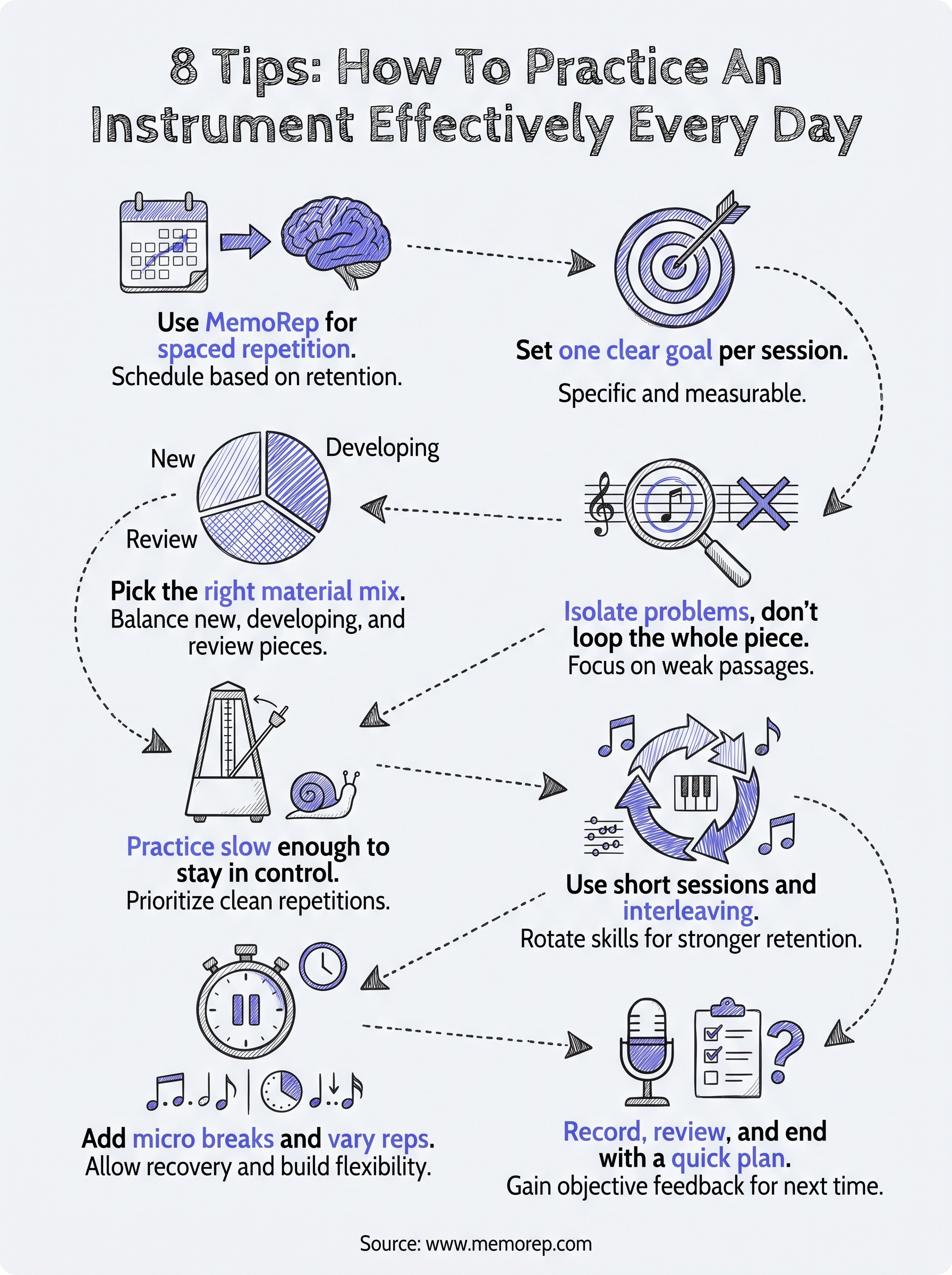
8 Tips: How To Practice An Instrument Effectively Every Day
Most musicians practice every day and still feel stuck. The issue isn't effort, it's structure. Knowing how to practice an instrument effectively matters more than logging hours, yet most players never learn a real method. They sit down, noodle through the same passages, and wonder why progress stalls after a few weeks.
The fix isn't practicing more. It's practicing smarter, with clear priorities, deliberate scheduling, and a system that tells you exactly what needs attention today. That's the problem we built MemoRep to solve: a spaced repetition platform that schedules your practice sessions based on how well you're actually retaining each skill, so nothing falls through the cracks.
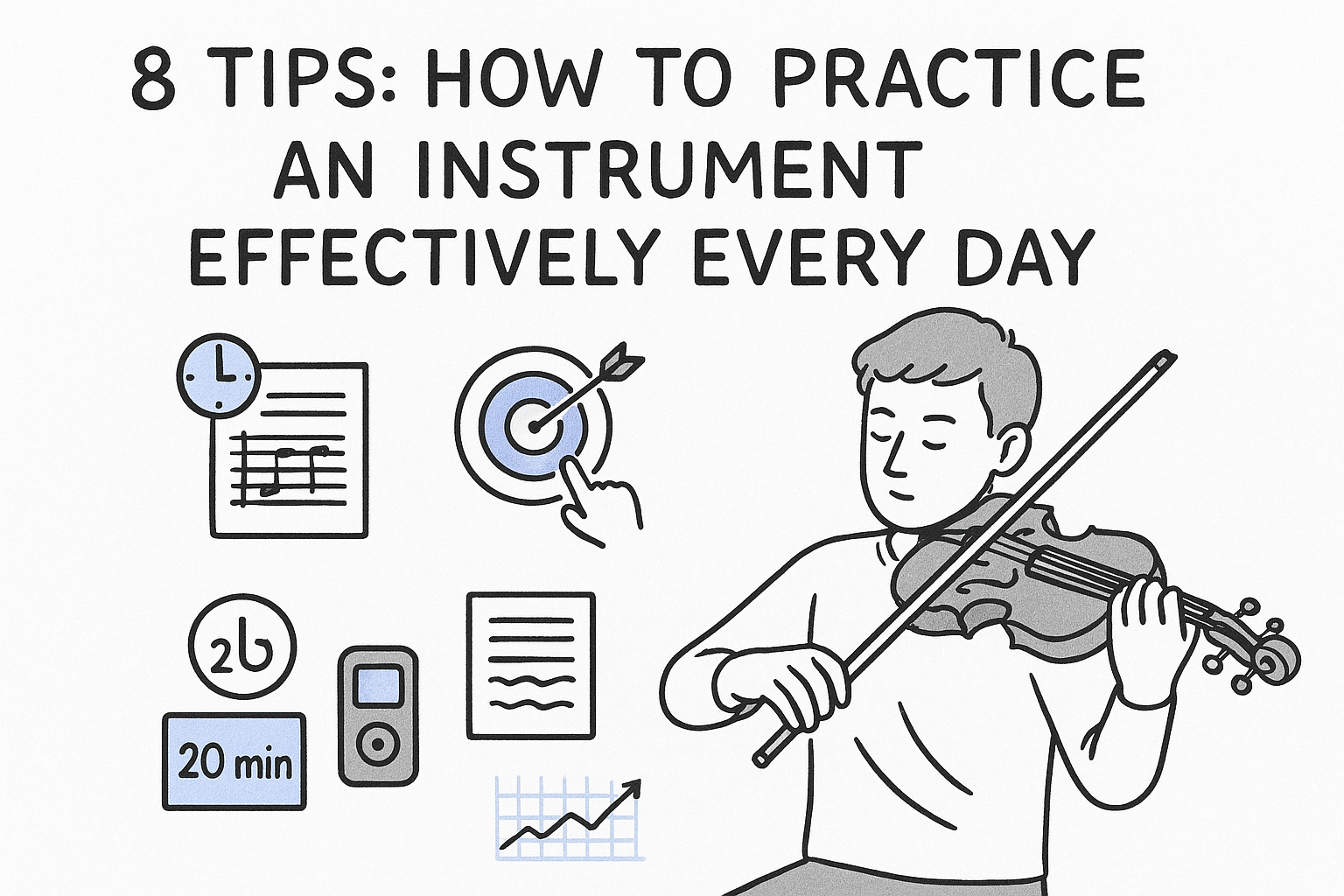
This article breaks down 8 practical tips you can start using right now to get more out of every practice session. Whether you're a beginner building fundamentals or an experienced player maintaining a large repertoire, these strategies will help you practice with purpose instead of habit.
1. Use MemoRep to schedule spaced repetition practice
Most musicians build their practice list in their head and end up revisiting the same comfortable pieces while harder skills quietly fade. MemoRep fixes this by turning your practice routine into a structured, algorithm-driven schedule that tells you exactly what to work on each day.
What to do
Sign up for MemoRep and create a project for your instrument or repertoire. Add individual practice cards for each skill, passage, or technique you want to maintain. When you finish a session, rate each card using the Again/Hard/Good/Easy system. The platform uses your ratings to calculate when each skill needs revisiting, so you never have to guess what's due.
Why it works
The platform is built on the Ebbinghaus forgetting curve and the SuperMemo SM-2 algorithm. These principles show that skills degrade predictably over time, and that reviewing material at the exact moment it starts to fade produces the strongest retention. Understanding how to practice an instrument effectively means working with your memory, not against it. MemoRep schedules each card at that precise window so you spend time reinforcing skills before they slip, not after.
Reviewing a skill right before it fades is significantly more effective than reviewing it randomly or waiting until it's fully forgotten.
Common mistakes to avoid
New users often add too many cards at once, which floods their daily queue and makes the system feel overwhelming. Start with your highest-priority skills, around 10 to 15 cards, and add more gradually as your daily workload stabilizes. Also avoid skipping rating sessions after practice. If you don't rate a card, the algorithm has no data to work with and your schedule becomes inaccurate.
How to track progress
MemoRep gives you progress visualizations that show how your retention is improving across each skill over time. Check these weekly to spot patterns, such as which techniques consistently get rated "Again" and need more focused attention in upcoming sessions. This data turns guesswork into a clear picture of where your practice is actually paying off.
2. Set one clear goal for each session
Walking into a practice session without a specific target is one of the fastest ways to waste time. When you sit down knowing only that you want to "practice," you drift between exercises without making meaningful progress on any of them.
What to do
Before you pick up your instrument, write down one concrete goal for the session. Make it specific and measurable, like "play the bridge at 80 BPM with no mistakes three times in a row" rather than "work on the bridge." This gives your session a clear finish line.
Why it works
Your brain responds differently to specific targets than to vague intentions. A defined goal activates focused attention, which is central to understanding how to practice an instrument effectively. You stop filling time and start solving a real problem.
A single clear goal turns a 30-minute session into deliberate practice instead of repetition for its own sake.
Common mistakes to avoid
Avoid setting multiple goals for one session. When you chase two or three targets at once, you split your attention and rarely complete any of them fully. Pick one, finish it, and stop there if your time runs out.
How to track progress
Write your goal down before you start and check it off when you hit it. Keeping a simple written log of completed goals over a week shows you how consistently you're meeting your targets and where to focus next.
3. Pick the right material mix for real progress
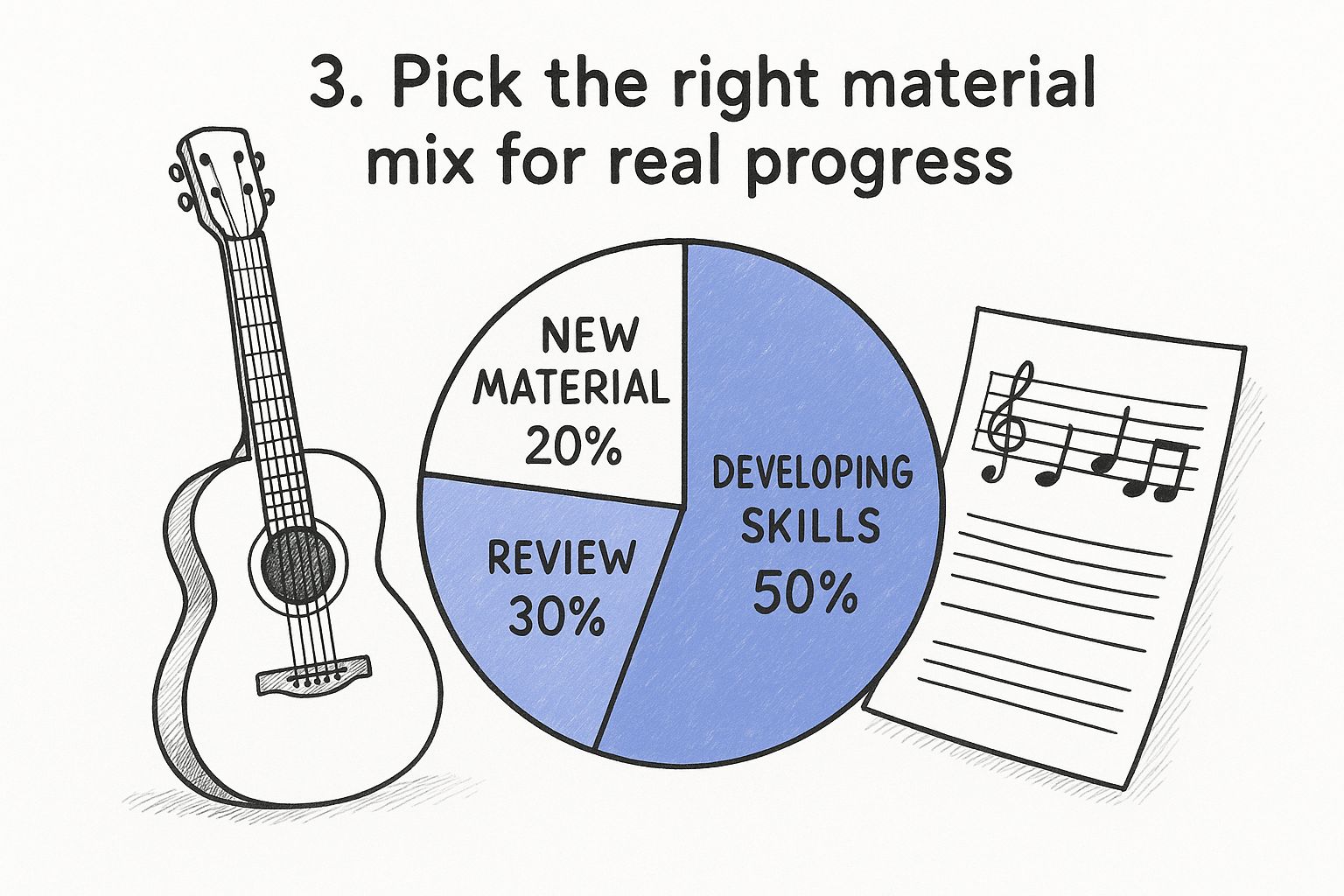
Spending every session on new material feels productive but leaves your existing skills to quietly deteriorate. A balanced mix of new content, developing skills, and review keeps your whole repertoire sharp without burning out your focus in any one direction.
What to do
Split your session into three categories: new material, skills you're actively developing, and established pieces due for review. A workable starting split looks like this:
- New material: 20% of your session
- Developing skills: 50% of your session
- Review pieces: 30% of your session
Adjust these percentages based on upcoming performances or specific weaknesses you want to close.
Why it works
Your brain needs repetition spread over time to convert short-term effort into durable muscle memory. Understanding how to practice an instrument effectively means recognizing that practicing only new material creates a leaky bucket, where you gain skills at the top while losing them at the bottom. A structured mix prevents skill decay and builds a growing, reliable repertoire.
Practicing only new material is one of the most common reasons players feel like they're always starting over.
Common mistakes to avoid
Avoid letting comfortable review pieces consume most of your session time. Playing things you already know well feels satisfying but produces minimal real growth. Keep review tight and purposeful, not a warm-up that never ends.
How to track progress
Log which category each piece belongs to and watch for rating shifts week over week. If a review piece consistently needs extra reps, move it back into your developing skills category and give it more focused attention.
4. Stop looping the whole piece and isolate problems
Running through an entire piece from start to finish feels like real practice, but it mostly reinforces what you already know while burying your actual problem spots under layers of easier sections.
What to do
Identify the two or three specific measures or passages that break down every time you play through the piece. Pull them out completely and work on them in short, focused loops of four to eight bars. Once you can play the isolated section cleanly three times in a row, reconnect it to the surrounding bars and test whether it holds.
Why it works
Your brain consolidates skills at the point of challenge, not during smooth execution. When you loop the whole piece, you spend most of your time on sections that don't need work. Isolating problems is a core part of understanding how to practice an instrument effectively because it concentrates your repetitions exactly where they produce the most improvement.
Targeted repetition on a weak passage produces faster gains than the same amount of time spent running the full piece.
Common mistakes to avoid
Avoid returning to the beginning every time you make a mistake. This habit trains you to play the opening confidently while the middle and end sections stay fragile. Fix the problem spot first, then run the full piece.
How to track progress
Log each problem passage as a separate card in MemoRep and rate it after each session. When those cards shift from "Again" to "Good," you have concrete proof that your isolation work is paying off.
5. Practice slow enough to stay in control
Speed is something you earn through clean repetitions, not something you push through by sheer effort. When you play a passage faster than your hands can handle, you rehearse the mistake instead of the solution. Drop your tempo until every note lands exactly right every time.
What to do
Set your metronome at a speed where you can play the passage with zero errors for three reps in a row. If you're making mistakes, you're playing too fast.
Slow down until it feels almost too comfortable, then raise the tempo by five BPM only after you hit that clean-rep target consistently. Never bump the tempo up as a reward for almost getting it right.
Why it works
Slow practice is central to understanding how to practice an instrument effectively at a neurological level. Your brain builds motor patterns through repetition and does not distinguish between a clean rep and a sloppy one. Controlled reps give your nervous system accurate movement data to encode.
Slow, clean repetitions build faster and more reliable technique than rushed practice ever will.
Common mistakes to avoid
Many players treat slow practice as just a warm-up phase to rush past before the real work begins. That misses the point entirely.
Skipping the metronome when you slow down is another common trap because you lose the consistent timing reference your muscle memory needs to form correctly.
How to track progress
Log your starting tempo and target tempo for each passage as a simple note after every session. Watching those numbers climb week over week gives you clear proof that your controlled practice is converting into real, lasting speed.
6. Use short sessions and interleaving
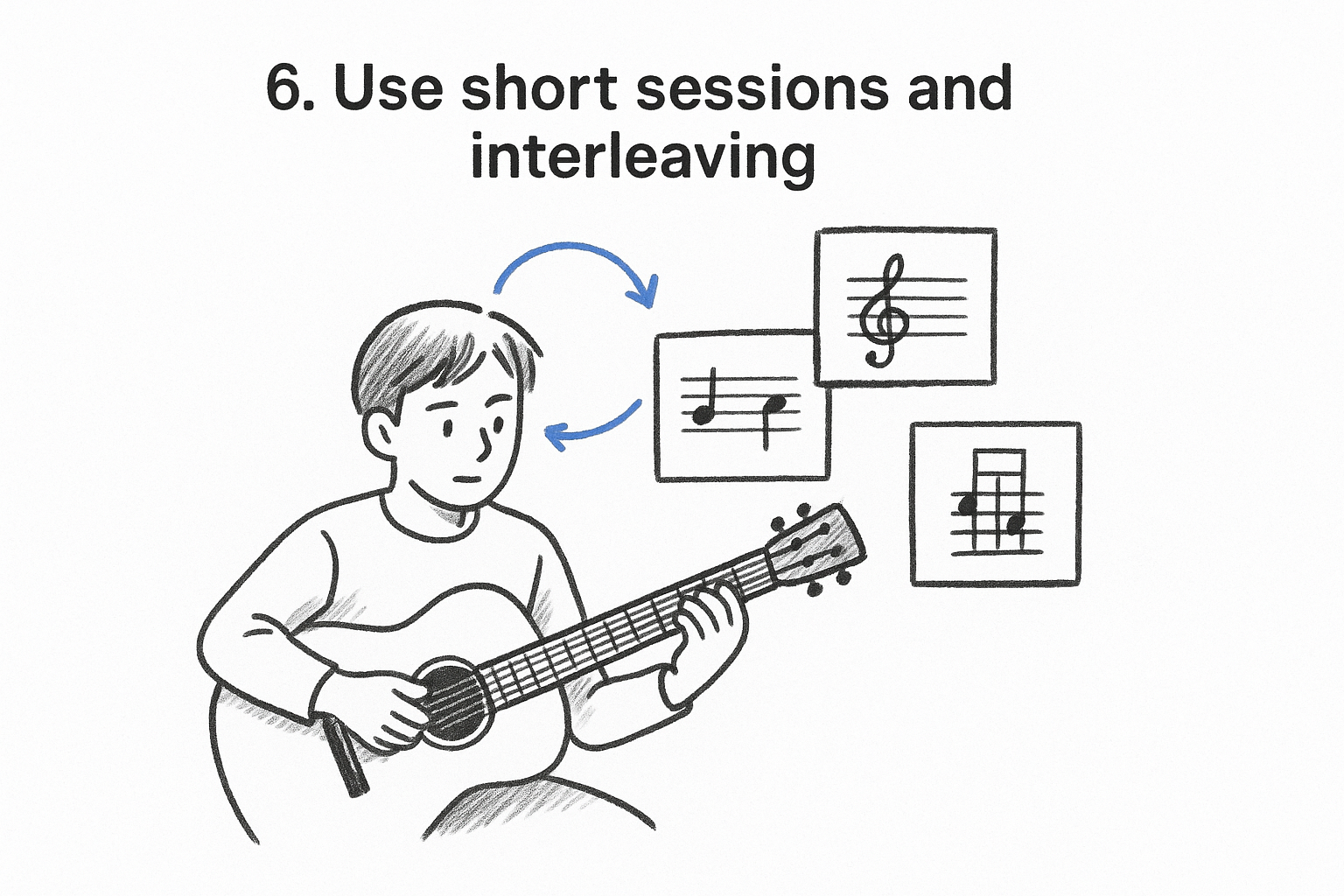
Long, single-subject practice blocks feel thorough but actually produce diminishing returns after about 20 to 30 minutes. Switching between two or three different skills within a session, a technique called interleaving, keeps your brain working harder and leads to stronger long-term retention.
What to do
Keep individual skill blocks to 15 to 20 minutes, then rotate to a different piece or technique. For example, work on a scales exercise, shift to a chord progression, then return to a melody passage. Cycling through three or four distinct skills in one session forces your brain to retrieve and re-engage each time you switch.
Why it works
Interleaving is one of the most research-supported answers to how to practice an instrument effectively. Each time you switch skills and come back, your brain has to reconstruct the motor pattern from scratch, which strengthens the encoding far more than blocked repetition does.
Retrieval effort during interleaved practice builds stronger long-term retention than repeating one skill in a single long block.
Common mistakes to avoid
Avoid switching too frequently, like every two or three minutes, before you've had enough reps to make any real progress. The goal is purposeful rotation, not random jumping. Stay with each skill long enough to hit a small win before you move on.
How to track progress
Log which skills you interleaved in each session and note your ratings for each. Over time you'll see whether your switching schedule is producing steady improvement across all of them or leaving certain areas behind.
7. Add micro breaks and vary reps to lock it in
Grinding through a passage for 20 straight minutes without stopping doesn't accelerate learning. Your brain and muscles both need brief recovery windows to process and consolidate what you're working on. Short pauses and varying how you repeat a skill are two underused tools that directly affect how deeply a skill gets encoded.
What to do
Take a 60 to 90 second break every 10 to 15 minutes of focused work. Put your instrument down and do nothing practice-related during that window. Also vary your reps by playing the passage in different ways:
- At a slower or faster tempo than your target
- With rhythmic variations like dotted rhythms
- In a different key or starting position
Variation forces your brain to generalize the skill rather than memorize one narrow execution.
Why it works
Knowing how to practice an instrument effectively includes understanding that repetition without variation trains you to perform in only one specific context. Micro breaks give your nervous system time to consolidate the motor pattern just laid down, and varied reps build flexibility so the skill holds under real performance conditions.
Brief recovery pauses between focused reps improve retention more than the same time spent in continuous repetition.
Common mistakes to avoid
Avoid using breaks to check your phone or do anything mentally demanding, since that disrupts consolidation. Also don't vary reps until you can execute the basic version cleanly at least once.
How to track progress
Note in your session log whether you used varied reps and how the passage responded. If variation consistently exposes the same weak spot, add it as a separate card in MemoRep for targeted follow-up.
8. Record, review, and end with a quick plan
Most players finish a session and immediately forget what they worked on. Taking two minutes to record yourself and write down what comes next turns a good session into a direct foundation for tomorrow's practice.
What to do
Use your phone to record a short audio or video clip of each passage you worked on during the session. After you stop playing, listen back once and note one specific thing to fix next time. Then write down two or three priorities for your next session before you put your instrument away.
Why it works
Recording yourself removes the bias that comes from playing inside your own head. Knowing how to practice an instrument effectively includes being able to hear exactly what your audience hears, not what you think you're producing. Ending with a written plan also eliminates decision fatigue at the start of your next session, so you pick up and work immediately.
Listening back to a recording reveals problems your ears miss in real time, making every review session more accurate than relying on memory alone.
Common mistakes to avoid
Avoid reviewing your recordings for more than five minutes after a session. The goal is one clear takeaway, not a full critique. Overanalyzing at the end of a session drains the focus you need for your next practice day.
How to track progress
Save your recordings weekly and compare them against older clips from the same passage. Steady improvement in those recordings is concrete proof your system is working.
Make tomorrow's practice easier
Every tip in this article points toward the same core idea: knowing how to practice an instrument effectively means building a system, not relying on motivation or memory to carry you through. Clear goals, structured scheduling, and deliberate repetition compound over time in ways that random sessions never will.
Start with one or two changes from this list and lock them in before adding more. Pick your hardest weak spot, isolate it, slow it down, and rate it honestly after each session. Small, consistent adjustments produce more lasting results than a complete overhaul you can't maintain.
The hardest part of any practice routine is deciding what to work on next. Let MemoRep handle that scheduling for you so you spend your time playing instead of planning. The first 200 users get free premium access for life, which means there's no reason to keep practicing without a system that actually works.